

How Artificial Intelligence and Machine Learning Revolutionizing Alexa?
 Toshendra Sharma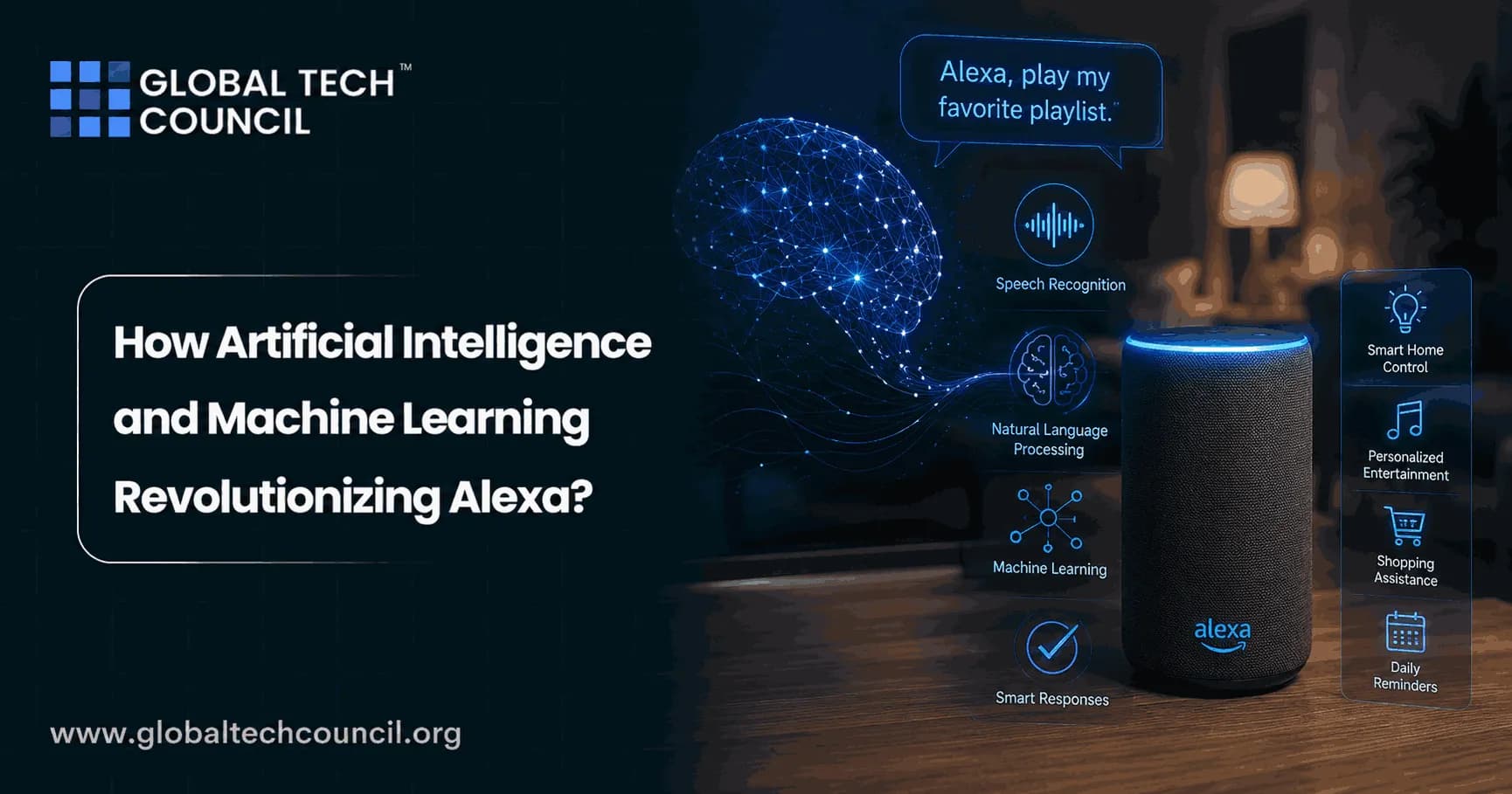
Alexa spent over a decade as a voice-activated timer and music player, useful but fundamentally limited to simple, pre-programmed commands. That changed on February 4, 2026, when Amazon completed its nationwide U.S. rollout of Alexa+, a generative AI rebuild that gave roughly 180 million Prime members a genuinely different assistant overnight, at no additional cost. This is not an incremental update. Alexa+ represents one of the most concrete, large-scale examples of what modern artificial intelligence and machine learning can actually do inside a product hundreds of millions of people already use every day. A Certified Artificial Intelligence (AI) Expert credential provides exactly the technical grounding needed to understand how a rebuild at this scale actually works under the hood.
From Simple Voice Commands to Alexa+: What Actually Changed
The original Alexa could set timers, play music, and answer narrow, pre-programmed questions, and little else. Alexa+ is a fundamentally different product, built from the ground up on large language models rather than the older rules-based command system. The results show up directly in how people use it. According to Amazon's own data, customers using Alexa+ are having twice as many conversations compared to the previous version, making three times more purchases, and requesting recipes five times more frequently, a clear signal that a more capable, conversational assistant genuinely changes user behavior rather than just adding a marketing label to the same experience. Understanding exactly what machine learning techniques made this leap possible, from natural language understanding to contextual memory, is precisely what a Certified Machine Learning Expert credential is designed to teach, moving past the marketing headlines into the actual technical mechanics.

The Multi-Model Architecture Behind Alexa+
Rather than relying on a single large language model, Amazon built Alexa+ around a routing system using Amazon Bedrock, its managed generative AI service, which automatically matches each customer request to whichever model is best suited for that specific task. This includes Amazon's own Nova models alongside Anthropic's Claude, working together rather than a single model trying to handle every type of request equally well. This kind of intelligent model routing reflects a broader shift happening across the AI industry in 2026, moving away from one-size-fits-all systems toward orchestrated combinations of specialized models chosen dynamically based on the task at hand, whether that's a simple factual question, a complex multi-step booking request, or an emotionally nuanced conversation.
Agentic AI: Alexa+ as a Digital Assistant That Takes Action
The most significant machine learning breakthrough behind Alexa+ is its agentic capability, the ability to navigate the digital world and complete tasks autonomously rather than simply answering questions. Alexa+ integrates directly with services including OpenTable, Uber, Ticketmaster, Expedia, Grubhub, and Whole Foods, letting users ask for something in plain language and having Alexa+ search availability, complete a booking, add it to a calendar, and send a confirmation without further input. Amazon has described this as teaching Alexa+ to navigate the digital world the way a person would, taking a customer's request and working through a developer's website or app on their behalf, behind the scenes, rather than requiring a rigid, pre-built integration for every possible action. Evaluating how reliably an agentic system like this actually performs these multi-step tasks, and where it can still go wrong, is exactly the kind of applied technical assessment a Deep Tech Certification in AI systems and agentic architecture is built to develop.
Personalization, Memory, and Proactive Intelligence
Alexa+ also introduces genuine memory and personalization, learning a user's preferences over time rather than treating every interaction as isolated. It can remember details like favorite meal preferences or family birthdays, and users can actively teach it new information by uploading documents, images, or forwarding emails for it to reference later. New Echo devices in 2026 have introduced "Omnisense" presence detection, letting the system recognize when someone enters or leaves a room and adjust settings or offer proactive suggestions accordingly, shifting Alexa from a purely reactive tool into something closer to an ambient, situationally aware assistant. Document and email analysis rounds this out, letting Alexa+ extract key details from forwarded content, summarize complex material, and generate calendar events automatically based on what it reads.
AI & Technology
As artificial intelligence continues to transform education, students are getting more opportunities to explore technology beyond traditional classroom learning. A Tech Olympiad can help students develop their understanding of AI, logical reasoning, problem-solving, and other technology skills through structured competition.
What This Means for Businesses and Developers
Alexa+'s international rollout has continued expanding rapidly through 2026, launching in the UK, Mexico, Italy, Spain, Germany, Austria, and France, each following an initial Early Access period before converting to a paid subscription for non-Prime users. For businesses and developers, Alexa+'s agentic integrations with services like OpenTable and Uber represent a genuinely new customer acquisition channel, one where a business's ability to be discovered and transacted with depends on how well it integrates with an AI agent acting on a customer's behalf, not just traditional search visibility. As more companies compete to be the service Alexa+ recommends or books automatically, clearly communicating a product's value to both the AI system and the humans evaluating it becomes a genuinely new skill. That is exactly where pairing technical AI understanding with a Marketing Certification becomes valuable, helping businesses position themselves for an environment where an AI agent, not just a search engine, may be the one making the first recommendation.
As artificial intelligence becomes part of everyday business operations, employers increasingly need people who can apply AI knowledge responsibly and effectively. Evaluating candidates on relevant skills, reasoning, and practical understanding can support stronger hiring decisions. HireValid can be explored by organisations seeking structured candidate assessments.
Conclusion
Alexa+ shows what happens when artificial intelligence and machine learning move from an add-on feature into the foundational architecture of a product used by hundreds of millions of people. A multi-model routing system, genuine agentic task completion, persistent memory, and proactive, context-aware assistance have replaced what was once a fairly narrow voice command tool. The usage numbers, twice the conversations, three times the purchases, five times the recipe requests, show this shift is not just a technical upgrade but a genuine change in how people rely on the assistant day to day. As Alexa+ continues expanding internationally and agentic AI becomes the norm rather than the exception across consumer technology, it stands as one of the clearest real-world proof points for how far AI and machine learning have actually come.
FAQs
1. How is Artificial Intelligence revolutionizing Alexa?
Artificial Intelligence enables Alexa to understand natural language, interpret user intent, and provide more relevant responses. It also helps Alexa personalize interactions, automate tasks, and improve its performance through continuous learning.
2. What role does Machine Learning play in Alexa?
Machine Learning helps Alexa learn from patterns in speech, language, and user interactions. These capabilities allow Alexa to improve speech recognition, understand different ways of asking questions, and deliver more accurate results over time.
3. How does Alexa understand human speech?
Alexa uses AI technologies such as Automatic Speech Recognition and Natural Language Processing to convert spoken words into understandable commands. The system analyzes the audio, identifies the user's intent, and determines the appropriate action or response.
4. How does Natural Language Processing improve Alexa?
Natural Language Processing allows Alexa to understand the meaning and context behind human language instead of relying only on exact commands. This makes conversations more natural and enables users to phrase requests in different ways.
5. Can Machine Learning make Alexa more personalized?
Yes. Machine Learning can help Alexa recognize patterns in user preferences, frequently requested information, routines, and interactions. This can support more personalized recommendations, responses, and smart-home experiences.
6. How does AI help Alexa recognize different accents and speaking styles?
AI models can be trained on diverse speech patterns, accents, pronunciations, and speaking styles. This helps Alexa improve its ability to interpret commands from users who speak differently or use regional variations of a language.
7. How does Alexa use AI for smart-home automation?
AI allows Alexa to connect and coordinate compatible smart-home devices such as lights, thermostats, locks, speakers, and appliances. Machine Learning can also help identify routines and make automation more convenient based on user preferences and behavior.
8. How does Machine Learning improve Alexa's voice recognition?
Machine Learning models analyze large amounts of speech data to identify sounds, words, phrases, and contextual patterns. As these models improve, Alexa can become better at handling background noise, different pronunciations, and complex requests.
9. Can Artificial Intelligence make Alexa more conversational?
Yes. Advances in AI, Natural Language Processing, and generative AI can make voice assistants better at maintaining context and responding naturally. Instead of treating every command as an isolated request, newer AI systems can support more flexible, conversational interactions.
10. How does AI help Alexa understand context?
AI can analyze previous parts of a conversation and relevant information from a request to determine what the user means. For example, a follow-up question can sometimes be interpreted based on what the user asked immediately before it.
11. How does Alexa use Machine Learning for recommendations?
Machine Learning can identify patterns in interactions and preferences to help personalize content and suggestions. Depending on the available features and user settings, this can influence recommendations involving music, routines, information, or connected services.
12. What is the role of Generative AI in the future of Alexa?
Generative AI can enable Alexa to produce more detailed, flexible, and context-aware responses rather than relying primarily on predefined responses. It could also help users complete multi-step tasks through natural conversations and interact with information in more sophisticated ways.
13. How does AI help Alexa perform multiple tasks?
AI can help interpret complex requests and determine the sequence of actions required to complete them. This makes it possible for voice assistants to move beyond simple commands toward multi-step assistance, such as managing routines or coordinating several connected services.
14. How does Machine Learning help Alexa work in noisy environments?
Machine Learning can help distinguish a user's voice from background sounds such as television, music, or conversations. Advanced speech-processing techniques can improve the system's ability to identify the intended command even when the surrounding environment is not completely quiet.
15. How does AI improve Alexa's ability to answer questions?
AI helps Alexa process language, identify the intent behind questions, and retrieve or generate relevant information. Improvements in language models can also make responses more conversational and better suited to complex or follow-up questions.
16. What are the benefits of AI-powered Alexa for users?
AI-powered Alexa can provide faster interactions, better speech recognition, personalized assistance, smarter automation, and more natural conversations. These capabilities can make voice technology more useful for everyday tasks at home, work, entertainment, and accessibility.
17. What challenges does AI create for Alexa?
Key challenges include privacy, data security, inaccurate responses, bias in AI models, accidental activations, and maintaining user trust. Developers must balance advanced AI capabilities with responsible data handling, transparency, reliability, and user control.
18. How can AI improve accessibility through Alexa?
Voice assistants can make digital services easier to access for people who may have difficulty using keyboards, touchscreens, or traditional interfaces. AI-powered speech recognition and natural-language interaction can support hands-free control and more flexible communication.
19. Will AI make Alexa more like a personal assistant?
AI can move Alexa closer to the concept of a proactive personal assistant by improving its ability to understand context, remember useful preferences, and handle more complex tasks. The extent of these capabilities depends on the features, permissions, and services available to users.
20. What is the future of Artificial Intelligence and Machine Learning in Alexa?
The future of Alexa is likely to involve more conversational AI, improved personalization, multimodal interaction, smarter automation, and greater ability to complete complex tasks. As AI and Machine Learning continue to evolve, voice assistants could become more capable digital interfaces for managing information, devices, and everyday activities.
Related Articles
View All
Artificial Intelligence
Artificial Intelligence vs. Machine Learning vs. Deep Learning
Artificial intelligence (AI), machine learning (ML), as well as deep learning (DL) are three concepts that are sometimes used primarily to represent advanced technology. It is, nonetheless, beneficial to be aware of the fundamental variations between them. Consider deep learning, machine learning,…

Artificial Intelligence
Best Online Artificial Intelligence Learning Resources in 2021
There are many courses available on the web that provide artificial intelligence certification training. However, not each of them fulfills the learning requirements of students. Hence it is crucial to get the best resources if you want to become an artificial intelligence expert. So here is a…

Artificial Intelligence
How Can Blockchains Transform Artificial Intelligence?
Blockchain can complement artificial intelligence by providing tamper-resistant records, decentralized identity, data provenance, and programmable smart contracts. Together, the technologies can support auditable AI workflows, secure data sharing, decentralized AI marketplaces, and clearer tracking of models and digital assets. The combination has potential, although scalability, privacy, governance, and integration remain significant challenges.
Trending Articles
The Role of Blockchain in Ethical AI Development
How blockchain technology is being used to promote transparency and accountability in artificial intelligence systems.
AWS Career Roadmap
A step-by-step guide to building a successful career in Amazon Web Services cloud computing.
Top 5 DeFi Platforms
Explore the leading decentralized finance platforms and what makes each one unique in the evolving DeFi landscape.