

Data Science vs. Software Development The Better Career Option
 Toshendra Sharma
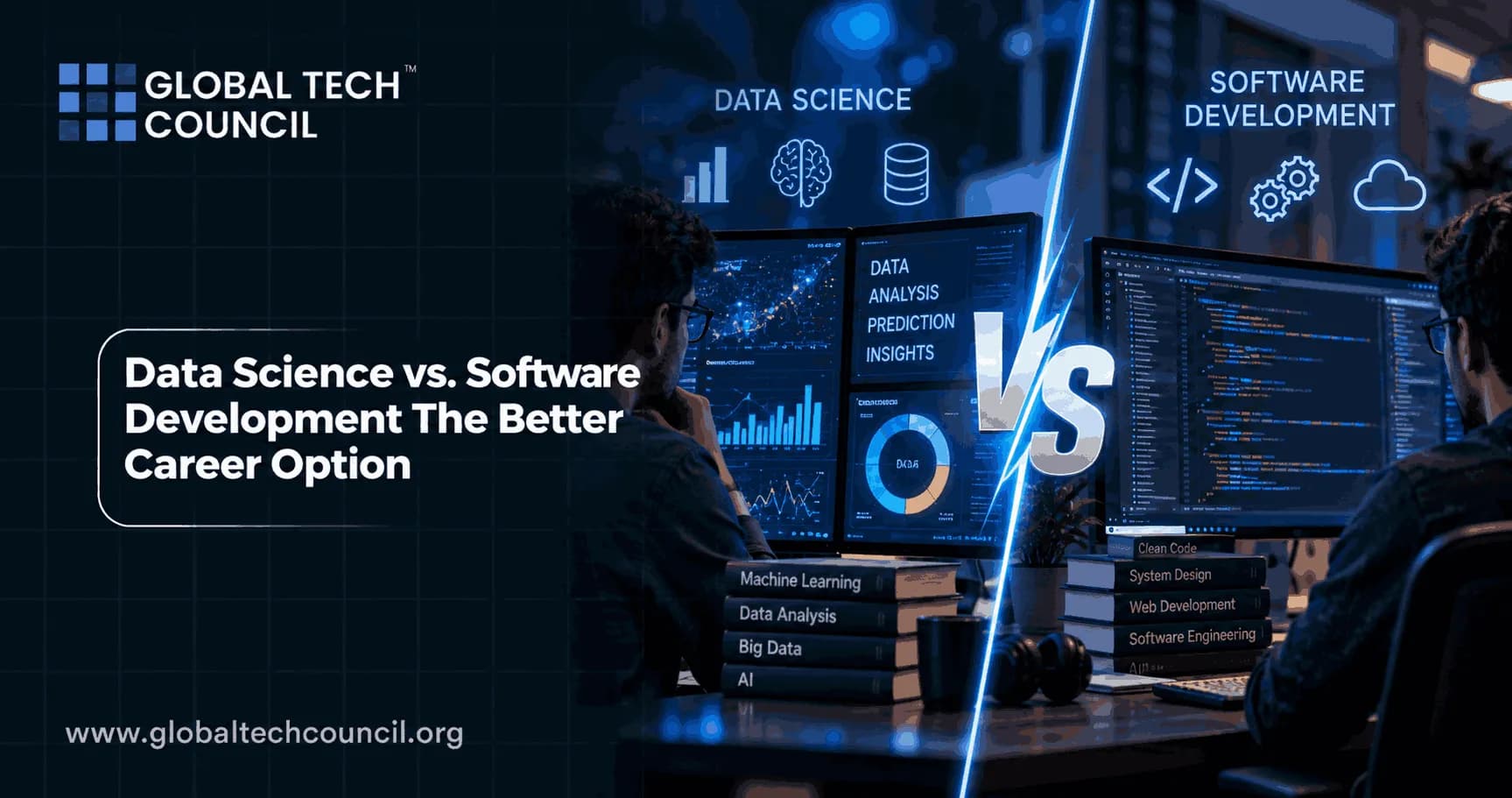
Choosing between data science and software development ranks among the most common career dilemmas facing students and professionals entering the technology industry today, and the honest answer is that neither path is universally better, each suits a genuinely different kind of thinking and long term interest. Data science leans heavily into statistical reasoning, pattern recognition, and extracting insight from raw information, while software development centers on building, structuring, and maintaining the systems and applications that power everything from mobile apps to enterprise platforms. Understanding exactly what each path actually demands, rather than choosing based on salary headlines alone, is the kind of grounded evaluation a Certified Data Science Developer credential helps professionals make, building the practical, hands on skill set needed to genuinely thrive in a data focused role rather than simply following industry hype. This article breaks down both career paths honestly, comparing their skill requirements, daily realities, and long term prospects.
What Data Scientists Actually Do
Data science centers on extracting meaningful insight from data, using statistical methods, machine learning, and analytical thinking to answer questions businesses genuinely care about.

Core responsibilities: Cleaning and preparing raw data, building predictive models, and translating complex findings into actionable business recommendations.
Key skills required: Statistics, probability, machine learning, and strong proficiency in languages like Python or R.
Typical tools: Jupyter notebooks, SQL databases, visualization libraries, and machine learning frameworks like TensorFlow or scikit-learn.
Common industries: Finance, healthcare, e-commerce, and any sector generating large volumes of data worth analyzing.
What Software Developers Actually Do
Software development focuses on designing, building, testing, and maintaining the applications and systems that power digital products and services.
Core responsibilities: Writing and debugging code, designing software architecture, and collaborating across teams to ship functional, reliable products.
Key skills required: Proficiency in programming languages, understanding of software design patterns, and familiarity with version control and testing practices.
Typical tools: Integrated development environments, version control systems like Git, and frameworks specific to web, mobile, or backend development.
Common industries: Nearly every industry now employs software developers, from tech companies to traditional businesses building internal tools.
Comparing the Two Paths Directly
Educational Background and Entry Requirements
Data science roles often favor candidates with strong mathematical or statistical backgrounds, though many successful data scientists come from diverse academic paths.
Software development places heavier emphasis on programming proficiency itself, often valuing demonstrated coding ability over formal academic credentials.
Building genuine coding fluency, regardless of which path you choose, benefits enormously from structured learning through recognized Programming Languages Certifications, which validate practical proficiency in the specific languages each career path actually depends on.
Daily Work and Problem Solving Style
Data scientists spend significant time exploring datasets, testing hypotheses, and iterating on models that may not produce immediate, guaranteed results.
Software developers typically work within more defined project scopes, building specific features or systems against clearer functional requirements.
Data science work often involves more ambiguity and exploratory analysis, while software development tends to follow more structured, incremental development cycles.
Skill Overlap Between the Two Fields
Both paths require genuine programming proficiency, though the specific languages and depth of software engineering knowledge required often differ.
Data scientists increasingly need to understand software engineering principles to deploy models into production environments effectively.
Software developers working on data intensive applications benefit from understanding basic data science concepts, even without specializing in the field themselves.
Salary and Demand Considerations
Both fields consistently rank among the highest paying and most in demand technology careers, with compensation varying significantly based on specialization, location, and experience level.
Data science roles often command premium salaries at the intersection of business strategy and advanced technical skill, particularly in specialized areas like machine learning engineering.
Software development offers considerably more role diversity, spanning everything from mobile development to backend infrastructure, each with its own demand and compensation patterns.
Neither field shows meaningful signs of slowing demand, making long term career security a genuine strength of both paths.
How Emerging Technology Is Reshaping Both Careers
Both data science and software development continue evolving rapidly as AI and machine learning become embedded more deeply into everyday tools and workflows. Professionals in both fields increasingly need broader technical fluency extending beyond their core specialty, which is exactly what a Deep Tech Certification helps build, giving data scientists and developers alike a well rounded foundation across the emerging technologies increasingly shaping both careers.
This same wave of technological change is opening entirely new creative applications worth understanding as well. One emerging application is AI microdrama, where generative AI helps bring serialized stories, characters, and fictional worlds to life, illustrating how the same generative modeling techniques data scientists build, and the same software engineering discipline developers apply to ship reliable products, are increasingly converging in genuinely new and unexpected creative domains.
Which Path Genuinely Fits You Better
Choosing between these two careers ultimately comes down to genuine personal fit rather than chasing whichever field appears to pay more at any given moment.
Choose data science if: You enjoy statistical reasoning, are comfortable with ambiguity, and find genuine satisfaction in uncovering patterns hidden within complex data.
Choose software development if: You prefer building tangible, functioning systems and enjoy the structured problem solving involved in designing and shipping working software.
Consider a hybrid path if: You are drawn to both disciplines, since roles like machine learning engineering increasingly blend data science expertise with genuine software engineering skill.
Building Long Term Career Resilience in Either Field
Regardless of which path you choose, long term career success in technology increasingly depends on communicating technical work clearly to non technical stakeholders, a skill many highly capable data scientists and developers underdevelop. Professionals in both fields who can explain complex technical decisions in business terms consistently advance faster than those with purely technical strength alone.
This is where a Marketing Certification genuinely complements technical expertise in either career, helping data scientists and software developers alike translate complex, technical work into language that resonates with executives, clients, and end users who ultimately decide whether a project gets funded, adopted, or scaled.
Neither data science nor software development is objectively the better career choice, each rewards a genuinely different kind of thinking, and the strongest long term careers often come from choosing the path that matches your natural curiosity rather than following salary trends alone. Whether you gravitate toward the statistical exploration of data science or the structured, systems oriented world of software development, building genuine, well rounded expertise through structured learning remains the clearest path toward long term success in either field.
FAQs
1. What Is the Difference Between Data Science and Software Development?
Data Science focuses on extracting insights and building predictive or analytical models from data. Software Development focuses on designing, building, testing, deploying, and maintaining software applications and systems.
2. Is Data Science Better Than Software Development as a Career?
There is no universally better option because the two careers involve different types of work and require different skill sets. The more suitable path depends on an individual's interests, technical strengths, career goals, and preferred type of problem-solving.
3. What Does a Data Scientist Do?
A Data Scientist collects and analyzes data, develops statistical or machine learning models, identifies patterns, and communicates findings to support decisions. Depending on the organization, the role can combine statistics, programming, business analysis, and machine learning.
4. What Does a Software Developer Do?
A Software Developer designs and builds software applications, features, services, and systems. Their responsibilities can include writing code, debugging, testing, reviewing code, working with databases and APIs, and maintaining software after deployment.
5. Which Skills Are Required for Data Science?
Data Science commonly requires knowledge of statistics, mathematics, programming, data analysis, databases, and machine learning. Python, SQL, data visualization, and familiarity with tools such as pandas and scikit-learn are frequently useful.
6. Which Skills Are Required for Software Development?
Software Development requires programming, algorithms and data structures, debugging, software design, version control, testing, and collaboration skills. Depending on the role, developers may work with languages such as Java, Python, JavaScript, C#, C++, or Go.
7. Is Coding More Important in Data Science or Software Development?
Coding is important in both fields, but its purpose can differ. Software developers generally spend a larger portion of their work building and maintaining production software, while Data Scientists often use programming alongside statistics, data analysis, experimentation, and modeling.
8. Which Career Requires More Mathematics, Data Science or Software Development?
Data Science generally requires more mathematics and statistics, particularly for roles involving machine learning and statistical modeling. Software Development can involve mathematical concepts such as logic, algorithms, and computational complexity, but many software roles do not require advanced mathematics on a daily basis.
9. Which Is Easier to Learn, Data Science or Software Development?
Neither field is universally easier because the learning difficulty depends on a person's background and interests. Data Science can require a combination of programming, statistics, mathematics, and domain knowledge, while Software Development involves programming fundamentals, system design, debugging, and software engineering practices.
10. What Tools Are Used in Data Science?
Data Scientists commonly use Python, SQL, Jupyter, pandas, NumPy, scikit-learn, visualization libraries, databases, cloud platforms, and machine learning frameworks. The specific technology stack varies depending on the organization and type of data science work.
11. What Tools Are Used in Software Development?
Software developers use programming languages, integrated development environments, version control systems, testing frameworks, databases, APIs, cloud platforms, and deployment tools. Git, GitHub, Docker, and cloud services are examples of technologies frequently used in modern development workflows.
12. Can Data Scientists Work in Artificial Intelligence?
Yes. Data Scientists can work on AI-related projects involving machine learning, predictive modeling, natural language processing, computer vision, recommendation systems, and data analysis. More specialized AI engineering or research roles may require additional knowledge of model deployment, deep learning, and software engineering.
13. Can Software Developers Move Into Data Science?
Yes. Software developers can transition into Data Science by developing skills in statistics, data analysis, machine learning, experimentation, and data visualization. Existing programming and software engineering experience can provide a useful foundation for the transition.
14. Which Career Has More Job Opportunities, Data Science or Software Development?
Both fields span many industries and contain multiple specializations, so the number and type of opportunities vary by market, location, experience level, and employer. Software Development covers a particularly broad range of applications, while Data Science opportunities are concentrated around data-intensive analytical and machine learning use cases.
15. Can Artificial Intelligence Affect Data Science and Software Development Jobs?
AI tools can automate or assist with parts of both data science and software development, such as code generation, debugging, data analysis, documentation, and model development. At the same time, professionals still need to define requirements, evaluate outputs, handle complex problems, and take responsibility for production results.
16. Which Career Is Better for Someone Who Enjoys Working With Data?
Data Science may be a natural fit for people who enjoy statistics, discovering patterns, experimentation, visualization, and extracting insights from datasets. However, data-focused software engineering roles can also involve substantial work with data infrastructure and analytical systems.
17. Which Career Is Better for Someone Who Enjoys Building Applications?
Software Development is generally centered on building and maintaining applications, platforms, services, and software systems. People who enjoy designing features, writing code, debugging, and turning requirements into working products may find this type of work particularly relevant.
18. What Are the Career Growth Opportunities in Data Science?
Data Science professionals can progress into roles such as Senior Data Scientist, Machine Learning Engineer, Data Science Manager, AI Specialist, or specialized analytical positions. Career progression depends on technical expertise, domain knowledge, leadership ability, and the responsibilities available within an organization.
19. What Are the Career Growth Opportunities in Software Development?
Software developers can progress into senior engineering, technical leadership, architecture, engineering management, platform engineering, security, cloud engineering, or specialized development roles. Growth can involve deeper technical expertise, larger systems, greater ownership, or people and project leadership.
20. How Should I Choose Between Data Science and Software Development?
Start by comparing the type of work you want to do rather than choosing based only on job titles or salary. Choose based on whether you are more interested in data and analytical modeling, or building and engineering software systems, while also considering your existing skills and willingness to learn the required foundations.
Related Articles
View All
Data Science
Tech jobs are high in demand, here’s how to start your career as a Data Science
Tech jobs are currently in high demand and it’s seeming like this will be the trend when looking to the future as well. One job opportunity or path you may wish to take within the tech industry is data science. You may be unsure of how to begin preparing for or searching for Data…

Data Science
How to start a career in data science
Data science training online involves the preparation of statistics, including cleaning, aggregating, and modifying the data for advanced data analysis. Following that, data scientists and analytical apps go through the deep search to extract valuable information. Further, this practice helps…

Data Science
A Complete Guide To Data Science Career Path
When it comes to embracing modern and growing technology, the world is rising and shining bright. To help them accumulate actionable knowledge from big data, businesses from almost all major industry verticals hire data science developers. A rapid rise in demand for highly qualified experts who…
Trending Articles
The Role of Blockchain in Ethical AI Development
How blockchain technology is being used to promote transparency and accountability in artificial intelligence systems.
AWS Career Roadmap
A step-by-step guide to building a successful career in Amazon Web Services cloud computing.
Top 5 DeFi Platforms
Explore the leading decentralized finance platforms and what makes each one unique in the evolving DeFi landscape.