

Top 5 Jobs in Data Science
 Aman Singh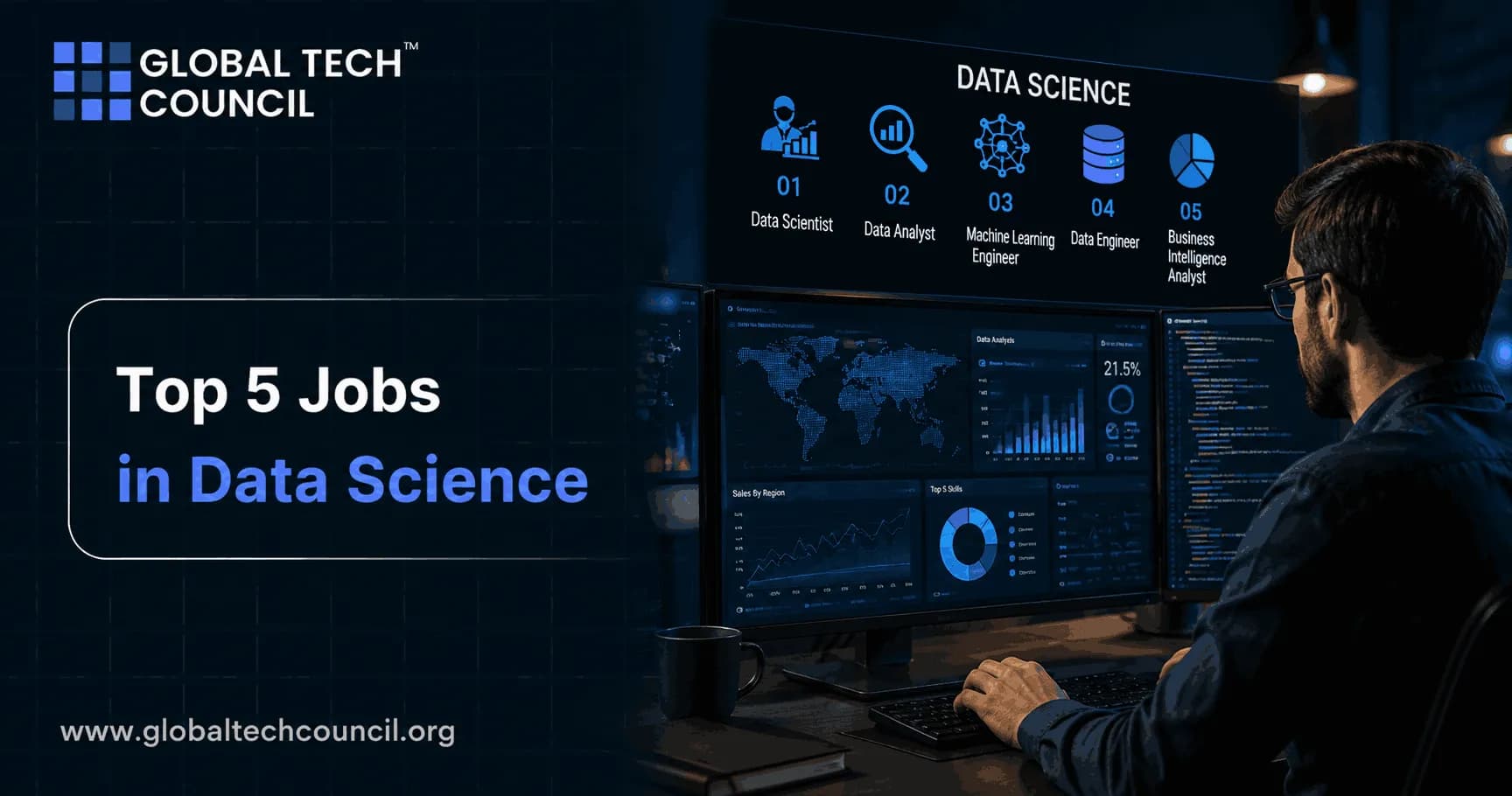
Over the past several years, data scientists have emerged as one of the most sought-after and in-demand professionals worldwide, and heading into 2026 that demand shows no sign of slowing. As businesses continue to recognize the significance of data in their operations, the need for data science professionals keeps escalating across nearly every sector. Today, data science serves as the foundation for analytics, data mining, natural language processing (NLP), machine learning (ML), generative and agentic artificial intelligence (AI), and other critical areas. The decisions made by businesses now heavily rely on the insights and recommendations provided by data scientists or their relevant counterparts. If you are looking to break into the field or formalize the skills you already have, earning a Certified Data Science Developer credential is one of the fastest ways to signal your expertise to employers.
Data scientists play a vital role in helping companies make informed and advantageous decisions based on the data analysis they conduct. This increasing reliance on data-driven decision-making has contributed to the significant rise in data science professionals entering the industry. The pay scale for data scientists is also relatively attractive, serving as a major motivating factor for individuals seeking to enter this field. The combination of high demand and competitive compensation has attracted many people to pursue careers in data science. As a result, data science continues to dominate the industry in 2026, offering rewarding opportunities for professionals with the right skills and expertise.

Understanding Data Science
Data science revolves around utilizing data to address questions and create solutions that facilitate data-driven decision-making for organizations. To succeed in this field, you must draw upon diverse knowledge encompassing areas such as artificial intelligence (AI), business intelligence (BI), and data analysis. AI plays a crucial role in data science by enabling the development of intelligent algorithms and models to make predictions, classify data, and automate processes. It involves machine learning, deep learning, and increasingly generative AI techniques to train models on large datasets and extract valuable insights. For professionals who want to go deeper into this side of the field, the Certified Artificial Intelligence (AI) Expert program is a solid way to build credibility alongside your data science foundation.
Business intelligence (BI) is another important aspect of data science, focusing on collecting, analyzing, and presenting data meaningfully to support decision-making processes within an organization. It involves using tools and technologies to transform raw data into actionable insights and reports. Data analysis forms the foundation of data science, encompassing various techniques and methodologies to extract insights, identify patterns, and derive meaningful conclusions from data. This involves statistical analysis, visualization, exploratory data analysis, and mining.
Data science is a multidisciplinary field that combines elements of AI, BI, and data analysis to harness the power of data and drive informed decision-making within organizations. By working and specializing in these skills and knowledge, data scientists uncover valuable insights, solve complex problems, and contribute to the success and create value for businesses across various industries.
Benefits of a Career in Data Science
The demand for data science professionals has surged as the world experiences an unprecedented data revolution, accelerated further by the rapid adoption of AI across industries. Businesses recognize the immense value of harnessing data for informed decision-making, leading to many people looking to pursue a career in Data Science. Some of the most common benefits associated with a career in data science are:
Unlocking Financial Success
Most job roles associated with data science earn a lot of money. Even at the entry-level, data science professionals earn higher salaries than the median income in the US. You can capitalize on your skills and expertise to command a rewarding remuneration package and additional perks that reflect the value you bring to organizations. The salary can vary across different roles in the field, but most of the roles are very high paying, and if you get a chance to work at a major corporation like Google, Amazon, or Microsoft, you can earn well above industry standards.
Tackling Complex Problems through Data Science
If you love solving complex problems, this field is right for you. Armed with cutting-edge analytical techniques and AI-assisted tools, you can analyze vast amounts of raw data and decipher hidden patterns, ultimately driving informed decisions. You can work on the art of transforming businesses by addressing critical questions like enhancing sales performance and identifying operational inefficiencies.
Data Science Careers Resistant to Automation
Data science professionals enjoy enhanced job security in a world increasingly driven by automation and AI agents. Specialized expertise and the ability to extract meaningful information from data render data science roles less susceptible to automation. By continually evolving your skills and staying ahead of the technological curve, you position yourself as an invaluable asset in the data-driven landscape as AI becomes more common in industry roles. Data science remains one of the least affected fields even as automation expands.
Driving Data-Driven Decision-Making Across Industries
You can experience the exhilaration of propelling industries forward with data-driven decision-making. As a data science expert, you possess the unique capability to unleash the potential of data, revolutionizing diverse sectors such as marketing, healthcare, sports, and entertainment. You can use the data to change how decision-making works across the industry and introduce new methods achieved through the insights from the data examined.
Top Jobs in Data Science
Some of the data science jobs in the field are more valuable and provide more returns than others, like:
1. Data Scientist
A data scientist is a specialist who uses scientific methods, processes, algorithms, and systems to draw conclusions and insights from structured and unstructured data. They develop models and algorithms to analyze data, make predictions, and uncover hidden patterns. Effective communication of findings to relevant stakeholders is also crucial to their role. They need to be able to explain everything to someone who doesn't come from a technical background.
Data scientists typically possess a strong background in statistics and mathematics, practical knowledge of programming languages like Python and R, and expertise in handling large datasets. The role needs an individual with both technical and soft skills expertise to ensure that the insights are viable for people with technical expertise. In the United States, the average annual salary for a data scientist is approaching $158,000 in 2026, according to recent salary tracking data. Other perks like insurance, compensation packages, and equity vary greatly based on the location of your job.
2. Machine Learning Engineer
A machine learning engineer is responsible for designing, building, and deploying scalable machine learning models for real-world applications. They develop and apply algorithms to analyze complex data, interpret it, and make predictions. Machine learning engineers collaborate with software engineers to integrate these models into finished products.
Machine learning engineers typically have a strong programming, computer science, and mathematics foundation. In the United States, the average income for a machine learning engineer is now around $130,000. Top earners in major cities, or those with significant expertise in areas like large language models, may earn even higher salaries at companies like Google, Meta, and Microsoft.
3. Big Data Engineer
Prominent data engineers design, build, and maintain a company's big data infrastructure architecture. They utilize big data technologies such as Hadoop, Spark, and NoSQL databases to manage the storage, processing, and analysis of large and complex datasets. Data engineers collaborate with data scientists, analysts, and software engineers to develop and implement big data solutions that meet the organization's business needs. In the United States, the average annual salary for a data engineer has climbed to roughly $115,000.
4. Business Intelligence Manager
Business intelligence managers oversee the development and implementation of data-driven solutions that support an organization's decision-making processes. They coordinate business intelligence tools and systems deployment, prioritize initiatives, and work closely with data analysts, data scientists, and IT teams.
These managers ensure that the data used in these solutions is high quality and effectively communicate findings and insights to senior leaders and stakeholders to inform business strategy. They are crucial in establishing data governance and security rules to protect confidential corporate data. In the United States, the salary range for a business intelligence manager typically falls between $128,000 and $162,000, with an average compensation of around $147,000 per year.
5. Data Analyst Manager
Data analyst managers lead a team of analysts and oversee the collection, analysis, and interpretation of large and complex datasets. They develop and implement data analysis strategies using various tools and technologies to support decision-making processes and inform business strategy. Data analyst managers collaborate closely with data scientists, business intelligence teams, and senior management to align data analysis initiatives with company goals. They are responsible for ensuring the accuracy and quality of the data used in analytical projects and conveying findings and recommendations to stakeholders. In the United States, the average base salary for a data analyst manager is now around $104,000.
Become a Certified Data Scientist with Global Tech Council Today!
How Can You Learn Data Science?
In this section, we will discuss how any passionate individual can develop the skills needed to perform jobs in data science.
Start With the Basics Programming Language + Database
Starting with the fundamentals is crucial when pursuing a career in data science. A strong grasp of programming languages and databases is essential for effectively manipulating data and applying algorithms. Python, R programming, SQL, and Scala are widely used programming languages in the field, and employers often seek proficiency in these languages. In terms of databases, MongoDB and MySQL are popular choices for storing structured data and retrieving it when needed. Python and R programming, in particular, are commonly utilized by data scientists across various domains.
Mathematics
Mathematics forms a critical foundation for data science. A solid understanding of statistics and mathematics is necessary to perform tasks and generate desired outcomes. Topics such as linear algebra, statistics, geometry, calculus, probability distribution, regression, dimensionality reduction, and vector models should be covered to develop fluency in data science. Deep knowledge of these topics is essential for implementing and applying major algorithms to real-life scenarios.
Data Analysis & Visualization
Data analysis and visualization play a significant role in transforming vast amounts of data into meaningful insights. Data scientists often utilize tools like Tableau, Power BI, QlikView, and D3.js to visualize data through charts and graphs, making it easier to comprehend and communicate key findings. These key findings and insights are essential in developing models that various organizations deploy for different purposes.
Web Scraping
Web scraping is a valuable technique data scientists employ to extract useful information from online sources. Companies of all sizes utilize web scraping to gather data such as customer reviews, surveys, and polls. Various tools and software facilitate the scraping process and efficiently handle large-scale data. Any data science professional looking to establish their expertise has to prove that they are good with web scraping and can find relevant and useful results, while staying mindful of evolving data-privacy regulations.
Machine Learning with Artificial Intelligence
Machine learning and artificial intelligence are essential areas of expertise for data scientists. A thorough understanding of these fields enables data scientists to apply tools and techniques for predictive analysis and decision-making tasks, including working alongside generative AI copilots that are now common in analytics workflows. Proficiency in working with different algorithms and data-driven models, and managing large datasets through cleaning and preprocessing, is highly valuable. Earning a recognized Deep Tech Certification can provide structured, comprehensive training for aspiring data scientists looking to validate these skills.
Deep Learning with Natural Language Processing
Deep learning and natural language processing (NLP) are closely linked and contribute to the success of applications in areas such as automatic text translation and conversational AI. Proficient data scientists possess strong programming skills, particularly in Python, enabling computers to understand and process human language effectively.
Big Data
As data volumes continue to grow exponentially, the importance of big data cannot be overstated. Big data technologies and techniques capture, store, extract, process, and analyze vast amounts of information. Tools like KNIME, RapidMiner, Integrate.io, Hadoop, and Spark are employed to handle the challenges of processing and analyzing such large datasets.
Problem-Solving Skill
Problem-solving skills are paramount for data scientists. The ability to tackle complexity, identify issues, and develop creative and effective solutions is essential. Data scientists must break down problems into manageable components and approach them systematically to ensure clarity in their data-driven solutions.
Get Certified
The Certified Data Science Developer™ Certification training has been redesigned to provide a comprehensive understanding of data science principles for 2026 and beyond. It covers a wide range of topics, starting from fundamental concepts such as statistics, data management, and analytics, to more advanced subjects like neural networks, machine learning, and R programming. This globally recognized certification, offered by the Global Tech Council, enhances your professional credibility and opens doors to various job opportunities in the field of data science. In just 18 hours, this self-paced online certification program equips individuals with a competitive advantage, enabling them to stand out in the job market and secure superior employment opportunities.
Become a Certified Data Scientist with Global Tech Council Today!
Future of Jobs in Data Science
From the above discussion, it is clear that data science jobs are in trend and safe. But what are some untapped opportunities in the field that may occur in the near future? Let's talk about that in this section.
Automation and Augmentation
The role of data scientists is evolving with the introduction of artificial intelligence (AI) and automation. While data scientists will not be replaced entirely, these technologies will significantly augment their work. New low-code, no-code, and AI-assisted platforms are expected to accelerate the adoption of automation in data science, allowing data scientists to oversee and interpret the results of automated processes. This may sound like something that will decrease the need for data scientists, but the expectations are the opposite. With the vast amount of data that will be structured with the help of AI, the need for people who can interpret that data will increase significantly.
Data Science as a Team Sport
Data science is shifting towards a collaborative approach. It's no longer just about building models; it's about effectively utilizing those models. The focus is on operationalizing models and leveraging them at scale across the organization. The future of data science lies in successfully implementing and deploying models for actionable insights throughout the business. This means that more and more corporations will hire people in the field for that purpose.
Data Science and Cybersecurity
As the reliance on digital information grows, data scientists will face an increasing demand for cybersecurity skills. Protecting data from hackers and cyber threats is becoming crucial. Data scientists need to be familiar with cybersecurity tools and techniques to assist companies in safeguarding their data assets. AI will play an essential role in this approach, and people with a skill set in both Data Science and AI will be highly valued.
Cloud Computing and Data Science
Cloud computing is gaining prevalence in data science. Data scientists can access powerful computing resources through the cloud to process large datasets. As more companies adopt cloud technologies, data scientists must be well-versed in cloud-based data processing tools and techniques. These tools will only make the current job more accessible as the time to process data reduces drastically with efficient cloud systems.
Operationalizing Data Science Workflows
Data science workflows will become more operationalized, with organizations adopting tools that capture data scientists' workflows and best practices. These tools will automate workflows, enabling companies to quickly train their workforce on data science practices and promote efficiency.
Changing Skillset for Data Scientists
Data scientists need to adapt their skillset to meet evolving demands. Coding and AI skills are becoming increasingly essential, alongside a stronger business acumen. The complexity of data requires data scientists to possess strong coding skills, and machine learning proficiency is also crucial. Understanding and interpreting data from a business perspective is now equally important, as is the ability to communicate insights to marketing, product, and leadership teams.
AI & Technology
As artificial intelligence continues to transform education, students are getting more opportunities to explore technology beyond traditional classroom learning. A Tech Olympiad can help students develop their understanding of AI, logical reasoning, problem-solving, and other technology skills through structured competition. Encouraging this kind of early exposure builds a strong pipeline of future data science talent who are already comfortable with the analytical and AI-driven thinking the field demands.
Quantum Computing's Impact on Data Science
Quantum computing will have a significant influence on data science jobs. Quantum computers can process vast amounts of data at unprecedented speeds, enhancing data analysis capabilities. Quantum data scientists must master new algorithms tailored for quantum computers and understand quantum mechanics principles to utilize these emerging technologies effectively.
Become a Certified Data Scientist with Global Tech Council Today!
Conclusion
The data science profession is currently experiencing tremendous demand in 2026, with employers recognizing its value and investing substantial resources in AI-driven analytics. By taking the appropriate steps, you can establish a promising career in data science. And since data science increasingly overlaps with how businesses reach and understand their customers, professionals who round out their technical skills with a Marketing Certification often find themselves even better positioned for cross-functional roles that blend analytics with strategy. The information in this blog provides valuable insights and guidance on how to embark on a successful journey in this field.
Frequently Asked Questions
1. What are the top 5 jobs in data science?
Five major data science career paths are:
Data Scientist
Data Analyst
Data Engineer
Machine Learning Engineer
AI Engineer / Generative AI Engineer
These roles overlap in some organizations, but each has a different primary focus.
2. What does a Data Scientist do?
A Data Scientist uses statistics, programming, machine learning, and data analysis to solve complex business problems. Typical responsibilities include data exploration, feature engineering, model development, experimentation, evaluation, and communicating findings to stakeholders.
3. What does a Data Analyst do?
A Data Analyst turns existing business data into useful insights. Their work commonly involves SQL, Excel, dashboards, data cleaning, visualization, and reporting to help organizations understand what happened and why.
4. What does a Data Engineer do?
A Data Engineer builds and maintains the infrastructure required to collect, transform, store, and deliver data. They commonly work with SQL, Python, ETL/ELT pipelines, data warehouses, cloud platforms, and distributed-data technologies.
5. What does a Machine Learning Engineer do?
A Machine Learning Engineer focuses on taking machine-learning models from development into reliable production systems. Responsibilities can include model deployment, data pipelines, monitoring, optimization, testing, and retraining.
6. What does an AI Engineer do?
An AI Engineer develops and integrates AI systems into products and business workflows. Depending on the position, this can involve machine learning, deep learning, large language models, retrieval-augmented generation, AI agents, APIs, and model deployment.
7. Which data science job is best for beginners?
For many beginners, Data Analyst can be one of the more accessible entry points because it typically emphasizes SQL, spreadsheets, visualization, basic statistics, and business communication rather than advanced machine learning.
However, the best starting role depends on your existing technical background and career goals.
8. Which data science job requires the most programming?
Machine Learning Engineer and AI Engineer positions generally require substantial programming and software-engineering knowledge, particularly when models need to be deployed and maintained in production.
Data Scientists also need strong programming skills, while Data Analyst positions can often involve less software engineering.
9. What skills are required for Data Scientist jobs?
Important Data Scientist skills include:
Python or R
SQL
Statistics
Probability
Machine learning
Data visualization
Feature engineering
Experimentation
Business understanding
Communication
Current career guidance also increasingly emphasizes familiarity with AI tools and cloud platforms.
10. What skills are required for Data Analyst jobs?
Core skills include:
SQL
Excel
Data cleaning
Data visualization
Power BI or Tableau
Basic statistics
Business analysis
Communication
Python can also be valuable, particularly as analysts take on more advanced analytical workflows.
11. What skills are required for Data Engineer jobs?
Data Engineers typically need:
Python
SQL
ETL/ELT
Data modeling
Databases
Data warehouses
Cloud platforms
Apache Spark or similar technologies
Workflow orchestration
Software engineering
Their main responsibility is creating reliable data infrastructure for analysts, scientists, and applications.
12. What skills are required for Machine Learning Engineer jobs?
Machine Learning Engineers commonly need:
Python
Machine learning
Deep learning
SQL
Model deployment
APIs
Docker
Cloud platforms
MLOps
Model monitoring
Knowledge of tools such as PyTorch, TensorFlow, MLflow, and Kubernetes can be useful depending on the position.
13. What skills are required for AI Engineer jobs in 2026?
AI Engineer positions increasingly involve skills such as:
Python
Machine learning
Deep learning
LLMs
Prompt engineering
RAG
Vector databases
AI APIs
AI agents
Model evaluation
Cloud deployment
The exact requirements vary significantly between companies and job descriptions.
14. Which data science job has the highest salary?
There is no single universally highest-paying data science role. Compensation depends heavily on experience, location, company, industry, technical specialization, and seniority.
Specialized Machine Learning and AI engineering positions can command high compensation, particularly when they involve production systems and advanced AI expertise.
15. Can a Data Analyst become a Data Scientist?
Yes. Data Analyst can be a practical foundation for moving into Data Science.
An analyst can gradually add:
SQL → Statistics → Python → Machine Learning → Model Deployment → Data Science Projects
Real-world projects and demonstrable technical skills can be particularly valuable when making the transition.
16. Can a Data Scientist become a Machine Learning Engineer?
Yes. A Data Scientist can transition toward Machine Learning Engineering by developing stronger software engineering, cloud, deployment, MLOps, system design, and production-model management skills.
The major shift is from primarily developing and evaluating models to building reliable systems around those models.
17. Do all data science jobs require Python?
No. Python is extremely common, but it is not mandatory for every data role.
For example, Data Analysts may primarily use SQL, Excel, and BI platforms, while some statistical roles make extensive use of R. Data Engineers and ML Engineers frequently use Python alongside other technologies.
18. Do data science jobs require a degree?
Requirements vary by employer and position. A degree in computer science, statistics, mathematics, data science, engineering, economics, or a related field can be useful, particularly for research-heavy roles.
However, employers may also evaluate practical skills, portfolios, projects, professional experience, and technical assessments.
19. How can I get my first data science job?
A practical roadmap is:
Learn Python and SQL.
Build a statistics foundation.
Learn data visualization.
Choose a specialization.
Complete practical projects.
Build a portfolio.
Learn Git and basic cloud concepts.
Practice technical interviews.
Apply for relevant entry-level roles.
Demonstrate measurable outcomes from your projects.
For beginners, starting with Data Analyst or analytics-focused roles can provide a pathway toward Data Science, Machine Learning, or AI Engineering.
20. What is the future of data science jobs?
Data science is expanding beyond traditional statistical analysis toward AI engineering, machine learning, generative AI, data engineering, analytics automation, and AI-assisted decision-making.
Organizations increasingly need professionals who can not only analyze data but also turn models and insights into useful products and production systems.
Related Articles
View All
Data Science
Top 10 Jobs in Data Science with Huge Potential for 2022
Data science is now the most crucial subject in the technological field. Our life is quite dependent on technology, and technology depends on data. All the gadgets, networks, systems, businesses, and all are heavily dependent on data. And data science does the extraordinary work of handling this…

Data Science
Top 10 Data Science Trends in 2025
The top 10 data science trends in 2025 are: Agentic AI, AutoML, Synthetic Data, Federated Learning, Augmented Analytics, Real-Time Analytics, Edge AI, Explainable AI (XAI), Data-Centric AI, and Data Democratization. These trends are reshaping how data is collected, processed, and used across…
Data Science
Top 10 Data Science Tools in 2025
The top 10 data science tools in 2025 are Python, R, Jupyter Notebook, Tableau, Power BI, Apache Spark, TensorFlow, RapidMiner, KNIME, and Google Colab. These tools help data professionals with everything from cleaning data to building predictive models and creating dashboards. If you’re…
Trending Articles
The Role of Blockchain in Ethical AI Development
How blockchain technology is being used to promote transparency and accountability in artificial intelligence systems.
AWS Career Roadmap
A step-by-step guide to building a successful career in Amazon Web Services cloud computing.
Top 5 DeFi Platforms
Explore the leading decentralized finance platforms and what makes each one unique in the evolving DeFi landscape.