

All About Machine Learning in Finance
 Aman Singh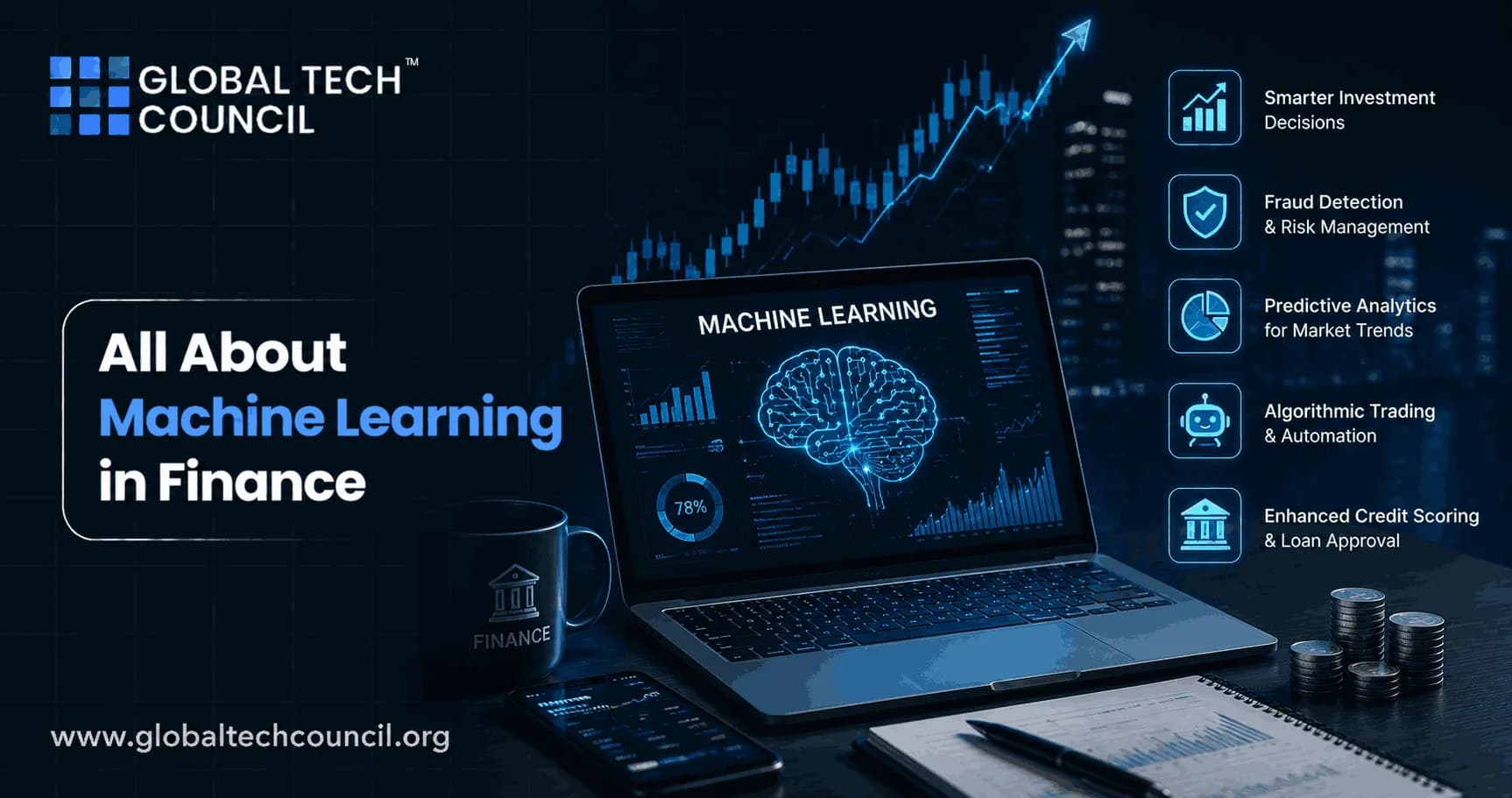
Machine learning has spent the past two decades moving from a promising research field into a genuine operational necessity across the financial industry. What has changed dramatically in 2026 is the scale and autonomy of that transformation. According to Bank of England research, 75 percent of major financial firms now deploy AI in their operations, up from just 53 percent in 2022, and the technology has moved decisively from simply generating insights toward taking direct, autonomous action across core financial workflows. Financial organizations aiming to stay competitive are treating this shift as a genuine strategic imperative, and many professionals building expertise in this space start with a Certified Machine Learning Expert credential to build a structured foundation before exploring the increasingly autonomous systems now reshaping the industry.
In this article, we will explore how machine learning continues to power finance, the genuinely significant shift toward agentic AI now underway in 2026, and how you can build real expertise to participate in this transformation.

Understanding Machine Learning's Evolving Role in Finance
Machine learning is a specialized field within data science that leverages statistical models to extract insights and make predictions from data. What has evolved considerably since ML first gained traction in finance is what happens after those predictions are made. Where earlier systems generated forecasts and recommendations for a human to review, a genuinely significant share of financial institutions in 2026 have moved toward systems capable of acting on those insights directly, within clearly defined limits.
This shift is substantial and measurable. Wolters Kluwer reports that 44 percent of finance teams now use agentic AI, representing an increase of more than 600 percent year over year, up from fewer than 7 percent of finance teams in January 2025. Gartner predicts that by the end of 2026, 40 percent of business software will include AI capable of completing end to end tasks independently, including fraud detection, loan processing, customer onboarding, and reporting, without requiring human intervention at every step.
Why Machine Learning Has Become Essential in Finance
Machine learning applications in the finance industry continue driving advancements in fraud detection, risk management, process automation, data analytics, customer support, and algorithmic trading. The earlier industry goal of a fully touchless financial close by 2025 has evolved into something more nuanced heading through 2026, genuine progress on automation paired with a clear recognition that full autonomy still requires careful governance. Auxis reports that 86 percent of finance teams say they have seen no significant value from their AI investments so far, often due to skills shortages, while 81 percent of finance functions are adopting or planning to adopt AI through outsourced services specifically to access the talent and tools needed for sustainable success.
This combination of real opportunity and genuine implementation risk has driven strong demand for professionals who understand both the technical and financial sides of this transformation. Understanding how agentic systems actually reason through multi step workflows, adapt to unexpected data, and operate within compliance guardrails requires deep, applied expertise, which is why many professionals are pursuing a Certified AI & Machine Learning Expert credential, building the combined knowledge needed to evaluate and implement these increasingly autonomous systems responsibly.
Benefits of Machine Learning in Finance
The integration of machine learning in finance continues delivering measurable advantages. It minimizes human errors that could otherwise lead to substantial financial losses, and enables real time solutions that expedite manual processes considerably. According to a 2026 industry report, standalone generative agents now achieve error rates as low as 0.3 percent in document verification tasks, a meaningful improvement over manual review. Machine learning also continues reducing workload by handling complex, repetitive tasks, freeing finance professionals to focus on higher value strategic decision making, while supporting more consistent, data driven decision making across the organization.
How Machine Learning Is Applied in Finance Today
1. Algorithmic Trading and Autonomous Execution
Machine learning algorithms continue analyzing real time market news and trading activity to inform decisions, and 2026 has introduced genuinely autonomous execution layers on top of this foundation, with agentic systems capable of adjusting trading strategies dynamically as market conditions shift, operating within firm defined risk boundaries rather than requiring manual approval for every action.
2. Fraud Detection and Prevention at Scale
Fraud detection remains one of machine learning's strongest use cases in finance, and agentic AI has meaningfully strengthened this capability in 2026. Beyond flagging suspicious transactions for human review, autonomous agents can now monitor transactions continuously, detect fraud patterns in real time, and adjust detection parameters dynamically as new fraud techniques emerge, including increasingly sophisticated deepfake enabled fraud, which has grown by more than 2,000 percent over the past three years and now specifically targets financial institutions.
Understanding how to build and govern these increasingly autonomous fraud detection and trading systems responsibly requires genuine technical depth extending well beyond traditional machine learning. This is why professionals working on production financial AI systems increasingly pursue a broader Deep Tech Certification, building the well rounded expertise needed to understand how machine learning connects with adjacent technologies like blockchain based transaction verification and cloud infrastructure now underpinning modern financial systems.
3. Portfolio Management and Always On Relationship Management
Robo-advisors continue offering personalized financial advice based on real time market trends and individual risk preferences, and this capability has expanded meaningfully in 2026. Agentic AI now functions as what industry analysts describe as an always on relationship manager, capable of negotiating personalized financial products in real time while balancing customer preferences against bank risk and regulatory constraints, a genuinely more dynamic capability than earlier static robo-advisory models.
4. Loan Underwriting and Expanded Credit Access
Machine learning continues simplifying loan underwriting by analyzing extensive consumer data to assess eligibility. A genuinely promising 2026 development involves more sophisticated models identifying creditworthy borrowers whom traditional scoring metrics would have missed entirely, particularly benefiting underserved markets, small business financing, and specialized industries that historically struggled to access traditional credit scoring frameworks.
5. Intelligent Document Processing and Touchless Operations
Where earlier automation relied on basic optical character recognition, 2026's intelligent document processing tools combine machine learning and natural language processing to handle complex, unstructured financial documents with genuine precision, enabling meaningfully higher levels of touchless processing across accounts payable, regulatory reporting, and financial analysis, addressing a persistent pain point where more than half of accounts payable teams previously spent over ten hours weekly on manual document extraction.
6. Customer Service and Compliance Automation
Intelligent chatbots continue improving customer service response times, and 2026 has extended machine learning meaningfully into anti-money laundering, Know Your Customer, and Know Your Business compliance systems, moving these functions from basic automation toward adaptive, real time intelligence that improves onboarding accuracy and strengthens risk management across financial institutions.
Real World Case Studies
Major financial institutions continue demonstrating machine learning's practical value. Capital One employs machine learning to identify fraudulent credit card transactions by analyzing timing, amount, and location patterns. Sberbank uses machine learning to predict customer spending patterns and personalize offers. Credit Suisse applies machine learning to assess loan default risk, while Barclays continues using it to detect fraudulent transactions in real time. Beyond individual institutions, Lloyds Banking Group has publicly described 2026 as a genuine turning point, applying agentic AI across customer interactions, internal operations, and engineering functions as part of a deliberate, enterprise wide deployment strategy.
Building the Next Generation of Technical Talent
As machine learning and agentic AI reshape finance and other industries, cultivating genuine technical curiosity among younger students helps build the workforce that will eventually design, deploy, and govern these increasingly autonomous systems.
The World Tech Olympiad (WTO) is a global technology competition for students from Class 2 to Class 12. Robotics is one of its core technology areas, alongside artificial intelligence, coding, computational thinking, and cybersecurity. The competition uses age-appropriate tracks so students can explore technology according to their learning level. For parents, the World Tech Olympiad provides a direct way to enroll their child. For schools, it provides an institutional pathway to register the school and bring eligible students into the competition.
Introducing students to computational thinking and AI concepts at this stage builds a genuine foundation for understanding the increasingly autonomous financial systems they will likely encounter throughout their careers.
Challenges That Remain Genuinely Unresolved
Despite significant progress, real challenges continue shaping how responsibly machine learning gets deployed in finance. Data privacy and security remain paramount given how sensitive financial information is. Ethical considerations around bias remain genuinely unresolved industry wide, with one 2025 study finding only 2 percent of companies had adequate AI guardrails in place. Model interpretability continues limiting acceptance in certain high stakes situations, and regulatory compliance requirements continue evolving alongside the technology itself. A skilled workforce with expertise spanning both finance and machine learning remains genuinely difficult to find and retain, a gap that continues driving demand for structured, verified certification pathways.
Communicating This Transformation Effectively
As financial institutions deploy increasingly autonomous machine learning systems, clearly explaining these changes to customers, regulators, and internal stakeholders has become just as important as the underlying technology itself, particularly given how much public trust in financial services depends on transparency. This is why many professionals working on these initiatives also pursue a Marketing Certification, strengthening their ability to communicate complex technical developments clearly to audiences who need to understand and trust these systems without necessarily sharing the same technical background.
Final Thoughts
Machine learning has fundamentally transformed the finance industry, and 2026 marks a genuine inflection point where that transformation has shifted from generating insights toward autonomous execution across trading, fraud detection, underwriting, and compliance. This shift brings real efficiency gains and expanded access to financial services, but it also demands genuinely careful governance, given the scale, sensitivity, and consequences of the decisions these systems now make independently.
Financial institutions that thoughtfully balance this growing autonomy with strong human oversight, clear governance, and transparent communication are best positioned to build lasting trust while capturing machine learning's full potential. The technology has moved well past pilot projects into genuine, production scale deployment, and the organizations that master both its capabilities and its responsible implementation will define the next chapter of financial services.
FAQs
1. What Is Machine Learning in Finance?
Machine learning in finance is the use of algorithms that learn patterns from financial data to make predictions, classifications, recommendations, or automated decisions. Financial institutions can apply machine learning to fraud detection, credit risk, investment research, trading, customer analytics, compliance, forecasting, and operational automation. Unlike traditional rule-based systems, machine learning models can identify complex relationships across large datasets and adapt as new data becomes available.
2. How Is Machine Learning Used in Finance?
Machine learning is used across banking, insurance, investment management, fintech, payments, lending, and capital markets. Common applications include detecting suspicious transactions, estimating default risk, predicting customer churn, forecasting financial variables, analyzing documents, identifying investment signals, and automating compliance processes. The basic workflow is Financial Data → Feature Engineering → ML Model → Prediction → Decision → Monitoring.
3. Why Is Machine Learning Important in Finance?
Finance generates enormous volumes of transactional, market, customer, and operational data. Machine learning can analyze these datasets faster than manual processes and identify patterns that conventional analytical approaches may overlook. This can improve risk management, fraud detection, personalization, forecasting, and operational efficiency. The advantage is not that machines possess mystical financial intuition. They are simply rather efficient at processing quantities of data that would make a spreadsheet consider early retirement.
4. How Is Machine Learning Used for Fraud Detection?
Machine learning models can analyze transaction amounts, locations, devices, merchant information, timing, account behavior, and historical fraud patterns to estimate whether an activity appears suspicious. Supervised models learn from previously labeled fraud cases, while anomaly-detection techniques can identify unusual behavior without requiring every fraudulent pattern to have appeared previously. Effective fraud systems continuously balance detection rates against false positives so legitimate customers are not repeatedly treated like international criminals for buying groceries.
5. How Does Machine Learning Help With Credit Risk?
Banks and lenders can use machine learning to estimate the probability that a borrower will repay or default. Models may analyze permitted financial and behavioral variables alongside conventional credit information to improve risk assessment. Machine learning can uncover nonlinear relationships that simpler scoring approaches may miss. However, lending models require careful attention to explainability, fairness, data quality, privacy, validation, and applicable regulations because credit decisions can materially affect people's lives.
6. How Is Machine Learning Used in Algorithmic Trading?
Machine learning can help analyze historical prices, volumes, volatility, order-book information, economic indicators, news, and other signals to identify potential trading patterns. Models may support signal generation, execution, portfolio construction, or risk management. Successful deployment requires rigorous backtesting, transaction-cost modeling, out-of-sample validation, and continuous monitoring. A model that brilliantly predicts yesterday's market is technically accurate and commercially rather less exciting.
7. Can Machine Learning Predict Stock Prices?
Machine learning can identify patterns and estimate probabilities related to financial markets, but reliably predicting future stock prices remains extremely difficult. Markets are noisy, adaptive, and influenced by economic conditions, corporate developments, investor behavior, geopolitics, and unexpected events. Models can support forecasting and decision-making, but claims of guaranteed market predictions should be treated skeptically. Strong financial ML focuses on probabilities and risk-adjusted decisions rather than supernatural certainty.
8. How Is Machine Learning Used in Portfolio Management?
Machine learning can assist portfolio managers with asset selection, risk estimation, market-regime identification, factor analysis, optimization, and rebalancing. Models can process conventional market data alongside alternative datasets to identify relationships relevant to portfolio decisions. ML can also help estimate correlations and downside risks. Human investment professionals remain important for defining objectives, constraints, risk appetite, and oversight, particularly when models encounter market conditions absent from their training data.
9. What Machine Learning Algorithms Are Used in Finance?
Financial ML applications use algorithms such as linear and logistic regression, decision trees, random forests, gradient boosting, support vector machines, clustering, anomaly detection, neural networks, and time-series models. The appropriate algorithm depends on the problem, dataset, interpretability requirements, latency constraints, and regulatory environment. A complicated model is not automatically better. Sometimes the boring model that everyone understands wins, an outcome machine-learning presentations rarely celebrate with sufficient enthusiasm.
10. What Is the Role of Deep Learning in Finance?
Deep learning uses multilayer neural networks to identify complex patterns in large datasets. Financial applications can include document analysis, fraud detection, time-series modeling, sentiment analysis, speech processing, and alternative-data analysis. Transformer architectures are particularly relevant to financial language and document processing. Deep learning can be powerful, but its computational requirements and limited interpretability can make simpler machine-learning methods preferable for certain regulated financial decisions.
11. How Is Natural Language Processing Used in Finance?
Natural language processing, or NLP, enables financial systems to analyze text from earnings reports, filings, news, research documents, contracts, customer communications, and other sources. NLP models can classify documents, extract entities, identify sentiment, summarize information, and support research workflows. Modern transformer-based models and generative AI have significantly expanded these capabilities, allowing financial professionals to interact with large document collections through natural-language interfaces.
12. How Is Machine Learning Used in Banking?
Banks can use machine learning for credit assessment, fraud detection, anti-money-laundering support, customer segmentation, churn prediction, personalization, document processing, cybersecurity, and operational forecasting. Models can help employees prioritize cases and identify unusual activity across millions of transactions. Financial institutions still need strong model governance because automated efficiency becomes considerably less attractive when nobody can explain why a system rejected a customer or flagged a legitimate transaction.
13. How Does Machine Learning Support Financial Forecasting?
Machine learning can support forecasting of revenue, cash flow, demand, liquidity, market variables, customer behavior, and financial risk. Models can incorporate more variables and nonlinear relationships than many conventional approaches. However, forecasts should be evaluated against appropriate baselines and continuously monitored. Historical patterns can change because of recessions, interest-rate shifts, regulation, competition, or structural market changes, producing model drift and weaker predictions.
14. How Is Machine Learning Used in Insurance?
Insurance companies can apply machine learning to underwriting, claims processing, fraud detection, pricing, customer segmentation, risk modeling, and document analysis. Computer vision may help analyze damage images, while NLP can process claims documents and customer communications. Machine learning can improve efficiency, but insurers must manage fairness, explainability, privacy, and regulatory concerns when models influence pricing, coverage, or claims decisions.
15. What Is the Role of Machine Learning in Fintech?
Fintech companies use machine learning to build digital lending, payments, fraud prevention, personal-finance, investment, insurance, and financial-automation products. ML can enable real-time risk scoring, personalized recommendations, transaction categorization, automated support, and predictive analytics. Because fintech products often operate digitally from end to end, machine learning can be integrated directly into customer journeys, although speed of deployment does not remove the need for security, governance, and regulatory compliance.
16. What Are the Benefits of Machine Learning in Finance?
Potential benefits include faster analysis, improved fraud detection, stronger risk modeling, greater personalization, automated processes, better forecasting, and the ability to analyze large structured and unstructured datasets. Machine learning can also help financial professionals prioritize attention by identifying transactions, customers, or events that warrant investigation. The strongest business case connects ML performance to measurable outcomes such as Lower Fraud Losses + Better Risk Decisions + Reduced Costs + Faster Processing + Improved Customer Experience.
17. What Are the Risks of Machine Learning in Finance?
Major risks include biased models, poor-quality data, overfitting, lack of explainability, privacy violations, cybersecurity threats, model drift, inaccurate predictions, and inappropriate automation. Financial organizations also face model risk when systems perform differently in production than expected during development. Strong controls should therefore cover Data Governance → Model Validation → Explainability → Security → Human Oversight → Monitoring → Auditability.
18. How Is Generative AI Different From Traditional Machine Learning in Finance?
Traditional machine learning generally focuses on prediction, classification, anomaly detection, and optimization. Generative AI creates or transforms content such as text, code, reports, summaries, and conversational responses.
Traditional ML might answer:
“What is the probability this transaction is fraudulent?”
Generative AI might answer:
“Summarize why this transaction was flagged and prepare the case information for an analyst.”
The technologies are increasingly complementary. Predictive ML can generate the score while generative AI helps humans understand and act on the underlying information.
19. What Skills Are Needed for Machine Learning in Finance?
Professionals should combine technical knowledge with financial understanding. Important technical skills include Python, SQL, statistics, probability, data preparation, machine learning, time-series analysis, model evaluation, and visualization. More advanced roles may require deep learning, NLP, cloud computing, MLOps, and generative AI.
Financial knowledge can include accounting, markets, banking, portfolio management, derivatives, credit, risk, or insurance depending on the specialization.
The strongest profile therefore combines:
Finance + Statistics + Programming + Machine Learning + Domain Experience
20. What Is the Future of Machine Learning in Finance?
Machine learning is likely to become increasingly embedded across financial decision-making rather than remaining a separate analytics function.
The traditional financial workflow often looks like:
Data → Analyst → Model/Spreadsheet → Decision → Report
An ML-enabled workflow can become:
Financial Data → Automated Data Pipeline → Machine Learning Model → Risk/Prediction Score → Human or Automated Decision → Continuous Monitoring
Generative AI adds another layer:
Documents + Financial Data + ML Outputs → Generative AI → Explanation + Summary + Recommended Next Step
AI agents could extend this architecture further:
Financial Task → AI Agent → Retrieve Approved Data → Use Models and Tools → Analyze → Prepare Action → Human Approval → Execution
Different financial functions can therefore develop distinct AI architectures.
Fraud management can become:
Transaction → ML Fraud Score → Anomaly Detection → Investigation → Generative AI Summary → Analyst Decision
Credit management can become:
Application → Data Validation → Credit Model → Risk Assessment → Explainability → Human/Policy Decision
Investment research can become:
Market Data + Filings + News + Research → ML/NLP Analysis → Generative AI Synthesis → Analyst Review → Investment Decision
Financial forecasting can become:
Historical Data + Business Drivers → ML Forecast → Scenario Analysis → AI Explanation → Management Decision
The future is therefore not simply “machine learning replaces financial professionals.” It is more accurately:
Financial Expertise + Machine Learning + Generative AI + Automation + Governance
Machine learning is particularly strong at Prediction + Classification + Pattern Recognition + Anomaly Detection.
Generative AI is strong at Language + Summarization + Knowledge Interaction + Content Generation.
Humans remain essential for Judgment + Accountability + Strategy + Ethics + High-Stakes Decisions.
Organizations that combine these layers effectively can build financial systems that are faster, more analytical, more personalized, and more responsive.
The key word is effectively.
Because giving a sophisticated model access to enormous quantities of financial data does not automatically create intelligence any more than giving someone 400 spreadsheets automatically makes them CFO.
Related Articles
View All
Machine Learning
Machine Learning in Finance: Fraud Detection, Risk Modeling, and Trading
Machine learning in finance improves fraud detection, credit risk modeling, AML monitoring, and trading, but success depends on validation and governance.

Machine Learning
The Future of Machine Learning: Trends, Opportunities, and Challenges
Explore the future of machine learning, including foundation models, edge ML, AutoML, MLOps, governance, market growth, and career opportunities.

Machine Learning
Machine Learning Certification Guide: Choose the Right Program
A practical 2026 guide to choosing the right machine learning certification based on role, skill level, curriculum, projects, cloud stack, and career goals.
Trending Articles
The Role of Blockchain in Ethical AI Development
How blockchain technology is being used to promote transparency and accountability in artificial intelligence systems.
AWS Career Roadmap
A step-by-step guide to building a successful career in Amazon Web Services cloud computing.
Top 5 DeFi Platforms
Explore the leading decentralized finance platforms and what makes each one unique in the evolving DeFi landscape.