


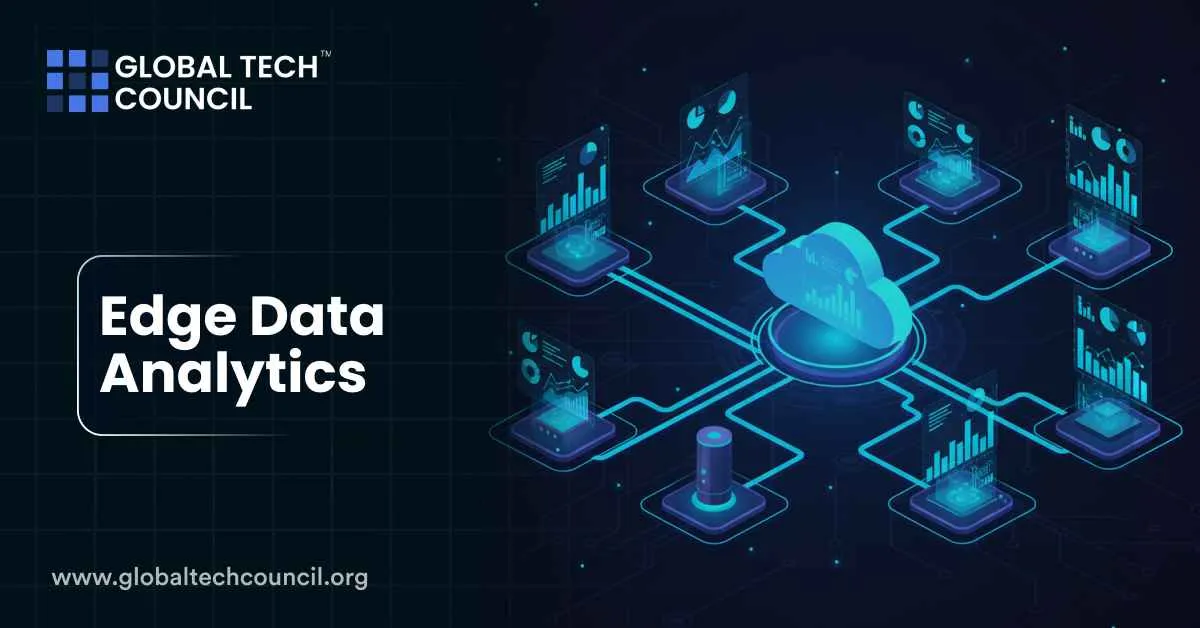
 In a world where every second counts, sending all data back to a central cloud for processing feels outdated. Businesses now demand insights at the very moment data is created—whether on factory floors, in retail stores, or inside connected vehicles. Edge data analytics makes this possible by processing information locally, close to its source, rather than waiting for cloud round-trips. The result is faster responses, lower costs, and better privacy. For professionals eager to understand the data pipelines and machine learning models that power this shift, a Data Science Certification provides the skills to design analytics that thrive at the edge.
What Edge Data Analytics Really Means
Edge analytics isn’t about replacing cloud computing but about complementing it. While the cloud remains useful for heavy computation, training models, and storing data long-term, the edge is where immediate action happens. IoT devices, local gateways, and embedded sensors can process streaming data on the spot, reducing latency and bandwidth needs. This hybrid model gives companies both agility and depth.
Why Businesses Are Turning to Edge Analytics
Several forces are pushing organizations toward this decentralized approach:
- Real-time requirements: Manufacturers need instant alerts when machines behave abnormally; hospitals need immediate signals from patient monitors.
- Data growth: With billions of devices generating constant streams, sending everything to the cloud is expensive and slow.
- Privacy and compliance: Localized processing helps meet data sovereignty laws and reduces exposure risks.
- Smarter devices: Advances in hardware and lightweight machine learning make it practical to run analytics where data originates.
Industry Use Cases
Edge data analytics is not confined to one sector—it is spreading quickly across industries.
- Manufacturing: Predictive maintenance through local vibration or heat analysis prevents costly equipment failures.
- Healthcare: Real-time monitoring of patient vitals reduces emergency response times.
- Retail: In-store cameras and sensors track movement and dwell time, enabling dynamic display changes.
- Transportation and logistics: Fleet tracking, cold chain monitoring, and route optimization improve efficiency.
- Smart cities and autonomous systems: From traffic light control to safety alerts, systems that cannot tolerate delays rely on edge analytics.
Benefits and Challenges of Edge Data Analytics
| Category | Benefits | Challenges |
| Speed | Instant responses with low latency | Limited compute power on devices |
| Cost | Reduced bandwidth and cloud storage use | High infrastructure setup and management |
| Privacy | Keeps sensitive data local | Security risks at distributed nodes |
| Resilience | Works even with poor connectivity | Complex synchronization across nodes |
| Scalability | Supports billions of IoT devices | Data integration and schema consistency |
The Challenges to Solve
Edge data analytics brings its own complexities. Devices at the edge have less compute and storage capacity, making advanced models harder to run. Managing updates across thousands of distributed nodes can be messy. Security is another hurdle: unlike secured cloud centers, edge devices may be physically accessible and vulnerable to tampering. And while local analytics are fast, ensuring consistent results across all nodes requires robust governance.
What the Future Holds
The next stage of edge analytics is about blending it seamlessly with cloud resources. Federated learning is gaining traction, allowing devices to train models collectively without sharing raw data, strengthening both privacy and performance. TinyML and hardware accelerators will make it easier to run sophisticated models on small, power-efficient devices. Industries like healthcare, automotive, and real-time manufacturing are expected to lead adoption as latency and privacy become non-negotiable.
For leaders looking to turn these opportunities into real strategies, a Marketing and Business Certification offers a structured way to align decentralized analytics with growth and customer value.
Building Trustworthy Edge Systems
Edge data analytics must balance innovation with accountability. Companies that succeed will be those that combine speed with governance, ensuring ethical data practices even outside traditional data centers. As these systems scale, transparency, compliance, and security will matter just as much as technical performance. For professionals aiming to build resilient and ethical architectures, a deep tech certification delivers advanced knowledge for creating secure, decentralized analytics environments.
Conclusion
Edge data analytics represents a major step in the evolution of enterprise intelligence. By processing information where it originates, businesses can act faster, cut costs, and safeguard sensitive data. The challenges of security, scalability, and integration are real, but the potential rewards are enormous. As this frontier expands, those equipped with both technical expertise and strategic vision will shape the future of decentralized insights.
Leave a Reply