


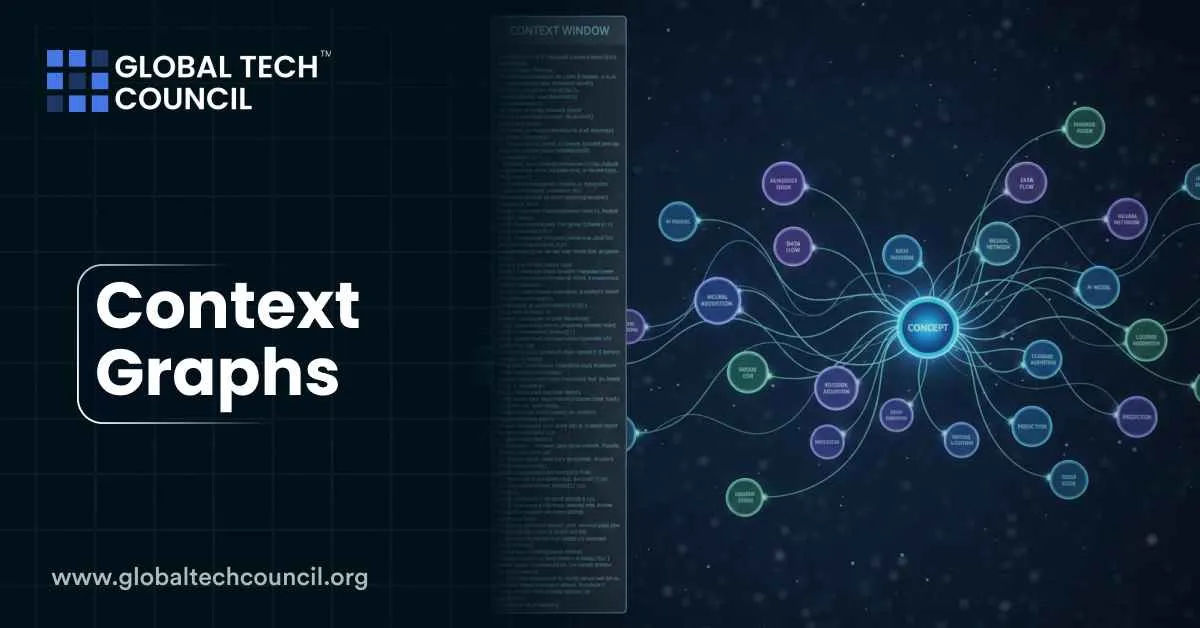
 Context graphs explain how modern AI systems understand decisions inside real organizations. Not prompts. Not demos. Real business decisions that affect money, customers, compliance, and trust.
As AI moves from answering questions to taking actions, one problem becomes obvious very fast. The issue is not that AI lacks intelligence. The issue is that AI does not understand why things were done a certain way before.
Anyone learning this seriously through an AI Course quickly realizes that intelligence without context creates risk. Context graphs exist to solve that exact problem.
What are context graphs?
A context graph is a structured system that maps how decisions happen inside an organization.
It connects:
- Data
- Rules
- People
- Systems
- Past decisions
- Approvals and exceptions
Instead of storing just outcomes, context graphs store reasoning.
They answer one critical question that every AI system struggles with:
Why was this decision allowed?
Why AI fails without context
Most companies already have plenty of data:
- CRMs track customers
- Finance systems track revenue
- Support tools track issues
- Documents store policies
Yet decisions still break.
For example, approving a discount depends on multiple factors:
- Customer value
- Past incidents
- Policy limits
- Previous exceptions
- Required approvals
Humans connect these factors naturally. AI does not unless the relationships are explicitly captured.
Without a context graph, AI sees isolated facts. With a context graph, AI understands relationships.
Systems store facts, not judgment
Traditional systems are good at recording events:
- A discount was applied
- A ticket was closed
- A refund was issued
They do not record reasoning:
- Why policy was overridden
- Why approval was granted
- Why this case differed from others
That reasoning usually lives in emails, chats, and meetings.
Context graphs capture that invisible layer and turn it into usable intelligence.
Decision traces made simple
A decision trace is the full story behind an action.
Instead of only recording what happened, it records how the decision was reached.
Example of what a context graph captures:
- Policy evaluated
- Exception rule triggered
- Risk level assessed
- Approval chain used
- Similar past cases referenced
This trace becomes reusable knowledge for future decisions.
Context graphs for AI agents
AI agents do more than respond. They act.
They can:
- Approve requests
- Send communications
- Update systems
- Trigger workflows
Once AI can act, mistakes become expensive.
Context graphs reduce risk by ensuring actions are grounded in policy, precedent, and accountability.
This is why teams building autonomous systems often study governance and decision design through an Agentic AI certification, not just model performance.
How context graphs evolve over time
Context graphs are not static. They grow as work happens.
Each of the following adds intelligence to the graph:
- Approved exceptions
- Denied requests
- Escalations
- Manual overrides
- Compliance reviews
Over time, patterns become visible:
- Policies that are frequently overridden
- Customers that trigger exceptions
- Decisions that always require human approval
- Rules that no longer reflect reality
This turns hidden operational behavior into actionable insight.
Context graphs vs knowledge graphs
Knowledge graphs focus on structure.
They describe:
- Entities
- Attributes
- Relationships
Context graphs focus on decisions.
They explain:
- Why actions were taken
- Why rules were bent
- Why outcomes differed
In simple terms:
- Knowledge graphs describe what exists
- Context graphs explain how judgment is applied
Real business scenario
A refund request exceeds the standard limit.
Without context, an AI system blocks it.
With a context graph, the AI sees:
- A recent outage affected the customer
- A renewal decision is pending
- Similar refunds were approved before
- Finance approved an exception last quarter
The AI routes the request correctly instead of failing blindly.
That difference is what separates automation from intelligence.
Human control
Context graphs do not remove humans from decision making.
They make human judgment visible and repeatable.
Humans still:
- Define policies
- Approve high risk actions
- Set escalation rules
- Decide when exceptions become standards
Context graphs ensure AI respects those boundaries.
How organizations adopt context graphs
Adoption usually starts small.
Most teams begin with one workflow:
- Discounts
- Refunds
- Procurement
- Compliance checks
- Customer escalations
They stop relying on free text explanations and start capturing structured reasoning.
As adoption grows, the context graph becomes a shared source of truth.
This alignment is why leaders focused on scale and execution often connect this work to a Marketing and Business Certification, not just technical training.
Context graphs in 2026
As AI agents become normal inside businesses, context graphs enable:
- Safer automation
- Explainable AI decisions
- Audit ready decision logs
- Consistent enforcement of rules
- Reduced repeat mistakes
- Clear ownership of responsibility
They allow speed without chaos. Enroll
Conclusion
AI does not fail because it is not smart.
AI fails because it does not remember how decisions were made.
Context graphs give AI that memory.
That is what turns AI from a tool into a dependable system.