


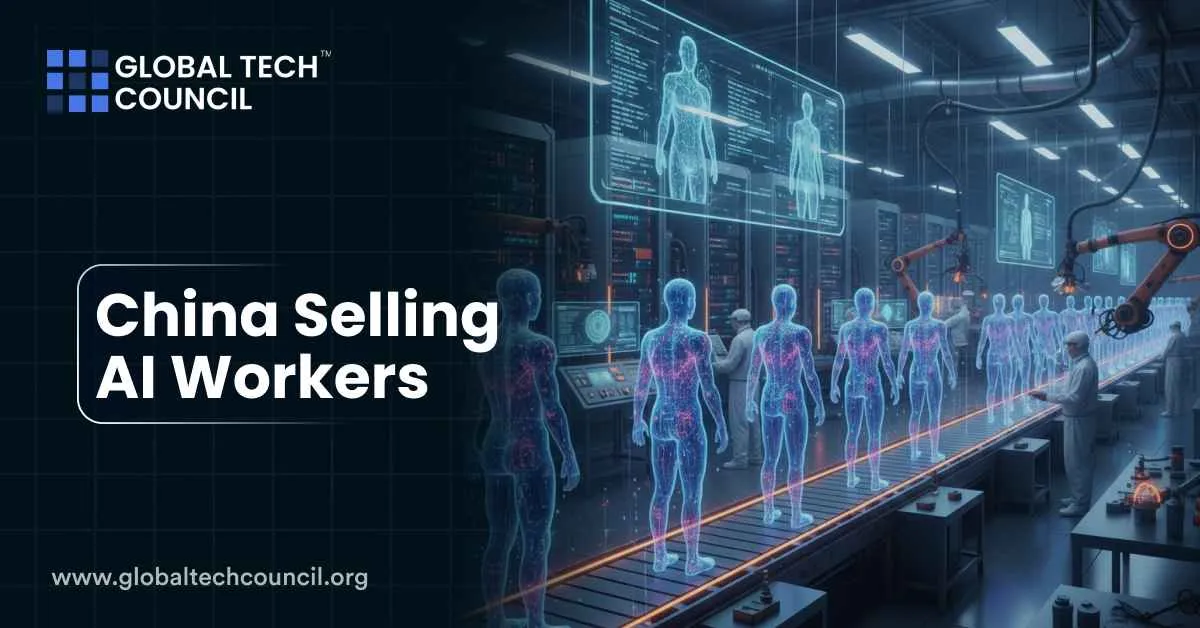
 Across offices, factories, government buildings, and online marketplaces in China, a new kind of worker is already active. It does not sit at a desk or log working hours. Instead, it processes documents, answers customers, analyzes data, and executes workflows continuously. This is what headlines describe as China “selling AI workers.”
The phrase sounds extreme, but the reality is practical. What China is commercializing are digital employees. These are AI agents packaged as job roles and sold as enterprise products. In some cases, they are deployed inside government offices and formally labeled as “digital staff.” In other cases, they appear as virtual humans sold on yearly contracts. Together, these deployments explain why the idea of AI workers has become mainstream.
Understanding this shift usually starts with foundational knowledge from an AI Course, because these systems are not simple chatbots. They are operational agents that follow rules, access systems, and perform work inside organizations.
AI workers
An AI worker is software designed to perform a defined job function with minimal human input. It follows instructions, plans steps, and executes tasks across digital systems.
Most AI workers combine three layers. A reasoning model that understands tasks, an agent layer that plans actions, and an execution layer that connects to tools like CRM systems, HR software, document platforms, and databases.
When companies in China “buy” an AI worker, they are purchasing a complete operational unit, not raw technology.
Digital employees sold to businesses
The most common form of AI workers in China is the enterprise digital employee.
These are sold as role based systems such as sales assistants, customer service agents, recruiters, analysts, or operations coordinators. Instead of marketing them as software, vendors position them as hires. This makes cost and output easy to compare with human roles.
A single digital employee might handle follow-ups, generate reports, respond to customer questions, and update internal systems. Multiple agents are often deployed together, forming what vendors describe as a digital team.
This is why the phrase “selling workers” resonates. It maps software directly to organizational structure and productivity.
Government digital staff
Government adoption has played a major role in normalizing the concept.
Several local administrations in China have announced the rollout of AI systems described as “digital staff.” These AI employees assist with document drafting, formatting, data analysis, and administrative workflows.
One widely discussed deployment involved dozens of AI employees introduced at once, framed as an efficiency upgrade rather than an experiment. These systems were positioned as assistants, not decision makers, reinforcing trust and legitimacy.
Virtual humans sold as workers
Another visible category is virtual humans.
These are AI driven avatars used for customer interaction, livestreaming, brand representation, and scripted support roles. They are often priced annually, similar to salaries.
Depending on realism and capabilities, virtual workers are sold at different price tiers. While they are not autonomous decision makers, their commercial framing contributes strongly to the “AI worker” narrative.
Examples
Baidu digital employees
Baidu has promoted digital employees designed for enterprise use, covering roles such as marketing consultants, recruitment assistants, course advisors, and operations coordinators.
These systems combine large language models with digital human interfaces and workflow automation, allowing them to function inside real business environments.
Laiye enterprise agents
Laiye focuses on AI agents combined with automation. Its digital employees are designed to execute tasks across departments, integrating reasoning with system level actions.
Enterprise presentations often describe these agents as long term colleagues, not tools, emphasizing continuity and reliability.
Merchant AI teams
In China’s B2B and e-commerce ecosystem, AI digital employee teams have been introduced to help merchants manage listings, respond to customers, analyze sales data, and optimize operations.
Instead of one assistant doing everything, vendors deploy multiple agents, each responsible for a specific role, mirroring human team structures.
Government scale deployment
Public announcements about large scale AI employee rollouts in government offices reinforced the idea that AI workers are operational assets, not experimental software.
Efficiency gains such as faster document processing and reduced manual workload are commonly cited outcomes.
What buyers are actually purchasing
AI workers are typically sold as one or more of the following:
Role templates that define responsibilities and workflows
Agent platforms for building, running, and monitoring agents
Digital human interfaces for voice or avatar interaction
Automation layers that connect agents to internal systems
The value lies in execution, not intelligence alone.
Importance of “selling AI workers”
The language aligns with how businesses think.
Hiring, headcount, productivity, and ROI are familiar concepts. Saying “hire a digital employee” is easier than explaining agent orchestration and system integration.
This framing also fits neatly into broader Marketing and Business Certification thinking, where organizations evaluate tools based on efficiency, scalability, and measurable outcomes rather than technical novelty.
Risks and concerns
Despite rapid adoption, concerns remain.
Job displacement is the most debated issue. Vendors emphasize task replacement rather than role elimination, but clerical and service jobs are clearly affected.
Accountability is another challenge. AI workers still require oversight, approval flows, and audit trails. Responsibility remains with the organization.
Data security is critical. These agents often access sensitive documents and customer information, requiring strict permissioning and monitoring.
Governance is essential. Without clear boundaries, AI workers can introduce risk instead of reducing it.
This is why many enterprises pair AI agent deployment with governance frameworks influenced by Blockchain Technology principles such as traceability, auditability, and controlled access.
AI workers definition
In China, “AI workers” refers to commercialized digital employees. These are AI agents packaged as job roles and deployed in enterprises or government offices, sometimes fronted by virtual humans, and sold via software subscriptions or enterprise contracts.
Importance
China’s approach shows how quickly AI agents can be normalized when framed as workers rather than tools.
As global companies adopt similar systems, this model offers a preview of how agent based work may become standard across industries.
Teams preparing for this shift often combine hands on experimentation with structured learning paths such as an AI Course alongside business focused frameworks from a Blockchain Course or Marketing and Business Certification to manage scale, risk, and value.
Conclusion
China is not selling people. It is selling systems that behave like workers within defined limits.
The shift matters because it changes how organizations think about labor, productivity, and scale. Digital colleagues are already handling repetitive work quietly and efficiently.
The future of work is not human versus AI. It is humans working alongside digital employees that never sleep, never forget, and never stop executing tasks they were designed to do.