


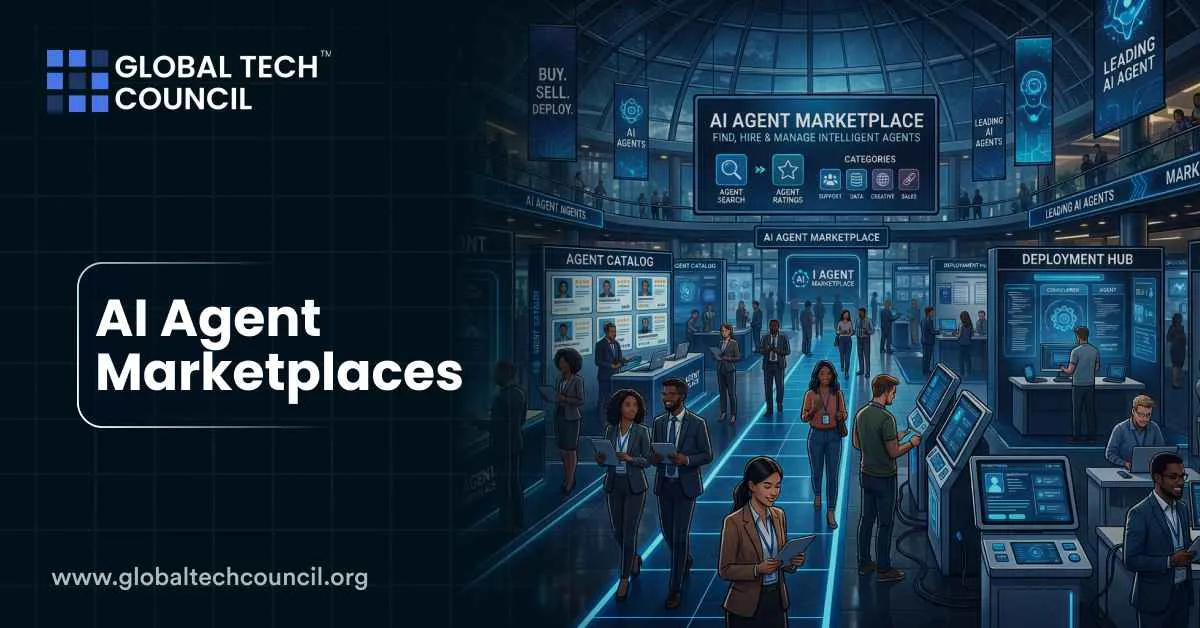
 AI agent marketplaces are becoming the structured distribution layer for enterprise-grade autonomous systems. Instead of building every agent from scratch, organizations now browse, validate, deploy, and manage agents the same way they install enterprise software. The difference is that these “products” are not static apps. They are goal-driven systems that invoke tools, access data, and execute workflows with varying degrees of autonomy. If you want to understand the architecture and control logic behind production-ready autonomous systems, start with an Agentic AI certification.
These marketplaces are not novelty storefronts. They are governance frameworks wrapped in distribution UX.
What an AI Agent Marketplace Actually Is
An AI agent marketplace is a controlled ecosystem inside a larger enterprise platform where organizations can:
- Discover prebuilt agents aligned to specific business functions
- Install them directly into production systems
- Configure permissions and integrations
- Monitor usage and performance
- Manage lifecycle updates and revocations
Unlike consumer AI directories, enterprise marketplaces are deeply integrated into platforms like CRM, ERP, collaboration suites, and IT service management systems. Installation is not symbolic. It directly connects the agent to production data and workflows.
The marketplace becomes a trust layer between third-party developers and enterprise buyers.
The Product Model: Agents, Templates, and Actions
Most listings are not fully autonomous “digital employees.” They are structured components designed for safe composability.
Common packaging formats include:
- Agent templates
Configurable workflow frameworks for recurring processes such as invoice dispute handling, onboarding automation, or IT ticket triage. - Agent actions
Atomic skills like “create CRM record,” “generate compliance summary,” or “initiate refund request.” These are easier to validate than open-ended autonomous flows. - Connectors and integrations
Standardized interfaces to enterprise systems, data warehouses, or SaaS applications.
The shift toward modularity is deliberate. Enterprises prefer composable components over opaque agents because it allows tighter governance, clearer auditability, and more predictable risk exposure.
Enterprise Ecosystems Leading the Market
Several major enterprise platforms now operate structured agent marketplaces.
Microsoft 365 Copilot and Microsoft Marketplace
Microsoft introduced an in-product Agent Store inside Microsoft 365 Copilot, enabling organizations to browse and install agents from Microsoft and partners. The broader Microsoft Marketplace consolidates enterprise AI distribution under a unified procurement and compliance framework.
Salesforce AgentExchange
Salesforce positions AgentExchange as a trusted marketplace for Agentforce components, focusing heavily on validated actions and industry-specific templates rather than unrestricted automation.
Oracle Fusion AI Agent Marketplace
Oracle’s marketplace supports deployment within Fusion Cloud Applications through Oracle AI Agent Studio. Oracle emphasizes validation standards, structured onboarding, and operational safeguards.
ServiceNow Store
ServiceNow integrates AI agents directly into its Store, tying them to IT and enterprise workflows where access control and change management are critical.
Moveworks AI Agent Marketplace
Moveworks offers prebuilt enterprise agents targeting HR, IT, finance, and sales use cases, focusing on production-ready deployment rather than experimental tooling.
These marketplaces succeed because they operate inside established enterprise systems of record. Distribution is not hypothetical. It is embedded.
Why AI Agent Marketplaces Are Scaling Now
Several structural shifts explain the acceleration.
Standardized orchestration frameworks
Modern agent platforms support consistent tool invocation patterns, memory handling, and API integration models. This makes packaging repeatable.
Enterprise demand for governance
Uncontrolled agent proliferation creates operational and security risk. Marketplaces centralize approval workflows, enforce permission standards, and create audit trails.
Usage-based monetization alignment
Agents naturally lend themselves to per-action or per-workflow billing models. Metered usage aligns with enterprise budgeting structures and ROI measurement.
Integration maturity
Enterprises now expect agents to integrate seamlessly with CRM, ERP, finance systems, identity providers, and workflow engines. Marketplace architecture enforces these integration standards.
Designing or evaluating these systems properly requires understanding distributed permissions, tool-call isolation, observability layers, and lifecycle management. That is architectural discipline, not prompt engineering. A Tech certification provides a structured understanding of how these systems operate at scale.
Security, Risk, and Governance Realities
AI agent marketplaces introduce a unique risk profile.
Prompt injection and tool misuse
If an agent can invoke sensitive tools, poorly designed safeguards can escalate privileges or manipulate workflows.
Cross-agent influence risks
In multi-agent environments, a less-privileged agent may influence higher-privileged logic if boundaries are not carefully enforced.
Over-permissioned connectors
Improper scoping of API access can expose systems beyond intended operational boundaries.
Insufficient observability
Without detailed execution logs and decision traces, enterprises cannot reconstruct failures or demonstrate compliance.
Version and update drift
Agents evolve. Without version control, rollback mechanisms, and change management workflows, small updates can create systemic instability.
This is why validation processes are becoming competitive differentiators. Marketplace operators are investing in review frameworks that include security testing, human oversight checks, and compliance documentation.
Economic and Strategic Implications
AI agent marketplaces are also changing vendor economics.
- Developers can distribute into enterprise ecosystems without building full sales channels.
- Platforms can expand functionality without building every agent internally.
- Enterprises can adopt autonomous workflows incrementally rather than committing to monolithic automation platforms.
The marketplace model creates a modular AI economy where value accrues to platforms that control distribution and governance layers.
Understanding how to position, differentiate, and communicate value in this ecosystem requires clarity and strategic discipline. That is not hype writing. It is structured narrative design, which is where a Marketing certification and Deep tech certification adds measurable advantage.
Conclusion
AI agent marketplaces represent the institutionalization of autonomous systems. They convert experimental agent frameworks into governed, purchasable, auditable enterprise components. The success of this model depends less on model intelligence and more on permission architecture, integration depth, security validation, lifecycle management, and commercial alignment.
In other words, the future of AI agents in enterprise environments will not be decided by who builds the most impressive demo. It will be decided by who builds the most reliable distribution and control layer around autonomous execution.