


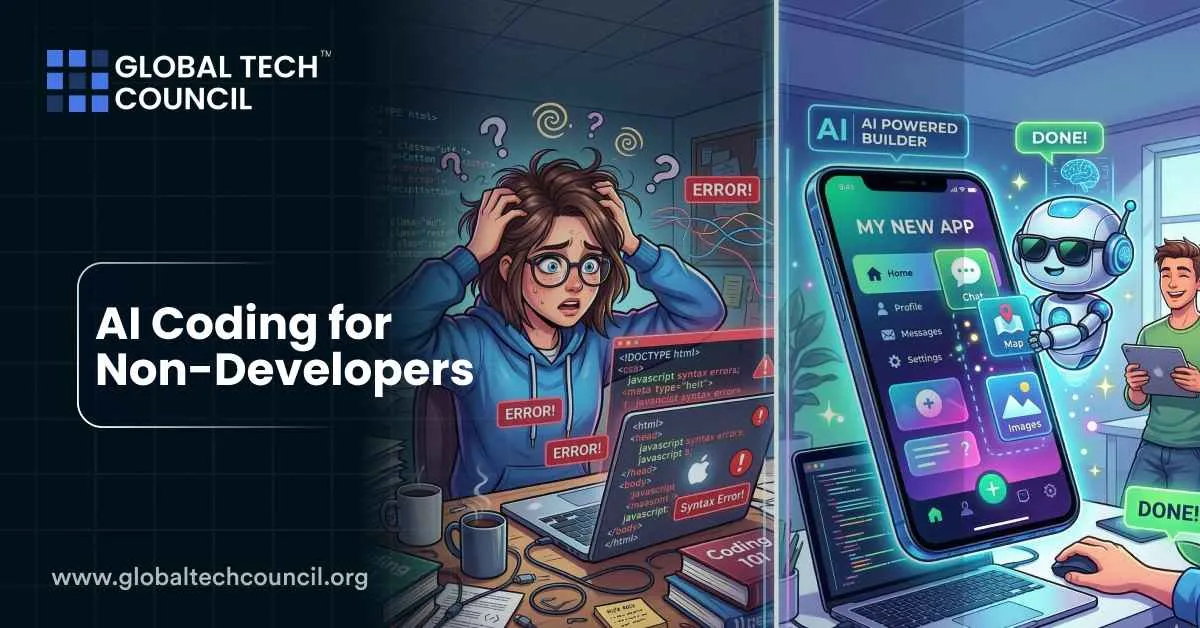
 Artificial Intelligence is changing who gets to build software. Not long ago, creating an app, automating a workflow, or analyzing business data usually required a developer with solid programming knowledge and time to spare, which, naturally, most teams never had. Today, AI coding tools are lowering that barrier. People without formal development training can now create useful digital solutions by describing their goals in plain language.
This shift is significant because many business problems do not originate inside engineering teams. They usually appear in marketing, operations, customer support, finance, education, or project management. Someone notices wasted time, inconsistent reporting, repetitive manual work, or an opportunity to improve a process. In the past, turning that idea into a working tool often meant waiting for technical help. Now, AI makes it possible for non-developers to build a first version themselves.
That does not mean software creation has become effortless or risk-free. AI can speed up development, explain code, and help with iteration, but human judgment still matters. The real change is that more professionals can participate in building solutions instead of standing outside the process and submitting requests into the void.
Understanding AI Coding for Non-Developers
AI coding for non-developers means using generative AI tools, coding assistants, and intelligent automation systems to create software, scripts, or digital workflows without needing deep programming expertise. Instead of writing everything manually, users can describe the result they want, then let AI generate code, explain logic, identify errors, and improve functionality.
For non-technical professionals, this can be surprisingly practical. A founder can build a prototype. A marketer can generate a dashboard. An operations manager can automate spreadsheet cleanup. A trainer can create a quiz tool or reporting system. The point is not to turn every employee into a software engineer. It is to make software creation more accessible for people who already understand the underlying business problem.
Why AI Coding Is Expanding So Fast
The growth of AI coding for non-developers is happening because several changes have converged at once. AI models have become better at understanding natural language instructions and turning them into structured code. At the same time, the tools themselves have become easier to use. Many platforms now support conversational prompts, file uploads, screenshots, sample data, and visual interfaces instead of demanding that users begin inside a developer environment.
The business case is also clear. Organizations want faster testing, quicker automation, and cheaper experimentation. Not every internal tool deserves a full engineering sprint. AI allows non-technical teams to validate ideas, solve small process problems, and launch prototypes before involving developers for production-level refinement.
Another reason for this growth is the merging of no-code, low-code, and AI-assisted development. Users can now combine visual builders with AI-generated logic, which gives them more control while still reducing technical complexity.
What Modern AI Coding Tools Can Actually Do
Today’s AI tools are doing far more than suggesting a few lines of code. Many can complete broader tasks from start to finish. A non-developer can request a landing page, an intake form, a reporting dashboard, or a data-cleaning script and receive a functional starting point with explanations.
AI coding tools are also becoming more multimodal. Users can upload a wireframe, share a spreadsheet, paste customer feedback, or provide a screenshot of a report they want to recreate. That makes the process easier for people who think in outcomes and examples rather than syntax.
A major development is the rise of intelligent systems that can handle multi-step workflows with less hand-holding. Professionals who want to understand these evolving systems often explore an Agentic AI certification to strengthen their knowledge of AI agents, workflow orchestration, and autonomous task execution in real business settings.
How Agentic AI Is Changing the Way Non-Developers Build
One of the biggest advances in AI coding is the move from simple prompt-response tools to agentic systems. Traditional tools respond to one instruction at a time. Agentic AI can plan steps, generate outputs, revise mistakes, test results, and continue working toward a goal with less constant supervision.
For example, instead of only generating a form, an agentic system may also connect it to a database, create validation rules, trigger notifications, and provide deployment instructions. That is a major shift for non-developers, because it moves AI from being a helper to being more like a structured collaborator.
This is especially useful in environments where teams need results quickly but lack dedicated technical bandwidth. It also explains why AI literacy is becoming valuable across multiple industries, especially those working at the intersection of automation, product development, and emerging technologies. For professionals looking to expand in innovation-focused fields, a Deeptech certification can support broader understanding across advanced digital disciplines.
Real Business Uses of AI Coding for Non-Developers
The real value of AI coding becomes clear when it solves practical problems. Marketing teams can build tools that audit landing pages, monitor SEO elements, or consolidate campaign metrics across channels. Instead of waiting weeks for a custom dashboard, they can produce something functional much faster.
Operations teams can automate repetitive work such as cleaning CSV files, reformatting reports, standardizing customer records, or moving information between systems. These tasks may not sound glamorous, but they consume significant amounts of time in most organizations.
Founders can use AI coding tools to build minimum viable products, test customer demand, and demonstrate a working version of an idea before hiring developers. Educators can create progress trackers, quiz generators, or scheduling systems tailored to their needs. Small businesses can launch appointment forms, estimate calculators, and customer-facing utilities without paying for full custom development from the start.
Marketing professionals in particular can benefit from combining AI-driven automation with strategic business knowledge. That is why some pursue a digital marketing expert certification to connect campaign execution, analytics, and AI-enabled productivity more effectively.
What Non-Developers Can Build With AI Today
AI-assisted development is already practical for a wide range of use cases. Non-developers can create internal dashboards that track performance metrics, simple apps for onboarding or approvals, tools that clean and organize data, and support systems that categorize incoming requests.
They can also build content utilities, reporting workflows, form-based applications, calculators, and lightweight SaaS prototypes. These may not always be ready for large-scale production, but they are often more than adequate for internal operations, market testing, and process improvement.
The biggest advantage is speed. A project that once required multiple handoffs can now move from concept to working draft in a matter of hours or days, depending on complexity.
Where AI Coding Still Has Limits
Despite the excitement, AI coding is not flawless. Generated code can appear polished while still containing logic issues, weak validation, security flaws, or broken edge cases. AI can produce incorrect outputs with apparent confidence, which makes careful review essential.
Security remains a major concern. Non-developers may not recognize exposed credentials, poor authentication practices, unsafe dependencies, or poor data handling. That becomes serious once customer data, payments, or regulated information are involved.
Maintenance is another issue. It is one thing to generate a useful prototype. It is another to maintain and scale it over time. As software becomes more complex, structure matters, documentation matters, and someone eventually has to understand how the whole system works.
AI also struggles with business nuance. It can generate workflows, but it does not actually understand the policies, exceptions, compliance rules, and context that often shape real organizational processes. People still need to define what should happen and why.
Best Practices for Non-Developers Using AI Coding Tools
The best results come from treating AI as a collaborator, not a solution in itself. Strong outcomes usually begin with a narrow problem. A simple dashboard, a report automation script, or a form-based tool is a better starting point than trying to build a full-scale platform immediately.
It also helps to describe the desired outcome clearly. Good prompts explain the user, the data, the purpose, and the expected result. Asking AI to explain each file, function, and dependency in plain language is equally important. That helps non-developers build confidence and avoid blindly deploying code they do not understand.
Testing matters more than people want to admit. Use realistic sample data, try incorrect inputs, and check unusual scenarios. Keep sensitive information out of prompts unless the tool’s privacy practices are clearly understood. Once a project affects customers, money, legal risk, or core systems, bring in a developer for review.
How AI Changes the Role of Developers
AI coding for non-developers does not remove the need for software developers. It changes where their expertise is most valuable. Developers are increasingly focusing on architecture, security, scalability, integration, governance, and code review rather than writing every routine component from scratch.
This can improve collaboration. Non-technical teams can show working prototypes instead of vague feature requests, and developers can spend more time refining the parts that truly require deep technical skill. In many organizations, AI allows business teams to move faster while still relying on developers for the work that requires specialized expertise.
Skills Non-Developers Should Learn Next
The future does not belong only to people who can write perfect syntax from memory. It belongs to those who can define problems clearly, evaluate AI outputs, and connect technical possibilities to business needs.
Non-developers benefit from learning how to prompt with precision, understand basic programming concepts, think in workflows, and validate results critically. They do not need to become senior engineers, but they do need enough technical literacy to recognize when something is working, when it is broken, and when it is producing unreliable results.
The Future of AI Coding for Non-Developers
AI coding will likely become more visual, more conversational, and more autonomous. We can expect better collaboration between humans and AI, more interfaces that combine natural language with drag-and-drop design, and stronger systems that can manage more of the build-test-improve cycle.
At the same time, standards will rise. Businesses will want faster creation without sacrificing security, reliability, or accountability. That means the professionals who benefit most from AI coding will not just be those who generate the most code. They will be those who can guide AI intelligently, verify results, and connect digital tools to real operational outcomes.
In that sense, AI coding is not about forcing everyone into software engineering. It is about making software creation a practical skill for a wider group of professionals.
Conclusion
AI coding for non-developers is opening the door to faster experimentation, smarter automation, and more direct problem-solving. Marketers, founders, analysts, educators, consultants, and operations leaders can now build useful tools without waiting endlessly for technical resources. The opportunity is real, but so are the limitations. AI can accelerate development, but it still needs human oversight, testing, and judgment. The best approach is not blind excitement or cynical resistance. It is practical adoption with enough technical awareness to understand what the AI is doing and enough skepticism to verify that it actually works.
For professionals who want to grow in this space, structured learning can help. Whether the goal is mastering intelligent systems through an Agentic AI certification, exploring advanced innovation pathways with a Deeptech certification, or strengthening growth strategy through a digital marketing expert certification, the larger message is clear: technical fluency is becoming a broader business advantage, not a niche skill locked inside engineering teams.
FAQs
1. What is AI coding for non-developers?
AI coding for non-developers means using AI tools to create apps, automate tasks, generate scripts, and build workflows without advanced programming knowledge.
2. Can non-developers really build useful software with AI?
Yes. Non-developers can build dashboards, forms, prototypes, automation scripts, and internal tools by describing what they need in plain language.
3. Why is AI coding becoming popular in business?
It helps teams move faster, reduce manual work, test ideas cost-effectively, and solve operational problems without depending on full development cycles for every request.
4. What is agentic AI in software creation?
Agentic AI refers to systems that can plan tasks, generate code, test outputs, revise mistakes, and handle multi-step workflows with less direct supervision.
5. Is AI-generated code reliable?
It can be useful, but it is not always reliable. AI-generated code should always be reviewed, tested, and checked for security and logic issues.
6. What kinds of tools can non-developers create with AI?
They can create reporting dashboards, customer forms, calculators, onboarding tools, workflow automations, support utilities, and early-stage product prototypes.
7. Does AI coding replace developers?
No. It helps non-developers create first drafts and small solutions, while developers remain essential for secure, scalable, and production-ready systems.
8. What are the biggest risks of AI coding for beginners?
The biggest risks include hidden bugs, poor security practices, unreliable outputs, and overconfidence in tools that still need human oversight.
9. Do certifications help in learning AI-driven workflows?
They can. Certifications can provide structure, practical frameworks, and industry context for professionals expanding into AI, deep tech, or digital strategy.
10. How can marketers benefit from AI coding?
Marketers can use AI coding to build campaign dashboards, automate reporting, improve landing pages, analyze performance data, and create internal productivity tools.