


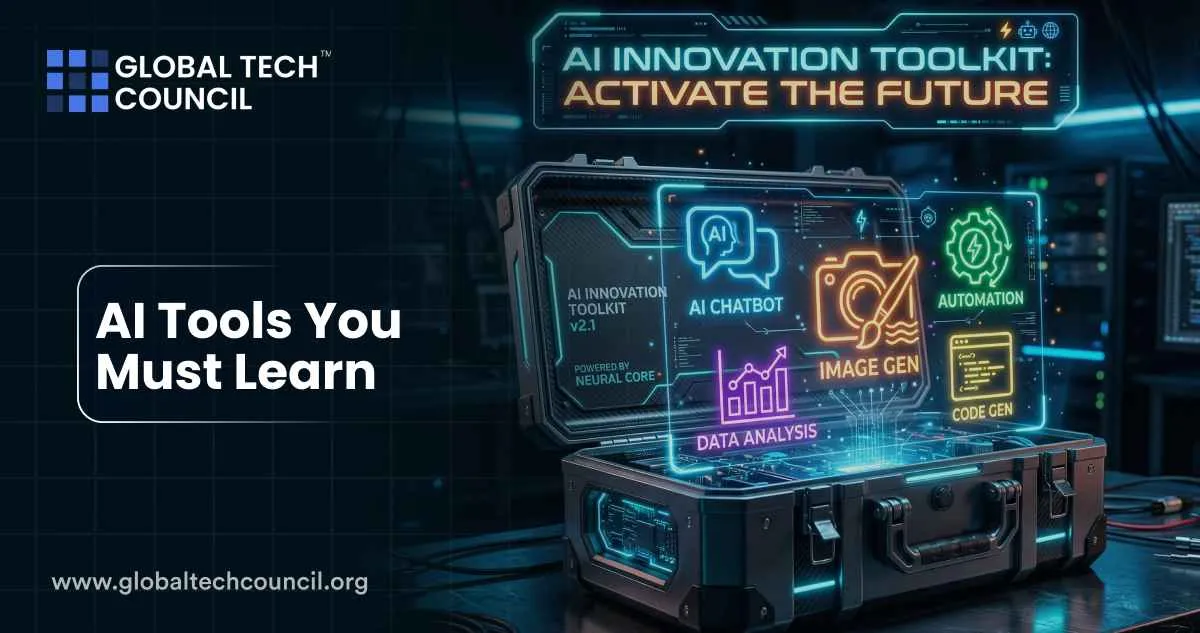
 Artificial Intelligence is no longer a specialized skill limited to research labs or giant technology companies. In 2026, AI tools are being used across nearly every industry to improve productivity, reduce manual work, support faster decision-making, and create better customer experiences. From software engineering and content strategy to analytics, operations, and digital marketing, AI has become a practical toolset for modern work.
The real challenge today is not finding AI tools. It is figuring out which ones are worth learning. The market is crowded with platforms, assistants, generators, and automation systems, all claiming to transform the future in five clicks or less. Most of them are oversold. The tools that matter are the ones that improve real workflows, solve meaningful problems, and help professionals build lasting skills.
A strong understanding of AI often starts with structured learning and practical application. Many professionals build this foundation through programs such as AI Expert certification, Agentic AI certification, AI Powered coding expert certification, deeptech certification, and AI powered digital marketing expert These learning paths can help professionals understand where AI fits into modern business, development, and digital workflows.
This article explains the most important AI tools to learn in 2026, how they are being used in practice, and why mastering them can improve your long-term career value.
Why AI Tools Matter More Than Ever in 2026
AI tools matter in 2026 because organizations are under pressure to do more with less time. Teams are expected to automate repetitive tasks, analyze information faster, create content at scale, improve software delivery, and personalize customer interactions. AI tools make this possible when used carefully and intelligently.
- For technical professionals, AI speeds up coding, testing, debugging, and documentation.
- For business teams, it improves reporting, forecasting, and task management.
- For marketers, it supports keyword research, campaign planning, SEO improvement, content ideation, and customer segmentation.
- For leaders, it helps summarize information, organize decisions, and streamline operations.
Learning AI tools is no longer just a niche technical advantage. It is becoming a standard professional capability. Companies increasingly value people who can use AI tools productively, evaluate outputs critically, and integrate them into real processes without causing chaos disguised as innovation.
Key Categories of AI Tools Professionals Should Learn
Generative AI Tools for Everyday Work
Generative AI tools are among the most widely used platforms in modern workplaces. They help users write, summarize, brainstorm, research, explain complex topics, and generate first drafts for many types of work.
These tools are useful because they reduce the friction involved in knowledge-heavy tasks. A product manager can summarize user feedback. A student can simplify technical ideas. A business analyst can turn raw notes into a structured report. A founder can outline a proposal or presentation much faster than starting from scratch.
The most valuable skill here is not just prompting. It is learning how to provide clear instructions, supply context, evaluate accuracy, and refine weak outputs. Generative AI works best when users think critically and revise actively. Blind trust is not a workflow. It is a gamble with better formatting.
AI Coding Tools for Developers and Technical Teams
AI coding tools have become essential in software development. They help developers write boilerplate code, explain functions, generate tests, refactor logic, detect likely bugs, and document systems more efficiently.
These tools save time on repetitive tasks and help teams move faster. A junior developer can use them to better understand unfamiliar code. A senior engineer can use them to accelerate implementation and focus more on architecture and product logic. In team environments, coding assistants can improve speed without replacing the need for real technical understanding.
That is why many professionals who want to develop practical technical AI skills explore AI Powered coding expert certification. It supports a better understanding of how AI fits into software development rather than treating code generation as magic. Because, tragically, generated code still needs someone competent enough to notice when it is nonsense.
Agent-Based AI and Workflow Automation Tools
One of the biggest changes in AI is the move from simple assistants to systems that can complete multi-step tasks. These tools are often described as agent-based or agentic AI systems. They do more than generate responses. They can retrieve information, reason through steps, interact with other tools, and support action-oriented workflows.
For example, an AI workflow might summarize a meeting, extract action items, assign task categories, draft follow-up messages, and store results in the correct system. In customer support, an agentic tool might analyze incoming tickets, identify urgency, search a knowledge base, and prepare a suggested response.
This area matters because it reflects the direction AI is taking. The future is not just about generating text. It is about coordinating work. Professionals who want to understand this shift often benefit from Agentic AI certification, especially if they want to design or manage more advanced AI-enabled workflows.
AI Data Analysis Tools for Faster Insights
AI data analysis tools help teams understand large amounts of information more quickly. These tools can summarize datasets, identify patterns, explain changes in results, generate charts, and support basic forecasting.
They are useful across many industries. A finance team can use AI to explain anomalies in monthly numbers. A retail manager can analyze product performance by location. A startup can use AI tools to identify patterns in customer usage or support behavior. A business team can turn large spreadsheets into clear summaries and decision-ready insights.
The core value of these tools is speed and accessibility. They help technical users work faster and help non-technical users ask better questions of their data. Still, the human role remains essential. Artificial Intelligence may identify a pattern, but people must determine whether it matters, why it matters, and what action should follow.
AI Marketing and Content Tools for Business Growth
AI is now deeply integrated into marketing. Businesses use AI tools for content ideation, SEO support, keyword grouping, ad copy generation, customer sentiment analysis, email drafting, and campaign optimization.
These tools help teams work more efficiently without losing direction. A marketer can create blog outlines faster, improve landing page language, test ad variations, and analyze customer feedback in much less time. AI also helps businesses personalize messaging and adjust strategy based on audience behavior.
For professionals who want to apply AI directly in marketing and growth roles, AI powered digital marketing expert can support more focused skill development. Marketing now demands more than creativity alone. It increasingly rewards people who can combine messaging, analytics, and AI-assisted execution.
AI Multimedia and Creative Production Tools
AI tools are also transforming visual and multimedia workflows. These platforms support image generation, video creation, voice synthesis, transcription, presentation building, and creative ideation.
In practical settings, a team might use AI to create visual assets for campaigns, generate rough design concepts, edit short videos, or build presentation drafts. Educators use them to create teaching materials. Content creators use them to produce visual ideas quickly. Businesses use them to speed up asset production for internal and external communication.
The real value is not just speed. It is the ability to move from idea to draft much faster. Still, quality control matters. Creative AI outputs often need revision, human taste, ethical judgment, and careful review. Machines can generate many things quickly. That does not mean they generate them well.
Core Skills That Make AI Tools More Useful
Understanding AI Fundamentals
Before relying heavily on tools, users should understand the basics of artificial Intelligence. This includes knowing what AI can do, what machine learning means, how large language models work at a high level, and where limitations appear.
Professionals who want a broader and stronger base often pursue AI Expert certification to support practical and conceptual understanding. A solid foundation improves judgment, which matters more than people admit when everyone is trying to automate first and think later.
Building Strong Prompting and Evaluation Skills
No matter which AI tool you use, prompting and evaluation are critical. Clear prompts lead to better outputs. Good evaluation helps users identify factual mistakes, weak logic, irrelevant content, or misleading claims.
The most effective AI users know how to iterate. They do not accept the first output blindly. They refine instructions, add context, compare results, and apply domain knowledge before making decisions or publishing content.
Learning Responsible and Strategic Tool Use
AI tools should improve workflows, not create new risks. Professionals need to think about privacy, bias, quality control, governance, and appropriate use cases. Some tools may process sensitive information. Others may generate misleading results or overly confident errors.
This is why responsible AI literacy matters. Learning how to use tools strategically is more valuable than knowing how to use many tools superficially.
How AI Tools Are Used in Real Work Environments
AI tools are already reshaping cross-functional work. In a software company, developers may use coding assistants to write and debug features. Product teams may use generative tools to summarize feedback and draft specifications. Customer operations teams may use agent-based systems to sort tickets and suggest responses. Marketing may use AI to turn product updates into campaign material. Analysts may use AI to explain usage trends and prepare reports.
- In healthcare, AI tools support note summarization, documentation, and workflow assistance.
- In finance, they help with reporting, anomaly detection, and document review.
- In ecommerce, they improve product search, review analysis, support chat, and personalized recommendations.
- In education, they help create lessons, simplify concepts, and provide scalable feedback.
The point is simple: AI tools matter when they improve real work, not when they merely produce impressive demos.
Choosing the Right AI Tools to Learn First
The best AI tools to learn depend on your goals.
Beginners should start with generative AI tools, simple automation tools, and basic productivity use cases. These are easier to understand and immediately useful in day-to-day work.
Developers should prioritize coding assistants, API-driven AI platforms, workflow automation systems, and tools that support software delivery.
Business professionals should focus on tools that improve writing, reporting, analysis, task automation, and customer communication.
Marketers should prioritize AI platforms for SEO, content planning, audience analysis, campaign testing, and message optimization.
For long-term growth, many professionals combine practical learning with structured credentials such as AI Expert certification, Agentic AI certification, AI Powered coding expert certification, deeptech certification, and AI powered digital marketing expert.
Common Mistakes to Avoid When Learning AI Tools
One common mistake is chasing every new platform without learning the basics. AI changes quickly, but core skills such as logic, evaluation, communication, and problem solving remain essential.
Another mistake is trusting AI output too easily. Tools can produce incorrect answers, weak assumptions, or polished nonsense. Strong users verify results before relying on them.
A third mistake is using AI without a practical goal. The best learning comes from real tasks, such as improving a report workflow, building a coding assistant process, creating an AI-supported content system, or streamlining customer communication.
It is also a mistake to ignore ethical and operational concerns. Privacy, compliance, fairness, and transparency matter, especially in business and customer-facing environments.
The Future of AI Tools in Professional Work
AI tools are becoming more integrated, more multimodal, and more action-oriented. Instead of standing alone as separate apps, they are increasingly being built directly into software platforms, development environments, analytics systems, and business operations.
This means the most valuable professionals in 2026 will likely be those who understand what AI tools can do, know where those tools create real value, and can apply them responsibly. AI literacy is becoming part of professional literacy.
The future does not belong to people who panic over every new release or worship every demo. It belongs to those who learn carefully, apply tools thoughtfully, and build skills that remain useful even as the technology changes.
Final Thoughts
Learning AI tools in 2026 is not about chasing hype. It is about gaining practical leverage in your work. The most important tools to learn include generative AI assistants, AI coding tools, agent-based systems, data analysis platforms, marketing tools, and multimedia creation tools. Each category supports a different kind of professional value, and together they shape the modern AI toolkit.
The smartest path is to combine tool familiarity with strong judgment and real-world practice. Build projects. Improve workflows. Learn how to evaluate outputs. Strengthen your understanding through structured learning where useful, whether that means AI Expert certification, Agentic AI certification, AI Powered coding expert certification, deeptech certification, or AI powered digital marketing expert.
AI tools will keep evolving. That part is unavoidable. The people who benefit most will be the ones who build lasting competence instead of collecting shiny interfaces like digital souvenirs.
Frequently Asked Questions
1. What are the most important AI tools to learn in 2026?
The most important AI tools to learn in 2026 include generative AI assistants, AI coding tools, workflow automation systems, AI data analysis tools, marketing AI platforms, and multimedia creation tools.
2. Why should professionals learn AI tools now?
Professionals should learn AI tools because businesses increasingly expect teams to work faster, automate routine tasks, improve decision-making, and create more value with fewer manual steps.
3. Are AI tools only useful for developers?
No. AI tools are useful for developers, marketers, analysts, managers, educators, founders, and customer support teams. Their value depends on how they are applied to real work.
4. What is the benefit of AI coding tools?
AI coding tools help developers generate code, explain functions, debug errors, create tests, and reduce repetitive work, which improves productivity and supports faster software delivery.
5. What is agentic AI in simple terms?
Agentic AI refers to AI systems that can complete multi-step tasks by combining reasoning, retrieval, planning, and tool use rather than simply responding to one prompt.
6. How do AI tools help in marketing?
AI tools help marketers with keyword research, SEO optimization, content creation, ad copy testing, email drafting, audience analysis, and campaign improvement.
7. Do AI tools replace human workers?
AI tools usually do not replace skilled professionals entirely. Instead, they change how work is done by automating repetitive tasks and helping people work more efficiently.
8. Are certifications useful for learning AI?
Certifications can be useful when they are combined with hands-on practice. They help structure learning and show employers that you are serious about developing relevant AI skills.
9. What mistakes should beginners avoid with AI tools?
Beginners should avoid trusting AI blindly, skipping foundational learning, using tools without a clear purpose, and ignoring quality, ethics, and privacy concerns.
10. How should someone start learning AI tools?
Start with one or two AI tool categories that match your role or career goal. Practice on real tasks, evaluate outputs carefully, and build experience gradually before moving into more advanced systems.