


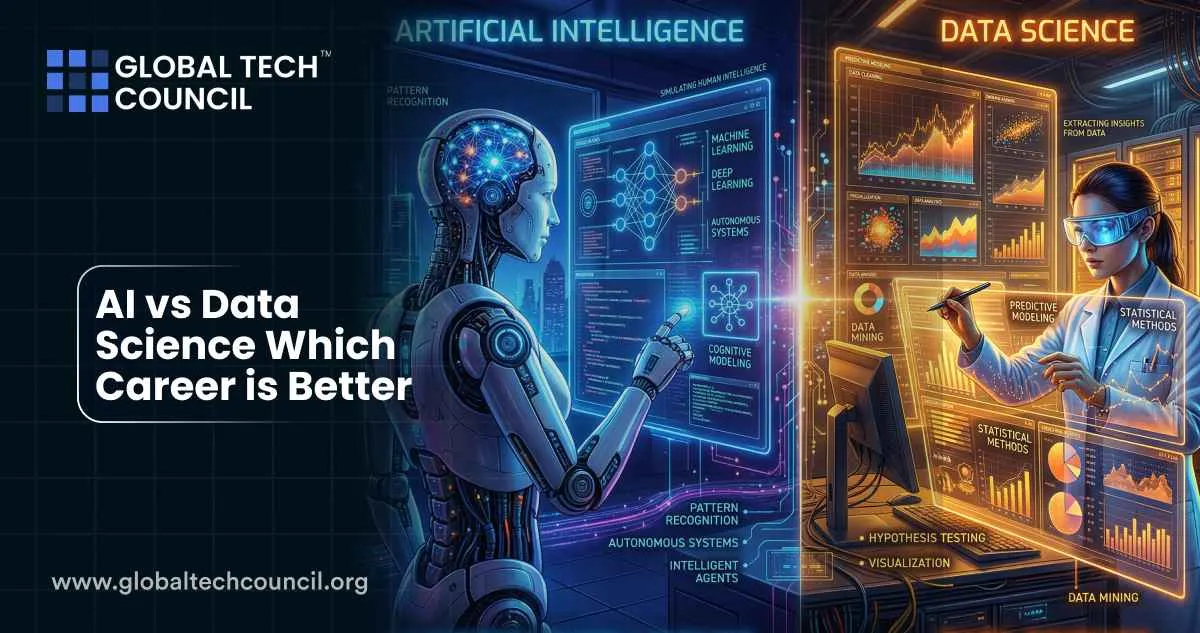
 Artificial Intelligence and data science are two of the most in-demand career paths in the technology world. Both fields offer strong salaries, exciting projects, and opportunities across healthcare, finance, retail, manufacturing, education, and marketing. Because of that, many students and professionals keep asking the same question: AI vs Data science, which career is better?
The honest answer is that both are excellent, but they are not the same. Data science is more focused on analyzing data, identifying patterns, building forecasts, and helping businesses make better decisions. AI is more focused on building intelligent systems that can automate tasks, understand language, recognize images, generate content, and interact with people or software in useful ways.
This difference matters more now because the market has changed. Companies still need data scientists for analysis, experimentation, forecasting, and business intelligence. At the same time, businesses are rapidly investing in AI assistants, recommendation systems, automation tools, generative AI products, and intelligent applications. So the better career depends less on hype and more on the type of work you want to do, which is annoyingly reasonable.
This guide compares AI and Data science in a practical way. It covers the nature of each field, job responsibilities, required skills, salary trends, industry demand, future growth, and how to choose the right path for your goals.
A Clear Difference Between AI and Data Science
Artificial Intelligence is the broader domain. It focuses on creating systems that can perform tasks that normally require some level of human intelligence. These tasks may include language generation, image recognition, recommendation, forecasting, speech understanding, document analysis, and process automation. AI includes machine learning, deep learning, natural language processing, computer vision, generative AI, and intelligent agents.
Data science is more focused on extracting value from data. It uses statistics, programming, machine learning, experimentation, and visualization to answer questions and solve business problems. A data scientist studies data, finds patterns, builds predictive models, tests assumptions, and communicates insights that help organizations make better decisions.
A simple way to think about it is this. Data science helps a company understand what its data means. AI helps a company build systems that can use data to act, predict, recommend, or automate.
Why This Career Comparison Matters More in 2026
A few years ago, many companies hired data scientists mainly for dashboards, reporting, predictive analysis, and experimentation. Today, the market looks different. Businesses are building AI copilots, document assistants, support bots, recommendation systems, search tools, and workflow automation platforms.
This shift has created more demand for AI engineers, machine learning engineers, MLOps specialists, generative AI developers, and AI product professionals. At the same time, the need for data science has not disappeared. In fact, AI expansion has made measurement, evaluation, experimentation, and insight generation even more important.
That is why this comparison matters. AI has stronger momentum in product innovation and intelligent software. Data science continues to offer broad value in analytics, forecasting, optimization, and business strategy.
What Professionals in AI Usually Do
AI careers usually focus on building intelligent systems and deploying them in real environments. An AI professional might develop a chatbot, create a recommendation engine, build an image recognition tool, design a document assistant, or automate a multi-step workflow using models and APIs.
Modern AI work often goes beyond training a model. It includes retrieval systems, prompt design, tool use, model orchestration, evaluation, integration, deployment, monitoring, and security. In business settings, AI roles are becoming more engineering-focused because companies want systems that actually work in products and operations, not just flashy demos that collapse on contact with reality.
Professionals who want a strong foundation in this field can build structured knowledge through an AI Expert Certification, especially when starting with core concepts, applications, and implementation strategies.
What Professionals in Data Science Usually Do
Data science careers are more focused on analytics, modeling, experimentation, and decision support. A data scientist may clean and prepare data, analyze customer behavior, build churn models, forecast demand, segment users, test product changes, or create dashboards for business leaders.
For example, a retail company may use data science to predict inventory demand, understand buying patterns, and test pricing decisions. A healthcare company may use it to identify treatment trends, improve operations, and predict patient outcomes. A bank may use it for fraud detection, credit scoring, and customer retention analysis.
Data science is usually closer to business questions like what happened, why it happened, what is likely to happen next, and what should be done about it.
Skills Needed to Build a Career in AI
AI usually requires stronger software and implementation skills. Python is central because it is widely used in machine learning, deep learning, automation, experimentation, and data handling. AI professionals also benefit from experience in machine learning, natural language processing, deep learning, vector databases, APIs, cloud tools, deployment, evaluation, and application design.
As AI systems become more advanced, another major skill area is agent-based automation. Companies increasingly want AI systems that can retrieve information, use tools, and complete multi-step tasks instead of simply generating one response. This is why an Agentic AI Certification can be useful for professionals working with intelligent agents, workflow automation, and structured task execution.
AI also rewards people who enjoy building systems. If you like coding, product development, automation, and turning models into working tools, AI can be a strong fit.
Skills Needed to Build a Career in Data Science
Data science also relies heavily on Python, but the emphasis is slightly different. Data scientists spend more time on statistics, data cleaning, hypothesis testing, model selection, experimentation, visualization, and interpretation.
A strong data scientist should understand probability, statistics, SQL, machine learning basics, data wrangling, and analytical storytelling. Communication matters a lot because data scientists often need to explain model results and business insights to non-technical stakeholders. A technically perfect model that nobody understands is mostly just an expensive way to decorate confusion.
Data science is often a better fit for people who enjoy analysis, pattern recognition, structured reasoning, and business problem-solving more than pure system building.
Industry Demand for AI and Data Science Roles
Both careers are in demand, but the demand shows up differently.
AI is growing quickly in software products, enterprise automation, customer support, search, cybersecurity, healthcare, retail personalization, robotics, and digital assistants. Companies want AI that can improve workflows, reduce manual effort, and create better user experiences.
Data science remains highly valuable in banking, insurance, healthcare, telecom, ecommerce, logistics, consulting, and large enterprises. Businesses still need professionals who can forecast, optimize, analyze performance, evaluate risk, and measure outcomes.
AI currently gets more attention because it is tied to visible product innovation. Data science remains essential because every serious business still depends on analysis and evidence-based decisions.
Salary Comparison Between AI and Data Science
Both fields pay well, but AI roles often have a slight salary advantage when they involve production deployment, generative AI, applied machine learning, or infrastructure-heavy work. Roles such as machine learning engineer, generative AI engineer, and MLOps engineer often command premium compensation in fast-growing technology environments.
Data science also offers strong salaries, especially in finance, healthcare, product companies, ecommerce, and consulting. Experienced data scientists who can combine analytics, experimentation, business understanding, and leadership remain highly valuable.
At entry level, pay can be fairly similar. Over time, AI can offer faster salary acceleration in engineering-heavy roles, while senior data scientists can reach equally strong compensation in the right domain.
Which Career Is Easier to Start
For many beginners, data science is often easier to enter. It can begin with analytics, SQL, statistics, data visualization, and basic machine learning. That makes it more approachable for people from mathematics, economics, business, analytics, or engineering backgrounds.
AI can be more difficult at the beginning because modern AI roles often require stronger software engineering ability. Building production-ready AI systems may involve APIs, backend logic, deployment pipelines, cloud platforms, prompt workflows, evaluation, and system reliability.
Still, easier does not mean better. It just means the entry path may be smoother for some people.
Long-Term Career Growth and Future Scope
AI has enormous long-term potential because it is becoming part of software, customer experiences, operations, content systems, enterprise tools, and automation platforms. The rise of multimodal systems, intelligent agents, and enterprise AI adoption suggests that AI careers will continue expanding.
Data science is also here for the long run. AI systems still depend on data, and businesses still need professionals who can analyze performance, test ideas, evaluate impact, and generate reliable insight. In many organizations, the future will include blended roles where professionals understand both AI systems and data-driven decision-making.
So if you want to work close to product innovation and intelligent automation, AI may have stronger future-facing momentum. If you want a flexible career that applies across many industries and business problems, data science remains one of the safest and smartest options.
Real Business Examples That Show the Difference
In a streaming company, a data scientist may study viewing behavior, predict churn, and test which interface changes improve engagement. An AI professional may build the recommendation engine or conversational assistant that helps users discover content.
In healthcare, a data scientist may analyze hospital efficiency and patient risk patterns. An AI engineer may develop a diagnostic imaging system or clinical documentation assistant.
In marketing, data scientists may segment audiences and forecast campaign performance, while AI professionals may build personalization systems, content engines, and automated lead-handling workflows. Professionals working in this area may find an AI powered digital marketing certification useful when combining AI tools with customer growth and campaign performance.
Which Career Fits Different Types of People
AI may suit you better if you enjoy coding, building products, designing automation, and working on systems that interact intelligently with users or software. It is often a better fit for developers, engineers, and technically ambitious professionals who want to build practical tools.
Data science may suit you better if you enjoy working with numbers, identifying patterns, testing ideas, and turning analysis into strategic decisions. It is a strong fit for people who are analytical, curious, statistically minded, and interested in business impact.
Choosing based on trend alone is not smart. Choosing based on your strengths usually works better, despite humanity’s ongoing dedication to avoiding that principle.
How to Choose Between AI and Data Science
Ask yourself three questions.
First, do you enjoy building systems or analyzing problems? If you prefer building, AI is likely a stronger fit. If you prefer analysis, data science may suit you better.
Second, do you enjoy software engineering? AI increasingly rewards engineering-heavy skills. Data science can still be technical, but its center of gravity is often more analytical.
Third, what kind of impact do you want to have? If you want to create intelligent tools, assistants, and automation systems, AI is the stronger path. If you want to influence strategy, experimentation, forecasting, and performance improvement, data science may be the better choice.
The good part is that these fields overlap. Many professionals move between them over time.
Final Verdict
If the question is AI vs Data science, which career is better, the most honest answer is this: AI currently offers more momentum, stronger visibility, and higher upside in product-focused technical roles, while data science offers wider accessibility, stable demand, and excellent long-term versatility.
Choose AI if you want to build intelligent systems, work on automation, and stay close to cutting-edge digital products. Choose data science if you want to solve business problems through analysis, modeling, experimentation, and evidence-based decision-making.
Both are strong careers. The better one depends on your interests, skills, and long-term goals.
Frequently Asked Questions
1. Is AI better than Data Science as a career?
AI is not automatically better. It offers strong growth in product and automation roles, while data science offers broad business relevance and stable demand.
2. Which career pays more, AI or Data Science?
AI roles often pay slightly more in engineering-heavy and generative AI positions, but experienced data scientists can also earn excellent salaries.
3. Is Data Science easier than AI?
For many beginners, data science is easier to enter because it often starts with analytics, statistics, and basic machine learning, while AI usually requires stronger engineering skills.
4. Can a data scientist become an AI engineer?
Yes. Many professionals move from data science into AI by improving their software engineering, deployment, and machine learning system design skills.
5. Is Python important for both AI and Data Science?
Yes. Python is one of the most important languages in both fields because it supports data analysis, machine learning, and automation.
6. Which field has better future scope?
Both fields have strong future scope. AI has more momentum in product and automation, while data science remains essential for analysis, experimentation, and business decisions.
7. Do I need a degree for AI or Data Science?
A degree can help, but practical skills, projects, certifications, and real-world experience also matter a great deal.
8. Which career is better for business-focused roles?
Data science is often stronger for analysis and decision support, while AI is stronger for intelligent products and automation systems.
9. Are certifications useful for AI and Data Science careers?
Yes. Certifications can improve credibility and structure learning, especially when combined with hands-on projects and practical skills.
10. What should I choose if I like both AI and Data Science?
Start with shared fundamentals such as Python, statistics, machine learning, and data handling. Then build small projects in both areas before choosing a deeper specialization.