


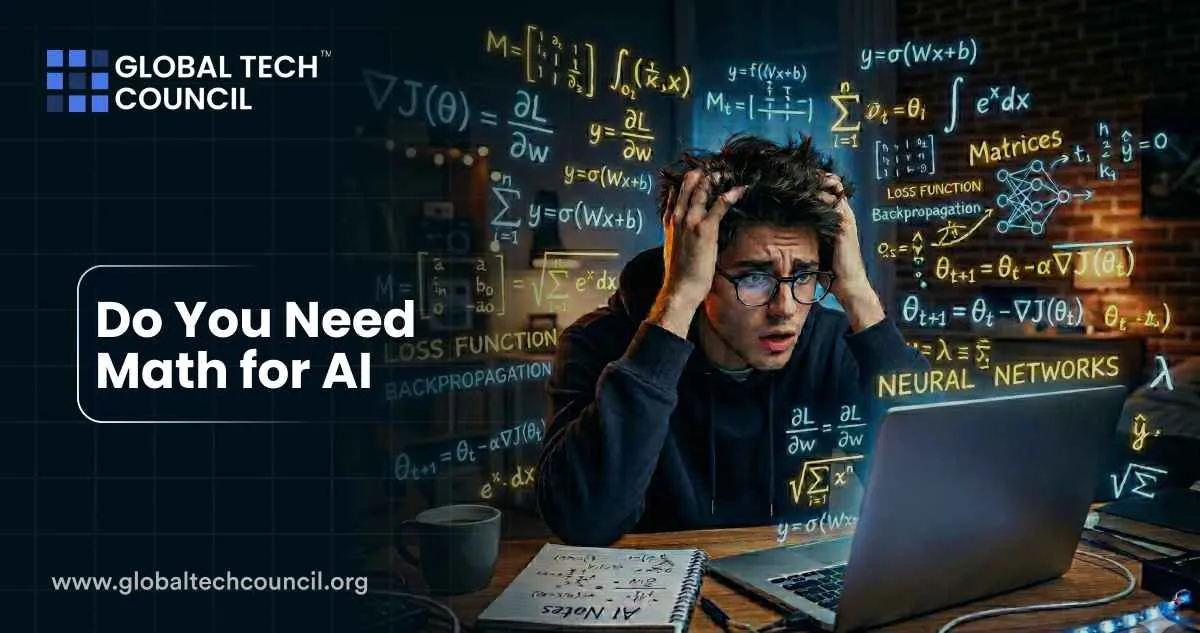
 Artificial Intelligence is now part of everyday business, software, healthcare, education, finance, marketing, and customer service. As more people enter the field, one question keeps coming up: do you need math for AI?
The honest answer is yes, but not in the exaggerated way many people imagine. You do need math to understand artificial Intelligence properly, especially if you want to build models, improve performance, or work in technical AI roles. At the same time, you do not need to be a math genius to begin learning AI, use AI tools, or work in many practical AI-related positions.
Modern AI frameworks, low-code tools, pretrained models, and developer platforms have made the field much more accessible. Still, people who understand the math behind AI often make better decisions, troubleshoot issues faster, and design more reliable systems.
If you want to build structured knowledge, programs like AI Expert certification, Agentic AI certification, AI Powered coding expert certification, deeptech certification, and AI powered digital marketing expert can help learners connect theory with real-world AI use cases.
This article explains how much math AI really requires, which branches of math matter most, when math becomes essential, and when practical skills may matter more.
Why AI Is So Closely Connected to Math
Artificial Intelligence has long been linked to equations, statistics, algorithms, and technical research. That connection exists for a reason. Many of the core ideas behind machine learning and deep learning rely on mathematical concepts such as linear algebra, calculus, probability, statistics, and optimization.
Neural networks use weighted sums, activation functions, and matrix operations. Classification models depend on probability. Regression relies on statistical analysis. Model evaluation uses metrics, error analysis, and data distributions. Even modern generative AI systems are built on mathematical structures, no matter how simple the user interface may look.
This is why many people assume AI is impossible without strong math skills. But that belief ignores an important reality. There is a difference between understanding AI deeply and starting to use AI effectively.
A beginner can explore AI tools, work with APIs, automate simple tasks, and build useful projects without mastering every mathematical detail. So yes, math matters, but how much it matters depends on your goals.
The Real Answer Depends on Your AI Career Goal
The amount of math you need for AI depends heavily on what you want to do.
If your goal is to use AI for business tasks, marketing, customer support, content workflows, or productivity systems, you may only need basic comfort with numbers, logic, and performance metrics. In these cases, you do not need to derive formulas or build algorithms from scratch.
If your goal is to become an AI engineer, machine learning developer, data scientist, or researcher, then math becomes much more important. You will need to understand model behavior, optimization, bias, variance, feature relationships, and evaluation methods. Without that foundation, you may be able to run code, but you may struggle to explain why a model works, fails, or needs improvement.
This distinction matters because AI now includes many different roles. Some are focused on model building. Others are focused on business application, product integration, workflow automation, or system design. Humans, as usual, took one field and turned it into a maze of overlapping job titles.
The Most Important Math Topics in AI
When people ask whether math is needed for AI, they are usually referring to four major areas: linear algebra, calculus, probability, and statistics. Each one plays a specific role in AI development.
Linear Algebra in AI
Linear algebra is one of the most important foundations of artificial Intelligence. AI systems often represent data as vectors, matrices, and tensors. Neural networks process input through matrix multiplication and transformations. Embeddings in search systems, recommendation engines, and language models also depend on vector representations.
If you want to understand how AI systems represent information, compare similarities, or transform input into output, linear algebra is extremely useful.
Calculus for Model Training
Calculus is central to training machine learning and deep learning models. Neural networks learn by reducing error, and that process depends on gradients and derivatives. Backpropagation, one of the key ideas in deep learning, is based on calculus.
The good news is that you do not always need to calculate derivatives by hand. Libraries and frameworks handle the hard computation for you. Still, understanding what gradients and optimization do can help you understand how training actually works.
Probability and Uncertainty in AI
Probability is essential in AI because many systems work under uncertainty. Classification outputs, prediction confidence, ranking, and generative AI all involve probability in one way or another.
Even if a model gives one final answer, that answer is often based on probability calculations behind the scenes. This is one reason probability matters so much in machine learning and AI decision-making.
Statistics for Evaluation and Data Understanding
Statistics is critical for understanding data, model performance, error rates, correlations, and distributions. Real-world data is messy, incomplete, and often biased. Without statistical thinking, it is easy to build a model that looks impressive during testing but performs poorly in real use.
In applied AI, statistics is often more practical than people expect. It helps you interpret results, compare models, and make sound decisions.
Can You Start Learning AI Without Advanced Math?
Yes, absolutely. You can begin learning AI without advanced math.
Many beginners start with Python, AI APIs, no-code tools, prompt engineering, and simple machine learning libraries. You can build useful projects and understand the basics of AI before diving deeply into higher-level math.
This is one reason AI has become more accessible in recent years. Tools have improved, documentation is clearer, and many technical details are abstracted by frameworks. Beginners can start with practical work and build deeper understanding over time.
That is often the smartest path. It helps you stay motivated and gives context to the math when you learn it later.
For learners entering technical workflows, AI Powered coding expert certification can be especially useful because it connects AI concepts with software development, coding productivity, and practical implementation.
When Math Becomes Non-Negotiable in AI
Math becomes essential when you move beyond using AI tools and start building, tuning, or evaluating serious systems.
If you are training models, selecting features, diagnosing performance problems, comparing architectures, or reading research papers, math is not optional. At that point, mathematical understanding helps you explain what is happening, not just observe it.
Imagine a fraud detection model that performs well in training but poorly on live data. Someone with weak math knowledge might randomly change settings and hope for improvement. Someone with stronger statistical understanding will examine class imbalance, threshold settings, false positives, data drift, and evaluation methodology.
That difference is not theoretical. It affects system accuracy, trust, and business results.
How Much Math Different AI Roles Require
The math required for AI changes significantly based on the job.
AI Users and Business Professionals
Business leaders, marketers, operations professionals, and customer support teams may not need advanced math. What they need is logical thinking, comfort with metrics, and the ability to evaluate whether AI is useful in real situations.
For example, a marketer using AI for campaign analysis, audience segmentation, and automation may benefit more from applied learning than heavy theory. In that case, AI powered digital marketing expert can be a practical learning path.
Developers Working With AI Tools
Software developers integrating AI into applications often need moderate math, but not always deep theoretical knowledge at the beginning. In many real products, the bigger challenge is connecting APIs, handling data, securing the system, and designing usable workflows.
This is where AI Powered coding expert certification can help developers become more effective with AI-assisted coding, integrations, and development workflows.
Machine Learning Engineers and Data Scientists
For machine learning engineers and data scientists, math matters much more. These roles require a working understanding of probability, statistics, model evaluation, optimization, and linear algebra. If you want to perform well in these areas, math is a real advantage.
AI Researchers
Research roles demand the strongest mathematical foundation. Researchers often need to understand papers, compare model formulations, analyze optimization strategies, and contribute new ideas. At this level, math is part of the field’s core language.
How Modern AI Tools Have Changed the Math Barrier
Recent AI tools have lowered the entry barrier. Foundation models, AI APIs, code assistants, and low-code platforms have made it easier for people to build useful AI applications without developing everything from scratch.
Someone can now create a chatbot, summarization tool, workflow assistant, or document analyzer without hand-coding a neural network. This has reduced the amount of math needed to start.
But lowered barriers do not mean math is irrelevant. They simply change where math matters most. Today, the difficult problems often involve evaluation, accuracy, bias, reliability, hallucination control, retrieval quality, latency, and cost. Solving those problems still requires quantitative reasoning.
The rise of autonomous and agent-based systems adds another layer. These systems must plan, reason, use tools, and complete multi-step tasks. For professionals exploring this area, Agentic AI certification can help build relevant skills around intelligent workflows and practical AI orchestration.
Can You Learn AI If You Struggle With Math?
Yes, you can. Many people enter AI with average or weak math backgrounds and improve over time.
What matters most in the beginning is not whether you were brilliant at math in school. What matters is your willingness to learn gradually, think logically, and stay consistent. Many people believe they are bad at math when the real issue is that they were taught poorly or rushed through concepts without understanding them.
You do not need advanced calculus on day one. Start with arithmetic, percentages, ratios, graphs, averages, basic algebra, and logical reasoning. Then build from there.
In fact, math often becomes easier to understand when connected to real AI projects. Concepts like model accuracy, probability distributions, similarity scores, and confusion matrices make more sense when you see them used in actual systems.
The Best Way to Learn Math for AI
The most effective way to learn math for AI is in stages.
Start with basic algebra and practical statistics. Then move into probability and data interpretation. After that, learn introductory linear algebra, especially vectors, matrices, and transformations. If you want to go deeper into deep learning, add derivatives, gradients, and optimization concepts.
Do not wait until you have mastered all mathematics before starting AI. That approach usually kills motivation. Learn the math that supports the next thing you want to build, then deepen your understanding as your projects become more advanced.
A structured learning path can help. For example, AI Expert certification can provide a broad understanding of AI concepts, use cases, and practical foundations. Broader programs like deeptech certification can also support learners exploring related advanced technologies.
Why Practical Skills Matter Alongside Math
Math is important, but it is not the only skill that matters in AI.
Programming matters. Communication matters. Data handling matters. Evaluation matters. Product thinking matters. Domain knowledge matters. Ethics and governance matter too. Someone with moderate math and strong practical judgment can often outperform someone with stronger theory but weak implementation skills.
In applied AI, real success usually comes from combining technical understanding with execution. That is why learners benefit most from building projects, testing systems, and understanding how AI fits into real business or technical environments.
Final Thoughts on Math and AI
So, do you need math for AI? Yes, but the answer is more balanced than most people expect.
You need some math for AI, especially if you want to understand how systems work, evaluate them properly, and move into technical roles. But you do not need elite math skills to begin. You do not need to postpone learning AI until every formula feels comfortable. And you do not need the same level of math for every AI career path.
If you want to use AI effectively, start now and build your math knowledge step by step. If you want to become a machine learning engineer or researcher, commit to learning the math more seriously. Either way, the path is manageable when approached in stages.
AI is not reserved for mathematical prodigies. It is a field where deeper math becomes more valuable as your role becomes more technical. That is the real answer, stripped of drama and internet mythology.
Frequently Asked Questions
1. Do beginners need advanced math to start AI?
No. Beginners can start learning AI with basic algebra, logic, and simple statistics while building practical skills over time.
2. Which math subjects are most important for AI?
The most important math topics for AI are linear algebra, calculus, probability, and statistics.
3. Can I learn AI if I am weak in math?
Yes. Many learners improve their math gradually while studying AI through projects and practical exercises.
4. Is calculus necessary for machine learning?
Calculus becomes important when learning optimization, gradients, and deep learning, but it is not always required for beginner-level AI projects.
5. Is statistics more useful than calculus in applied AI?
In many applied AI tasks, statistics is often more immediately useful because it helps with data interpretation, model evaluation, and decision-making.
6. Do AI developers need strong math skills?
It depends on the role. Developers integrating AI tools may need moderate math, while machine learning engineers and researchers need much stronger mathematical understanding.
7. Can certifications help learners without a strong math background?
Yes. Structured programs like AI Expert certification and Agentic AI certification can help learners organize concepts clearly and build practical knowledge.
8. Is coding more important than math when starting AI?
For many beginners, coding is the best place to start because it allows them to build projects and understand how AI works in practical settings.
9. Is AI useful in business roles without advanced math?
Yes. Many business roles use AI successfully without advanced math, especially in marketing, operations, and automation.
10. What is the best way to learn math for AI?
The best approach is to learn math step by step alongside real AI projects, starting with algebra and statistics, then moving into probability, linear algebra, and optimization.