


 What is Edge AI Deployment
 What is Edge AI Deployment
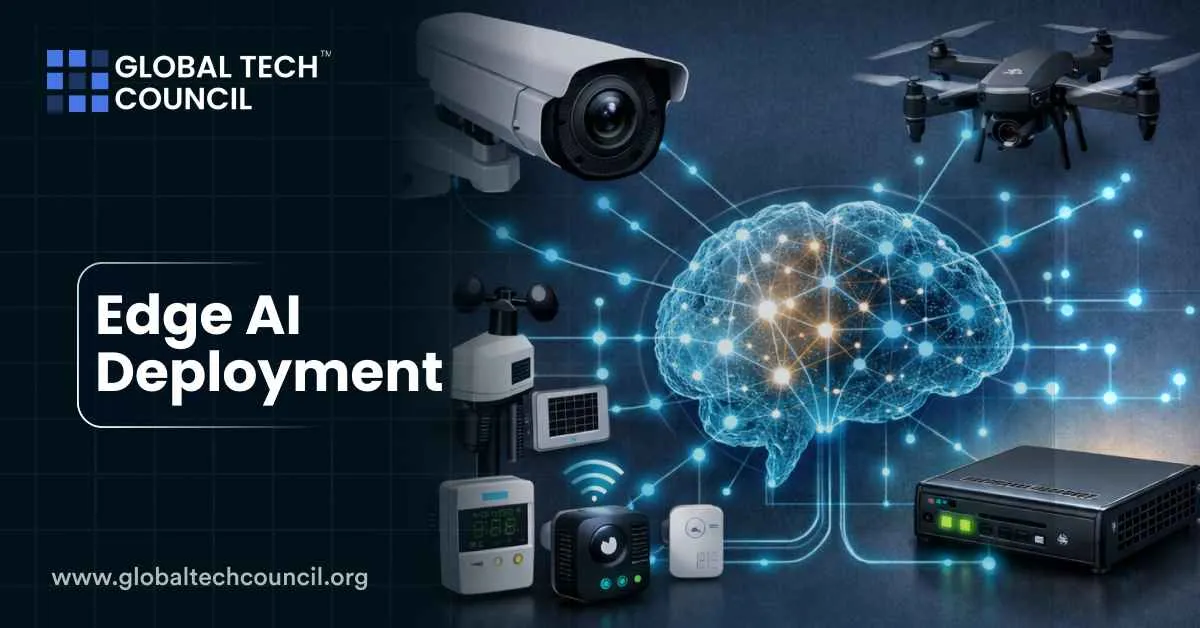
Edge AI deployment means running AI models on or near the devices that generate data, instead of sending everything to a distant cloud first. In practical terms, it is the difference between a factory camera detecting a defect on the production line in milliseconds and waiting for a round trip to a cloud service before deciding what to do.
This approach is growing because organizations want lower latency, better privacy, reduced bandwidth use, and stronger resilience when connectivity is limited. Cloud vendors now openly position edge inference around those benefits. AWS IoT Greengrass, for example, supports running ML inference on edge devices using locally generated data while still using the cloud for training and heavier processing. Azure IoT Edge documentation similarly emphasizes local analysis, faster response, and offline operation.
As usual, the idea is simple. The deployment reality is where people discover systems engineering exists.
What Edge AI Deployment Means
Local Inference, Cloud Coordination
Most edge AI systems use a hybrid model. Training often happens in the cloud or data center, where compute is abundant. Inference runs at the edge, where decisions must be fast and close to the data source. AWS documents this pattern directly in its Greengrass ML inference guidance.
This hybrid setup helps teams balance speed and scale. The cloud remains useful for model training, fleet management, analytics, and updates, while the edge handles real-time decisions.
Typical Edge AI Environments
Edge AI deployments appear in many settings:
- Retail stores (camera analytics, inventory monitoring)
- Factories (defect detection, predictive maintenance)
- Hospitals and clinics (device monitoring, imaging workflows)
- Vehicles and robotics (navigation, object detection)
- Smart buildings and utilities (anomaly detection, local automation)
Cisco’s 2025 launch of a localized AI computing platform for edge workloads reflects this broader move to place AI processing near where decisions are made in sectors like healthcare, retail, and manufacturing. Reuters reported the announcement and noted the focus on local AI processing as data center demand rises.
Why Organizations Deploy AI at the Edge
Low Latency
Latency is the most common reason. If a robotic arm, inspection camera, or safety system must react immediately, waiting on cloud connectivity can be too slow. Edge inference enables near-real-time action.
Google Distributed Cloud also frames edge AI around extending AI infrastructure on-premises without compromising latency or connectivity.
Privacy and Data Residency
Some organizations cannot move sensitive data freely due to legal, operational, or customer requirements. Processing data locally can reduce exposure and simplify data residency management.
This is especially relevant in healthcare, industrial environments, and regulated sectors where raw video, sensor, or operational data may need to stay on-site.
Bandwidth and Cost Efficiency
Sending every frame, signal, or event to the cloud can be expensive and unnecessary. Edge AI can filter, summarize, or classify data locally, transmitting only important events or aggregated results. This reduces bandwidth costs and improves system efficiency.
Offline and Harsh Environments
Many edge systems operate with unreliable connectivity. Azure IoT Edge explicitly supports local operation and faster reactions to local changes, which is important in remote sites and industrial environments.
Core Components of Edge AI Deployment
Edge Hardware
Edge AI hardware ranges from microcontrollers and NPUs to industrial gateways and GPU-equipped systems. Platform choice depends on the model size, latency requirements, power limits, and environment.
NVIDIA Jetson remains a popular edge AI platform, and NVIDIA’s 2025 Jetson developer content highlights fully standalone deployment of modern AI models for robotics and edge use cases. Coral also continues to position its platform around ultra-low-power local AI, with an Edge TPU toolchain for compiling compatible TensorFlow Lite models.
Model Optimization
Most cloud-trained models are too large or slow for direct edge deployment. Teams typically optimize models through quantization, pruning, distillation, or runtime-specific conversion.
Intel’s OpenVINO documentation centers on converting, optimizing, and running inference efficiently across Intel hardware in cloud, on-prem, and edge environments. This is a good example of how deployment success depends not just on the model, but on toolchains and inference runtimes.
Runtime and Device Management
A real deployment needs more than a model file. It needs:
- Secure provisioning
- Runtime environment
- Remote updates
- Health monitoring
- Logging and telemetry
- Rollback support
AWS IoT Greengrass and Azure IoT Edge both emphasize fleet deployment and device software management as core parts of edge operations, not optional extras.
Security Controls
Edge devices are often physically accessible and distributed across many locations, which increases operational risk. NIST’s IoT cybersecurity program supports standards and guidance for improving cybersecurity of IoT systems and connected products, which is highly relevant for Edge AI deployments running on connected devices.
In practice, Edge AI security usually includes secure boot, identity-based access control, encrypted communications, signed model updates, and hardened device configurations.
Real-World Examples
Factory Quality Inspection
A manufacturer can deploy vision models on edge cameras or gateways to detect defects on the production line in real time. Instead of streaming all video to the cloud, the system flags only defective items or sends periodic quality metrics upstream. This reduces latency and network load while improving response time.
Retail Loss Prevention and Shelf Monitoring
Retail stores increasingly use edge AI for camera-based monitoring, inventory visibility, and local analytics. Edge deployment helps process video on-site, which can improve privacy handling and reduce constant cloud video transfer.
Cisco’s localized AI infrastructure push for retail and other data-heavy environments reflects this exact operational need for on-site inference.
Healthcare Device and Imaging Workflows
Hospitals and clinics may use edge AI to support imaging review, triage assistance, or device monitoring where response time and data sensitivity matter. Local inference can reduce delays and support continuity when network conditions are inconsistent.
Common Deployment Challenges
Model Size and Performance Limits
Large models can exceed edge device memory, thermal limits, or power budgets. Teams often discover that a model that performs beautifully in a cloud notebook becomes unusable on the target device without optimization.
Fleet Complexity
Deploying one edge prototype is easy. Deploying and maintaining thousands of devices is not. Version control, update orchestration, observability, and rollback plans become critical quickly.
Azure IoT Edge documentation on automatic deployments for device groups underscores how fleet management complexity becomes a central concern in production.
Security and Physical Exposure
Unlike cloud servers, edge devices may live in stores, plants, vehicles, or public locations. This increases tampering and configuration risk, which is why device hardening and secure update pipelines matter from day one.
Recent Developments in Edge AI Deployment
More Mature Edge Infrastructure
A clear recent trend is the maturation of edge AI infrastructure stacks, combining compute, networking, and remote management. Cisco’s localized AI platform announcement in late 2025 is a strong example of mainstream infrastructure vendors treating edge AI as a core deployment category.
Generative AI at the Edge
Another notable development is growing interest in running smaller generative AI and multimodal models on edge hardware. NVIDIA’s Jetson guidance in late 2025 explicitly focuses on LLMs, VLMs, and foundation models for robotics and standalone deployment scenarios.
This is pushing teams to think harder about model compression, runtime optimization, and hardware acceleration.
Toolchain and Runtime Improvements
OpenVINO, Coral, and cloud-edge runtimes continue to lower deployment friction through better optimization, compilers, and device management tooling. Coral’s Edge TPU compiler workflow and OpenVINO’s edge deployment documentation illustrate how practical deployment increasingly depends on strong software tooling, not just hardware specs.
Best Practices for Edge AI Deployment
Start With a Specific Use Case
Pick one high-value problem with clear latency, privacy, or cost benefits. “We want AI at the edge” is not a deployment strategy.
Design for Constraints Early
Benchmark on target hardware early. Optimize for memory, power, latency, and thermal limits before scaling.
Build Hybrid Operations
Use cloud services for training, monitoring, and orchestration while keeping critical inference local. This is the practical pattern documented by AWS and Azure edge services.
Secure the Full Lifecycle
Treat model files, runtimes, and device configs as part of your security boundary. Use signed updates, device identity, and continuous monitoring.
Skills and Certifications for Professionals
Edge AI deployment requires a mix of AI, systems engineering, device operations, and communication skills. A Tech certification can support foundational knowledge in infrastructure, networking, and modern deployment workflows. An AI certification can help professionals build practical understanding of model development, deployment considerations, and responsible AI implementation. A marketing certification and Deep Tech Certification is also useful for teams that must explain AI-enabled products, privacy safeguards, and deployment value to customers and stakeholders.
Conclusion
Edge AI deployment is becoming a practical foundation for real-time, privacy-aware, and resilient AI systems. The strongest deployments combine optimized models, suitable hardware, secure device management, and clear operational processes rather than relying on a single tool or platform.
As edge infrastructure matures and more compact AI models become deployable on-device, organizations that build disciplined edge AI workflows will be better positioned to deliver fast and dependable intelligence where it matters most. The cloud is still useful, just not always invited to every millisecond decision.