


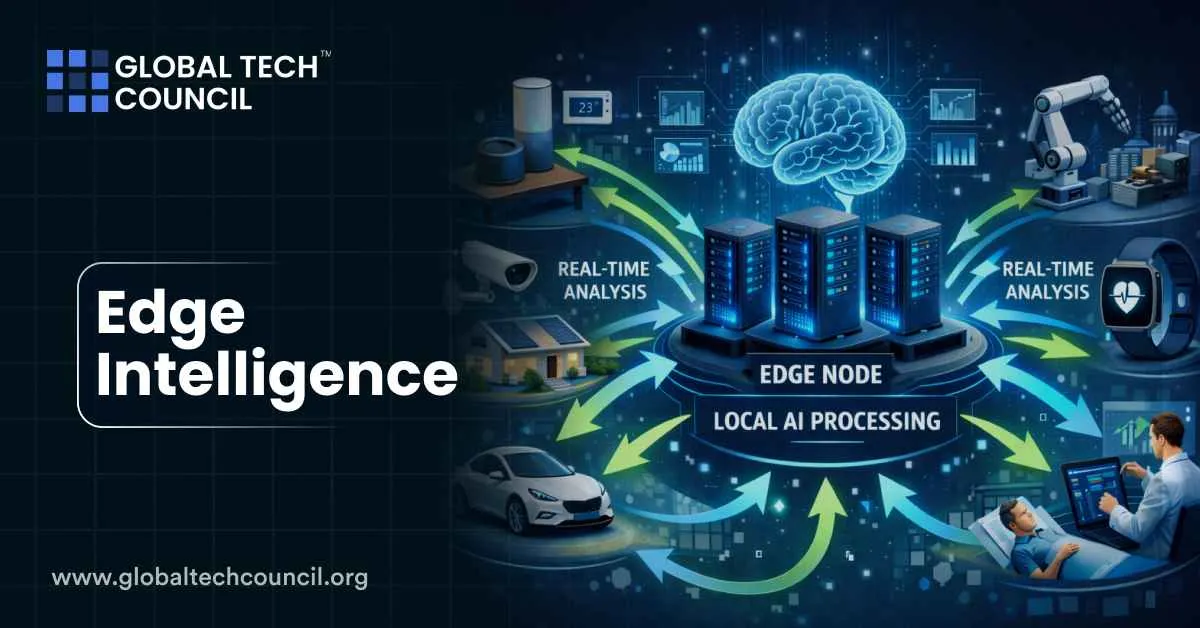
 Edge intelligence is the practice of running AI directly on or near the devices that generate data, instead of sending everything to a distant cloud for processing. Think cameras, sensors, phones, factory machines, vehicles, medical devices, retail kiosks, and robots that make decisions locally, in real time. It sounds simple, but it is a major shift in how intelligent systems are built because it changes latency, privacy, reliability, and cost all at once.
What used to be “send data to the cloud, wait, then act” is increasingly becoming “act now, sync later.” That is edge intelligence in one sentence, which is still one sentence too many for most product brochures.
What Edge Intelligence Means
Edge intelligence combines three ideas:
- Edge computing: compute happens close to where data is produced.
- On-device AI: inference runs on local hardware such as CPUs, GPUs, NPUs, or microcontrollers.
- Smart operations: models are deployed, updated, monitored, and governed across fleets of devices.
The “edge” is not a single location. It can be a smartphone, a factory gateway, a router, a vehicle computer, a hospital bedside monitor, or an industrial PC in a warehouse. The defining point is that decisions are made locally, with minimal dependence on a round trip to the cloud.
Why It Is Growing Now
Real-time decisions
Many applications cannot afford cloud delay. An autonomous forklift avoiding a worker, a camera detecting a safety incident, or a machine stopping before it damages itself all require responses in milliseconds, not “after the internet feels like cooperating.”
Privacy and compliance
Sending raw video, audio, and biometric data to the cloud creates privacy exposure and regulatory risk. Edge intelligence keeps sensitive data local, often transmitting only summaries, alerts, or encrypted features.
Bandwidth and cost
Continuous streaming from millions of devices is expensive. Local inference reduces data transfer and cloud compute costs, especially in video analytics and IoT.
Resilience
Factories, mines, ships, rural clinics, and retail sites all experience unreliable connectivity. Edge intelligence lets systems keep functioning even when the network does not.
The Hardware Behind Edge AI
Edge intelligence is powered by specialized compute. For years, edge devices relied on CPUs and small GPUs. Today, the big change is the rise of NPUs and purpose-built AI accelerators.
Qualcomm, for example, markets its Snapdragon X Elite platform as capable of running generative AI language models with over 13B parameters on-device, enabled by its AI-focused hardware stack. This matters because it signals that “serious” AI is moving into everyday devices, not only data centers.
NVIDIA’s Jetson line has also become a standard platform for robotics and industrial edge deployments. NVIDIA describes the Jetson Orin Nano Super Developer Kit as a compact system aimed at bringing generative AI to smaller edge devices. In late 2025, NVIDIA also published practical guidance on running smaller language and vision models on Jetson devices for robotics and edge use cases.
In plain terms: edge hardware is finally catching up to the ambition of edge software.
Core Building Blocks
Model optimization
Edge devices have constraints: memory, power, thermals, and sometimes strict real-time requirements. That drives techniques such as quantization, pruning, distillation, and compilation for device-specific runtimes. The goal is simple: keep accuracy acceptable while fitting into edge budgets.
On-device inference pipelines
Edge intelligence is rarely “just a model.” It is typically a pipeline:
- Sensor input (camera, mic, accelerometer, industrial telemetry)
- Pre-processing (denoise, resize, feature extraction)
- Inference (model execution)
- Post-processing (thresholds, tracking, ranking, rule checks)
- Action (alert, control signal, logging, local storage)
Fleet management
At scale, the hard part is not deploying one model, it is deploying 100,000 models across a messy real world. You need versioning, rollbacks, monitoring, and safe update mechanisms.
Cloud-edge frameworks support this operational layer. AWS IoT Greengrass, for instance, is built to extend cloud capabilities to edge devices for near real-time local responses, and it continues to ship frequent core updates.
Recent Developments
Generative AI reaches the edge
For years, edge intelligence focused on small classification models: detect a defect, spot a person, classify a sound. Now, smaller language models, vision-language models, and on-device assistants are becoming realistic on advanced edge hardware, including laptops, robots, and industrial gateways. Qualcomm and NVIDIA’s recent positioning around on-device generative AI reflects that market direction.
TinyML expands its scope
The TinyML community has pushed the idea that meaningful ML can run on resource-constrained devices. In 2024, a “Generative Edge AI” working group white paper described the field widening beyond classic TinyML into broader edge generative use cases and applications. This is important because it reflects a shift in what developers expect from edge devices: not only detection, but richer understanding and interaction.
Edge intelligence for smart cities and infrastructure
Edge intelligence is increasingly tied to urban systems: traffic monitoring, public safety, infrastructure health, and environmental sensing. A 2025 review focusing on edge intelligence in urban landscapes highlights the growing research base and the role of TinyML for low-power, real-time applications in cities.
Real-World Examples
Manufacturing quality control
A production line camera can run a vision model locally to detect defects, measure tolerances, or identify missing components. Local inference means immediate action: flag the item, stop the line, or reroute. Sending video to the cloud introduces delay and cost, and it also risks exposing proprietary designs.
Retail loss prevention and operations
Retailers use edge cameras for queue estimation, shelf availability, and incident detection. The edge approach often transmits only event metadata rather than raw video, reducing bandwidth and privacy risk.
Healthcare monitoring
Edge intelligence can power bedside devices that detect anomalies in vitals or analyze device signals locally, supporting faster clinical response and reducing exposure of sensitive patient data. In regulated settings, keeping data on-site can simplify compliance controls.
Robotics in warehouses and agriculture
Robots depend on local perception and control loops. NVIDIA’s Jetson ecosystem is a common example of how robotics teams deploy edge AI for navigation, manipulation, and on-device assistants for operators.
Vehicles and mobility
Vehicles generate massive sensor data. Edge intelligence allows real-time perception and driver-assist decisions even without reliable connectivity, while periodic uploads support learning and diagnostics.
Key Challenges
Security at the edge
Edge devices are physically accessible, deployed in uncontrolled environments, and often run for years. That creates risks: tampering, model theft, data extraction, and supply-chain vulnerabilities. Secure boot, hardware-backed keys, signed updates, and runtime monitoring are not “nice to have.” They are survival.
Model drift
Edge conditions change: lighting, seasons, factory materials, user behavior, microphone placement. Models can degrade silently. Strong monitoring and retraining loops are essential.
Fragmented hardware and tooling
Edge ecosystems include many chipsets, runtimes, and OS environments. Portability is improving, but it is still work.
Governance and auditability
When AI makes decisions at the edge, you need records: what version ran, what inputs triggered the output, what thresholds were used, and how the system behaved over time.
Where Blockchain Fits
Edge intelligence increasingly intersects with trust and provenance. When thousands of devices generate signals, there is a real need to prove integrity: “Was this event authentic?” and “Was this model version approved?” In some architectures, blockchain-based systems can support immutable audit logs, device identity, and provenance of model updates. That is not magic, but it can be useful when multiple parties share infrastructure and trust is limited.
This is one reason professionals sometimes pair AI skills with decentralized tech knowledge, especially in regulated or multi-stakeholder environments.
Skills and Certification
Edge intelligence demands a practical mix of skills: ML fundamentals, deployment engineering, device constraints, security thinking, and lifecycle operations. Structured learning can help, particularly for professionals moving from cloud-only AI into embedded and edge systems.
If you are building a foundation in AI systems, an AI certification can support core competency in machine learning and applied AI. For broader cross-domain capability, a deep tech certification can help connect AI to systems engineering and emerging technology stacks. And A Marketing and Business Certification can also be relevant when AI is used in customer communication, because ethical use includes transparency, brand risk management, and avoiding manipulative or deceptive personalization.
Conclusion
Edge intelligence is becoming a default design choice for real-time, privacy-sensitive, and bandwidth-heavy applications. Better NPUs, stronger edge platforms, and the spread of smaller generative models are pushing more intelligence onto devices, from factories to hospitals to robots.
The trade-off is complexity: more devices, more security surface area, and more operational discipline. Still, the direction is clear. The edge is no longer just where data is collected. It is where decisions happen.