


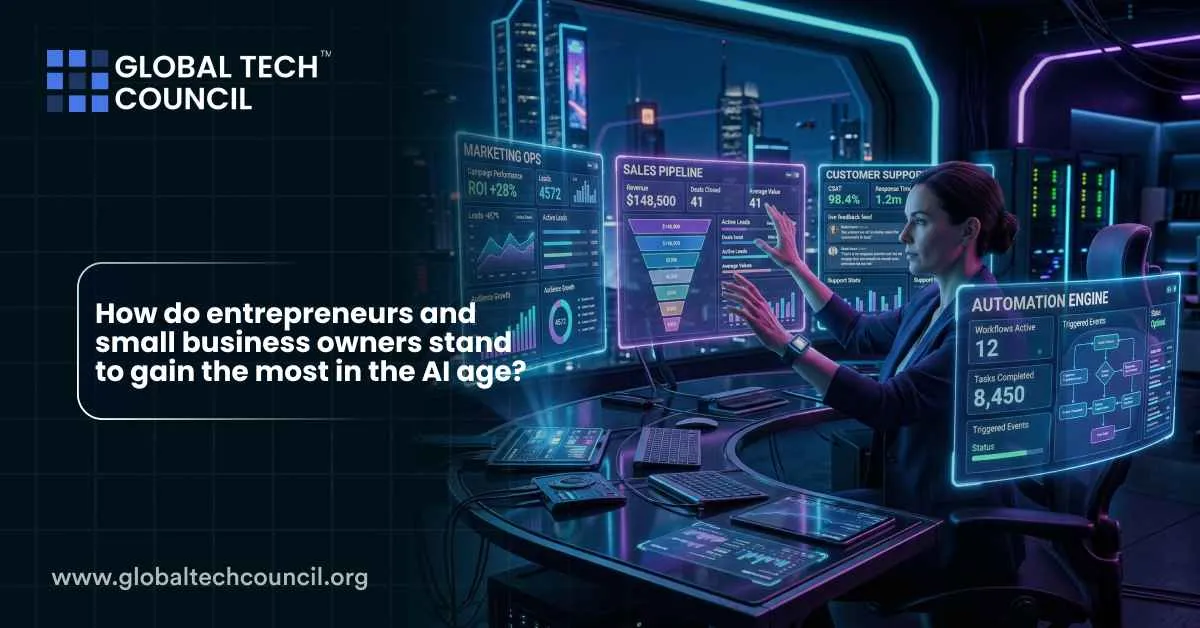
 For most of business history, scale has been synonymous with advantage. Large corporations could afford dedicated departments for marketing, legal, finance, customer service, and technology. They could invest in research and development, build proprietary systems, and hire specialist talent that small businesses and independent entrepreneurs could not access or afford. The playing field was tilted steeply toward those with the most capital and the largest teams.
Artificial Intelligence is fundamentally disrupting this dynamic. a solo entrepreneur with a laptop, a clear value proposition, and a working understanding of AI tools has access to capabilities that previously required entire departments. AI can generate professional marketing content, automate customer support, analyze business data, manage lead outreach, optimize advertising spend, process invoices, and handle scheduling, all at a cost that is a fraction of what employing human labor to do the same work would require. The entrepreneur who understands how to use these tools effectively is, for the first time in business history, operating at something approaching genuine parity with organizations many times larger.
The professionals capturing the greatest value from this shift are those who go beyond passive AI tool usage and develop genuine expertise in how AI systems work and how to direct them with strategic precision. The most effective starting point for any entrepreneur building AI expertise is comprehensive, structured AI knowledge. An AI Expert certification provides the rigorous, systematic foundation in AI principles, machine learning concepts, and AI application domains that equips entrepreneurs to engage with AI across every dimension of their business, from using tools strategically to designing custom workflows and governing AI systems responsibly.
This guide examines the specific advantages AI creates for entrepreneurs and small business owners, how to capture those advantages across every key business function, what skills and credentials create the deepest competitive positioning, and how to design an AI adoption strategy that builds compounding business value over time.
Why Small Business Owners and Entrepreneurs Benefit Most From AI
The Leverage Asymmetry That Favors Small Business
When a large company with one thousand employees gains a ten percent efficiency improvement from AI, it is a meaningful operational win. When a sole proprietor gains the same efficiency improvement, it is often the difference between a sustainable business and an unsustainable one. But the leverage AI provides goes far beyond marginal efficiency gains. For a small business, AI can eliminate entire cost centers, provide capabilities that were previously completely inaccessible, and enable the owner to operate as a multi-functional team without the overhead of actually building one. The leverage available to a skilled, AI-enabled entrepreneur relative to competitors without AI capability is not ten percent. It can be transformational.
Closing the Capability Gap Between Small and Large Businesses
The most significant advantage AI provides to small businesses is access to capabilities previously gated behind cost and scale. Professional-quality marketing content was accessible only to businesses that could afford experienced copywriters and designers. Sophisticated customer data analysis required data analysts and analytics infrastructure. Round-the-clock customer support required a team of agents. AI makes each of these capabilities accessible to a business of any size, at a cost per unit of output that is orders of magnitude lower than the human-labor alternative. The capability gap between large and small businesses has not disappeared, but it has narrowed dramatically and continues to narrow.
Speed and Adaptability Advantages That Large Organizations Cannot Match
Smaller businesses have a structural advantage over large organizations in their ability to adopt and adapt quickly. A solo founder can implement a new AI workflow in an afternoon. A large corporation may require months of procurement, IT approval, security review, and change management to deploy the same capability. This speed asymmetry, combined with AI’s capability-democratizing effects, creates a window of competitive opportunity for entrepreneurs that is most open right now, at the early stages of broad AI adoption, before large organizations have fully operationalized their AI programs.
How AI Transforms Every Small Business Function
Marketing and Customer Acquisition
Marketing is the function where AI has delivered the most immediate and visible value to small businesses. AI content generation tools allow a single founder to maintain a professional, consistent content presence across a blog, email newsletter, and social media channels simultaneously. AI advertising optimization tools automatically allocate budget across placements, audiences, and creative assets to maximize return on spend without requiring daily manual management. AI-powered SEO tools analyze competitive positioning and generate specific content improvement recommendations that build organic search visibility over time.
For entrepreneurs who want to maximize the marketing value of their AI adoption, strategic marketing knowledge is as important as AI tool proficiency. Understanding how to define a compelling value proposition, design a conversion-optimized customer journey, and measure marketing performance in terms of business outcomes rather than vanity metrics is what transforms AI tool usage from impressive activity into revenue-generating results. An AI powered digital marketing expert certification provides the strategic marketing foundation that makes AI tool proficiency genuinely impactful, equipping entrepreneurs to direct AI marketing tools toward the specific business outcomes they need rather than simply generating content and campaigns without clear strategic purpose.
Customer Service and Relationship Management
Customer service is often the function that first breaks as a small business grows, because demand scales with the customer base while the human capacity to respond does not. AI-powered customer service tools can handle a significant proportion of routine customer inquiries autonomously, answer frequently asked questions with accuracy and speed, route complex issues to the business owner with relevant context pre-populated, and follow up with customers automatically after service interactions.
A freelance software consultant with a growing client base implemented an AI customer service assistant trained on her service documentation, project management processes, and common client questions. The assistant handled approximately seventy percent of incoming inquiries without her involvement, including onboarding information requests, project status questions, and standard billing queries. She recaptured twelve hours per week previously spent on routine communications, redirecting that time to billable client work. Her client satisfaction scores improved because response times dropped dramatically, even as her personal involvement in routine communications decreased significantly.
Operations, Automation, and Back-Office Management
The operational backbone of a small business, the invoicing, scheduling, inventory management, supplier communication, and administrative processes that keep the business running but generate no direct revenue, is one of the highest-leverage areas for AI automation. Tools that automatically generate and send invoices, AI scheduling assistants that manage appointment booking and calendar coordination, AI-powered inventory forecasting that prevents stockouts, and automated document processing that extracts structured data from unstructured business communications are all accessible and affordable for businesses of any size.
Entrepreneurs who want to build custom automation beyond what off-the-shelf tools provide benefit significantly from programming knowledge. Python is the foundational language for building custom business automation scripts, integrating multiple software systems through API connections, and processing business data in ways that proprietary tools cannot accommodate. Developing comprehensive Python proficiency through a structured certification program gives entrepreneurs the technical capability to build and maintain custom automation solutions, reducing dependence on developers for routine system maintenance and extending the reach of their AI-powered operations.
Financial Intelligence and Business Analytics
AI-powered financial management tools have transformed what small business owners can understand about their own financial performance. AI bookkeeping platforms categorize transactions automatically, identify unusual patterns, and generate financial summaries that would previously require a bookkeeper’s time. AI business intelligence tools analyze sales data, customer behavior, and market trends to surface insights that inform pricing, product, and investment decisions. Cash flow forecasting tools use historical patterns and forward-looking indicators to predict financial needs with sufficient lead time to avoid the liquidity crises that disproportionately affect growing small businesses.
Agentic AI: The Most Powerful Tool Available to Entrepreneurs Today
What Agentic AI Systems Can Actually Do for a Small Business
The most significant AI development for entrepreneurs in the current period is the emergence of agentic AI systems: autonomous agents that plan and execute multi-step business workflows without continuous human direction. For a solo entrepreneur or a small team, agentic AI effectively functions as a tireless, highly capable contributor that can be assigned a goal and trusted to pursue it systematically within defined parameters.
Consider a small business owner in the professional services sector who is responsible for client acquisition, relationship management, project delivery, business development, marketing, and financial management simultaneously. An agentic AI system can be configured to research prospective clients and prepare personalized outreach, monitor her email inbox for client inquiries and draft responses for her review, track project milestones and send proactive status updates to clients, compile monthly financial summaries, and monitor competitor positioning, all within parameters she defines, escalating to her only when something requires her specific judgment.
Building Agentic Systems With Genuine Expertise
Deploying agentic AI effectively requires more than selecting a platform and turning it on. It requires understanding how to define goals clearly enough for an autonomous system to pursue them reliably, how to specify the operational boundaries within which the system should act, how to design the escalation conditions that bring human judgment into the workflow at the right moments, and how to monitor and evaluate the system’s outputs to ensure quality and alignment with business intent.
An Agentic AI certification provides the structured technical and conceptual foundation, covering agent architectures, tool use frameworks, memory systems, multi-agent coordination, and responsible deployment principles, that allows entrepreneurs to design and manage these systems with genuine competence rather than improvising through failures that damage client relationships or business reputation.
Deep Technology Sectors and Specialized Agentic Applications
For entrepreneurs operating in advanced technology sectors including blockchain, AI infrastructure, and other deep technology domains, agentic AI takes on even greater strategic significance. These sectors move fast, demand technical credibility from all market participants, and reward founders who can combine cutting-edge AI deployment capability with deep domain expertise. A Deeptech certification equips entrepreneurs in these advanced sectors with the specialized technical literacy needed to build AI-powered systems within complex, regulated, or highly specialized environments, combining domain depth with the efficiency advantages that agentic AI provides. The combination of deep technology knowledge and agentic AI expertise is among the most powerful professional profiles in the current market.
Building Technical Self-Sufficiency as an Entrepreneur
Python: The Technical Foundation for Business Automation
Python is the lingua franca of the AI ecosystem and one of the most accessible programming languages for non-technical entrepreneurs who want to develop practical technical skills. With Python, a business owner can build custom scripts that automate data extraction from business applications, integrate multiple software systems through their APIs, analyze sales and customer data with more depth and flexibility than off-the-shelf reporting tools allow, and build AI-powered tools using the same libraries and frameworks that professional AI developers use.
The investment required to develop practical Python proficiency is significantly lower than most non-technical entrepreneurs assume. A structured Python certification program provides the foundational programming knowledge that makes these capabilities accessible, building from language fundamentals through to practical applications in data processing, API integration, and AI library usage. Entrepreneurs who make this investment consistently describe it as one of the highest-return professional development decisions they have made, because the compounding value of technical self-sufficiency across a business lifetime is substantial.
Node.js for Web Applications and Real-Time Systems
For entrepreneurs building web-based products, customer-facing applications, or digital services that require real-time functionality, server-side architecture knowledge is a valuable technical foundation. Node.js is widely used for building the application backends, API servers, and event-driven automation systems that power modern web products. Its non-blocking architecture makes it particularly effective for the high-concurrency, real-time communication requirements of customer-facing business applications.
Entrepreneurs who develop server-side development skills gain the technical capability to build and maintain their own web application backends, design and evaluate API integrations between their business systems, and create the webhook-driven automation workflows that connect AI capabilities to their operational platforms. This technical self-sufficiency reduces dependence on external developers for ongoing maintenance, lowers the cost of system iteration, and gives entrepreneurs direct control over their technology infrastructure.
The Case for Comprehensive AI Knowledge
Alongside practical programming skills, building comprehensive AI knowledge through formal study creates a durable foundation that makes every subsequent tool adoption more effective. Platforms change rapidly. The underlying knowledge of how AI systems work, what they optimize for, how to design effective workflows, and how to evaluate and improve AI outputs transfers across tools and remains valuable through technological transitions. An AI Expert certification provides this durable foundational layer, equipping entrepreneurs to make informed AI adoption decisions, engage credibly with technical partners and vendors, and design AI-powered business systems that serve genuine strategic goals rather than simply following current trends.
Real Entrepreneurs Winning With AI Right Now
The Solo Consultant Who Operates Like an Agency
A management consultant working independently recognized that her biggest competitive disadvantage relative to established consulting firms was the range of deliverables she could offer. She invested in building an AI-powered workflow using AI research agents to gather and synthesize market intelligence, AI analytics tools to process financial and operational data, and AI content generation to produce professional-quality written deliverables. She also developed Python skills to build custom data processing scripts that allowed her to work with client datasets more flexibly than any off-the-shelf tool permitted. Her service offering now spans deliverables that previously would have required a team, and her client retention is consistently higher than the industry average because clients receive the comprehensive output quality of a large firm at the cost structure of an independent practitioner.
The E-Commerce Founder Who Scaled Without a Team
A founder of a direct-to-consumer e-commerce brand used AI tools to scale her business to seven figures without growing her team beyond three people. AI copywriting tools generated product descriptions, email campaigns, and social media content. An AI advertising optimization platform managed her paid social and search campaigns autonomously. An AI customer service chatbot handled the majority of pre-sale and post-sale inquiries. AI demand forecasting informed her inventory purchasing decisions. Her marketing strategy was built on a strong foundation of digital marketing principles developed through formal training, which allowed her to configure and evaluate her AI marketing tools with genuine strategic judgment rather than relying on default settings.
The Software Founder Who Built a Product Independently
A solo technical founder built and launched a subscription SaaS product serving a niche professional market using AI coding tools throughout the development process. AI-assisted coding accelerated his feature development significantly. AI documentation generation kept his product documentation current without dedicated effort. An AI-powered customer onboarding assistant reduced his time-to-value for new users and his churn rate in the critical first thirty days. His deep technical knowledge, developed through structured certification programs, allowed him to evaluate AI-generated code critically and build the custom integrations his product required. He launched a product that in a previous technological era would have required a founding team of three to four engineers.
Designing Your AI Adoption Strategy for Maximum Business Impact
Start With the Highest-Leverage Pain Points
Every small business has functions that consume a disproportionate share of the owner’s time relative to the value they generate directly. These are the highest-priority AI automation candidates. Common examples include manual reporting that could be automated with scripts and API integrations, routine customer communications that could be handled by AI assistant tools, content production that AI tools can generate with human editing and strategic direction, and administrative scheduling that AI workflow tools can manage autonomously. Starting with the highest-leverage pain points generates immediate, measurable value and frees time for the higher-value strategic activities that genuinely require the business owner’s unique judgment and relationships.
Build Capabilities Sequentially, Not Simultaneously
A common mistake among entrepreneurs early in their AI adoption journey is attempting to adopt too many tools at once. The result is shallow familiarity with many platforms, none of which is used with sufficient depth to generate meaningful business value. A more effective approach is sequential capability building: master one AI capability thoroughly before adding the next, building a genuinely integrated AI-powered operation over time rather than an impressive-sounding collection of tools that are not generating results.
Invest in Foundational Knowledge, Not Only in Tools
The entrepreneurs who generate the most sustained value from AI adoption are those who invest in understanding AI principles, not just learning specific platforms. Platforms change rapidly. The underlying knowledge of how AI systems work, what they optimize for, how to design effective workflows, and how to evaluate AI outputs transfers across tools and remains valuable through technological transitions. Structured certification programs in AI fundamentals, agentic systems, programming languages, and domain-specific AI applications create the durable knowledge foundation that makes every subsequent tool adoption more effective and more purposeful.
Conclusion
The AI age does not simply give entrepreneurs and small business owners new tools. It gives them a new competitive position. For the first time, a well-equipped individual with strategic clarity, genuine AI expertise, and the right combination of domain knowledge and technical capability can operate with the effective capacity of a team many times larger, at a fraction of the cost such a team would require. The capability gap that has historically separated small businesses from larger competitors is narrowing at an unprecedented rate.
The entrepreneurs who capture this advantage most fully are those who approach AI adoption as a strategic investment: who develop genuine understanding of the systems they deploy, who invest in the formal credentials that deepen and verify that understanding, and who build the combination of AI expertise and domain knowledge that transforms AI tools from impressive capabilities into compounding business assets.
Whether you are a solo founder building your first product, an established small business owner looking to scale without proportional cost increases, or an independent professional building a practice that competes with much larger firms, the AI age offers capabilities and competitive positioning that are genuinely unprecedented. The window to build these capabilities before they become universal is open now. The entrepreneurs who walk through it with genuine expertise and strategic intention are the ones who will look back on this era as the inflection point in their business growth.
FAQ
- Why do entrepreneurs and small business owners benefit so much from AI?
AI gives small businesses outsized leverage by cutting costs, speeding up work, and adding capabilities that usually require a larger team. - Which business functions benefit most from AI?
The biggest gains are in marketing, customer service, operations, finance, and product development. - What is agentic AI, and how can entrepreneurs use it?
Agentic AI can manage multi-step tasks on its own, such as outreach, reporting, client communication, and workflow automation. - How important is marketing strategy alongside AI tools?
Very important. AI tools work best when guided by strong strategy, including audience targeting, positioning, and conversion planning. - Do small business owners need programming skills to benefit from AI?
Not always, but basic coding skills like Python can unlock better automation, integrations, and custom AI use. - How can entrepreneurs in advanced tech sectors maximize AI?
They should combine AI skills with deep domain knowledge to build credibility and stronger technical solutions. - What is the most common mistake when adopting AI?
Trying too many tools at once instead of focusing on one high-impact use case and mastering it first. - How does broad AI knowledge help beyond tool use?
It helps entrepreneurs evaluate vendors, build smarter workflows, spot weak outputs, and make better long-term decisions. - Which certifications create the most value for entrepreneurs?
Useful certifications include AI foundations, agentic AI, AI-powered marketing, and Deeptech, depending on the business. - How should entrepreneurs prioritize AI investments?
Start with repetitive, time-consuming tasks AI can handle well, then use AI to improve higher-value work while protecting areas that need human judgment.