


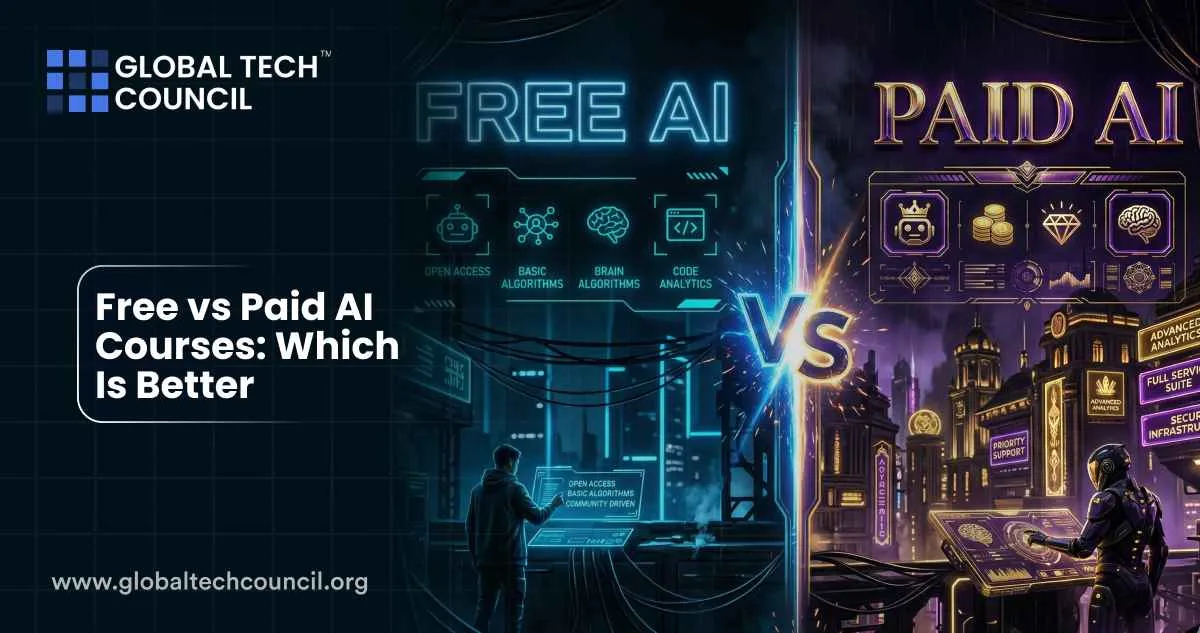
 Artificial Intelligence is now one of the most valuable skills in the modern job market. It affects software development, marketing, finance, operations, customer service, education, and product strategy. As AI becomes part of everyday work, many professionals want to learn it quickly and effectively. This creates one of the most common questions in AI education today: should you choose free AI courses or invest in paid ones?
The answer depends on what you want from the learning experience. Free AI courses can be excellent for accessibility, flexibility, and exploration. Paid AI courses can provide structure, deeper training, practical assignments, and recognized credentials. One is not automatically better than the other. The right choice depends on your career goals, current skill level, budget, and the kind of outcomes you want.
For people looking for structured professional development, programs such as AI Expert certification, Agentic AI certification, deeptech certification, and AI powered digital marketing expert can support different learning paths and professional needs.
This article explains the difference between free and paid AI courses, how recent AI trends are changing the education landscape, and how to choose the best option for your long-term growth.
Why This Decision Matters More Than Ever
A few years ago, AI education was mainly designed for data scientists, engineers, and academic researchers. Today, the audience is much wider. AI is now relevant for marketers, analysts, founders, consultants, managers, freelancers, developers, and students. The rise of generative AI, AI assistants, prompt-based workflows, and intelligent automation has expanded the need for practical AI knowledge across many industries.
This shift has created a massive number of online courses. Some are valuable and current. Others are shallow, outdated, or built more for promotion than education. As a result, choosing between free and paid AI courses is no longer a simple budget question. It is really a question of value.
Many learners assume free means weak and paid means better. That assumption is not always true. Some free courses provide excellent introductions, while some paid courses make grand promises and deliver recycled basics. What matters most is whether the course helps you build useful knowledge and apply it effectively.
What Free AI Courses Do Well
Free AI courses are often the best entry point for people who are just beginning. They lower the barrier to learning and allow people to explore the field without financial pressure. This is especially useful for students, career changers, and professionals who want to understand whether AI is relevant to their work before investing in formal training.
One major strength of free AI courses is accessibility. Learners can start immediately, often at their own pace, without worrying about cost. This makes it easier to study around work, family responsibilities, or other commitments. Free learning also allows people to test different areas of AI, such as machine learning, prompt engineering, natural language processing, automation, and AI ethics.
Another benefit is flexibility. Most free courses are self-paced, so learners can progress on a schedule that suits them. This can make learning less stressful, especially for working professionals. If someone wants a broad introduction to AI concepts or needs a quick overview of a specific topic, a free course can be an efficient solution.
Free courses are also excellent for exploration. A beginner may start with AI basics, then discover an interest in automation, content generation, or business applications. That exploration can later guide them toward a more targeted learning path.
Where Free AI Courses Often Fall Behind
Although free AI courses have real advantages, they often come with limitations. The most common issue is lack of depth. Many free programs are designed to introduce a concept rather than build full practical competence. They may explain what AI is, but they often do not go far enough into implementation, assessment, or industry application.
Another challenge is the lack of structure. Free courses often depend heavily on video lessons with minimal assignments, no feedback, and limited accountability. A learner may complete the content and still feel uncertain about how to use AI in a real project or job setting. Watching videos about AI is not the same as learning how to apply it professionally. A shocking development, I know.
Credentials can also be a weakness. Some free courses offer certificates of completion, but these may not carry much professional weight. If your goal is to show employers or clients that you have verified, practical AI skills, a more structured certification usually has more value.
Free courses may also become outdated more quickly. AI evolves fast, especially in areas such as generative AI, intelligent agents, and workflow automation. If the course has not been updated to reflect these changes, it may still be informative but not especially useful for current market demands.
Support is another common limitation. If you get stuck or need guidance, there may be no instructor, mentor, or learning community to help you. For highly self-directed learners, that may be manageable. For many others, it becomes a real obstacle.
What Paid AI Courses Bring to the Table
Paid AI courses are often designed for learners who need more than a basic overview. A strong paid course usually offers a more complete and guided learning experience. This can be especially helpful in a field as broad and fast-moving as artificial Intelligence.
One of the biggest advantages of paid courses is depth. High-quality paid programs usually combine foundational knowledge with practical application. They often include projects, case studies, assessments, tools, and real-world examples. Instead of simply defining AI concepts, they help learners use those concepts in realistic settings.
Another strength is structure. Paid programs usually follow a clear path, which helps learners build knowledge step by step. This matters because AI learning can easily become scattered. Many people jump from one tutorial to another and end up with fragments of information rather than a coherent skill set.
Paid AI courses may also include support systems such as instructor access, discussion groups, mentorship, downloadable resources, or feedback on assignments. These features can improve both learning outcomes and completion rates.
Professional recognition is another advantage. Learners who want to strengthen their resumes or demonstrate focused expertise often benefit from recognized certifications. For example, AI Expert certification can support broad AI knowledge, while Agentic AI certification can be valuable for those focused on intelligent automation and advanced AI workflows. Professionals interested in broader emerging technologies may explore deeptech certification, while marketing professionals can gain role-specific value from AI powered digital marketing expert.
The Real Drawbacks of Paid AI Courses
Paid AI courses are not automatically the best choice for everyone. Their main drawback is cost. Some are affordable, but others require a significant investment. If you are still exploring the field, paying too early may not be the smartest move.
Another issue is uneven quality. A paid course can have attractive branding and still offer weak content. Some programs spend more effort on their sales page than on their curriculum. A higher price does not guarantee updated material, practical learning, or useful support.
Fit also matters. A course may be technically strong but still not suit your goals. A highly technical machine learning course may not help a marketer, and a broad business overview may frustrate a developer who wants advanced implementation skills. The value of any paid AI course depends on how well it matches your needs.
Time commitment can also be a challenge. More structured paid courses often require regular study, assignments, and deadlines. That can be a good thing for serious learners, but it may be difficult for people balancing full-time work or other responsibilities.
How Recent AI Trends Have Changed Learning Choices
The debate between free and paid AI courses has become more complex because AI itself has changed. The first major shift is the rise of generative AI. Modern learners now need to understand large language models, prompt design, output evaluation, responsible use, and practical business applications. Older courses that focus only on traditional machine learning may still be useful, but they do not fully reflect today’s market.
The second shift is the growth of intelligent automation and agent-based systems. Businesses increasingly want people who understand how AI can retrieve information, use tools, complete tasks, and support complex workflows. This has made Agentic AI certification especially relevant for professionals who want to work with the next generation of AI systems.
The third shift is role-specific AI education. Not everyone needs to become a machine learning engineer. Marketers, consultants, product teams, and business professionals often need AI skills tied directly to their work. That is why targeted paths such as AI powered digital marketing expert are becoming more useful than generic courses for many learners.
When Free AI Courses Make the Most Sense
Free AI courses are usually the better option when you are just starting out or still testing your interest. They are ideal for beginners who want to build basic understanding before deciding whether to specialize.
They are also helpful when you need narrow knowledge quickly. For example, a manager who wants to understand AI terminology, a freelancer exploring prompt writing, or a student learning the basics of machine learning may get enough value from a free course without needing paid training immediately.
Free resources also work well as supplements. Many professionals use free materials to review concepts, learn about a new tool, or strengthen weak areas while following a larger learning plan.
If your main goal is exploration, basic literacy, or low-risk learning, free AI courses are often the smartest starting point.
When Paid AI Courses Are Worth the Investment
Paid AI courses are usually more valuable when your goal is deeper skill development, structured progression, and professional credibility. If you want learning that leads to portfolio work, practical use, or a recognized credential, paid programs often provide better results.
They are especially useful for people with clear goals. Someone building AI skills for business strategy, automation, product development, or marketing may benefit more from a guided program than from a collection of scattered free lessons.
Paid learning also makes sense when support matters. If you learn better with feedback, deadlines, assessments, and a clear curriculum, a paid program can improve your chances of finishing and applying what you learn.
For learners who want stronger career positioning, credentials such as AI Expert certification, Agentic AI certification, deeptech certification, and AI powered digital marketing expert can add value when they are paired with real, practical ability.
A Smarter Way to Choose Between Free and Paid AI Courses
The best way to decide is to evaluate your own situation honestly. Start with your goal. If you are exploring AI for the first time, free learning may be enough. If you need career-ready skills, specialization, or a stronger signal to employers, paid training is often the better choice.
Next, consider your experience level. Beginners often benefit from starting free, while intermediate learners with clear direction may gain more from structured paid programs. Then think about your learning style. If you are disciplined and comfortable teaching yourself, free resources may work well. If you need guidance and accountability, paid learning usually offers a stronger environment.
Finally, think about outcomes. Do you simply want understanding, or do you need projects, assessments, and a credential that supports your professional goals? That answer will often make the choice much clearer.
Final Thoughts
So which is better, free or paid AI courses? The honest answer is that both can be valuable. Free AI courses are excellent for accessibility, exploration, and foundational learning. Paid AI courses are often better for structure, specialization, support, and recognized professional development.
For many learners, the best strategy is a hybrid one. Start with free resources to understand the field and identify your interests. Then move into a paid program when you need deeper knowledge, stronger accountability, or career-focused certification.
The most important thing is not whether the course is free or paid. It is whether the course helps you learn effectively, apply your skills in real situations, and move forward with evidence of competence. That is what creates real value in AI education.
Frequently Asked Questions
1. Are free AI courses good for beginners?
Yes, free AI courses are often a strong starting point for beginners because they provide basic knowledge without financial risk.
2. Are paid AI courses always better than free ones?
No. Some paid courses are excellent, while others are weak. Quality depends on the curriculum, instructor, updates, and practical relevance.
3. What is the main advantage of free AI courses?
The biggest advantage is accessibility. Learners can explore AI topics without spending money and can study at their own pace.
4. What is the main advantage of paid AI courses?
The main advantage is structured learning. Paid courses often provide deeper content, practical assignments, support, and recognized credentials.
5. Is AI Expert certification worth it?
It can be valuable for learners who want broad AI knowledge and a structured certification that supports professional growth.
6. Who should choose Agentic AI certification?
It is best for professionals interested in intelligent agents, automation, tool-using systems, and multi-step AI workflows.
7. What is the purpose of deeptech certification?
It can help professionals strengthen their profile in emerging technologies and innovation-focused fields beyond basic AI learning.
8. Who should consider AI powered digital marketing expert?
It is ideal for marketers, consultants, business owners, and growth professionals who want to apply AI in campaigns, analytics, content, and targeting.
9. Can free AI courses help me get a job?
They can help build knowledge, but job readiness usually improves when learning includes projects, practical application, and sometimes formal certification.
10. What is the best overall strategy for learning AI?
A hybrid strategy is often best. Start with free foundational learning, then invest in a paid program when you need depth, specialization, support, or stronger credentials.