


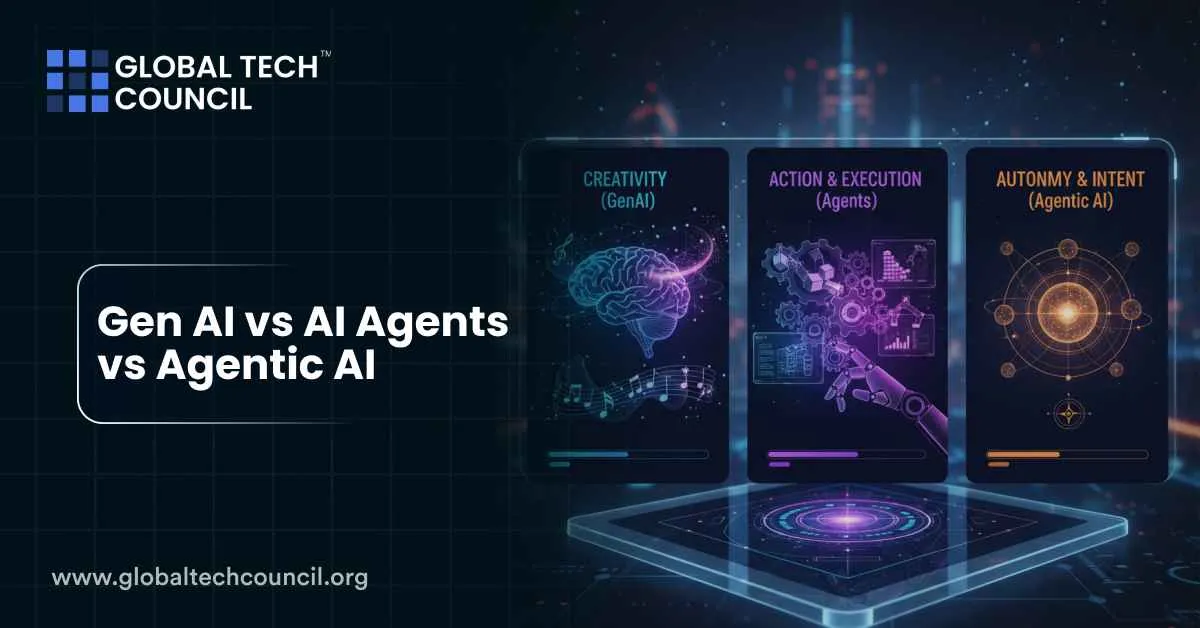
 Artificial Intelligence is expanding faster than most teams can adapt. Models evolve, new capabilities roll out, and tasks that once required entire departments now run through automated systems. To work effectively in this environment, decision makers need a solid understanding of three major categories: generative AI, AI agents, and agentic AI. These terms might look similar, yet each one solves a different problem inside a workflow.
Teams often rely on formal training programs such as a Tech certification to learn how these systems behave in practical settings. The goal is not only to understand the technology, but also to avoid building workflows that collapse under real world pressure.
Why the Industry Now Uses Three Categories
The field grew into three layers because businesses needed varied forms of intelligence. Generative systems can produce text and images, but they react instead of directing tasks. Agents come next. They bring structure and can operate tools or follow a process. Agentic systems complete the picture by introducing genuine autonomy. They pursue long range goals and keep working without being prompted each time.
Without recognizing these differences, organizations sometimes use a simple model for problems that need structured decision making. This mismatch causes failures that are easy to avoid with the right foundation.
What Generative AI Can Do Today
Generative AI models learn patterns from data and produce new content. They can write, summarize, translate, generate images, craft outlines, and respond to questions across many subjects. Their strengths lie in language fluency and creativity. When given a specific prompt, they can deliver high quality output in seconds.
Despite this flexibility, these models are reactive. They do not plan long sequences on their own. They also lack awareness of past steps unless the user includes that information in the prompt. They perform well when the task is easily described, but they struggle when the task depends on changing goals. These limits created space for the next category.
How AI Agents Expand the Capabilities of Generative Models
AI agents are frameworks built around generative models. They do not rely on prompting alone. Instead, they follow instructions, hold intermediate steps, and connect to external tools. An agent can retrieve information, make calls to APIs, format results, and produce a complete solution to a goal instead of a single response.
This class of systems can divide a goal into smaller parts and decide which action to take next. That might involve using a database, visiting a webpage, running a calculation, or storing temporary progress along the way. A generative model cannot do this without additional logic.
Agents work well in support automation, planning tasks, research pipelines, scheduling, document generation, and any process with several ordered stages. They bring consistency and control to workflows that cannot rely on ad hoc prompting.
What Defines Agentic AI
Agentic AI represents the next significant step. These systems are constructed to operate with independence. Instead of waiting for instructions, they follow objectives, track progress, revise plans when circumstances change, and evaluate their own output.
An agentic system can maintain long term memory, operate through feedback loops, manage multiple agents at once, and coordinate information over lengthy periods. It behaves more like a digital operator than a tool. This makes it suitable for large scale operations that require persistent attention.
Because these systems can influence entire business processes, many teams explore advanced learning paths such as a Deep Tech certification to build the knowledge required to deploy them safely.
Practical Illustrations
These three categories become easier to grasp when viewed through examples.
Drafting a Report
A generative model can produce an initial draft.
An agent can gather recent data, check references, update charts, and compile everything into a refined document.
An agentic system can monitor business metrics on an ongoing schedule and deliver an updated report without being asked.
Customer Support
A generative model can write a helpful reply.
An agent can identify order details, confirm shipping status, and process a refund.
An agentic system can examine recurring issues across thousands of cases and recommend changes to operation procedures.
Data Processing
A generative model can describe a dataset.
An agent can extract records, sort fields, and run transformations.
An agentic system can supervise the entire pipeline, detect anomalies, and alert staff when numbers shift in unexpected ways.
Strengths and Weaknesses Across the Three Categories
Each type of system offers advantages and tradeoffs. Recognizing them helps teams choose correctly.
Generative AI
Strengths:
Language fluency, creativity, idea generation, fast responses.
Weaknesses:
No built in memory, no tool usage, limited planning, cannot operate independently.
AI Agents
Strengths:
Reliable multi step execution, tool access, consistent workflows, improved accuracy.
Weaknesses:
Dependent on the quality of the tools they call, requires testing, can stall without proper safeguards.
Agentic AI
Strengths:
Autonomous reasoning, real time adaptation, continuous operation, coordination across systems.
Weaknesses:
Complex to design, requires strong oversight, demands governance to prevent unintended outcomes.
These strengths and limits influence how organizations adopt AI for long term strategy. Many business leaders choose a Marketing and business certification to understand how these technologies shift organizational planning.
How These Three Forms of AI Work Together
In real systems, generative models, agents, and agentic platforms often operate side by side. Each contributes a different layer to the workflow.
Role of Generative AI
It acts as the creative engine. It produces content, converts instructions into text, assists with research, and generates explanations.
Role of AI Agents
They serve as the operational coordinators. They choose actions, interact with tools, and complete defined tasks from start to finish.
Role of Agentic AI
Agentic systems act as supervisors that guide the workflow toward long term objectives. They monitor outputs, update strategies, and balance priorities across multiple processes.
Choosing the Right Category
The correct choice depends on the job at hand.
When Generative AI Is Enough
Content creation, conversational interactions, brainstorming sessions, and quick research insights.
When AI Agents Are the Better Option
Structured routines, automation steps, tool driven workflows, and tasks that require predictable sequences.
When Agentic AI Becomes Necessary
Operations that need ongoing attention, continuous monitoring, complex goals, or independent execution.
Looking Toward the Future
AI is moving toward ecosystems where many intelligent components cooperate. Generative models provide reasoning skills. Agents deliver structured action. Agentic systems bring sustained decision making. Together, they support advanced environments that handle tasks without constant supervision.
As organizations combine these elements, they will create systems that operate with stability, scale, and reliable outcomes. The companies that recognize the differences among these three categories will be better positioned to build durable and effective AI driven workflows.