


 Deep learning has become one of the most influential technologies in artificial intelligence. It supports virtual assistants, recommendation engines, medical image analysis, fraud detection, language models, content generation, and advanced automation systems. Although the term sounds highly technical, the central idea is simple. Deep learning uses multi-layered neural networks to learn patterns from data and improve performance over time.
This technology matters because it helps machines process information in ways that are closer to human pattern recognition than traditional software rules. Instead of relying only on hand-coded instructions, deep learning systems learn from large datasets and discover meaningful signals on their own. That is why deep learning plays such a major role in modern AI applications across healthcare, finance, retail, marketing, transportation, and software development.
For learners who want to strengthen their AI knowledge in a structured way, programs such as AI Expert certification and Agentic AI certification can help connect theory with real-world applications. Technical professionals may also benefit from AI Powered coding expert certification, while professionals interested in broader innovation can explore a deeptech certification. For marketing professionals applying AI in business strategy, an AI powered digital marketing expert program can also be highly relevant. Humans do love attaching certificates to everything, but in fairness, some of them are actually useful.
This guide explains deep learning in a clear and accessible way, including how it works, how it differs from machine learning, what types of models it uses, where it is applied, and why it continues to shape the future of AI.
Understanding the Meaning of Deep Learning
Deep learning is a specialized branch of machine learning, which itself belongs to the broader field of artificial intelligence. Traditional machine learning often depends on structured data and manually selected features. Deep learning goes further by allowing systems to learn useful features automatically from raw data.
For example, in a traditional image recognition process, a developer might define specific visual features such as edges, shapes, or textures. In deep learning, the model discovers those features on its own. Early layers may detect simple visual signals, while deeper layers begin identifying more complex patterns such as faces, vehicles, organs, or objects in motion.
This automatic feature learning is what makes deep learning especially powerful. It reduces the need for manual engineering and allows models to improve as they process more data. That is one reason deep learning has become essential in modern AI systems.
Deep Learning Compared With Machine Learning
Many people confuse machine learning and deep learning, but they are not identical. Machine learning includes many algorithms such as decision trees, linear regression, clustering methods, and support vector machines. These approaches are often effective on smaller and more structured datasets.
Deep learning focuses on neural networks with multiple layers. These models are particularly strong when working with large datasets and unstructured information such as text, audio, images, and video.
In simple terms, deep learning is a subset of machine learning. All deep learning belongs to machine learning, but not every machine learning model uses deep neural networks. The difference matters because deep learning usually requires more data and computing power, but it often performs better on complex tasks like computer vision, language understanding, and speech recognition.
The Core Role of Neural Networks
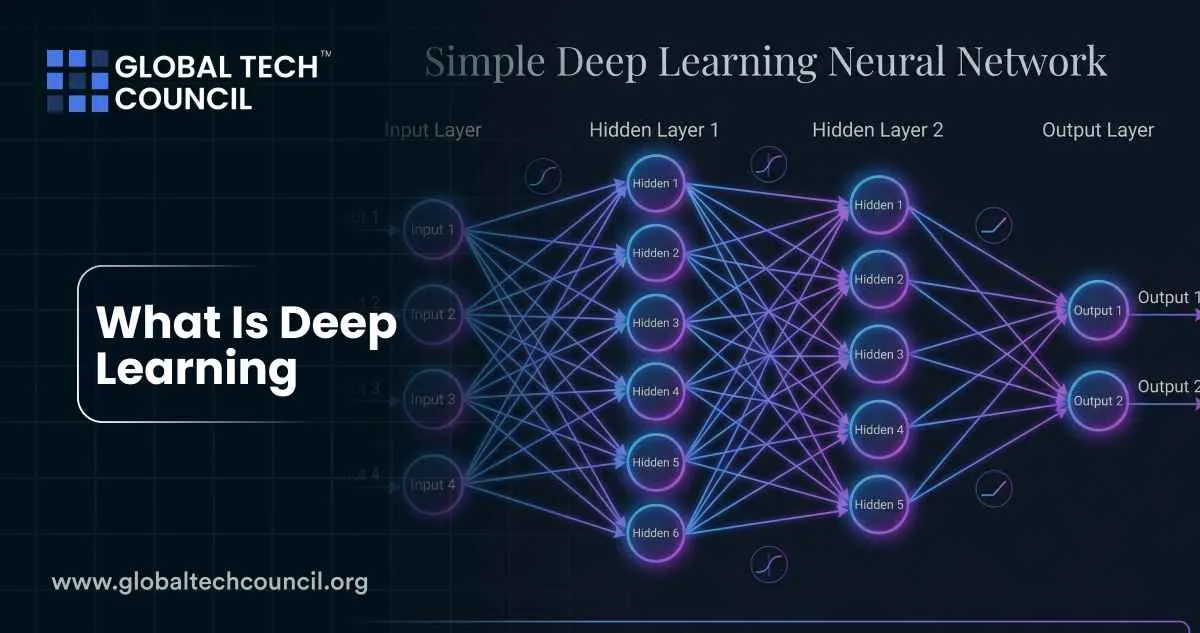
At the center of deep learning is the neural network. A neural network is a layered system designed to process information and improve predictions by learning from examples. It is loosely inspired by how biological neurons communicate, although people tend to romanticize that comparison far beyond reason.
A basic neural network includes three main parts:
- An input layer that receives data
- One or more hidden layers that process the data
- An output layer that produces the final result
Each node in the network receives information, applies a mathematical weight, adds a bias value, and passes the result through an activation function. During training, the system adjusts these values to reduce errors and improve future predictions.
For example, if a model is learning to recognize cats in images, the first layers may detect edges and textures, the middle layers may identify ears or whiskers, and the deeper layers may determine whether the full image likely contains a cat.
How Deep Learning Models Learn
Deep learning models improve through training. During training, the system receives many examples, makes predictions, compares them with the correct answers, and adjusts its internal parameters to improve performance.
Forward Processing
In the first step, data moves through the network from the input layer to the output layer. Each layer transforms the information slightly until the model produces a result.
Error Measurement
Once the prediction is made, the model calculates how far it is from the correct answer. This difference is measured by a loss function. A lower loss means the model performed better.
Backward Adjustment
The model then sends the error backward through the network. This process updates the weights and biases so the model becomes more accurate over time. The optimization method commonly used for this is gradient descent.
After many training cycles, called epochs, the model gradually becomes better at recognizing patterns and producing correct outputs.
Why Deep Learning Is So Important
Deep learning matters because it solves problems that were once extremely difficult for computers. Tasks such as recognizing speech, understanding written language, identifying objects in images, generating realistic text, and detecting disease patterns are now far more practical because of deep neural networks.
This has created a major business and social impact. Deep learning is no longer limited to research laboratories. It is used in consumer apps, enterprise software, healthcare platforms, financial systems, logistics operations, and digital marketing tools.
Companies use deep learning to automate customer support, improve fraud detection, personalize recommendations, process documents, forecast demand, and optimize supply chains. Hospitals use it for medical imaging and clinical decision support. Developers use it to power coding assistance, testing workflows, and intelligent applications.
Major Types of Deep Learning Models
Different deep learning architectures are suited to different kinds of tasks. Understanding the major categories makes it easier to see why deep learning is so versatile.
Feedforward Neural Networks
These are the simplest neural networks. Data moves in one direction from input to output. They are commonly used for straightforward classification and prediction tasks.
Convolutional Neural Networks
Convolutional neural networks, often called CNNs, are designed for image-related tasks. They are very effective at recognizing visual patterns such as edges, textures, shapes, and objects.
CNNs are widely used in facial recognition, medical imaging, defect inspection, and satellite image analysis.
Recurrent Neural Networks
Recurrent neural networks, or RNNs, are built for sequential data, where earlier information affects later output. They were commonly used for time series, speech, and language tasks.
Long Short-Term Memory Networks
LSTM models are a type of recurrent network designed to handle longer dependencies in sequences. They were widely used in forecasting and speech processing before newer architectures became dominant.
Transformers
Transformers are now among the most important deep learning architectures. They use attention mechanisms to focus on the most relevant parts of the input. This makes them highly effective for language processing and increasingly useful for vision, audio, and multimodal AI systems.
Transformers power large language models, summarization systems, code generation, search assistance, and advanced conversational AI.
Autoencoders
Autoencoders compress data into a smaller representation and then reconstruct it. They are useful for anomaly detection, noise reduction, feature learning, and dimensionality reduction.
Generative Adversarial Networks
Generative adversarial networks, or GANs, use two neural networks in competition. One creates data, and the other evaluates it. This structure became famous for generating realistic images and synthetic media.
Where Deep Learning Is Used in the Real World
Deep learning has already become part of daily life, even when people do not notice it. It is embedded in many of the digital services and products people use every day.
Healthcare
Deep learning helps analyze X-rays, CT scans, MRIs, pathology images, and patient records. It supports early disease detection, image enhancement, and diagnostic assistance.
Finance
Banks and financial firms use deep learning for fraud detection, anti-money laundering systems, algorithmic trading, and credit risk analysis.
Retail and Ecommerce
Retailers rely on deep learning for recommendation engines, dynamic pricing, customer behavior analysis, and demand forecasting.
Transportation
Deep learning supports autonomous driving research, driver monitoring, route planning, traffic analysis, and vehicle safety systems.
Marketing
In marketing, deep learning helps businesses segment audiences, personalize messaging, predict customer behavior, and improve campaign targeting. This is one reason an AI powered digital marketing expert program can be valuable for professionals working at the intersection of AI and growth strategy.
Software Development
Deep learning now plays a growing role in developer tools. It supports code generation, bug detection, testing assistance, and software automation. For professionals building intelligent systems, AI Powered coding expert certification can help strengthen practical implementation skills.
Programming and Deep Learning Development
Deep learning depends heavily on programming for experimentation, model training, integration, deployment, and monitoring. Among programming languages, Python remains the most widely used because of its mature ecosystem.
Libraries such as TensorFlow, PyTorch, Keras, NumPy, and related tools have made Python the leading environment for deep learning research and production development. Developers use these tools to build models, test results, and move intelligent systems into real-world applications.
However, deep learning is not only about training models. It also involves APIs, data pipelines, deployment layers, and user-facing systems. That broader technical environment is why professionals often benefit from structured technical learning alongside AI theory.
Emerging Trends in Deep Learning
Deep learning continues to evolve rapidly. Several trends are shaping its current and future role in artificial intelligence.
Foundation Models
Large pretrained foundation models have changed how AI systems are built. Instead of training a model from the beginning for every task, organizations can adapt existing models to new use cases more quickly.
Multimodal AI
Modern deep learning systems increasingly process more than one type of data at once. They can combine text, images, audio, and video to support richer applications and more natural interactions.
Efficient AI Models
The field is no longer focused only on making bigger models. Efficiency has become a priority. Techniques such as quantization, distillation, pruning, and smaller task-focused architectures help reduce costs and improve deployment.
On-Device Intelligence
Deep learning is increasingly moving onto phones, cameras, vehicles, and industrial equipment. This improves privacy, reduces latency, and enables faster real-time decision-making.
Agentic Systems
Deep learning models are now being combined with retrieval tools, planning methods, and multi-step execution systems. This shift is helping AI move from simple response generation toward more autonomous workflows. That growing trend is one reason Agentic AI certification is becoming relevant for professionals interested in next-generation AI systems.
Responsible AI
As deep learning affects more critical decisions, organizations are paying more attention to fairness, explainability, governance, monitoring, and model safety. Accuracy alone is not enough anymore. Apparently society prefers its algorithms powerful and accountable. Inconsiderate, but reasonable.
Benefits of Deep Learning
Deep learning offers several major advantages that explain why it is used so widely.
It can learn features automatically from raw data rather than relying entirely on manually defined rules. It performs extremely well on unstructured information such as images, audio, and language. It scales effectively with more data and stronger computing power. It can also be reused across tasks through transfer learning, which saves time and resources.
These strengths have made deep learning central to modern AI development in both consumer and enterprise environments.
Challenges and Limitations to Understand
Deep learning is powerful, but it also has important limitations. Pretending otherwise is how people end up shocked that their miracle system behaves like an expensive toddler with access to a server rack.
One challenge is the need for large, high-quality datasets. Poor or biased data can significantly reduce model performance. Deep learning models also require substantial computing resources, which increases costs and energy usage.
Another issue is interpretability. Deep neural networks are often harder to explain than simpler models. This becomes a serious concern in regulated industries such as healthcare, finance, and law. Bias, fairness risks, overfitting, and deployment complexity also remain important challenges.
Building a model is only one step. Real-world success also depends on testing, monitoring, retraining, governance, and safe deployment.
How to Begin Learning Deep Learning
A good way to start learning deep learning is to combine theory with practical projects. Learners should first understand the basics of machine learning, statistics, linear algebra, and neural networks. After that, they can begin working with Python and common frameworks such as PyTorch or TensorFlow.
Small projects can make the concepts easier to understand. Examples include image classifiers, sentiment analysis systems, recommendation tools, or simple chatbot prototypes. Structured learning can also help professionals build stronger career-ready knowledge. Programs such as AI Expert certification offer foundational understanding, while a deeptech certification may help learners connect deep learning with broader emerging technologies.
Final Thoughts
Deep learning is one of the most important technologies in modern artificial intelligence. It uses layered neural networks to learn from data, recognize patterns, and solve complex problems that traditional systems struggled to handle. From healthcare and finance to ecommerce, transportation, marketing, and software development, its impact is already extensive.
Its strength comes from its ability to process large amounts of data, learn features automatically, and perform well on unstructured inputs such as text, images, and speech. At the same time, deep learning comes with real challenges, including compute demands, interpretability limits, and governance concerns.
For students, developers, marketers, business leaders, and AI professionals, understanding deep learning is now a practical advantage. Whether the goal is technical growth, product innovation, operational efficiency, or strategic decision-making, deep learning sits at the center of today’s AI landscape.
Frequently Asked Questions
1. What is deep learning in simple terms?
Deep learning is a type of artificial intelligence that uses layered neural networks to learn patterns from data and make predictions or decisions.
2. How is deep learning different from machine learning?
Machine learning is the broader field, while deep learning is a specific part of it that uses many-layered neural networks, especially for complex and unstructured data.
3. Why is deep learning called deep?
It is called deep because the model contains multiple hidden layers between the input and output layers.
4. What is a neural network?
A neural network is a system of connected nodes that processes information in layers and improves through training.
5. Where is deep learning used today?
Deep learning is used in healthcare, finance, retail, transportation, marketing, cybersecurity, and software development.
6. Why is Python popular in deep learning?
Python is widely used because it has powerful libraries and frameworks that make model building, training, and deployment easier.
7. What are transformers in deep learning?
Transformers are advanced neural network architectures that use attention mechanisms and are widely used in language models and multimodal AI systems.
8. What are the biggest challenges in deep learning?
The main challenges include data quality, high computing cost, bias, limited explainability, overfitting, and deployment complexity.
9. Can beginners learn deep learning?
Yes. Beginners can start with machine learning basics, Python, neural network concepts, and small practical projects before moving to advanced applications.
10. Is deep learning a good career field?
Yes. Deep learning skills are valuable across technology, healthcare, finance, marketing, research, and enterprise AI strategy.