

Big Data and Artificial Intelligence-A Match Made in Heaven
 Toshendra Sharma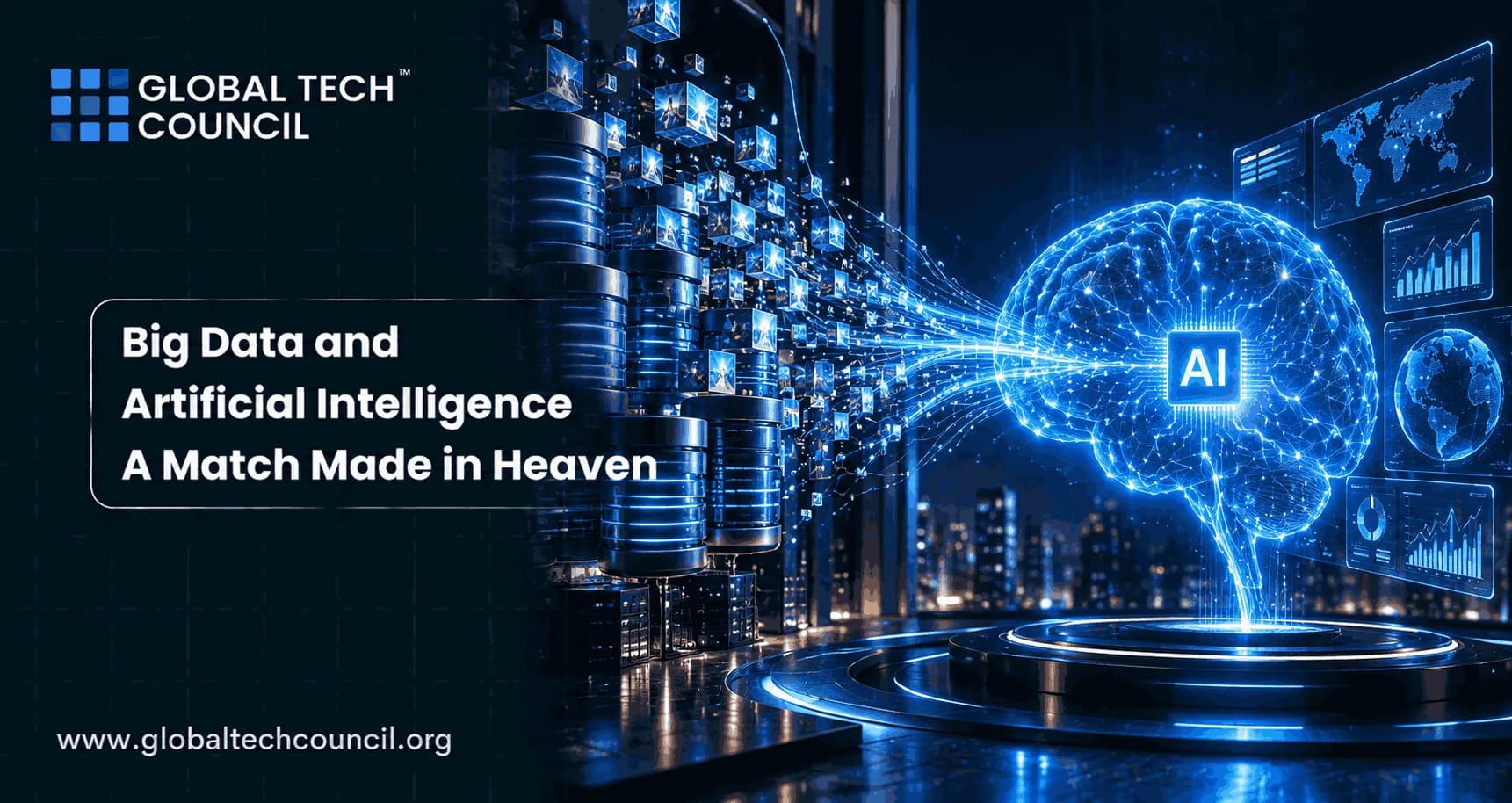
Introduction: Two Technologies That Complete Each Other
Few technology pairings complement each other as naturally as big data and artificial intelligence. One provides the raw material, the other provides the intelligence to make sense of it, and together they have become the engine behind nearly every major digital transformation happening across industries today. The world is expected to generate somewhere between 230 and 240 zettabytes of data in 2026 alone, a volume so vast that meaningful human analysis without AI's help has become practically impossible. For professionals who want to understand how to manage and extract value from datasets at this scale, a Certified Big Data Expert credential builds the technical foundation needed to work confidently within this data-driven landscape.
The relationship between these two technologies is not incidental. It is genuinely symbiotic, with each one making the other significantly more powerful than it could ever be alone.

Why AI Cannot Function Without Big Data
Artificial intelligence, particularly the deep learning and generative models increasingly dominating the field, learns from examples rather than explicit instructions. This means AI's effectiveness scales directly with the volume and quality of data it has access to during training. Big data supplies exactly that raw material, providing the massive, varied datasets that allow AI models to recognize patterns, adjust their internal parameters, and improve their predictions with each iteration.
Without sufficiently large and representative datasets, even the most sophisticated AI architecture will underperform, since the model simply lacks enough examples to learn meaningful patterns from. This dependency has elevated big data from a back-end technical concern into a mission-critical business asset, directly powering the AI-driven products and decisions organizations increasingly rely on. Professionals looking to specialize specifically in building and training these data-hungry AI systems often pursue a Certified Artificial Intelligence (AI) Expert credential, gaining structured knowledge of how large datasets translate into functioning, accurate machine learning models.
The Feedback Loop That Keeps Improving Both Technologies
What makes this relationship particularly powerful is that it works in both directions, forming a continuous feedback loop rather than a one-way dependency. Better data trains a sharper AI model, and that sharper model in turn becomes better at identifying patterns and generating higher-quality insights from new data it encounters. Some organizations now deploy AI-infused data pipelines that automatically monitor data flows for anomalies and adjust processing logic in real time, effectively using AI to manage the very data pipelines that feed AI systems in the first place.
This compounding relationship explains why the global big data analytics market is projected to grow substantially through the rest of the decade, expanding well beyond four hundred billion dollars in 2026 alone as more organizations recognize that investing in one technology naturally strengthens the other.
The Real Bottleneck Is Data Quality, Not Model Sophistication
Despite widespread investment in big data infrastructure, a significant gap remains between organizations that collect data and those that actually use it effectively. Industry research suggests that while the vast majority of businesses have invested in big data initiatives, only a fraction consistently use analytics in ways that meaningfully inform decisions. This gap often comes down to data quality issues rather than shortcomings in AI model design itself.
Inaccurate or inconsistent labels in training data cause models to learn flawed patterns, while data leakage, where information from outside the intended training set contaminates results, can make a model appear artificially accurate during testing before failing once deployed in real conditions. Class imbalance presents another common obstacle, where underrepresented outcomes in a dataset, such as rare fraud cases making up a tiny fraction of transactions, can cause models to simply default to the majority outcome rather than learning to detect the rare event they were built to catch. Addressing these challenges requires a broad technical skill set that spans data engineering, statistics, and machine learning simultaneously. A Deep Tech Certification helps professionals build that wider foundation, equipping them to recognize and correct these data quality issues before they undermine an otherwise well-designed AI system.
AI Microdrama and the Expanding Reach of Generative Technology
One emerging application is AI microdrama, where generative AI helps bring serialized stories, characters, and fictional worlds to life. Platforms built around this kind of storytelling depend heavily on massive datasets of narrative structures, character dynamics, and audience engagement patterns to train models capable of generating compelling, coherent fiction. This growing creative use case illustrates just how far the big data and AI partnership now extends, moving well beyond traditional business analytics and into entirely new categories of AI-generated entertainment that simply would not be possible without the underlying data infrastructure supporting them.
Building Infrastructure That Can Keep Pace
Supporting AI at the scale modern applications demand requires infrastructure specifically designed for the task. High-performance computing resources help organizations manage increasingly large AI workloads, while unified data intelligence platforms bring training, inference, and analytics together under a single system rather than forcing teams to stitch together separate tools for each function. Real-time inference capabilities have also become increasingly important, allowing systems to deliver instant answers rather than requiring batch processing that introduces delays between data collection and actionable insight.
Cloud infrastructure has become nearly universal across big data and AI projects, with major providers offering scalable storage and managed data warehouses capable of handling massive datasets on demand, removing much of the infrastructure burden that once made large-scale AI projects prohibitively expensive for smaller organizations.
Communicating This Technical Partnership to Business Stakeholders
Even as the technical case for combining big data and AI grows stronger, business leaders and decision-makers who are less familiar with the underlying technology still need clear explanations of why this pairing matters for their organization's bottom line. Technical teams often understand the value intuitively, but translating concepts like data pipelines, model training, and feedback loops into language that resonates with executives requires a distinct communication skill set.
A Marketing Certification helps professionals bridge that gap, equipping them with the tools needed to explain how big data and AI work together in terms that build internal support and justify continued investment in the infrastructure and talent needed to sustain these initiatives long term.
Big data and artificial intelligence are often described as a match made in heaven precisely because neither technology reaches its full potential without the other. As data volumes continue climbing and AI models grow increasingly sophisticated, this partnership is likely to deepen further, driving the next wave of innovation across industries that have only begun to explore what becomes possible when massive datasets meet increasingly capable intelligent systems.
FAQs
1. What is the relationship between Big Data and Artificial Intelligence?
Big Data provides the large and diverse datasets that AI systems can analyze to identify patterns, generate insights, and make predictions. AI, particularly machine learning, helps organizations turn massive amounts of structured and unstructured data into actionable information.
2. Why are Big Data and AI considered a powerful combination?
Big Data provides AI with information to learn from, while AI provides the algorithms needed to analyze that information efficiently. Together, they can help organizations discover patterns, automate decisions, improve forecasting, and develop more personalized services.
3. How does Big Data help Artificial Intelligence?
AI and machine learning models depend on data for training and evaluation. Large, diverse, and relevant datasets can provide models with more examples from which to learn, although simply having more data does not automatically produce better AI results.
4. How does AI help Big Data analytics?
AI can process and analyze large datasets more efficiently by identifying patterns, relationships, anomalies, and trends. Machine learning, deep learning, natural language processing, and predictive analytics can help extract useful insights from complex datasets.
5. What is Big Data analytics?
Big Data analytics is the process of examining very large and diverse datasets to discover useful patterns and insights. It can use technologies such as machine learning, data mining, statistical analysis, and predictive modeling to support decision-making.
6. What role does machine learning play in Big Data?
Machine learning enables computer systems to learn patterns from data and use those patterns to make predictions or decisions. Because Big Data can contain huge amounts of information, machine learning can help identify relationships and trends that may be difficult to detect through manual analysis.
7. Can Big Data improve AI accuracy?
High-quality, relevant, representative data can improve the ability of an AI model to generalize to real-world situations. However, more data alone does not guarantee better results because incomplete, biased, irrelevant, or poor-quality data can produce unreliable outputs.
8. How is Big Data used to train AI models?
Data can be collected from sources such as applications, sensors, websites, transactions, social platforms, and business systems. After the data is cleaned, organized, and prepared, it can be used to train machine learning or deep learning models to recognize patterns and make predictions.
9. What are some applications of Big Data and AI?
Big Data and AI are used in areas such as healthcare, finance, manufacturing, retail, cybersecurity, transportation, marketing, and supply-chain management. Applications include fraud detection, recommendation systems, predictive maintenance, demand forecasting, medical analysis, and customer personalization.
10. How are Big Data and AI used in healthcare?
Healthcare organizations can analyze large datasets containing medical records, imaging, research information, and other health-related data. AI can then help identify patterns, support clinical research, assist diagnosis, and improve predictions, although healthcare applications require careful attention to data quality, privacy, security, and reliability.
11. How do Big Data and AI help businesses?
Businesses can combine large datasets with AI to understand customers, forecast demand, optimize operations, identify risks, and support decision-making. AI analytics can also analyze structured and unstructured data at scale and generate recommendations or predictions.
12. How are Big Data and AI used in marketing?
Marketers can analyze customer interactions, purchase behavior, website activity, campaign performance, and other datasets. AI can use these signals to identify customer segments, predict behavior, personalize recommendations, optimize campaigns, and support marketing decisions.
13. How do Big Data and AI support predictive analytics?
Predictive analytics uses historical and current data to estimate likely future outcomes. Machine learning models can analyze large datasets to identify patterns and generate forecasts, making predictive analytics an important connection between Big Data and AI.
14. What are the benefits of combining Big Data with AI?
Key benefits include faster analysis, improved forecasting, automation, personalized experiences, anomaly detection, and data-driven decision-making. AI can also make it easier to extract insights from large and diverse datasets that would be difficult to analyze manually.
15. What types of data can AI analyze?
AI systems can work with structured, semi-structured, and unstructured data. Depending on the model and application, this can include numbers, text, images, audio, video, sensor readings, transactions, and other digital information.
16. What challenges arise when combining Big Data and AI?
Major challenges include data quality, privacy, security, bias, infrastructure costs, data integration, scalability, and model reliability. Organizations also need appropriate governance and monitoring to ensure that AI systems continue to perform as expected after deployment.
17. Is more data always better for AI?
No. The quality, relevance, diversity, and representativeness of data can be more important than simply increasing its volume. Poor-quality or irrelevant data can make AI systems less reliable, while biased datasets can contribute to biased results.
18. What is the role of cloud computing in Big Data and AI?
Cloud computing provides scalable infrastructure for storing and processing large datasets and running AI workloads. Organizations can scale computing and storage resources according to demand rather than relying exclusively on fixed on-premises infrastructure.
19. What is the future of Big Data and Artificial Intelligence?
The combination is expected to remain important as organizations generate and process increasingly diverse datasets. Emerging applications include AI-powered analytics, intelligent automation, industrial AI, real-time decision-making, digital twins, and AI agents, while data governance and trustworthy AI remain important requirements.
20. Why are Big Data and Artificial Intelligence called a match made in heaven?
Big Data supplies the information from which AI systems can learn, while AI provides powerful methods for extracting value from that information. When the data is relevant and well managed and the AI system is appropriately designed and monitored, the combination can turn enormous datasets into useful predictions, insights, and automated actions.
Related Articles
View All
Big Data
How Artificial Intelligence and Big Data Together Can Drive Success?
The fourth industrial revolution is here, acknowledgments to AI and Big Data. According to Big Data experts, there is no definitive figure on the quantity of data in Big Data. It is expected that more than 90% of all existing data was generated last year and continues to expand. Even though this is…
Big Data
From Big Data to Smart Data – The New Paradigm in 2025
The era of collecting endless volumes of data is fading fast. In 2025, organizations are realizing that more data doesn’t always mean better decisions. The real shift is from big data—raw, massive, and often messy—to smart data, which is cleaner, contextual, and ready for action. This new paradigm…

Big Data
How to Become a Big Data Expert?
Becoming a big data expert requires skills in programming, databases, data engineering, distributed systems, cloud platforms, analytics, and modern data architectures. Learn how to build practical expertise with technologies such as Python, SQL, Spark, data pipelines, and cloud services while developing a portfolio that demonstrates real-world data skills.
Trending Articles
The Role of Blockchain in Ethical AI Development
How blockchain technology is being used to promote transparency and accountability in artificial intelligence systems.
AWS Career Roadmap
A step-by-step guide to building a successful career in Amazon Web Services cloud computing.
Top 5 DeFi Platforms
Explore the leading decentralized finance platforms and what makes each one unique in the evolving DeFi landscape.