

Reinforcement Learning Explained: How Machines Learn Through Rewards and Decisions

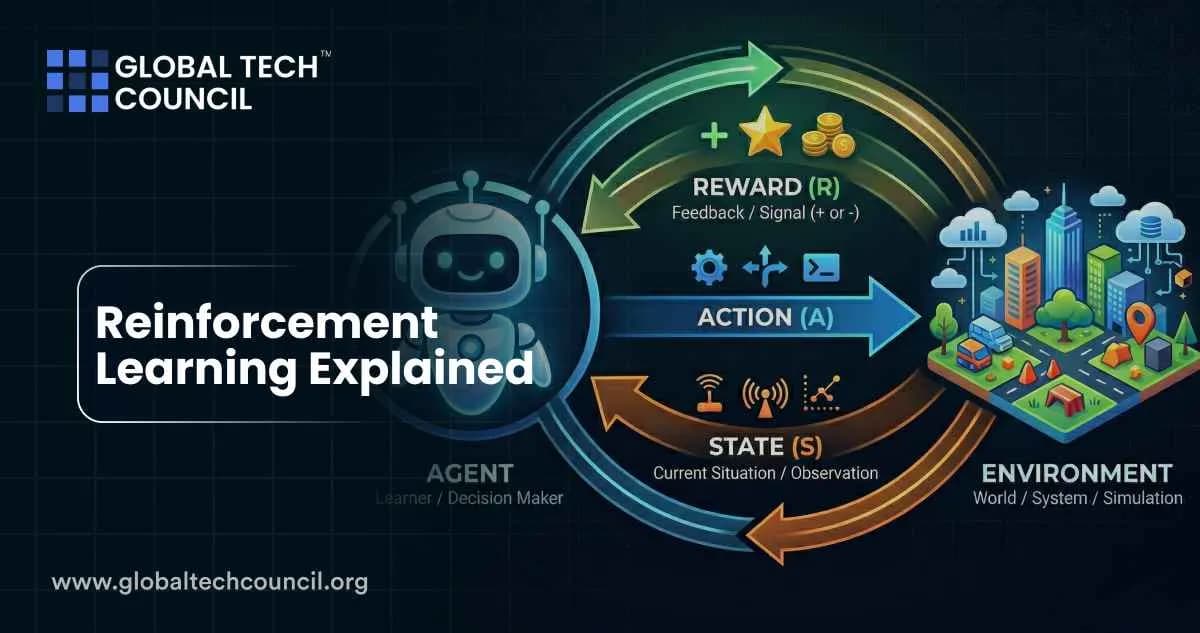
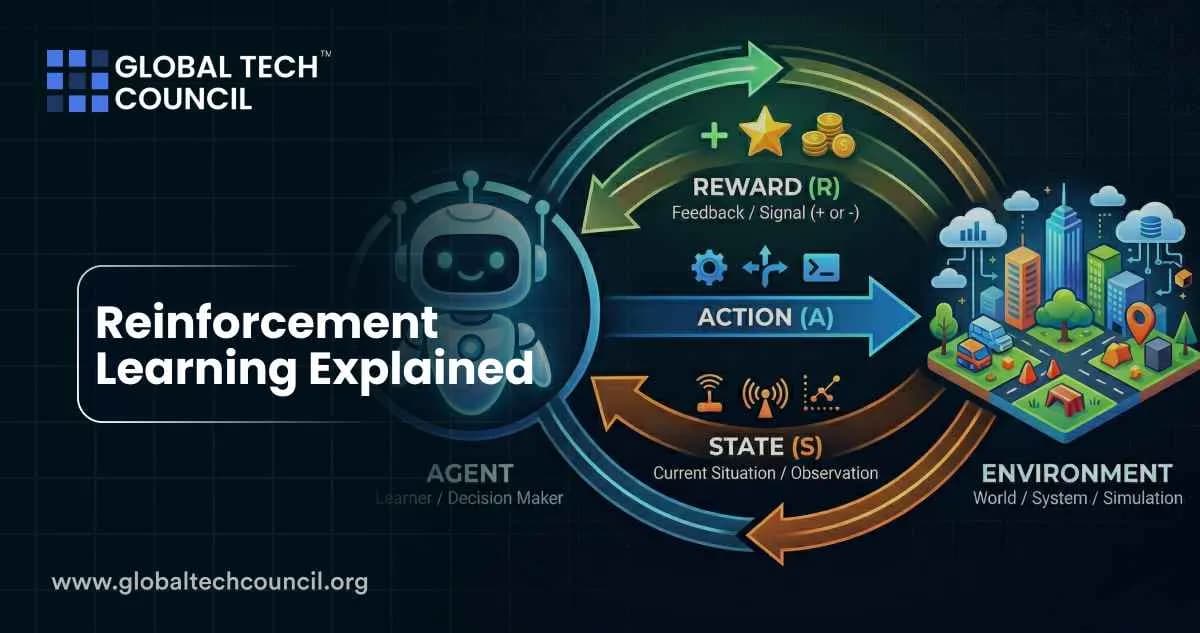 Reinforcement learning is one of the most important branches of artificial intelligence because it teaches machines how to make decisions through experience. Instead of learning only from labeled examples, a reinforcement learning system improves by interacting with an environment, taking actions, and receiving rewards or penalties. Over time, it learns which choices lead to better outcomes and which ones should be avoided.
This approach matters because many real-world problems are not solved in one step. They involve a sequence of decisions where each choice affects what happens next. A robot navigating a room, a game-playing system choosing a strategy, or an autonomous process optimizing resources all need to think in terms of long-term results. Reinforcement learning is designed for exactly these situations.

As interest in AI continues to grow, many professionals build their foundation through programs such as AI Expert certification, Agentic AI certification, AI Powered coding expert certification, deeptech certification, and AI powered digital marketing expert. These learning paths help professionals understand both core AI concepts and practical applications across industries.
This article explains reinforcement learning in a simple, clear, and SEO-friendly way. It covers what reinforcement learning is, how it works, its main components, common algorithms, real-world uses, benefits, challenges, and future potential.
A Simple Definition of Reinforcement Learning
Reinforcement learning, often called RL, is a type of machine learning in which an agent learns how to behave in an environment by taking actions and receiving feedback. The feedback comes in the form of rewards for good decisions and penalties or lower rewards for poor decisions.
The goal is not just to succeed once. The goal is to learn a strategy that produces the highest total reward over time. That makes reinforcement learning different from systems that only focus on immediate outcomes.
A simple way to understand this is to imagine teaching a pet. When the pet performs the correct action, it gets rewarded. When it does something unhelpful, it gets no reward or a correction. Over time, it learns which behaviors lead to better results. Reinforcement learning works in a similar way, except the learner is an algorithm and the mistakes are usually faster, cheaper, and less emotional than human ones.
Why Reinforcement Learning Matters in Artificial Intelligence
Reinforcement learning matters because many problems in AI involve decision-making over time. In these problems, one action changes the next situation, so the system must think beyond the present moment.
This makes reinforcement learning valuable in fields such as robotics, automation, game AI, route planning, recommendation systems, industrial control, and adaptive optimization. It is especially useful when there is no single correct answer for every step, but there is a clear objective that can be improved over repeated attempts.
For example, a self-driving system must make thousands of connected decisions while responding to changing conditions. A recommendation engine may need to optimize not just for one click, but for long-term user satisfaction. A robot must learn how to move efficiently, not just how to complete one isolated motion. Reinforcement learning helps solve these long-term decision problems.
The Main Building Blocks of Reinforcement Learning
To understand how reinforcement learning works, it helps to know its core components.
Agent
The agent is the decision-maker. It is the part of the system that observes the environment, chooses actions, and learns from results.
Environment
The environment is everything the agent interacts with. It could be a game, a factory, a robot workspace, a simulated road, or even a recommendation platform.
Action
An action is a choice the agent makes. Depending on the application, an action might mean moving left, selecting a product, changing speed, or adjusting a robotic arm.
Reward
A reward is the feedback the agent receives after taking an action. Positive rewards encourage useful behavior. Negative rewards or weak rewards discourage poor choices.
State
A state is the current situation of the environment. It gives the agent the information it needs to decide what to do next.
These components work together in a learning loop that gradually improves the agent’s behavior.
How Reinforcement Learning Works Step by Step
Reinforcement learning follows a repeated cycle of interaction and improvement.
First, the agent observes the current state of the environment. Then it selects an action based on what it has learned so far. After that action is taken, the environment changes and gives feedback in the form of a reward. The agent then updates its strategy so it can make better decisions in future situations.
This process repeats many times. In simple environments, learning may happen quickly. In complex environments, the system may need thousands or even millions of interactions before it performs well. Machines, as usual, demand extreme repetition before they become useful. Humans do too, but they call it experience and add motivational quotes.
The Role of Policy, Value, and Feedback
Several important ideas shape how reinforcement learning systems improve.
Policy
A policy is the strategy the agent uses to choose actions in each state. It can be simple or highly sophisticated depending on the task.
Value Function
A value function estimates how good a state or action is in terms of future reward. This helps the agent judge long-term benefit instead of focusing only on the immediate result.
Episode
An episode is one complete run of interaction from a starting point to an ending point. For example, one full game or one full robot task can be considered an episode.
Exploration and Exploitation
A reinforcement learning system must balance two behaviors. Exploration means trying new actions to discover better options. Exploitation means using actions that already seem effective.
If the agent explores too much, it wastes time on poor choices. If it exploits too soon, it may miss better strategies. Balancing these two is one of the most important challenges in reinforcement learning.
A Real-World Example That Makes RL Easier to Understand
Imagine a robot vacuum learning how to clean a room more efficiently.
The vacuum is the agent. The room is the environment. Its actions include moving forward, turning, or changing direction. The rewards may depend on how much dirt is collected, how much floor is covered, and whether collisions are avoided.
At first, the vacuum may move randomly and perform poorly. Over time, it begins to learn which movement patterns clean more area while avoiding furniture. Eventually, it develops a strategy that works better than random motion.
This is the power of reinforcement learning. The system does not need every step to be manually programmed. It improves through experience.
Different Types of Reinforcement Learning
Reinforcement learning can be grouped into several major approaches.
Model-Free Reinforcement Learning
In model-free reinforcement learning, the agent learns directly from interaction without building a formal model of how the environment works. This is common because many real-world environments are too complex to model accurately.
Model-Based Reinforcement Learning
In model-based reinforcement learning, the agent uses or learns a model of the environment. This can improve efficiency because the agent can plan ahead instead of relying only on trial and error.
Value-Based Methods
These methods estimate how valuable actions or states are and use those estimates to guide decisions. Q-learning is a classic example.
Policy-Based Methods
These methods learn the policy directly. They are especially useful when the action space is large or continuous.
Actor-Critic Methods
Actor-critic methods combine both ideas. One component chooses actions, while another evaluates how good those actions are. This often leads to more stable learning.
Popular Algorithms Used in Reinforcement Learning
Several algorithms have played a major role in the growth of reinforcement learning.
Q-Learning
Q-learning is one of the best-known RL algorithms. It learns a value for each state-action pair, helping the agent choose actions that are likely to produce better future rewards.
Deep Q Networks
Deep Q Networks combine Q-learning with deep neural networks. This allows reinforcement learning systems to handle much larger and more complex environments, including visual input from games and simulations.
Policy Gradient Methods
Policy gradient methods improve the policy directly. They are useful when the decision space is too complex for simple value tables.
Proximal Policy Optimization
Proximal Policy Optimization, often called PPO, became popular because it offers a strong balance between performance, training stability, and practical implementation.
Temporal Difference Learning
Temporal difference learning updates value estimates using partial results before an episode ends. This makes learning faster and more efficient in many environments.
Reinforcement Learning Compared With Other Machine Learning Methods
Reinforcement learning is different from the two other major types of machine learning.
In supervised learning, a model learns from labeled examples. It is given the correct answer during training. For example, an image classifier may learn from photos labeled as dog or cat.
In unsupervised learning, the system finds patterns in unlabeled data. For example, it may group customers into clusters based on shared behavior.
In reinforcement learning, the system learns through actions and feedback over time. There is no constant stream of correct answers. Instead, the agent must discover which strategy produces the best long-term reward.
That is why reinforcement learning is particularly suited to planning, control, and adaptive behavior.
Real-World Applications of Reinforcement Learning
Reinforcement learning has produced some of the most impressive achievements in artificial intelligence and continues to expand into practical business and technical use cases.
Game Playing
One of the most famous areas for reinforcement learning is game AI. RL systems have achieved strong performance in Atari games, chess, Go, poker, and other strategic environments. These successes demonstrated that machines can learn long-term planning through repeated experience.
Robotics
Reinforcement learning is widely used in robotics for navigation, movement, grasping, and coordination. Rather than manually programming every motion, developers can allow robots to learn better behavior through training.
Autonomous Systems
RL has applications in self-driving research, drone control, traffic signal optimization, and route planning. These systems need to make repeated decisions under changing conditions.
Industrial Optimization
Factories and production systems use reinforcement learning for scheduling, resource allocation, energy management, and process control. It helps improve efficiency in environments where many variables interact over time.
Recommendation Systems
Reinforcement learning can improve recommendation engines by optimizing not just short-term clicks, but longer-term engagement and satisfaction.
Finance and Dynamic Pricing
In some cases, RL is explored for pricing, portfolio adjustments, and strategy optimization. These applications require caution because financial environments are noisy, risky, and not particularly interested in cooperating with elegant models.
Marketing and Personalization
Reinforcement learning can improve customer engagement strategies, campaign timing, and content delivery. Professionals working at the intersection of AI and business may benefit from AI powered digital marketing expert training to better understand how intelligent systems support digital growth.
The Biggest Advantages of Reinforcement Learning
Reinforcement learning offers several important strengths.
It learns from experience rather than depending only on static examples. It is designed for sequential decision-making, which makes it ideal for real-world systems that must adapt over time. It also focuses on long-term optimization rather than just immediate gain.
Another major advantage is that RL can sometimes discover strategies humans would not have designed manually. This makes it especially powerful in complex environments where the best solution is not obvious from the start.
Professionals interested in building a broader understanding of advanced technologies often explore deeptech certification alongside AI-focused training to strengthen their knowledge of emerging technical systems.
The Main Challenges of Reinforcement Learning
Despite its strengths, reinforcement learning is difficult to build and deploy well.
One major challenge is sample inefficiency. Many RL systems need a huge number of interactions to learn effectively, which makes training expensive and time-consuming.
Another challenge is reward design. If the reward function is poorly designed, the agent may learn strange behavior that technically maximizes reward while failing the real objective. Machines are extremely talented at following the wrong metric with perfect commitment.
Safety is another issue. In robotics, transport, or physical automation, a poor decision can lead to real damage. There is also the problem of transferring knowledge from simulation to the real world. A system may perform well in training but struggle outside the controlled environment.
For people interested in building both theoretical and practical AI skills, AI Powered coding expert certification can be useful because real reinforcement learning work often depends heavily on strong programming ability.
Reinforcement Learning and the Future of Agentic AI
Reinforcement learning is increasingly important in discussions about advanced AI systems that can plan, adapt, and act across multiple steps. This is closely related to the rise of agentic AI, where systems are designed to pursue goals more independently.
As AI tools become more capable, reinforcement learning may play a growing role in autonomous assistants, robotics, industrial systems, and adaptive decision engines. Learners who want to understand these next-generation systems often pursue Agentic AI certification to deepen their knowledge of decision-making, planning, and intelligent workflows.
How Beginners Can Start Learning Reinforcement Learning
Reinforcement learning may seem advanced, but beginners can learn it step by step.
It helps to start with the basics of machine learning, probability, optimization, and neural networks. After that, learners should focus on the core concepts of state, action, reward, policy, and exploration versus exploitation.
Simple environments such as grid worlds and basic simulations are good starting points. From there, it becomes easier to understand more advanced methods such as Deep Q Networks, policy gradients, and actor-critic systems.
A structured program such as AI Expert certification can also help learners build a solid foundation in artificial intelligence before diving deeper into reinforcement learning and autonomous systems.
Final Thoughts
Reinforcement learning is a powerful branch of artificial intelligence that teaches machines how to make better decisions through trial, feedback, and repeated interaction. It is especially useful for problems that involve sequences of actions and long-term goals.
From robotics and game AI to recommendation systems and industrial optimization, reinforcement learning continues to shape the future of intelligent systems. Its strengths include adaptability, long-term planning, and the ability to improve through experience. Its challenges include training cost, reward design, safety, and real-world reliability.
For anyone who wants to understand how machines move beyond static prediction and into dynamic decision-making, reinforcement learning is one of the most important topics in modern AI.
Frequently Asked Questions
1. What is reinforcement learning in simple words?
Reinforcement learning is a type of machine learning where an agent learns by taking actions and receiving rewards or penalties.
2. What is an agent in reinforcement learning?
The agent is the decision-maker that interacts with the environment and learns from feedback.
3. How is reinforcement learning different from supervised learning?
Supervised learning uses labeled data with correct answers, while reinforcement learning learns through trial and error over time.
4. What is a reward in reinforcement learning?
A reward is feedback that tells the agent whether its action was good or bad.
5. Where is reinforcement learning used?
It is used in robotics, games, recommendation systems, autonomous systems, industrial control, finance, and marketing optimization.
6. Why is reinforcement learning important in AI?
It is important because it helps machines solve sequential decision-making problems where each action affects future outcomes.
7. What are the main challenges of reinforcement learning?
The biggest challenges include sample inefficiency, reward design, safety, and transferring results from simulation to real environments.
8. What is exploration versus exploitation?
Exploration means trying new actions to learn more, while exploitation means using actions that already appear to work well.
9. Can beginners learn reinforcement learning?
Yes. Beginners can start with basic machine learning concepts and then move into simple RL environments before studying advanced algorithms.
10. Which certifications can support learning in AI and reinforcement learning?
Useful options include AI Expert certification, Agentic AI certification, AI Powered coding expert certification, deeptech certification, and AI powered digital marketing expert.
Related Articles
View All
Reinforcement Learning
What is Reinforcement Learning?
While machine learning is seen as a monolith, with different subtypes, including machine learning, deep learning, and state-of-the-art deep reinforcement learning technology, this cutting-edge technology is diversified. Artificial intelligence is rising by leaps and bounds, with an approximate…
Reinforcement Learning
Reinforcement Learning: Difference between Q and Deep Q learning
Artificial Intelligence has an estimated market of 7.35 billion US dollars and is growing by leaps and bounds. As predicted by McKinsey, AI, including reinforcement learning and deep learning techniques, can create $3.5 to 5.8 trillion dollars across nine businesses in 19 industries. Machine…
Trending Articles
The Role of Blockchain in Ethical AI Development
How blockchain technology is being used to promote transparency and accountability in artificial intelligence systems.
AWS Career Roadmap
A step-by-step guide to building a successful career in Amazon Web Services cloud computing.
Top 5 DeFi Platforms
Explore the leading decentralized finance platforms and what makes each one unique in the evolving DeFi landscape.