


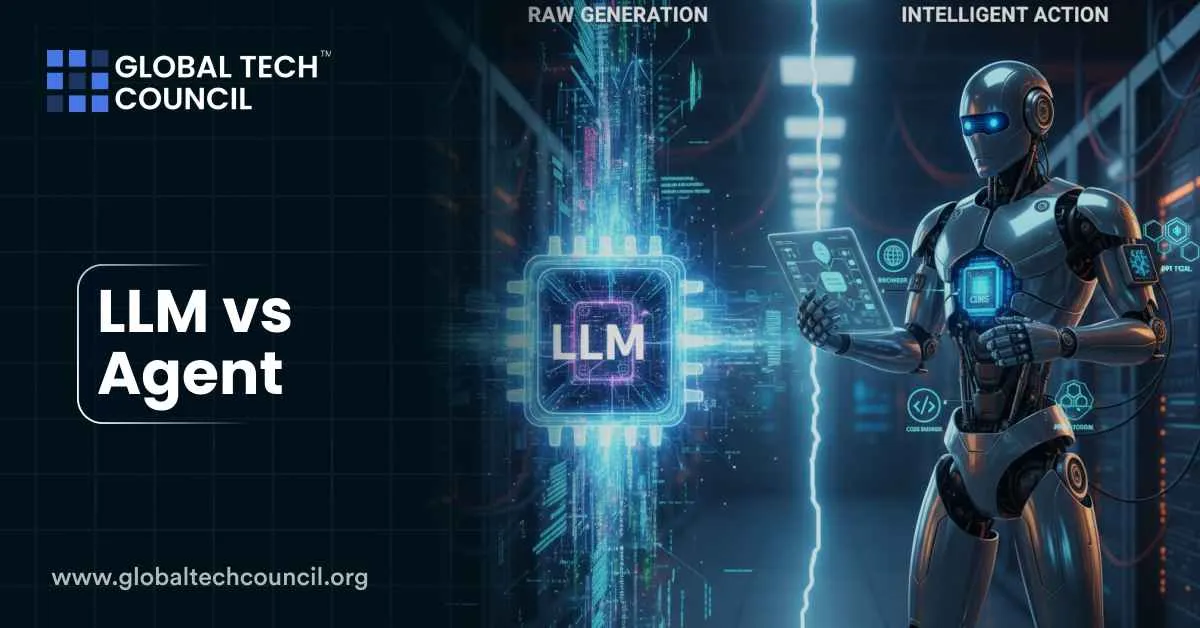
 As AI systems become more capable, organizations are discovering that large language models and AI agents are not two versions of the same technology. They represent different layers of intelligence, solve different categories of problems and require different implementation strategies. Companies planning to deploy advanced AI workflows often begin with foundational learning through programs like the Tech Certification because understanding the gap between LLMs and agents is now essential for building scalable enterprise solutions.
What an LLM Actually Does
A large language models predicts text based on patterns learned from data. It excels at:
- Reasoning through language
- Summarizing information
- Writing or transforming content
- Interpreting instructions
- Offering recommendations or explanations
However, an LLM’s interaction is limited to the immediate request. Once it produces an output, the process ends. It cannot monitor systems, store long term state or pursue objectives over time. Its operation is strictly single turn, even when wrapped in conversational interfaces.
Key characteristics of LLMs:
- They do not decide what to do next
- They lack persistent context beyond the window
- They cannot trigger tools without external scaffolding
- They do not evaluate whether their actions succeeded
- They are reactive instead of proactive
Even at the highest capability levels, an LLM remains a prediction engine, not an autonomous system.
What an Agent Does Differently
Agents extend LLMs by adding layers of control, memory and action. An agent is built to behave more like a system component than a text generator. It can:
- Maintain internal state across steps
- Break tasks into plans
- Use tools such as APIs, shells or automation scripts
- Evaluate results and correct mistakes
- Continue working until a goal is satisfied
Agents decide what to do next instead of waiting for a user’s next instruction. This shifts AI from being a passive assistant to an active participant in operations.
Enterprises studying workflow transformation often turn to strategic learning programs like the Marketing and Business Certification because the rise of agents changes work distribution, operational design and how human teams interact with AI.
Why LLMs Cannot Behave Like Agents
The gap between the two is structural. Several critical capabilities cannot be added to an LLM through prompting alone.
LLMs do not store long term memory
They operate only within the limits of their current context window. Agents track progress and maintain working memory.
LLMs cannot take actions
They cannot run API calls, execute commands or modify system states without an external action layer.
LLMs cannot evaluate outcomes
If asked to solve a problem, they produce an answer but cannot check if it truly works in a live system.
LLMs cannot initiate
They do not monitor environments or start tasks on their own.
This is why prompting alone cannot transform an LLM into an agent.
Why Agents Cannot Replace LLMs
Agents still depend on LLMs for reasoning. Without LLMs, agents cannot analyze instructions, interpret results or generate meaningful decisions. Agents provide autonomy. LLMs provide intelligence.
Removing LLMs from an agent makes the system blind. Removing agent scaffolding from an LLM makes the system passive. They are complementary rather than interchangeable.
The Rise of Multi Agent Frameworks
Modern enterprises are experimenting with multi agent ecosystems where different agents specialize in tasks. Examples:
- A planning agent decomposes tasks
- A coding agent generates solutions
- A testing agent validates results
- A documentation agent creates summaries
- A monitoring agent watches system logs
Each agent uses an LLM internally, but the agent layer defines responsibility, workflow and tool permissions. These networks increase reliability because agents cross check each other’s work.
Multi agent designs are becoming standard in complex domains such as software engineering, finance, logistics and large enterprise operations.
LLM vs Agent
| Category | LLM | Agent | Why It Matters |
| Operation style | Single turn | Multi step | Agents complete workflows |
| Memory | Short lived | Persistent | Enables long running tasks |
| Autonomy | None | High | Agents act without prompts |
| Tools | Not built in | Tool enabled | Supports real system actions |
| Error correction | No self checking | Iterative repair cycles | Boosts reliability |
| Best use | Reasoning and content | Automation and execution | Defines deployment strategy |
This table helps decision makers evaluate which architecture fits their operational needs.
Where Enterprises Use LLMs and Agents Together
Customer service
LLMs handle conversational reasoning.
Agents classify cases, update systems and route tasks.
Engineering operations
LLMs help explain logs or code.
Agents diagnose failures, run test suites and create patches.
Enterprise knowledge systems
LLMs interpret and summarize documents.
Agents maintain context, detect changes and notify teams proactively.
Compliance and governance
LLMs analyze regulations.
Agents monitor activity patterns and detect violations.
The pairing of the two technologies creates a complete intelligence stack.
Why Agents Require Strong Governance
Agents introduce powerful capabilities, which means they also require strict control. Effective governance includes:
- Permissioned tool use
- Access policies
- Safety filters
- Rate limits
- Observability layers
- Mandatory human review steps
Engineering leaders often rely on advanced training like the Deep Tech Certification to understand safe deployment patterns, agent policy design and long term autonomy management.
The Strategic Shift Ahead
LLMs introduced natural language intelligence into organizations. Agents introduce operational intelligence. LLMs answer questions. Agents complete tasks. LLMs help humans think. Agents help systems act.
Enterprises that only deploy LLMs will gain productivity improvements. Enterprises that deploy agent architectures will gain automation, acceleration and continuous operational enhancement.
Final Thoughts
The future of AI is not choosing between LLMs and agents but combining them intelligently. LLMs provide the flexible reasoning engine. Agents provide the structured autonomy needed for real world outcomes. Organizations that understand the boundary between the two will be best positioned to build safe, scalable and high performance AI systems.