


 AI is very good at talking about places. It can describe cities, summarize travel tips, explain geography concepts, and give broad regional context. The gaps appear when people expect AI to operate like a map, a navigation engine, or a live geographic system.
When users rely on AI for routes, borders, maps, or local time, mistakes show up quickly. The core issue is not intelligence. It is that geography requires spatial logic, live constraints, and precise connections. Many people only recognize this difference after learning how real systems work through applied paths such as a Tech certification, where the line between explanation and execution becomes clear.
Route planning
Routing is one of the most common failure points.
People regularly encounter AI suggestions that underestimate travel time, describe routes that do not actually connect, or imply roads and crossings that do not exist. These errors are not random. Routing depends on structured road graphs, turn restrictions, terrain limits, ferries, borders, and distance calculations.
Unless AI is directly connected to a live mapping system, it is not computing a route. It is predicting what a route description usually sounds like. That distinction matters when accuracy affects safety, timing, or cost.
Borders and crossings
Border related questions expose another weakness.
AI often blends correct high level advice with incorrect specifics. It may sound confident about vehicle rules, permits, or crossings that are restricted or temporarily closed. Sometimes it references official guidance without actually tying the answer to a verifiable source.
Anything involving border crossings, restricted zones, insurance rules, or temporary access should be treated as verify only. These are legal and operational constraints that change frequently and require authoritative confirmation.
AI generated maps
Map generation highlights the problem even more clearly.
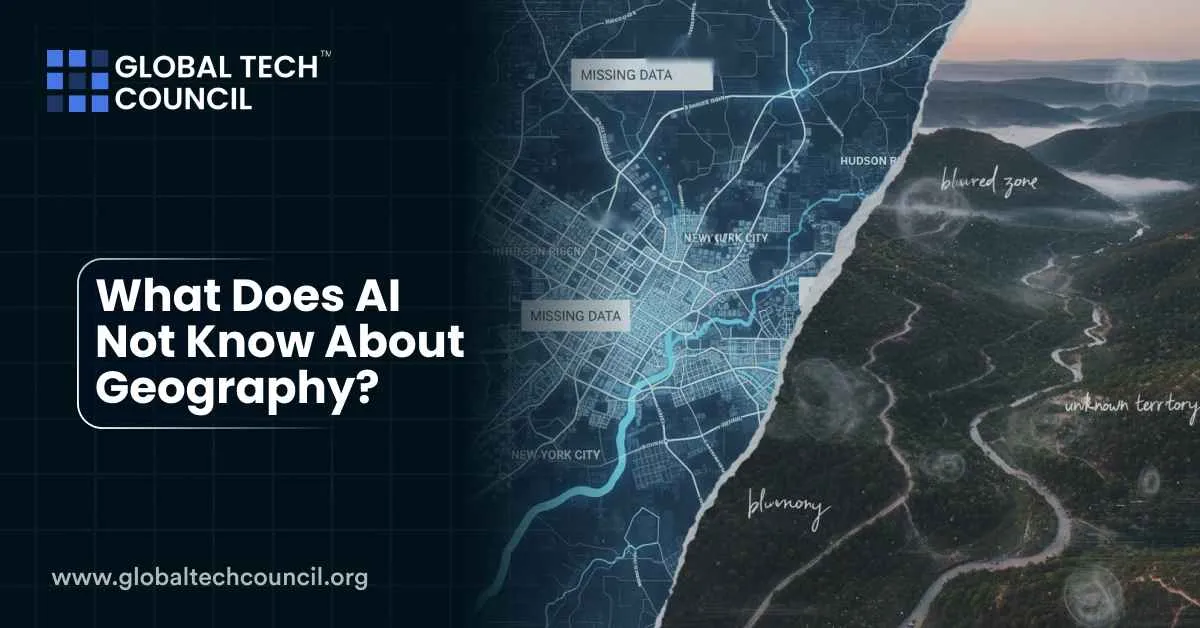
AI generated maps frequently include invented place names, distorted coastlines, missing regions, or labels that look plausible but are wrong. These outputs resemble maps visually, but they are not bound by cartographic truth.
Image models learn visual patterns. They do not store or validate real world geography. This makes AI generated maps one of the most convincing and dangerous failure cases when users assume visual accuracy equals correctness.
Spatial interpretation errors
Even when analyzing real maps, AI tends to overgeneralize.
Users notice that AI often produces clean narratives about regions while missing important local exceptions. When asked to explain geographic patterns or data distributions, it may prioritize a smooth explanation over addressing edge cases that contradict the story.
Geography is full of exceptions. AI is optimized for coherence, not for highlighting irregularities.
Fine grained location guesses
Another common experience is partial accuracy that feels impressive but fails where it matters.
AI may correctly identify a general region from an image or description, then confidently guess a specific street, neighborhood, or landmark that turns out to be wrong. The explanation sounds detailed, but the precision is inferred, not verified.
For practical use, AI performs better at broad location context than at street level accuracy.
Time zones and local time
Time zones appear simple, yet they cause frequent issues.
Users report AI giving incorrect local times, mixing dates across regions, or inventing timestamps. This happens because many AI systems do not have live clock access unless explicitly connected to a time tool.
Without a real time source, AI generates answers that sound reasonable rather than answers that are correct.
Why these mistakes keep happening
All of these issues point to the same underlying limitation.
AI does not maintain an internal spatial model of the world. It learns patterns about geography rather than operating on geography itself.
Many geographic tasks require graph logic, legality checks, live updates, and precise spatial relationships. When those are missing, AI fills the gaps with language. That language can sound confident and structured while still being wrong.
Understanding this difference between explanation and operation is central to advanced system design and is often explored through deeper infrastructure focused learning with organizations like the Blockchain Council.
How experienced users work around this
People who rely on geography in real situations develop consistent habits.
They use AI to brainstorm routes, summarize travel considerations, and understand regional context. Then they verify everything that matters using dedicated tools such as navigation apps, community location platforms, and official government or border authority sites.
AI becomes a thinking partner, not a source of geographic truth.
Common geography blind spots to remember
Based on repeated real world use, AI struggles most with physical connectivity, accurate long distance travel time, border feasibility, correct map generation, subtle regional exceptions, precise street level identification, and local time accuracy without tools.
Knowing these limits prevents frustration and reduces risk.
What this means for everyday use
AI is not bad at geography. It is bad at pretending to be a map.
Once users understand this boundary, AI becomes far more useful. You stop asking it to replace navigation systems and start using it to think more clearly before opening one.
This distinction also matters in professional settings where AI outputs influence planning, logistics, or decision making. Translating AI insight into real world action requires both technical understanding and business judgment, which is why many teams pair system level learning with execution focused paths like Marketing and Business Certification.
Conclusion
So what does AI not know about geography?
It does not reliably understand physical connectivity, legal constraints, live conditions, or fine grained spatial truth unless it is explicitly connected to authoritative tools.
AI explains geography well. It struggles to operate inside it.
Once you respect that boundary, AI becomes a powerful assistant instead of a misleading guide.