


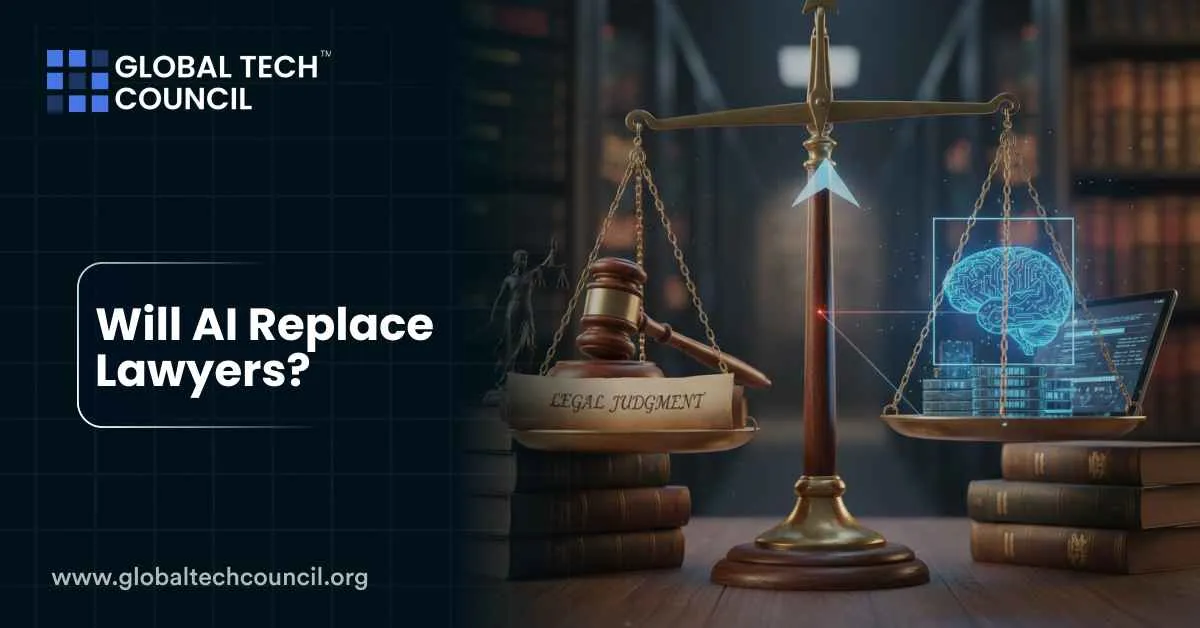
 AI tools can now draft contracts, summarize cases, and scan thousands of documents in seconds. That naturally leads to one big question for anyone watching the legal profession closely: will AI replace lawyers?
The grounded answer from inside the legal world is more practical than dramatic. AI is not replacing lawyers as licensed professionals. What it is doing is changing how legal work is produced, how teams are structured, and which skills actually matter. Tasks are being automated first, and once that happens, hiring patterns, junior roles, and billing expectations begin to shift.
Understanding this difference between automation and replacement is easier when you understand how real systems behave, which is why many professionals begin with structured learning through a Tech Certification before trusting AI in high-stakes environments like law.
How lawyers are actually using AI today
Inside law firms and legal departments, AI is rarely treated as an autonomous decision-maker. It is treated as an efficiency layer.
Common uses include improving the clarity and structure of legal writing. Lawyers use AI to tighten arguments, clean up tone, and remove repetition in briefs, memos, and correspondence. Another frequent use is producing first drafts of routine documents. Standard clauses, simple agreements, and internal templates often begin with AI and then go through heavy human editing.
AI is also used to compare clauses across contracts, surface boilerplate variations, and summarize long source material when lawyers provide the text themselves. In these scenarios, trust comes from controlled inputs and careful review.
The pattern is consistent. AI reduces the time spent on first passes. Lawyers remain responsible for legal accuracy, strategy, and judgment.
Where AI breaks down in legal work
This is where replacement stops being realistic.
AI systems still hallucinate case law, fabricate citations, and invent quotations. Even when challenged, they can confidently produce more incorrect material. Lawyers have repeatedly documented these failures in real practice.
AI also struggles with jurisdiction-specific rules. Filing deadlines, local procedures, venue requirements, and court-specific practices are frequently missed or misapplied. In law, these details are not optional. Getting them wrong can derail an entire case.
Courts have already sanctioned lawyers for submitting filings that included AI-generated fake citations. These incidents are now part of legal education and compliance training. The lesson is clear. In law, being confidently wrong is far more dangerous than being slow.
This reality is why deeper system-level understanding matters. Many legal professionals who work closely with AI explore advanced learning paths such as deep tech certification programs to understand why models fail, how hallucinations arise, and where guardrails must exist.
The real impact on junior lawyers
The biggest visible change is happening at the junior level.
Work that once went entirely to first-year associates is now partially automated. Drafting basic documents, summarizing records, and preparing initial research outlines take less time. As a result, firms can often produce the same output with fewer junior staff.
This does not mean junior lawyers are obsolete. It means their work is changing. Instead of spending most of their time drafting from scratch, juniors increasingly focus on verification, citation checking, fact alignment, exhibit preparation, and tailoring arguments to specific judges or clients.
There is real concern about training pipelines. If juniors spend less time doing foundational drafting, firms must intentionally redesign how judgment and legal reasoning are taught. This is an operational challenge, not a signal that lawyers are being replaced.
AI and self-represented litigants
Another pressure point comes from outside law firms.
Self-represented parties are using AI to draft filings, motions, and complaints. Lawyers and judges report seeing documents that look polished but contain incorrect citations, mismatched captions, or entirely fabricated authority.
Some courts respond with warnings or sanctions. Others acknowledge that AI may be the only accessible help for people who cannot afford legal representation. This tension is already playing out in real courtrooms.
AI expands access to legal language, but it does not replace legal responsibility. That gap is not theoretical. It shows up in filings every week.
So will AI replace lawyers?
In practice, replacement looks like structural change rather than disappearance.
Individual lawyers can handle more work because AI reduces drafting and review time. That can reduce overall headcount without eliminating the profession. Junior roles evolve rather than vanish. Clients push back harder on billing for tasks that software clearly accelerates.
The profession becomes more output-focused and less tolerant of inefficiency.
Why lawyers are difficult to replace
Across legal communities, several reasons come up repeatedly.
Only licensed lawyers are allowed to practice law and take responsibility for outcomes. That accountability cannot be delegated to software. Legal mistakes carry high downside risk including sanctions, malpractice claims, and irreversible harm to clients.
Clients also do not pay lawyers only for documents. They pay for judgment, negotiation, risk assessment, and advocacy. These are relational and strategic functions that depend on human trust.
AI can support these activities. It cannot own them.
How law firms are adapting
This shift is already visible in operations.
Many firms are appointing internal AI leads or committees. Training programs now include guidance on when AI is allowed, how outputs must be reviewed, and how confidentiality is protected. Legal tech vendors are hiring large numbers of lawyers to help design workflows that combine human judgment with automation.
To stay relevant, lawyers are also expanding their skill sets. Some deepen their understanding of systems and infrastructure through technical learning. Others focus on client communication, pricing models, and practice management.
As AI becomes embedded in client delivery, firms increasingly recognize that adoption is not just a technical issue. It is a business and change management issue. That is why legal leaders often complement technical knowledge with programs like Marketing and Business Certification to align AI use with client expectations, ethics, and firm strategy.
What this means for the future of legal careers
The question lawyers now face is not whether AI will be used. That decision has already been made.
The real question is whether a role depends primarily on judgment, accountability, and trust, or on repetitive tasks that software can now perform faster. Careers built around the first category remain resilient. Roles built around the second category will continue to change.
Conclusion
AI is not replacing lawyers outright. It is replacing parts of legal work that once justified long hours, large teams, and slow processes. That still reshapes hiring, training, and career paths in meaningful ways.
For anyone working in law or planning to enter the profession, the most important shift is mental. Stop asking whether AI will replace lawyers. Start asking which parts of your work create value that cannot be automated.
That distinction is already deciding who remains essential.