


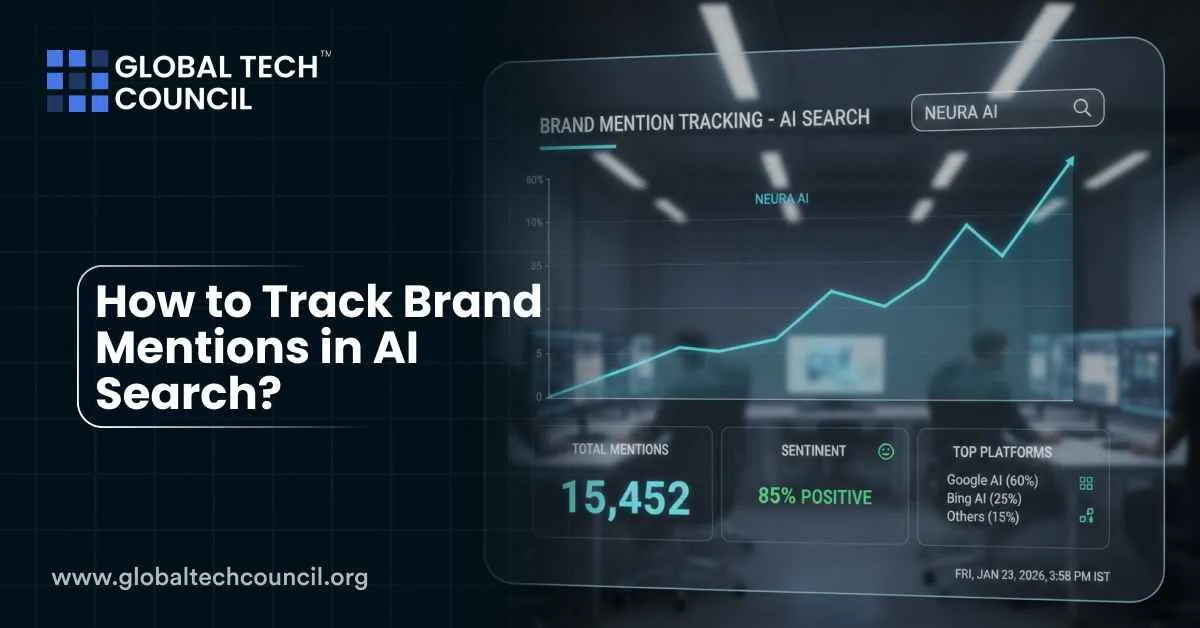
 Tracking brand mentions in AI search means understanding how often AI systems talk about your brand, whether they credit your site, and how they position you when answering real user questions. There is no built-in report inside Google AI Overviews, ChatGPT, or Perplexity that shows this clearly. Teams that do this well combine prompt tracking, AI visibility tools, and analytics to see both exposure and impact.
To do this properly, it helps to understand how AI systems generate answers and reuse sources. That technical grounding is why many teams approach this work with a Tech Certification mindset, focusing on verification and repeatable measurement rather than assumptions.
What brand mentions mean in AI search
In practice, brand mentions in AI search fall into three clear categories.
Mentions
Your brand name appears directly in the AI-generated answer.
Citations
The AI links to your site or explicitly names it as a source.
Positioning
The AI recommends you, compares you, or frames you neutrally or negatively.
Most AI visibility tools are built around these signals because they reflect how AI answers shape perception, even when no click happens.
Manual checks to set a baseline
Before using tools, many teams start with manual tracking to understand where they stand.
A typical approach looks like this:
- Build a list of 20 to 50 real prompts customers would ask
Best tools for X
X vs competitor
Is X worth it
Alternatives to X
Pricing of X - Run those prompts across key AI surfaces
Google AI Overviews
ChatGPT
Perplexity - Save proof
Copy the full answer text
Note which sources are cited
Capture screenshots for reporting
This step is useful for learning patterns. Teams usually move on because manual checks do not scale and AI answers change often.
Using AI visibility tools
Most practitioners adopt tools when they need consistency and history.
Common capabilities include:
- Running prompt lists on a schedule
- Logging full AI answers, not just scores
- Tracking mentions, citations, sentiment, and competitors
- Saving historical snapshots to compare over time
Tools frequently discussed by practitioners include:
- ZipTie for full prompt tracking and exports across major AI engines
- Ahrefs Brand Radar for broader share-of-voice analysis
- CoreMention for competitive AI visibility scoring
A common lesson from users is simple. If a tool does not store the exact prompt and full response, explaining results to leadership becomes difficult.
Tracking where AI pulls sources from
Many teams are surprised to learn that AI often cites third-party pages instead of the brand’s own site.
Because of that, AI mention tracking is usually paired with:
- Monitoring unlinked brand mentions across the web
- Watching Reddit, Quora, GitHub, and review platforms
- Tracking directories and comparison pages that frequently rank
Understanding how content is indexed and reused across these surfaces aligns closely with deeper system-level thinking taught in Deep Tech Certification programs.
Measuring traffic and outcomes
Not every AI mention leads to a visit, but some do.
To measure impact:
- Set up custom channel groups or filters in GA4
- Track referrers such as chat.openai.com, perplexity.ai, and gemini.google.com
- Review landing pages, conversions, and assisted conversions
Teams often note that GA4 can misclassify this traffic, so manual validation is important before trusting automated reports.
Common challenges teams face
When tracking brand mentions in AI search, several issues come up repeatedly.
Location and context variation
AI answers change by country, login state, and session context.
Mentions without credit
Your brand may be named, but the citation goes to another site.
Brand-only tracking gaps
Category and comparison prompts usually drive more exposure than brand-name searches.
A practical tracking workflow
Most teams follow a repeatable setup like this:
- Build a realistic prompt set
Brand-focused queries
Category-level questions
Comparison prompts
Problem-based queries
- Run prompts across AI surfaces
Google AI Overviews
ChatGPT
Perplexity - Log results in an auditable format
Prompt
Date
Platform
Mention yes or no
Citation yes or no with URL
Screenshot or saved response
- Add external monitoring
Reddit
Quora
Review platforms
- Measure outcomes
AI referrals in GA4
Assisted conversions
Changes in branded search
This approach ties AI visibility to business results, which is why it often fits naturally within a Marketing and Business Certification framework rather than pure SEO reporting.
Tips from real users
Teams that get reliable insights avoid robotic prompts. They build prompts from:
- Sales calls and objections
- Support tickets
- Real comparison questions customers ask
- People Also Ask-style queries
This keeps tracking aligned with how users actually search and talk.
Conclusion
Tracking brand mentions in AI search is about visibility, proof, and context. You need to know when your brand appears, where the credit goes, and how the AI frames you. Manual checks help you learn, tools help you scale, and analytics help you connect mentions to real outcomes. Teams that succeed treat AI search as a new discovery layer and track it with the same discipline they apply to traditional search and brand monitoring.