


 Understanding relationships in data is important, but knowing why things happen is even more powerful. That is the promise of causal inference in machine learning. While traditional predictive models focus on correlations, causal inference seeks to identify cause-and-effect relationships. This article explores the foundations of causal inference, how it applies to machine learning, recent developments, real-world applications, and why professionals with the right skills and certifications are increasingly sought after in this area.
What Is Causal Inference?
Causal inference is the process of drawing conclusions about how changes in one variable cause changes in another. In contrast to correlational analysis, which only identifies patterns, causal inference attempts to answer questions such as: Does increasing advertising spend cause higher sales? or How does a new treatment affect patient outcomes?
In medicine, for example, researchers want to know whether a new drug improves recovery rates, not just that it is statistically associated with better outcomes. Causal inference provides frameworks and tools to make such determinations, even when randomized controlled trials are not feasible.
Differences Between Correlation and Causation
- Correlation means two variables move together. A rise in ice cream sales might correlate with greater sunscreen purchases, but one does not cause the other.
- Causation means a change in one variable directly influences another. A causal model would explore whether a policy change led to measurable behavior change.
Traditional machine learning models excel at finding correlations, but they can mislead if used to infer causation. Causal inference supplements ML with techniques that explicitly model causal relationships.
Key Concepts in Causal Inference
Causal Graphs
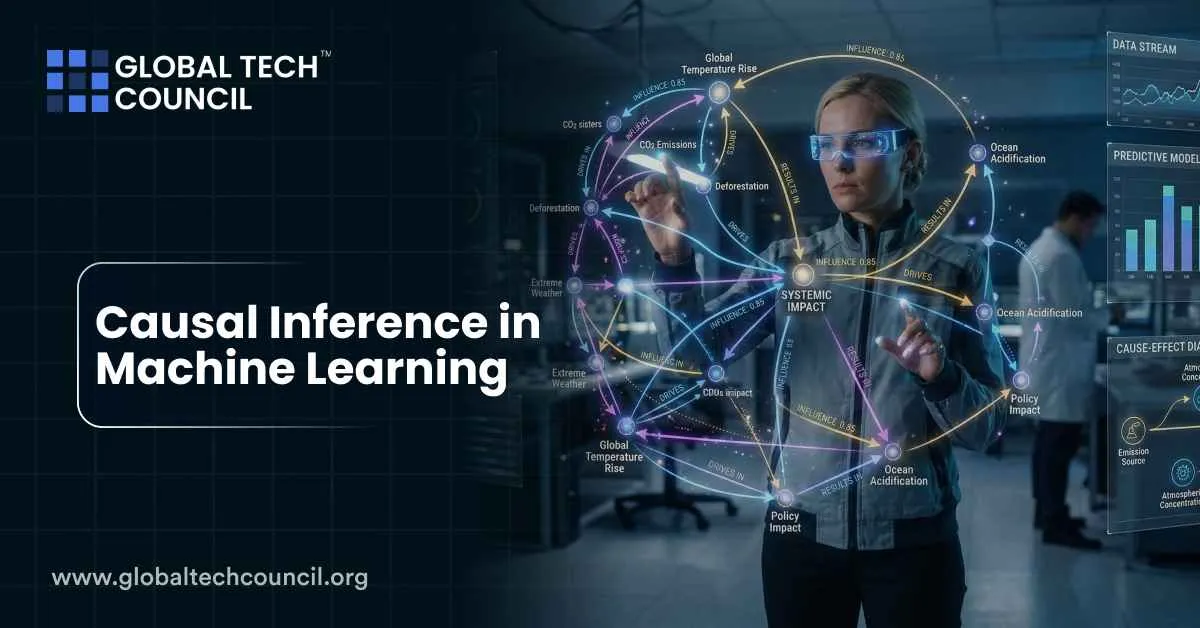
Causal graphs (also known as directed acyclic graphs or DAGs) represent variables as nodes and causal effects as directed edges. These graphs help researchers visualize assumptions and guide analytical steps.
Counterfactuals
A counterfactual asks “What would have happened if we had done something differently?” For example, what would a customer’s purchasing behavior look like if they had not received a discount?
Interventions
Instead of merely observing data, researchers simulate interventions to understand effects. In healthcare, this could involve simulating different treatment plans to gauge outcomes.
How Causal Inference Enhances Machine Learning
Machine learning excels at recognizing patterns, but it struggles with understanding underlying causal mechanisms. Causal inference helps by:
- Improving decision making: Models that understand cause and effect can suggest actions with predictable outcomes.
- Reducing bias: Standard ML models may latch onto spurious correlations. Causal methods help differentiate signal from noise.
- Enabling robust predictions: Causal approaches tend to generalize better when the data distribution changes.
For instance, an e-commerce company using causal inference can evaluate whether personalized recommendations caused increased sales, beyond mere association, and can adjust strategies accordingly.
Tools and Methods
Randomized Controlled Trials (RCTs)
RCTs remain the gold standard for causal inference, but they can be expensive, unethical, or impractical in many settings. Machine learning offers alternatives that work with observational data.
Propensity Score Matching
This method balances treatment and control groups on observed characteristics so causal effects can be estimated more reliably.
Instrumental Variables
When uncontrolled confounders exist, instrumental variables act as proxies to help isolate causal effects.
Causal Forests and Do-Calculus
Causal forest methods adapt decision trees for causal effect estimation, while do-calculus provides formal rules for reasoning about interventions.
Recent Advances
Causal inference has seen rapid growth with advances in both theory and computational tools.
Integration With Deep Learning
Researchers are combining causal models with neural networks to build systems that can perform causal reasoning on complex, high-dimensional data such as images and time series.
Confounding Adjustment With Big Data
With large datasets, new algorithms can better adjust for hidden confounders, improving the reliability of causal effect estimates.
Causal Discovery
Automated techniques for learning causal structures from data are emerging. These methods aim to uncover causal links without extensive domain knowledge.
Real-World Examples
Healthcare
In clinical research, causal inference helps evaluate the effectiveness of treatments when randomized trials are not possible. For example, researchers may use EHR data to estimate how a new protocol affects recovery time, accounting for confounders such as age and prior health conditions.
Marketing and Business Strategy
Businesses use causal inference to understand which marketing actions drive measurable results. Instead of only noting that more ad impressions correlate with sales, causal models help determine which campaigns actually caused increased conversions. This is particularly relevant for professionals pursuing Marketing Certification, as modern marketing analytics increasingly involves causal reasoning techniques.
Policy Analysis
Governments use causal inference to assess the impact of interventions like tax changes, subsidies, or public health campaigns. By comparing regions with different policies and adjusting for underlying differences, policymakers can identify causal effects.
Autonomous Systems
In autonomous vehicles, understanding causation is critical for safety. Causal models help systems reason about how different actions (e.g., braking, swerving) influence outcomes in dynamic environments.
Challenges and Limitations
Despite its power, causal inference is complex. Challenges include:
- Hidden confounders: Variables that influence both cause and effect can bias results.
- Model assumptions: Many methods rely on assumptions that may not hold in real data.
- Computational complexity: Advanced causal discovery algorithms can be resource-intensive.
Addressing these issues requires both domain knowledge and expertise in causal techniques.
Skills and Certification
As causal inference becomes more central to data science and machine learning, organizations are seeking professionals with the right blend of analytical and practical skills. Structured learning pathways such as Tech certification help professionals acquire foundational knowledge in AI, machine learning, and data reasoning.
Programs such as the Certified Artificial Intelligence Expert — available through the Global Tech Council — offer formal training on machine learning fundamentals, including aspects of causal reasoning and analysis.
Broader certification platforms like Blockchain Council offer training across emerging technologies. Pursuing a mix of technical credentials — including those focused on AI, Blockchain, and Crypto — positions professionals to tackle real-world analytical challenges.
Conclusion
Causal inference bridges the gap between correlation and understanding. By integrating causal reasoning with machine learning, organizations can make more actionable decisions and reduce the risk of misleading conclusions. As this field continues to evolve, the demand for skilled professionals and robust analytical frameworks will only grow. Those who invest in their expertise — whether through AI, Deep Tech Certification, or Marketing Certification paths — will be better equipped to harness the full potential of causal insights in the age of data.