


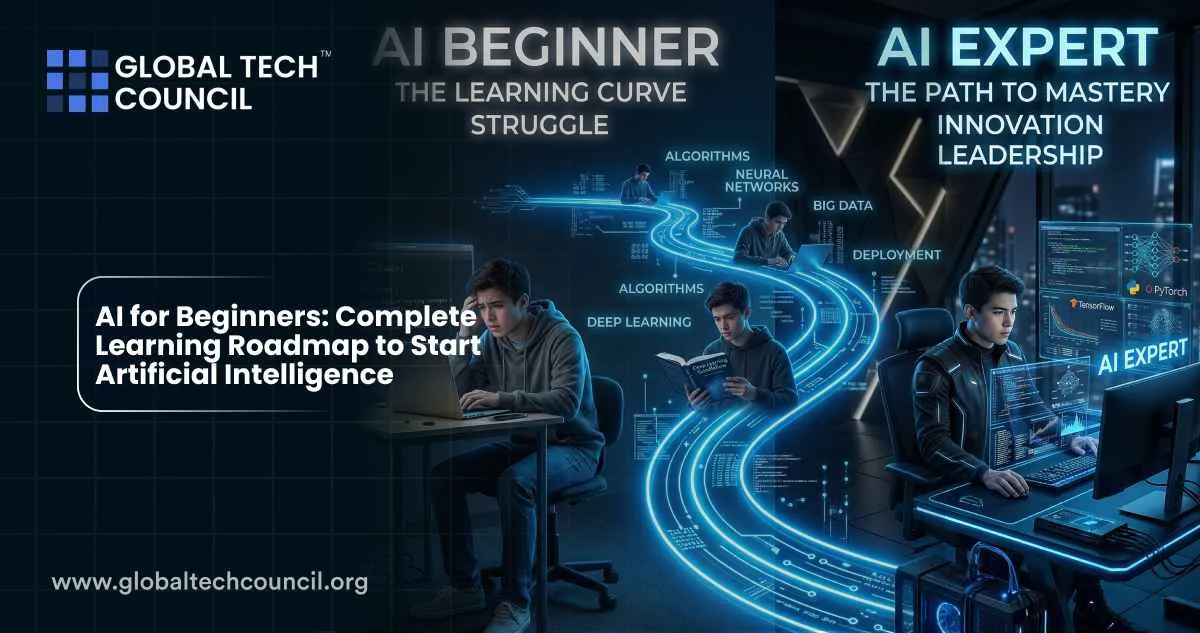
 Artificial Intelligence has become one of the most important technologies in modern business, education, software, healthcare, finance, and marketing. It powers chatbots, recommendation engines, smart search, fraud detection, content generation, voice assistants, image analysis, and coding tools. Because AI is now part of so many products and workflows, beginners are asking a very practical question: how do you start learning AI in the right way?
The difficulty is not a lack of information. It is the opposite. New learners are surrounded by tutorials, tools, trend reports, online opinions, short courses, and technical jargon. One source says begin with Python. Another says start with machine learning. Someone else insists prompt design is enough. Then another person appears to declare that you need advanced mathematics before touching anything. It is an impressively inefficient way to educate people.
The truth is much simpler. AI becomes easier when it is learned in a structured order. You do not need to master everything at once. You need to build a foundation, understand the most useful tools, develop practical skills, and then choose a direction based on your goals.
This guide offers a clear AI learning roadmap for beginners in 2026. It explains what to learn first, which skills matter most, how to gain practical experience, and how to grow toward a career-focused path. It also highlights how professional programs such as AI Expert certification, Agentic AI certification, deeptech certification, and AI powered digital marketing expert can support structured learning.
Why Learning AI Matters More Than Ever
AI is no longer a niche subject for researchers or engineers alone. It has become a practical advantage across industries. Companies use AI to automate repetitive tasks, improve customer service, analyze large amounts of data, personalize digital experiences, accelerate software development, and support decision-making.
This matters for beginners because AI is now connected to real career value. Employers increasingly want professionals who understand how AI tools work, where they create value, and how to apply them responsibly. That does not mean everyone needs to become a machine learning researcher. It means AI literacy is becoming a useful skill across technical and non-technical roles.
Learning AI also matters because entry barriers are lower than they used to be. Today, beginners can explore AI directly through chat tools, automation systems, coding assistants, search platforms, and application programming interfaces. You can start building useful knowledge before reaching advanced theory. That is a rare gift from the technology world, so naturally people still find ways to make it confusing.
Build Conceptual Clarity Before Technical Depth
The first step in any AI learning path is understanding what AI actually means. Many beginners jump straight into tutorials without having a clear picture of the field. That creates confusion later because they cannot tell whether they are learning artificial Intelligence, machine learning, deep learning, generative AI, or automation.
Artificial Intelligence is the broad field of building systems that perform tasks usually associated with human intelligence. These tasks may include prediction, language understanding, pattern recognition, planning, classification, and content generation. Inside AI, there are several major areas.
Machine learning is the method that allows systems to learn from data rather than relying only on fixed rules. Deep learning is a branch of machine learning that uses layered neural networks to process complex patterns in text, images, audio, and other data. Generative AI creates new content such as text, code, images, and summaries. Agentic AI goes further by enabling systems to plan steps, use tools, and complete multi-stage tasks.
This basic understanding saves time and prevents the common beginner mistake of mixing up every AI term into one giant blob of technical soup.
Connect AI Concepts to Real Business Use
Once you understand the major AI categories, the next step is seeing how they are used in the real world. This makes the field practical and keeps motivation high.
In healthcare, AI helps analyze medical images, improve documentation, and support diagnosis. In finance, it helps detect fraud, assess risk, and monitor suspicious transactions. In retail and e-commerce, it powers recommendations, pricing systems, and customer segmentation. In education, it helps personalize learning and automate feedback. In software development, it supports code generation, debugging, and documentation. In marketing, it helps with SEO, customer targeting, campaign analysis, and personalized communication.
Real-world examples help beginners understand that AI is not just theory. It is a set of tools and methods designed to solve actual problems. When you see how AI is used in practical settings, the subject becomes much easier to learn because it has a purpose.
Start by Using AI Tools Before Building Them
Many beginners assume they should start with programming immediately. That is not always the best first move. One of the smartest ways to begin is to use AI tools directly.
Work with chatbots, writing assistants, image tools, transcription systems, research tools, and coding assistants. Ask them to summarize text, answer questions, generate outlines, explain difficult concepts, and rewrite content. Test different prompts. Compare the results. Watch where the system performs well and where it fails.
This stage matters because it builds intuition. You quickly learn that AI can sound polished while still being inaccurate. You learn that context matters, instructions matter, and human review matters. These lessons are essential. A beginner who understands the strengths and weaknesses of AI tools will learn technical skills much more effectively later.
Using AI tools early also helps beginners identify their interests. Someone drawn to AI writing workflows may move toward marketing or content systems. Someone interested in AI coding assistants may move toward development. Someone fascinated by AI search or document analysis may explore retrieval and enterprise knowledge tools.
Learn the Technical Foundation That Supports AI Work
After building conceptual understanding and tool familiarity, the next step is learning the technical basics that support AI applications. For most beginners, this starts with Python, data handling, and simple programming logic.
Python remains one of the most useful languages in AI because it is readable, flexible, and widely used for automation, scripting, machine learning, and application development. Beginners should start with variables, functions, loops, lists, dictionaries, file handling, and basic error management. Once those basics are comfortable, they can move into practical tasks such as reading files, cleaning simple data, calling APIs, and automating repetitive work.
Programming matters because it turns AI from something you use into something you can build with. Even a basic technical foundation expands your options dramatically. It allows you to connect models to data, create simple tools, and test ideas in real workflows.
This is one reason many beginners prefer structured learning paths such as AI Expert certification, which can help organize foundational concepts and practical technical skills in a more logical way.
Understand Why Data Matters So Much
One of the most overlooked parts of AI learning is data literacy. Beginners often focus on models because models get attention. In real systems, data quality often matters just as much, if not more.
AI depends on data to learn, retrieve context, generate useful responses, and support decisions. That means beginners should understand the difference between structured and unstructured data, the importance of clean and current information, and the role of labeling, relevance, and formatting.
For example, an internal AI assistant can only give reliable answers if the documents behind it are accurate and up to date. A recommendation system only works well if user behavior data is relevant and well organized. A customer support system becomes risky when it relies on outdated policy documents.
You do not need to become a data scientist immediately. But you do need to understand that better inputs produce better results. That principle sits at the center of useful AI work.
Learn How AI Connects to Applications Through APIs
Modern AI development often starts with existing models rather than building a model from scratch. That is why API literacy is such an important beginner skill.
An application programming interface allows your code to send information to an AI model and receive a response. This is how many real AI applications function. A chatbot summarizer, document assistant, or workflow tool often depends on this model-to-application connection.
Learning how APIs work gives beginners a practical view of AI product development. You learn how to send a prompt, receive a result, handle parameters, manage errors, and shape outputs for users. Once you understand this process, building beginner projects becomes far easier.
A simple summarization tool is a good example. A user provides text, your application sends it to a language model, and the model returns a shorter version. That one project teaches important lessons about input design, output handling, user experience, and system behavior.
Build Small Projects to Turn Knowledge Into Skill
Projects are where learning becomes real. Tutorials can teach ideas, but projects build confidence, judgment, and problem-solving ability.
Beginners should start with small, focused AI projects. Build a text summarizer, a document question-answering tool, a note organizer, a chatbot for a specific topic, or a content assistant that produces structured outputs. The point is not to build something massive. The point is to combine concepts, tools, and technical steps into a working system.
Projects help beginners understand how AI behaves in practice. They teach you how to manage messy inputs, refine prompts, improve outputs, and connect technical pieces into something useful. They also create a portfolio, which is valuable for jobs, freelance work, and career growth.
The best beginner projects solve real problems. An education-focused learner might build a study note generator. A business-focused learner might build a meeting summarizer. A marketing-focused learner might build a content ideation assistant. Practical usefulness makes learning more memorable and more valuable.
Understand the New Direction of AI in 2026
A modern beginner roadmap should reflect the current AI landscape. The field has changed rapidly, and those changes shape how people should learn today.
Generative AI made the subject far more interactive. Beginners can now experiment with language and image systems directly rather than only reading about them. Multimodal AI has expanded what systems can do across text, images, audio, and code. Smaller and more efficient models have made practical deployment more accessible for businesses. Retrieval-based systems have become central because organizations want models that use trusted documents and internal knowledge, not just general training.
One of the biggest changes is the rise of agentic AI. These systems can plan steps, use tools, retrieve information, and complete multi-stage workflows rather than only answering one prompt. This area is becoming increasingly important in operations, customer service, research, automation, and enterprise productivity.
Professionals interested in this emerging direction may benefit from Agentic AI certification, especially as businesses continue exploring more advanced AI workflow design.
Choose a Learning Path That Matches Your Career Goals
AI is a broad field, so eventually every beginner needs to choose a direction. The right specialization depends on your interests and career goals.
If you want to build AI-powered tools and products, focus on programming, APIs, system integration, data handling, and workflow design. If you want to move deeper into machine learning, spend more time on statistics, training methods, model evaluation, and experimentation. If you work in marketing, focus on AI-driven content, personalization, SEO, campaign performance, and analytics.
That marketing path is becoming especially important because AI is transforming how businesses create content, segment audiences, improve customer engagement, and optimize digital strategies. Professionals who want role-specific expertise may benefit from AI powered digital marketing expert, which connects AI knowledge directly to practical marketing use cases.
Beginners who want broader exposure to advanced technical ecosystems may also explore deeptech certification, since AI increasingly intersects with other innovation-focused domains.
Make Responsible AI Use Part of Your Skill Set
A strong AI learning path should include evaluation, responsibility, and judgment. Many beginners focus only on what AI can do and ignore whether it should do it in a given context.
Responsible AI use means checking outputs for accuracy, bias, relevance, consistency, privacy issues, and business risk. It means understanding that fluent output is not always factual output. It also means knowing when human review is necessary.
For example, a customer-facing assistant needs tighter controls than a brainstorming tool. A healthcare-related system requires more caution than a marketing content generator. A finance workflow demands stronger reliability and compliance awareness than a general productivity app.
Beginners who learn evaluation early become much more effective. They are better prepared for real business environments, where speed matters, but trust matters more.
Final Thoughts
AI for beginners does not need to be chaotic or overwhelming. The smartest way to enter the field is through structure. Start with conceptual clarity. Understand real-world use cases. Use AI tools directly. Learn technical basics such as Python and APIs. Build data literacy. Create small projects. Study current trends such as retrieval and agentic AI. Then choose a specialization that matches your goals.
That is how broad curiosity becomes real skill. Some learners will begin with AI Expert certification to build a strong foundation. Others will move toward Agentic AI certification, deeptech certification, or AI powered digital marketing expert based on their role and ambitions.
The path is not mysterious. It is structure, repetition, and practical application. Irritatingly ordinary, really, but effective.
FAQ
- What is the best way for a beginner to start learning AI?
The best way is to begin with AI fundamentals, understand real-world use cases, use AI tools directly, and then build technical skills in a clear sequence. - Do beginners need coding to learn AI?
Not at the beginning. You can start with concepts and tools first. Coding becomes more important when you want to build applications or automate workflows. - Is Python necessary for learning AI?
Python is not the only way to begin, but it is one of the most valuable languages for AI, automation, data analysis, and machine learning. - Should I learn machine learning before generative AI?
You do not need to master machine learning first, but understanding basic machine learning concepts helps you understand generative AI more clearly. - How long does it take to learn AI from scratch?
That depends on your goals. Basic AI literacy may take a few weeks or months, while stronger technical and project-building skills usually take longer. - Can non-technical professionals learn AI?
Yes. Marketers, analysts, managers, consultants, and business professionals can all learn AI effectively when they focus on practical use cases and relevant workflows. - Why are APIs important in AI learning?
APIs are important because they connect AI models to applications, tools, and workflows. They are a core part of how many real AI products are built. - What kind of AI projects should beginners build?
Beginners should build small, practical projects such as summarizers, chatbots, document assistants, note generators, and simple automation tools. - What is agentic AI?
Agentic AI refers to systems that can plan tasks, use tools, retrieve information, and complete multi-step actions with limited supervision. - Do certifications help beginners in AI?
Certifications can help when they provide structure, guided learning, and career-relevant validation. They are especially useful for learners who want a clear roadmap.