


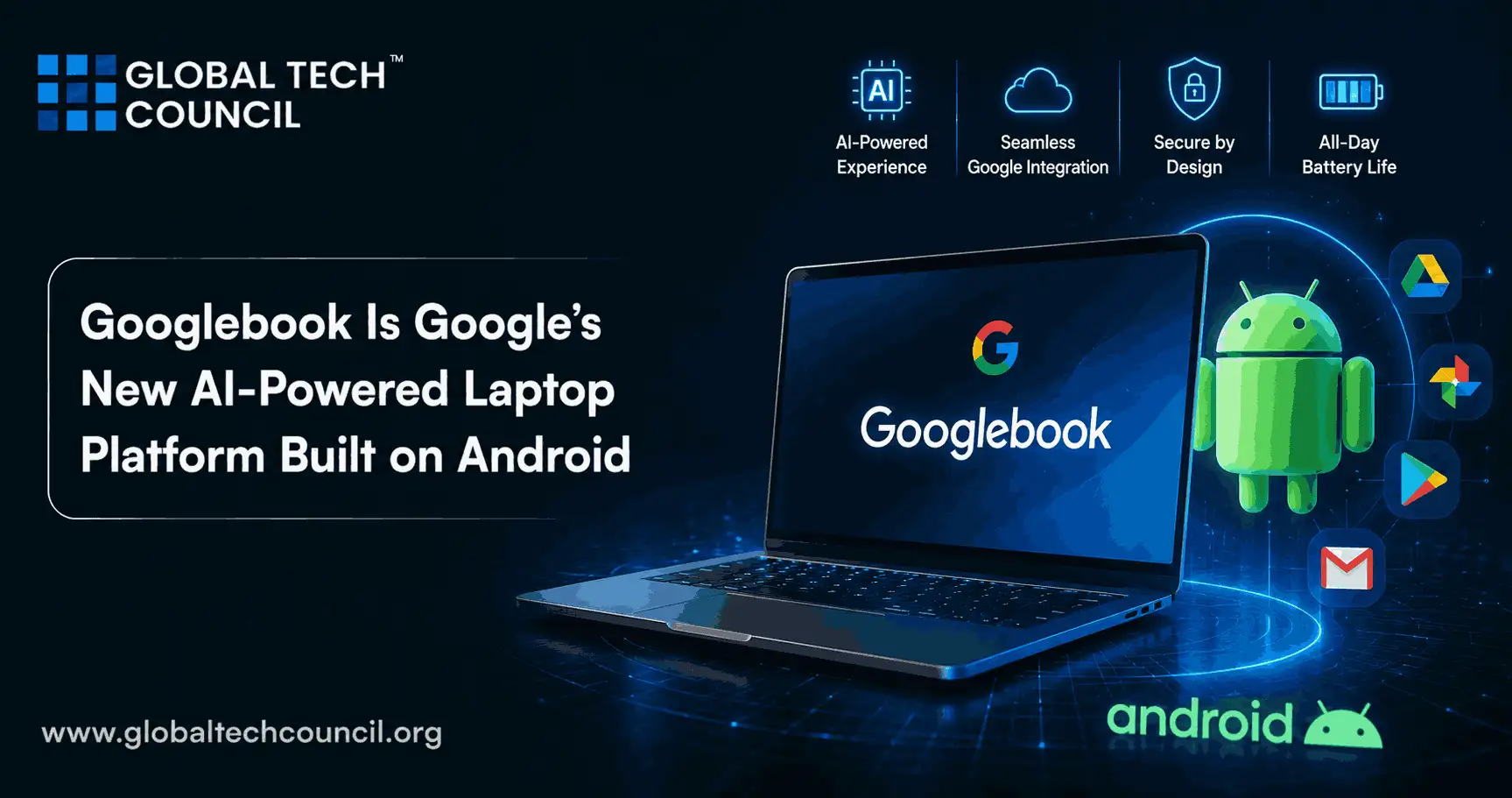
 Artificial intelligence is changing the way people interact with computers. Instead of manually opening applications, searching files, and switching between tabs, users increasingly expect technology to understand commands, automate workflows, and assist with everyday tasks intelligently. Google appears to be moving aggressively toward that future with what many industry observers are calling “Googlebook.”
Although Google has not officially confirmed a product under this name, speculation surrounding an Android-powered AI laptop platform has grown significantly in recent months. Reports about deeper Android desktop support, ChromeOS integration, and Gemini AI expansion suggest that Google may be preparing a major shift in personal computing.
If launched successfully, Googlebook could represent Google’s attempt to create a fully AI-native laptop ecosystem that blends Android flexibility, cloud computing, and Gemini-powered intelligence into one seamless experience. Humanity once wanted faster computers. Now it wants laptops that summarize meetings, draft emails, organize files, and probably pretend to care about productivity goals. Technology truly rewards laziness with astonishing efficiency.
Understanding the Googlebook Concept
The term “Googlebook” is being used informally across the tech community to describe Google’s possible next-generation laptop platform powered by Android and AI.
Unlike traditional laptops that rely heavily on manual user interaction, Googlebook is expected to focus on AI-assisted workflows and automation.
The rumored platform may include:
- Android-based operating system architecture
- Deep Gemini AI integration
- AI-powered productivity features
- Cross-device synchronization
- Enhanced multitasking support
- Cloud-native functionality
- AI-generated content tools
- Intelligent system-wide search
The idea is not simply to create another Chromebook. Instead, Googlebook may function as an AI-first computing system designed for modern work environments.
Why Google May Be Developing Googlebook
Google’s strategy appears connected to the broader industry movement toward AI-powered operating systems and devices.
Growing Competition in AI Computing
Microsoft has already introduced Copilot-powered Windows PCs, while Apple is integrating advanced AI features across macOS and iOS. Google needs a stronger position in the AI laptop market to remain competitive.
A dedicated AI-powered Android laptop platform would allow Google to compete directly against:
- Microsoft AI PCs
- Apple MacBooks
- Premium Chromebooks
- AI-integrated enterprise laptops
The competition for dominance in AI computing is becoming increasingly intense.
Gemini AI Is Becoming Central to Google’s Ecosystem
Google has invested heavily in Gemini AI models. These models are now being integrated into:
- Google Search
- Gmail
- Google Workspace
- Android devices
- Cloud services
- Development tools
An AI-first laptop platform could serve as the ideal environment for showcasing Gemini’s full capabilities.
Professionals looking to build expertise in advanced AI systems are increasingly pursuing programs like the AI expert certification to understand how AI technologies are reshaping industries and business operations.
Android Is Evolving Beyond Smartphones
Android has changed significantly over the last few years. It now supports:
- External monitors
- Keyboard and mouse controls
- Multi-window environments
- Desktop modes
- Productivity applications
This evolution makes Android increasingly suitable for laptop-style experiences.
How Googlebook Could Transform Computing
Googlebook is expected to focus heavily on automation and AI-assisted user experiences.
AI as the Main User Interface
One of the biggest expected innovations is the possibility that Gemini AI could become the primary interaction layer.
Instead of manually navigating applications, users may simply describe tasks conversationally.
Examples include:
- “Prepare a weekly sales report.”
- “Summarize my unread emails.”
- “Create meeting notes from yesterday’s conference call.”
- “Find all invoices related to last month’s projects.”
- “Generate a presentation from this document.”
This would reduce the need for repetitive manual workflows.
Specialists who want to work directly with Google’s evolving AI ecosystem are increasingly exploring the google gemini expert certification to gain practical knowledge about Gemini-powered applications and enterprise integration.
Because apparently clicking through folders became too emotionally exhausting for modern civilization.
Integration Between Devices
Googlebook could become deeply integrated with Android phones, tablets, smart devices, and cloud services.
Users may experience seamless synchronization for:
- Notifications
- Files
- Messages
- Calls
- AI-generated summaries
- Calendar events
- Workspace collaboration
This interconnected ecosystem could improve productivity for both personal and professional users.
AI-Powered Productivity Features
One major advantage of Googlebook may be its intelligent productivity capabilities.
Smart Writing and Content Generation
Gemini AI could assist users with:
- Email drafting
- Report writing
- Blog creation
- Document summaries
- Translation tasks
- Editing suggestions
This would help professionals save time while improving workflow efficiency.
Intelligent File Management
Traditional file searching can be inefficient, especially for enterprise users handling thousands of documents.
Googlebook may introduce conversational file retrieval systems where users ask natural language questions instead of searching manually.
For example:
- “Show all marketing presentations from April.”
- “Find the spreadsheet shared by the finance team.”
- “Locate the contract edited last Friday.”
AI would understand context rather than relying solely on filenames or folders.
AI Meeting Assistance
Remote work has increased demand for intelligent meeting tools.
Googlebook could potentially provide:
- Real-time transcription
- Automated action-item generation
- AI-generated summaries
- Multi-language translation
- Speaker identification
These features may become essential for hybrid work environments.
Could Googlebook Replace ChromeOS?
There is ongoing debate about whether Googlebook represents the future replacement for ChromeOS.
ChromeOS Limitations
Chromebooks are popular in education and lightweight productivity markets, but they still face limitations compared to Windows and macOS systems.
Challenges include:
- Limited desktop application support
- Reduced offline capabilities
- Dependence on web apps
- Enterprise software compatibility issues
Googlebook may address these limitations by offering a more powerful Android-based system with native AI integration.
Possible Android and ChromeOS Unification
Google has already started integrating Android features into ChromeOS. Industry experts believe the company may eventually merge both systems into a unified platform.
Potential advantages include:
- Simplified software development
- Better app compatibility
- Improved performance
- Unified user experiences
- Stronger AI integration
This could significantly strengthen Google’s position in the laptop market.
AI Coding and Software Development
Developers are increasingly relying on AI-powered coding tools for productivity and automation.
Googlebook could become highly attractive for software engineers if Gemini AI integrates deeply into development workflows.
Possible coding features include:
- AI code generation
- Debugging assistance
- Documentation automation
- Error detection
- Code optimization suggestions
Google has already integrated Gemini into development environments such as Android Studio.
As AI-assisted programming becomes mainstream, many developers are upgrading their skills through programs like the AI Powered coding expert Course, which focuses on AI-driven coding workflows and intelligent automation systems.
Software development now increasingly resembles supervising an extremely fast intern that occasionally produces brilliance and occasionally invents code that should probably be investigated by international authorities.
The Rise of Agentic AI
Another important trend connected to Googlebook is Agentic AI.
Unlike traditional AI assistants that simply respond to prompts, agentic AI systems can complete multi-step tasks autonomously.
For example, an AI agent on Googlebook could:
- Read incoming emails
- Schedule appointments
- Generate reports
- Update project documents
- Send reminders automatically
This would dramatically reduce repetitive administrative work.
As organizations prepare for autonomous AI systems, many professionals are pursuing the Agentic AI expert certification to understand implementation strategies and enterprise applications.
Googlebook’s Potential Impact on Businesses
Businesses are actively searching for technologies that improve efficiency while reducing operational costs.
Googlebook may become attractive for enterprise users because of its AI-driven capabilities.
Improved Team Collaboration
Integration with Google Workspace could allow businesses to streamline communication and project management.
Features may include:
- AI meeting summaries
- Shared intelligent workspaces
- Automated scheduling
- Collaborative AI document editing
- Smart workflow recommendations
Reduced Administrative Work
AI automation could help companies reduce repetitive manual processes.
Tasks such as:
- Data entry
- Scheduling
- Report creation
- Meeting summaries
- Internal communication
could increasingly be handled by AI systems.
Better Cloud Integration
Google’s cloud infrastructure could provide seamless synchronization between devices and enterprise platforms.
This would support remote and hybrid work environments effectively.
AI-Powered Digital Marketing Opportunities
Marketing teams are already using AI for content creation, customer targeting, campaign optimization, and analytics.
Googlebook may provide built-in AI marketing tools capable of:
- SEO recommendations
- Ad copy generation
- Social media optimization
- Audience insights
- Campaign analysis
As AI transforms marketing strategies, professionals are enrolling in programs such as the AI powered digital marketing course to develop practical AI-powered marketing expertise.
The modern marketing world is essentially algorithms attempting to influence humans while other algorithms measure whether the influence worked. Entire departments now exist to interpret graphs generated by machines talking to other machines. Remarkable species behavior.
Security and Privacy Challenges
Despite its potential advantages, Googlebook may face criticism regarding privacy and data security.
AI-powered operating systems often process large amounts of personal information, including:
- Emails
- Documents
- Voice interactions
- Browsing activity
- Calendar data
This creates concerns around:
- Data privacy
- AI surveillance
- Cloud dependence
- Security vulnerabilities
Google will likely need to implement strong safeguards such as:
- On-device AI processing
- End-to-end encryption
- AI permission controls
- Enterprise-grade security tools
User trust will play a major role in adoption.
Hardware Expectations for Googlebook
Although official specifications remain unknown, analysts expect Googlebook devices to feature modern AI-focused hardware.
AI-Optimized Chips
Future Googlebook devices may use processors optimized for machine learning tasks, including:
- Google Tensor chips
- Qualcomm Snapdragon X processors
- ARM-based architectures
These chips would improve AI performance while reducing battery consumption.
Lightweight and Portable Designs
Googlebook may target portability with thin and lightweight hardware designs suitable for mobile productivity.
Touchscreen and Stylus Features
Android’s touch-friendly interface makes touchscreen support highly likely.
Stylus compatibility could also appeal to students, designers, and professionals.
Long Battery Life
Android optimization may allow Googlebook devices to deliver excellent battery performance compared to traditional laptops.
Challenges Googlebook Could Face
Despite growing excitement, Googlebook may encounter several obstacles.
App Compatibility Concerns
Professional users rely heavily on desktop software.
Googlebook must ensure compatibility with:
- Enterprise applications
- Creative software
- Productivity suites
- Developer tools
Without strong application support, adoption could remain limited.
User Skepticism
Google has a long history of discontinuing products and services. Some consumers may hesitate to invest in another experimental ecosystem.
That concern is not irrational. Google sometimes treats products the way people treat abandoned gym memberships.
Intense Market Competition
The AI laptop market is becoming increasingly competitive with strong offerings from:
- Microsoft
- Apple
- Lenovo
- Dell
- HP
Googlebook would need a clear advantage to stand out.
The Future of AI-Native Operating Systems
Googlebook reflects a broader industry transformation toward AI-native computing environments.
Future operating systems may become:
- Conversational
- Predictive
- Autonomous
- Personalized
- Context-aware
Instead of manually managing software, users may increasingly rely on AI agents to complete tasks automatically.
This shift could redefine productivity, communication, and digital workflows over the next decade.
Conclusion
Googlebook could become one of Google’s most significant computing initiatives if the platform eventually launches as expected. By combining Android, Gemini AI, cloud integration, and intelligent automation, Google may be building a new category of AI-first laptops designed for the modern digital economy.
Although many details remain speculative, current industry developments strongly suggest that Google is moving toward a unified AI-powered ecosystem that blends mobile flexibility with desktop-level productivity.
If successful, Googlebook could transform how people interact with technology by making AI assistance a central part of everyday computing experiences.
As AI-powered systems continue to evolve, professionals who understand AI development, automation, coding assistance, and digital transformation will likely hold a major advantage in future workplaces.
Humanity spent decades teaching computers to follow instructions. Now it is building machines that anticipate instructions before anyone finishes typing them. The future remains deeply efficient and slightly unsettling.
FAQs
1. What is Googlebook?
Googlebook is a rumored AI-powered laptop platform believed to combine Android, Gemini AI, and cloud-based productivity tools into a unified computing system.
2. Has Google officially announced Googlebook?
No, Google has not officially announced a product called Googlebook. However, industry reports and technology developments strongly suggest Google is working on advanced AI-powered computing systems.
3. What operating system might Googlebook use?
Googlebook is expected to use an Android-based operating system with desktop-oriented features and AI integration.
4. How is Googlebook different from Chromebooks?
Googlebook may focus more heavily on AI automation, Android integration, and intelligent workflows compared to traditional ChromeOS-based Chromebooks.
5. Will Googlebook support Android apps?
Most likely yes. Android app compatibility is expected to be one of the platform’s biggest strengths.
6. What role will Gemini AI play in Googlebook?
Gemini AI may function as a built-in assistant capable of handling productivity tasks, generating content, automating workflows, and supporting conversational interactions.
7. Can Googlebook help businesses?
Yes. Businesses may benefit from AI automation, smart collaboration tools, cloud integration, and improved productivity features.
8. Will Googlebook support AI coding tools?
Googlebook is expected to integrate AI-powered coding assistance for developers using Gemini AI and Google development tools.
9. What are AI-native operating systems?
AI-native operating systems are platforms designed around artificial intelligence capabilities instead of relying solely on traditional manual interactions.
10. Could Googlebook compete with Windows AI PCs?
Yes. Googlebook may become Google’s direct competitor to Microsoft’s Copilot-powered AI PCs.
11. What is Agentic AI?
Agentic AI refers to autonomous AI systems capable of performing multi-step tasks independently with minimal user input.
12. Is Googlebook expected to support cloud computing?
Yes. Cloud integration will likely be a major component of the platform.
13. What hardware may power Googlebook devices?
Possible hardware includes Tensor chips, Snapdragon processors, ARM-based systems, and AI acceleration hardware.
14. Will Googlebook work for students?
Students may benefit from AI-powered note-taking, smart research assistance, document summarization, and collaboration tools.
15. What privacy concerns exist around Googlebook?
Concerns include data collection, AI monitoring, cloud dependence, and cybersecurity risks associated with AI-driven systems.
16. How could Googlebook improve productivity?
The platform may automate repetitive tasks, provide intelligent search capabilities, generate content, and assist with workflow management.
17. What industries may benefit from Googlebook?
Industries such as education, software development, digital marketing, finance, healthcare, and enterprise collaboration may benefit significantly.
18. Why are AI certifications becoming popular?
AI certifications help professionals validate their skills and stay competitive in rapidly evolving technology markets.
19. Could Googlebook replace traditional laptops?
If successful, AI-powered platforms like Googlebook could eventually reduce dependence on traditional operating systems and computing models.
20. What is the future of AI-powered laptops?
AI-powered laptops are expected to become more autonomous, conversational, and capable of handling complex tasks with minimal human input.