


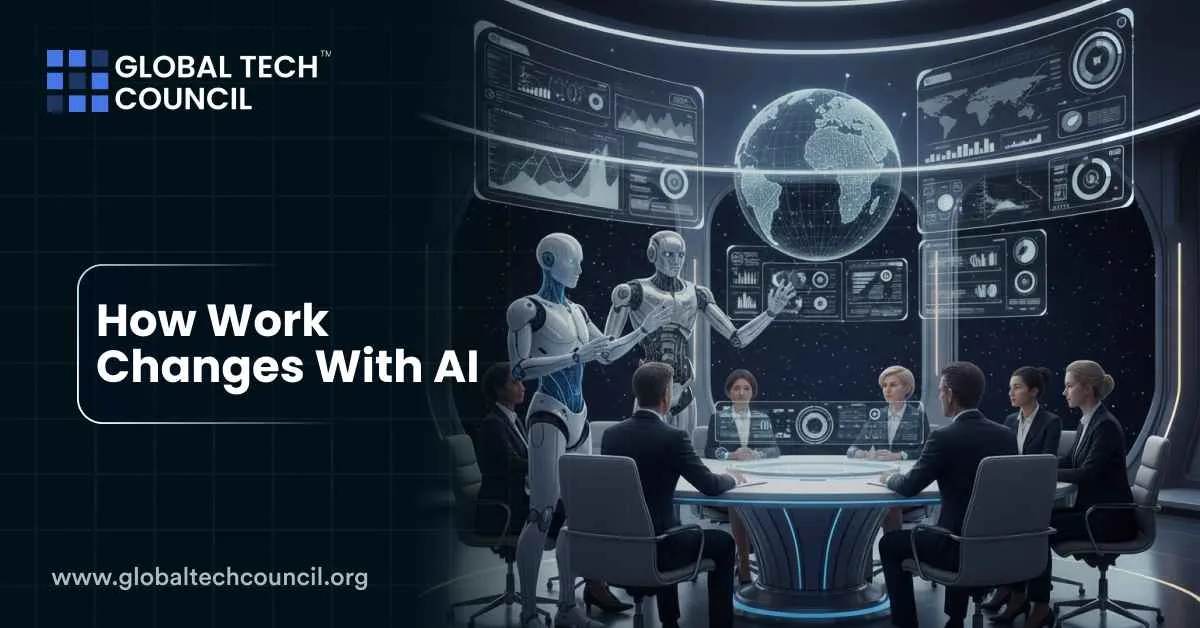
 Work in 2026 changes in a very practical way: you stop using AI as a search box and start using it like a worker that can take a task, run with it, and bring back something you can approve. The shift is subtle at first, then it becomes obvious. Your day has fewer blank pages. Your “first draft” moments get faster. Your follow ups get tighter because the system can hold context while you focus on decisions.
The fastest way to stay comfortable with this change is to build a solid base in modern systems and workflows through something like Tech Certification.
The new default is delegate and review
In 2025, many teams used AI to answer questions. In 2026, more teams use AI to complete work.
The pattern looks like this:
- You define the objective and constraints.
- AI produces a structured output.
- You review, correct, and approve.
- The output becomes a deliverable, not just a suggestion.
This changes how people plan their day. Instead of spending hours building a rough version of something, you spend minutes setting direction, then you spend time on the parts that actually need judgment.
Job descriptions start to quietly change
Many roles will not get new titles, but the work inside them changes. People become more like editors, managers, and decision makers.
You will see this across functions:
- Marketing teams shift from “write everything” to “direct, refine, and publish.”
- Analysts shift from “build every chart manually” to “question, validate, and explain.”
- Ops teams shift from “chase status updates” to “design systems that stay updated.”
- Customer teams shift from “type every response” to “review and personalize drafts.”
In 2026, the most valuable employees are often the ones who can define what good looks like and move fast through iterations.
Output quality matters more than raw speed
A lot of people assume the big win is speed. In reality, the bigger win is quality on the first pass.
When AI gives you something close to final, the entire workflow shifts:
- Fewer revisions
- Less back and forth
- Faster approvals
- Cleaner handoffs between teams
This is why “instruction following” becomes a big deal at work. Small requirements matter. Tone matters. Format matters. Word count limits matter. If the system is consistent, it becomes dependable. Dependable is what gets adopted.
Vibe building spreads beyond software teams
A major 2026 story is that non engineers build tools. Not perfect tools, but useful tools.
This looks like:
- A sales ops person creates a lead scoring helper.
- A recruiter builds a screening workflow that stays consistent.
- A finance ops manager builds a monthly close checklist generator.
- A team lead creates a status dashboard that stays updated.
The secret is not that everyone becomes a developer. The secret is that building becomes a normal way to solve small pains. Once that habit forms, it spreads.
The “tinkerer” becomes a power role inside companies
Most organizations have at least one person who loves to test new tools and stitch things together. In 2026, that person becomes a multiplier.
This internal builder usually does three things well:
- They can describe a problem clearly.
- They are patient with iteration and debugging.
- They can turn “this is annoying” into “this is automated.”
They become the person teams go to when something feels repetitive, messy, or slow.
If your organization supports this role, you get faster without hiring more people. If your organization ignores it, people still do it, but it happens in a scattered way with less visibility.
AI stops being a feature and becomes a workflow layer
In 2026, many companies realize something important: adding AI to an existing workflow is not the same as redesigning the workflow for AI.
Here is the difference:
- AI as a feature: a chat box that answers questions about a product.
- AI as a workflow layer: the system can pull context, draft the work, route approvals, and record decisions.
That second version drives real ROI because it targets the time sinks that teams feel every day.
The real bottleneck becomes context
People complain about “bad AI output” when the real issue is missing context.
In 2026, the winning organizations are the ones that fix context problems:
- Clear data definitions
- Consistent naming conventions
- Better documentation
- Clean permission layers
- Standard connectors across tools
When context is clean, AI feels smart. When context is messy, AI feels like extra work.
The rise of “work packets”
A useful way to think about 2026 is that AI handles work in packets, not in fragments.
A packet is a chunk of work that has:
- A clear goal
- Required inputs
- A known output format
- A review step
- A handoff to the next stage
Examples of work packets:
- “Summarize these customer calls and produce a structured list of recurring objections.”
- “Draft the QBR deck outline based on these metrics and last quarter’s narrative.”
- “Generate a first pass project plan with milestones, risks, and owners.”
- “Propose three messaging directions and map each to audience segments.”
Packets reduce the temptation to micromanage the system. You stop nudging sentence by sentence, and you start reviewing finished sections.
Meetings start to feel different
AI changes meetings in two ways.
First, preparation improves:
- Agendas come pre drafted.
- Background notes are consolidated.
- Data points get pulled in advance.
- Risks and decisions are surfaced early.
Second, follow through improves:
- Action items get captured cleanly.
- Owners and deadlines get recorded.
- Summaries become usable, not vague.
- Next steps are easier to track.
This sounds small, but it is massive. Most organizations do not fail because they lack ideas. They fail because execution slips. Better meeting hygiene improves execution.
Managers spend less time chasing status
In many workplaces, a surprising amount of time goes into “Where are we on this?” communication.
In 2026, teams that use AI well reduce this through:
- Automated status reports that pull from tools people already use
- Weekly summaries that highlight blockers and decisions needed
- Clear audit trails of what changed and why
The managerial role becomes less about chasing and more about unblocking.
“Human in the loop” becomes the normal comfort zone
Most professionals do not want full autonomy immediately. They want control, especially for high stakes work.
In 2026, a common setup is:
- AI drafts
- Humans approve
- AI executes small actions when approved
- Humans stay responsible for outcomes
This model scales because it respects trust. Trust is built through consistent performance, not through big promises.
The autonomy debate becomes a settings problem
Instead of arguing “Should AI be autonomous?”, teams start asking, “How autonomous should it be for this specific workflow?”
You might want:
- Low autonomy for sensitive communications
- Medium autonomy for drafting and planning
- Higher autonomy for routine back office steps with clear rules
This is not philosophical. It is operational. In 2026, better tools make it easy to dial autonomy up or down based on the task.
Work becomes more structured, even in creative roles
This surprises people. AI does not only automate. It also pushes structure into workflows.
Even creative teams start using:
- Brief templates
- Tone guidelines
- Output checklists
- Review rubrics
Why? Because structured inputs produce better outputs. When you feed the system clear direction, it produces work that feels aligned. That reduces revision cycles and makes creative output easier to scale without losing quality.
Hiring starts to favor “AI fluent” operators
In 2026, “AI fluency” is less about memorizing tools and more about how someone works.
Employers start valuing:
- Clear thinking and clear delegation
- Comfort with iteration
- Strong review skills
- Good judgment about what to trust and what to verify
- The ability to design a process, not just do a task
This is why some professionals go deeper into how modern AI systems actually work through Deep tech certification.
ROI becomes easier to prove, but harder to fake
In earlier phases, companies could talk about AI without changing much. In 2026, measurable impact becomes the focus.
You will see stronger scrutiny around:
- What time is actually saved
- Whether quality is improved
- Whether customer experience is better
- Whether costs are reduced without creating new risks
Teams that “just adopt tools” will struggle to prove impact. Teams that redesign workflows will show results.
People stop fearing replacement and start fearing stagnation
A lot of the public conversation stays stuck on job replacement. In real workplaces, the sharper anxiety becomes different: being the only person on your team who cannot keep up with new workflows.
The shift looks like this:
- The top performers use AI to move faster.
- Their output becomes the baseline.
- Others feel pressure to match that pace.
- The gap becomes visible in delivery speed and quality.
The response is not panic. The response is training, repeatable workflows, and practical adoption.
How leaders should plan for 2026
Leaders get better outcomes when they treat AI like an operating model change, not a tool rollout.
A grounded plan looks like this:
- Pick 3 to 5 workflows where time is clearly wasted.
- Define success metrics for each workflow.
- Start with human review in every loop.
- Improve context quality and permissions.
- Expand only after reliability is proven.
Leaders also need the business side aligned, especially around incentives, adoption, and change management, which is why programs like Marketing and Business Certification come up when companies move from pilots to organization wide rollout.
Stay ahead
You do not need a dramatic career change. You need better habits.
Here is a practical checklist for 2026 readiness:
- Practice giving AI a clear objective with constraints and references.
- Ask for structured outputs that are easy to review.
- Build a repeatable prompt for one recurring work task you do weekly.
- Create a personal review checklist so outputs stay consistent.
- Keep a simple log of where AI saves you time and where it slows you down.
The people who win in 2026 are not the ones who know the most tools. They are the ones who turn AI into a reliable work partner through smart delegation and disciplined review.
Conclusion
Work in 2026 changes because AI stops being “helpful sometimes” and starts being a system that can carry real tasks across the finish line. The daily advantage goes to the people and teams who redesign workflows around that reality, and who treat trust, context, and review as the real foundations of AI productivity.