


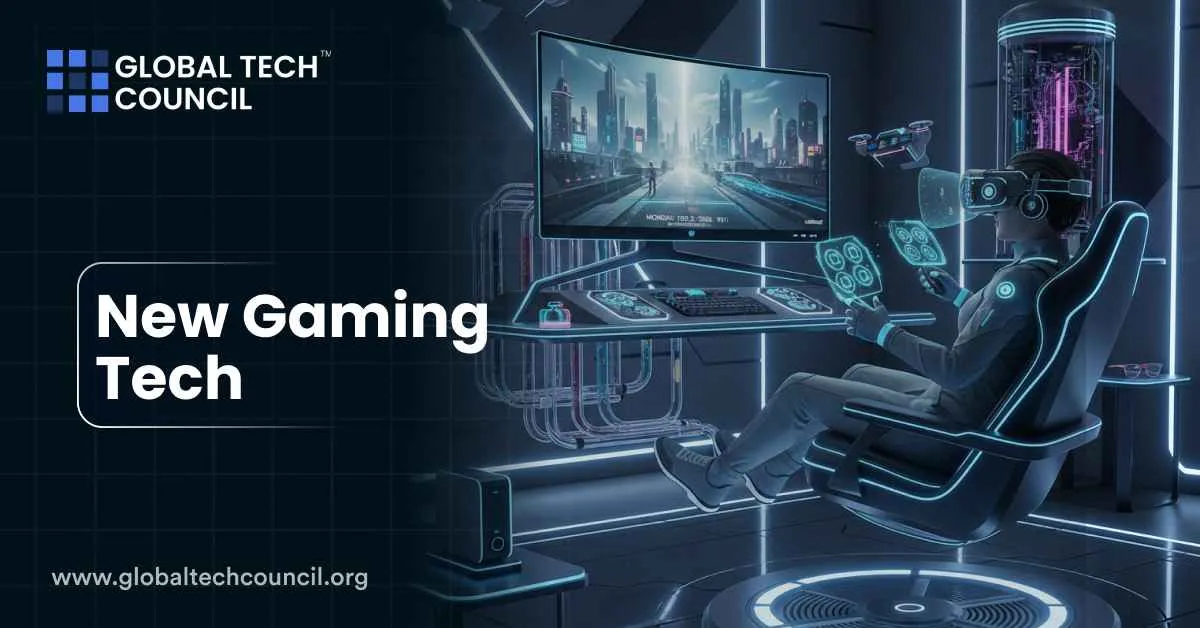
 New gaming tech is no longer just about better graphics or faster consoles. It is about how games are built, delivered, and experienced across devices, locations, and industries. From AI-assisted development to cloud-based platforms and next-generation hardware, gaming technology has entered a phase where technical infrastructure matters as much as gameplay itself.
This shift did not happen overnight. It is the result of a decade of investment in engines, networks, displays, and computing systems that now converge in gaming. To understand how these systems work together, many professionals start by grounding themselves in core technology concepts through programs like the Tech Certification, which help explain the technical layers behind modern digital platforms.
How New Gaming Tech Took Shape
The current wave of new gaming tech began accelerating around 2023, when three forces started to align. First, game engines reached a level of maturity that allowed real-time cinematic visuals. Second, cloud infrastructure became fast and stable enough to support interactive streaming. Third, hardware manufacturers began experimenting with new form factors instead of traditional consoles alone.
By 2024, these trends were visible in both consumer products and developer tools. Unreal Engine 5 adoption increased across major studios, enabling features like real-time global illumination and high-density geometry without manual optimization. At the same time, cloud gaming platforms expanded from experimental services into mainstream offerings.
Hardware That Redefined How Games Are Played
One of the clearest signals of new gaming tech is the change in hardware design.
On 16 October 2025, Asus and Microsoft Gaming released the ROG Xbox Ally, a handheld gaming PC that runs Windows 11 and supports full PC titles. Unlike earlier handheld consoles, this device blurred the line between PC and console gaming. It shipped with AMD Ryzen Z2 processors, up to 24 GB of RAM on the Ally X model, a 120 Hz Full HD display, and Wi-Fi 6E support. The release marked a clear shift toward portable yet uncompromised gaming performance.
Another major milestone came from display technology. On 12 December 2025, Philips and AOC announced dual-mode gaming monitors capable of reaching 1,000 Hz refresh rates at 1080p, with an alternative 500 Hz mode at 1440p. These monitors were designed specifically for competitive gaming, where motion clarity and input responsiveness directly affect performance.
Virtual reality hardware also moved forward. On 12 November 2025, Valve officially announced Steam Frame, its standalone VR headset expected to launch in early 2026. Unlike earlier VR systems, Steam Frame does not require a PC connection or external base stations. It uses dual 2160 × 2160 displays, supports refresh rates up to 144 Hz, and runs on SteamOS with Wi-Fi 7 connectivity. This announcement signaled Valve’s intent to make VR more accessible without sacrificing quality.
Cloud Gaming Becomes Practical, Not Experimental
Cloud gaming was once dismissed as unreliable. That perception changed significantly in 2024 and 2025.
NVIDIA GeForce NOW upgraded its service to emulate RTX 5080-class performance in the cloud, supporting resolutions up to 5K at 120 frames per second. By mid-2025, the platform supported more than 4,500 games, including many AAA titles. This meant players no longer needed high-end local hardware to access demanding games.
Microsoft also continued expanding Xbox Cloud Gaming, while optimizing Windows 11 for cloud and handheld devices. In 2026, Microsoft confirmed OS-level improvements for gaming performance, including better background task management and automatic upscaling features designed specifically for portable gaming systems.
These developments turned cloud gaming into a viable option rather than a fallback.
AI Changes How Games Are Made and Played
Artificial Intelligence is now embedded across the gaming lifecycle.
On the development side, studios use AI tools to generate environments, textures, and early prototypes. This reduces production time and allows smaller teams to build complex worlds. AI is also used for automated testing, helping identify bugs and balance issues before release.
Inside games, AI shapes non-player character behavior, adaptive difficulty, and procedural storytelling. Research published on 15 September 2025 introduced systems like EyeNexus, which uses gaze tracking to optimize VR cloud streaming. In controlled tests, it reduced latency by up to 70.9% and improved perceived visual quality by 24.6% by prioritizing where players actually look.
These advances require a deeper understanding of advanced computing, distributed systems, and AI models. This is why many professionals working at the edge of gaming, simulation, and immersive systems pursue advanced learning paths such as Deep Tech Certification programs to understand how these technologies interact at scale.
Software Platforms and Operating Systems Catch Up
New gaming tech is not only about hardware. Software platforms are adapting too.
In September 2025, Google announced Play Games Sidekick, an AI-powered assistant integrated into mobile gaming. It allows players to ask questions, receive hints, and get contextual help without leaving the game. This feature reflects a broader trend of AI becoming a companion layer rather than a separate tool.
Game engines are also evolving into multi-industry platforms. Unreal Engine is now used not only for games, but also for film production, architectural visualization, and training simulations. This crossover is one reason gaming tech increasingly influences sectors beyond entertainment.
Events That Show Where Gaming Tech Is Headed
Industry events offer a clear view of priorities.
The Taipei Game Show 2025, held from 21 to 24 February 2025, drew more than 370,000 attendees, showcasing new hardware, AR and VR experiences, and cloud-based platforms. The scale of the event highlighted how much attention technology now receives alongside games themselves.
Later in the year, organizers confirmed that Tokyo Game Show 2025 would be the largest in its history, with 772 participating companies, including 299 international exhibitors. This expansion reflects global competition around gaming technology, not just game titles.
The Business Impact of New Gaming Tech
The global gaming market was estimated to reach USD 269.06 billion in 2025, with projections approaching USD 435 billion by 2030. This growth is driven as much by technology infrastructure as by content.
Cloud services, subscription models, in-game economies, and cross-platform ecosystems all depend on reliable tech stacks. Companies that understand how to position products within this environment need more than technical insight. They need clarity on user behavior, monetization, and long-term engagement. This is where broader strategic knowledge, such as that offered through the Marketing and Business Certification, becomes relevant.
Challenges That Still Remain
Despite progress, new gaming tech faces real constraints.
- High development costs continue to pressure studios.
- Hardware fragmentation makes optimization difficult.
- Online systems remain targets for security breaches and cheating.
- Cloud gaming still depends heavily on regional network quality.
These challenges explain why innovation is uneven and why not every new technology succeeds immediately.
Conclusion
Looking ahead to 2026 and beyond, gaming technology is likely to focus on integration rather than novelty. AI, cloud systems, engines, and hardware are becoming parts of a single ecosystem. Games will be designed to move smoothly across devices, adapt to players in real time, and support communities at scale.
New gaming tech is no longer a side feature of the industry. It is the structure that holds everything together. Understanding it means understanding how modern interactive systems are built, operated, and sustained.