


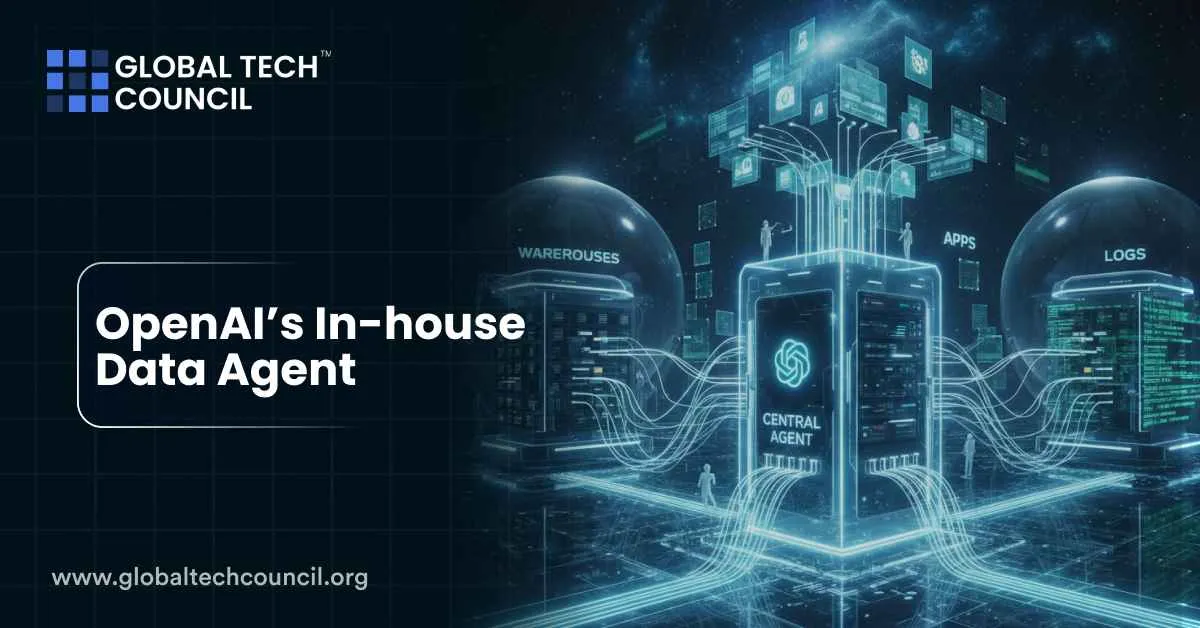
 Most people still think “AI + data” means a chatbot that can spit out a SQL query and then confidently explain whatever numbers fall out. That’s cute, in the way a toy steering wheel is “driving.” OpenAI’s in-house data agent is something else: an internal system designed to help thousands of employees ask real business and engineering questions against an enormous data footprint and get answers they can actually trust.
This kind of system only looks simple from a distance. At scale, the hard part is not writing SQL. The hard part is understanding what the data means, where it came from, whether it is still valid, and who is allowed to see it. If you want a solid foundation for how modern internal AI systems are built, the broad “agents, tools, permissions, evaluation” picture is what matters, not prompt tricks. That’s where structured learning paths like a Tech certification can be useful early on, because they force you to think in systems instead of demos.
What OpenAI’s in-house data agent is
OpenAI’s in-house data agent is an internal-only AI agent that takes a natural-language question and turns it into a verified, explainable answer based on the company’s data platform. It is built for employees who need decisions quickly, without turning every question into a ticket for the data team.
It supports teams across engineering, data science, finance, go-to-market, and research. The goal is not to “replace analysts.” The goal is to remove the slow, repetitive parts of analytics work so people can spend time on judgment instead of digging.
Scale is the backdrop that makes this matter. OpenAI has described its internal data platform as massive, spanning hundreds of petabytes, tens of thousands of datasets, and thousands of internal users. When you are operating at that level, “just query the database” is a fantasy. The real work becomes: locating the right source, understanding the schema, interpreting definitions correctly, and validating results under changing assumptions.
The real problem it solves
Before systems like this, many companies run the same exhausting loop:
- A stakeholder asks a question.
- They do not know which table to use.
- Someone else tries to find the “right” dataset.
- Schemas get reverse-engineered.
- Queries break because joins are messy.
- Results look plausible, but definitions are unclear.
- Everyone argues about whether the metric is even the same metric as last quarter.
This is slow and it is also risky. Not because humans are bad at SQL, but because institutional memory is scattered across code, dashboards, random docs, and whatever the last person said in Slack six months ago. The agent’s value is in compressing that messy loop into something closer to minutes than days.
Instead of escalating every question, a non-specialist can ask something like: “How did feature X impact retention last quarter?” The system then does the mechanical work: identifying candidate datasets, inspecting schemas, generating and running queries, fixing errors, summarizing what it found, and explaining assumptions.
This is not a dashboard. It’s decision acceleration with guardrails.
How it’s delivered internally
A good internal tool fails if it demands that everyone change their workflow. OpenAI’s data agent is designed to show up where employees already spend their time, such as internal chat surfaces and developer tooling. The idea is simple: people adopt what is convenient, even more than what is powerful.
By meeting users in their existing interfaces, the agent becomes a normal part of asking questions rather than a special destination. That matters because the difference between “we built it” and “people actually use it” is usually one extra login screen.
How it works: context as a system, not a prompt
The most important idea here is that context is treated as infrastructure. Many “AI data assistants” collapse because they rely on a prompt that tries to describe the whole business. That does not scale, and it does not stay correct.
OpenAI’s approach uses layered context so the agent can ground itself before it generates queries. Think of it as multiple rails that guide the agent toward the right tables and the right interpretations. Those rails can include table usage patterns, lineage, human notes, knowledge from internal documentation, prior corrections, and live inspection of the warehouse and pipelines.
That layered approach targets the classic failure mode: the AI finds a table that looks right, confidently queries it, and never realizes the definitions are wrong. At small scale, you can catch that with human review. At large scale, you need the system itself to be skeptical.
The trace-based execution loop
Another key ingredient is that the agent runs in an observable loop rather than producing a single “final answer” out of nowhere. A typical flow looks like this:
- It interprets the question and identifies intent.
- It retrieves relevant context using search over curated knowledge.
- It inspects schemas and lineage to verify candidates.
- It generates SQL.
- It executes the query.
- It detects errors or suspicious results.
- It repairs joins, filters, or assumptions.
- It re-runs.
- It summarizes the outcome and lists assumptions.
The point is not merely iteration, it’s transparency. Users can inspect the SQL and the outputs. That alone changes behavior, because people stop treating the system as magic and start treating it as an assistant whose work can be checked.
Two design choices worth copying
Offline context preparation
If the agent tries to scan everything at query time, you get slow responses and higher risk of nonsense. A scalable approach is to preprocess context offline, organize it, and make it retrievable in a focused way. Then, at question time, the agent pulls only the most relevant pieces instead of wandering across the entire knowledge universe.
That reduces latency, and it also reduces hallucinations, because the system is constrained to vetted context rather than improvising.
Continuous evaluation with “golden” queries
Analytics agents drift. Definitions change. Pipelines change. A query that worked last month might quietly break today by returning the wrong thing. OpenAI’s approach, as described publicly, includes an evaluation harness that tests the agent against known questions with known “golden” outputs.
This is the mindset that separates prototypes from infrastructure. It’s basically unit testing for analytics workflows, except the unit under test is an agent, not a function.
This is also why teams building these systems often end up needing broader operational and business literacy, not just technical chops. Internal tools live or die based on adoption and governance, so pairing engineering understanding with strategy helps. Many professionals fill that gap with programs like a Marketing and Business Certification when their work crosses product, growth, and leadership decisions.
Security and permissions
Here’s where things get serious, because the fastest way to kill trust in an internal AI system is letting it become a shadow access layer.
A properly built data agent should not bypass your existing access control. It should enforce pass-through permissions: you can only query what you already have the right to query. If something requires extra authorization, the system should flag that and suggest safe alternatives.
This sounds obvious. It is not obvious in practice. Many AI tools are built as “helpful” layers that accidentally centralize access in the agent itself. That is how you end up with an internal scandal and a lot of uncomfortable meetings.
What OpenAI learned while building it
A few lessons that come up repeatedly in real-world agent systems:
- Too many tools can make the agent worse, not better.
- A small set of well-defined tools tends to produce more reliable behavior.
- Overly prescriptive step-by-step prompts can reduce quality.
- High-level guidance often beats micromanagement.
- The real meaning of data often lives in the code that produces it.
That last point matters a lot. Tables are outputs. Pipelines encode assumptions. If you want correct interpretation, you have to connect the agent to the systems that generate the data, not only the data itself.
What users tend to think about systems like this
Community reactions to internal analytics agents are usually consistent, even across different companies:
People are less scared of automated SQL than outsiders expect, because plenty of dashboards are already wrong.
Trust is the main problem, not query generation.
Canonical definitions and semantic layers become more valuable, not less.
There is enthusiasm for speed, paired with skepticism about non-technical users accepting summaries without checking.
That skepticism is healthy. A fluent summary is not the same as a correct analysis. A strong system design anticipates that and pushes users toward validation, not blind faith.
Why this matters beyond OpenAI
You cannot buy this agent. There is no public signup. No pricing page. No “try it now.” But it functions as a blueprint for what enterprise data agents are becoming: context-driven, tool-using systems that operate inside permission boundaries and defend trust through transparency and evaluation.
If you’re building something similar, the pattern is pretty clear: connect the agent to vetted context, give it constrained tools, make the execution trace visible, and test it continuously. This is the “deep tech” side of internal AI, where engineering choices are governance choices. If you want a deeper grounding in those architectures, Deep tech certification visit the Blockchain Council is one of those routes people use when they want structured exposure to modern stack thinking across systems, tooling, and trust.
Key risks and limitations
No matter how polished the interface looks, the risks do not vanish:
- Metrics drift without governance.
- Summaries can create false confidence.
- Different teams can carry different definitions for the “same” KPI.
- Users can overuse the system without validating outputs.
- Bad inputs can produce plausible but wrong answers.
Evaluation and transparency reduce risk, but they do not eliminate it. The goal is not perfection. The goal is fewer bad decisions, faster, with clearer accountability.
Conclusion
OpenAI’s in-house data agent is not impressive because it can write SQL. That’s table stakes now. It’s impressive because it treats context like infrastructure, respects access boundaries, exposes its work, and assumes errors will happen and must be detected.
This is what AI looks like when it grows up and becomes a real internal system: less spectacle, more guardrails, and a lot more boring engineering that quietly prevents expensive mistakes. Humans love flashy demos, then act shocked when reality demands reliability. This agent is built for reality.