


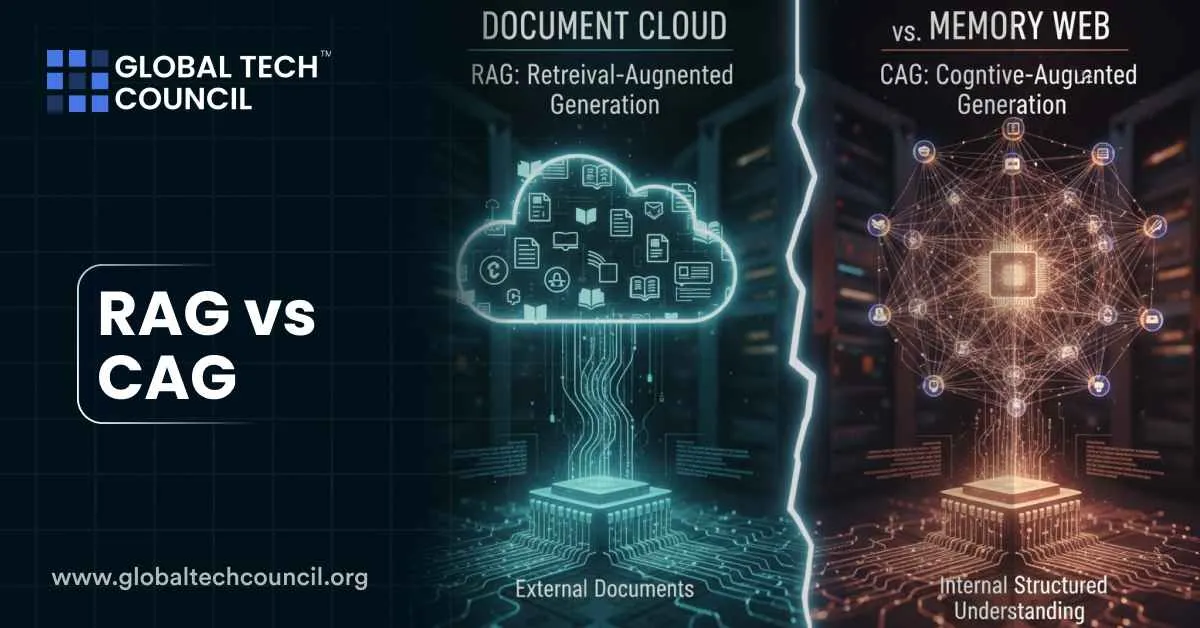
 Retrieval Augmented Generation and Context Autonomous Generation represent two distinct approaches in modern AI system design. While they are often mentioned together, they solve entirely different operational problems and enable different levels of intelligence. Organizations preparing to deploy advanced AI architectures commonly begin by strengthening technical decision making through programs like the Tech Certification because understanding the divide between RAG and CAG is now essential for building scalable and safe automation.
What RAG Really Does
Retrieval Augmented Generation integrates a language model with an external knowledge index. When a user asks a question, a RAG system:
- Converts the query into an embedding
- Searches a vector database or document store
- Identifies the top relevant passages
- Inserts those passages into the model’s context
- Produces a grounded answer
RAG’s strength lies in factual accuracy. It ensures that responses align with real documents, policies or datasets. Companies rely on RAG for customer support, product knowledge bases, enterprise search, policy interpretation and operational documentation. It is reliable, structured and predictable.
The limitation is that RAG only works when a question exists. It cannot watch environments, maintain internal state or take actions on its own. It is a reactive architecture rather than an autonomous one.
What CAG Represents
Context Autonomous Generation is much broader. Instead of responding to questions, CAG systems operate continuously. CAG engines:
- Observe multiple data streams
- Update internal memory and state
- Detect signals, events or anomalies
- Trigger actions or workflows
- Execute multi step reasoning and planning
- Maintain objectives over long time periods
CAG is the architecture behind agentic systems. In a CAG environment, the model decides what matters without waiting for a human prompt. For example, it can monitor logs, evaluate metrics, check for changes in documents or detect shifts in customer sentiment. It is a running system, not a response engine.
Business leaders who want to understand how CAG impacts product design, customer operations and team workflows often use programs like the Marketing and Business Certification because CAG introduces structural changes in how organizations plan and execute processes.
Why RAG Cannot Replace CAG
RAG cannot behave autonomously for several fundamental reasons.
RAG reacts instead of initiates
It only activates when a prompt is present. Without a question, RAG does nothing.
RAG does not store long term context
Each response is based solely on the current query and retrieved documents. No internal state persists.
RAG has no action capabilities
It cannot call APIs, move data, run tools or modify systems. It cannot create workflows.
RAG cannot evaluate outcomes
There is no built in correction loop to check whether a response succeeded in a real task.
These constraints make RAG excellent for grounding but unsuitable for autonomous operations.
Why CAG Cannot Replace RAG
CAG models excel at context understanding and action, but they still require external factual grounding. Without retrieval, a CAG system may drift, misinterpret outdated information or lose precision in specialized domains.
RAG provides the fresh facts.
CAG provides the operational intelligence.
This is why modern enterprise AI stacks are moving toward dual layer architectures rather than choosing one approach over the other.
RAG vs CAG
| Attribute | RAG | CAG | Impact |
| Activation | Prompt based | Continuous | CAG acts without user supervision |
| Memory | Short lived context | Long running state | Enables ongoing workflows |
| Inputs | Vector search results | Multi stream event data | Supports real time operations |
| Autonomy | None | High | Agents rely on CAG |
| Tools | Not natively integrated | Fully integrated | CAG can execute real actions |
| Best use | Knowledge accuracy | Workflow automation | Defines implementation strategy |
This table is designed for teams evaluating architecture choices.
Where Enterprises Use RAG and CAG
Customer experience
RAG provides factual answers from documentation.
CAG monitors conversation patterns, escalates urgent situations and automates case routing.
Engineering operations
RAG answers technical questions and retrieves system information.
CAG detects failing builds, monitors logs and initiates automated diagnostics.
Compliance and risk
RAG retrieves policy definitions and regulatory text.
CAG scans activity logs, identifies risk signals and triggers alerts or workflows.
Research and analytics
RAG supports structured retrieval.
CAG synthesizes cross domain trends over time.
Using both systems together gives organizations a balanced combination of accuracy and autonomy.
The Architecture Behind CAG
Building CAG systems is significantly more complex than deploying RAG. CAG typically requires:
- Event listeners that detect new signals
- Long term memory stores for state tracking
- Tool use layers for structured action
- Context managers that determine relevance
- Policies that limit unsafe behavior
- Observability tooling for audits
- Execution controllers to regulate loops
These pieces create an environment where the model continuously interprets and reacts to context.
Advanced teams looking to deploy these systems safely invest in deep technical training through programs like the Deep Tech Certification because CAG touches infrastructure, security, data engineering and governance.
Choosing the Right Architecture
RAG should be chosen when the primary goal is information accuracy, knowledge grounding or document retrieval. It is ideal for high reliability domains such as support, compliance, product knowledge and internal research.
CAG should be chosen when the goal is automation, monitoring or multi step decision making. It is suited for operations, engineering, finance, logistics, customer workflows and systems that require continuous attention.
Most companies eventually use both because they serve complementary roles. RAG ensures truth. CAG ensures action.
Final Thoughts
RAG changed how enterprises retrieve and use information. CAG is changing how enterprises operate. One system grounds knowledge. The other interprets context, detects signals and performs autonomous tasks. Understanding the difference helps organizations design AI strategies that are accurate, scalable and safe.