


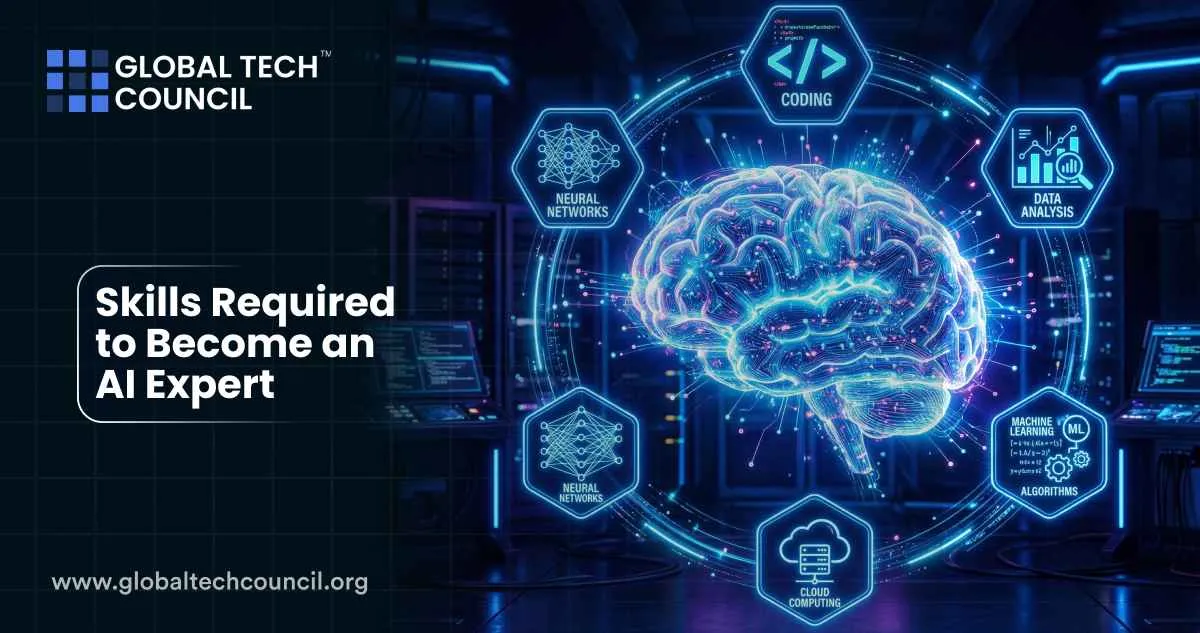
 Artificial Intelligence is no longer limited to research labs or a handful of giant technology companies. In 2026, AI is powering business decisions, automating workflows, supporting customer service, improving software development, strengthening cybersecurity, and transforming industries such as healthcare, finance, retail, education, and digital marketing. As adoption grows, the expectations for AI professionals are also changing.
A few years ago, being considered an AI expert usually meant understanding machine learning algorithms and building predictive models. Today, that definition is far broader. An AI expert must understand data, programming, model behavior, deployment, responsible AI, automation, and real business applications. In other words, the role now demands both technical skill and practical judgment, which is inconvenient for anyone hoping buzzwords alone might count as expertise.
This article explains the most important skills required to become an AI expert in 2026, why these skills matter, and how they are used in real-world environments. It also explores how modern trends such as generative AI, agentic systems, workflow automation, and AI governance are reshaping the field.
The Modern Meaning of AI Expertise
An AI expert is not simply someone who has used an AI chatbot or completed a short online course. A true AI expert understands how AI systems work, where they fail, how they can be improved, and how they can be applied responsibly in practical settings.
For example, in retail, an AI expert may improve recommendation engines, demand forecasting, and customer support workflows. In healthcare, the same professional may work on imaging systems, patient risk analysis, or operational planning. In software companies, AI experts often help design copilots, internal assistants, and knowledge retrieval systems.
The key difference is not just technical understanding. It is the ability to connect AI to meaningful outcomes while balancing performance, reliability, cost, user trust, and ethics.
Why AI Skills Matter More Than Ever in 2026
AI expertise is becoming more valuable because businesses are moving beyond experimentation. Companies no longer want isolated demos or flashy prototypes that impress people for twelve minutes and break immediately afterward. They want production-ready systems that scale, integrate with existing tools, and deliver measurable value.
Several trends are driving this demand. Generative AI is now embedded in business workflows. AI agents are being used to handle multi-step tasks. Smaller, specialized models are gaining attention because they are cheaper and easier to manage. At the same time, privacy concerns, compliance rules, governance requirements, and security risks are increasing.
This means employers need professionals who can do much more than train models. They need experts who understand deployment, evaluation, monitoring, workflow design, and strategic business use.
Programming Skills Form the Foundation
Programming remains one of the most important skills for anyone who wants to become an AI expert. AI systems are built, tested, deployed, and monitored through code. Even professionals who work more on strategy or product direction benefit from understanding how code supports AI applications.
Python is the most important language in this field. It is widely used in machine learning, deep learning, automation, data analysis, and experimentation. Python libraries such as TensorFlow, PyTorch, scikit-learn, and pandas make it central to modern AI development. Professionals who want structured learning in this area often begin with an AI Expert certification that covers essential concepts and practical AI knowledge.
In many production settings, backend development skills are also useful. AI applications often need APIs, integrations, dashboards, and real-time communication layers. That means understanding how software systems connect is just as important as understanding models.
For example, an AI support assistant inside a SaaS platform may rely on Python for data processing and model logic, while the application layer handles user requests, authentication, and interface behavior. A capable AI expert should understand how these pieces work together.
Mathematics and Statistics Still Matter
Although modern AI tools make development more accessible, mathematics remains a core part of AI expertise. A professional in this field should understand probability, statistics, linear algebra, calculus, and optimization well enough to interpret how models learn and why they behave the way they do.
Statistics is especially important for evaluating results, testing assumptions, and understanding performance. Linear algebra supports vectors, embeddings, and neural networks. Probability helps explain uncertainty and prediction confidence. Optimization is central to model training.
This does not mean every AI professional must become a mathematician. It does mean they should know enough to avoid treating AI like magic. That particular human habit has already wasted enough time in enough meeting rooms.
For instance, if a fraud detection model reports high accuracy, an AI expert should know how class imbalance may distort that number. In healthcare, they should understand why precision and recall matter differently depending on the cost of false positives and false negatives.
Strong Data Skills Are Essential
AI systems depend on data quality. That makes data handling one of the most critical skills in the field. An AI expert should know how data is collected, cleaned, labeled, transformed, stored, and evaluated for a given use case.
In many real-world projects, poor data quality causes more problems than weak model selection. A model trained on biased, incomplete, or outdated data will produce unreliable results no matter how advanced the architecture appears.
Experts should understand structured and unstructured data, feature engineering, data pipelines, data governance, and document-based retrieval systems. In 2026, this also includes working with images, audio, text, customer records, and vectorized knowledge sources.
For example, a legal assistant built on a language model may fail not because the model is weak, but because the source documents are duplicated, inconsistent, or missing recent updates. An expert who understands data can identify and fix the real problem.
Machine Learning Knowledge Remains Core
Anyone who wants to become an AI expert must understand the basics of machine learning. This includes supervised learning, unsupervised learning, reinforcement learning, classification, regression, clustering, feature selection, overfitting, underfitting, bias, variance, and evaluation metrics.
Even though many modern AI products are built on top of pre-trained models, machine learning fundamentals still provide the backbone of the field. Without them, it becomes difficult to compare approaches, interpret outcomes, or troubleshoot failures.
A recommendation system, for example, may involve ranking models, user segmentation, predictive scoring, and feedback loops. An AI expert needs to understand which method fits the problem and how to evaluate whether the system is improving.
A strong foundation in these concepts often makes formal learning more useful, especially through an AI Expert certification that covers both theory and practical applications.
Deep Learning and Model Architecture Knowledge Are Increasingly Important
Deep learning powers some of the most advanced AI systems used today. It plays a central role in natural language processing, image recognition, recommendation systems, voice technology, and generative AI tools.
An AI expert should understand neural networks, activation functions, backpropagation, embeddings, transformers, attention mechanisms, and transfer learning. In 2026, transformer-based models remain especially important because they drive many language and multimodal systems.
For instance, document summarization, visual inspection in manufacturing, and voice assistants in customer service all depend on deep learning techniques. Understanding architecture helps professionals choose the right model, estimate costs, and improve performance.
This does not mean every AI expert needs to train huge models from scratch. In many business environments, the most valuable skill is knowing how to adapt and deploy existing models effectively.
Generative AI Skills Are No Longer Optional
Generative AI has become one of the most important areas in the field. It includes systems that generate text, code, images, audio, and task-oriented outputs. As a result, professionals who want to become AI experts must understand how generative systems work in practical settings.
This includes prompt design, retrieval-augmented generation, context control, grounding, hallucination reduction, output evaluation, tool use, and safety measures. Experts need to know when a model can be trusted, when retrieval is required, and when human oversight must remain in place.
For example, a financial services company may use a language model to summarize internal policy updates. A weak setup may generate vague or misleading summaries. A well-designed system will retrieve the correct documents, apply consistent instructions, and validate the final output. That difference separates casual experimentation from real expertise.
Agentic AI and Workflow Automation Are Reshaping the Role
One of the biggest developments in 2026 is the rise of agentic AI. These systems do more than answer questions. They can plan actions, use tools, retrieve information, interact with software, and complete multi-step tasks with limited supervision.
That is why understanding agent-based workflows is becoming one of the defining skills of modern AI professionals. Businesses want AI systems that can support operations, sales, customer service, and internal productivity with more autonomy.
A sales assistant, for example, may review lead data, update a CRM, draft a follow-up email, and schedule a meeting. A customer service agent may classify an issue, retrieve policy details, propose a solution, and escalate complex cases. Designing these systems requires knowledge of orchestration, prompt chaining, permissions, failure handling, and monitoring.
Professionals who want structured expertise in this area may benefit from an Agentic AI certification, especially as workflow automation becomes more common across industries.
Deployment and MLOps Knowledge Separate Professionals from Hobbyists
Building a model is only part of the job. A true AI expert also understands what happens after development. This is where deployment knowledge and MLOps become essential.
MLOps includes version control, deployment pipelines, monitoring, retraining, observability, infrastructure, and drift detection. Many AI projects fail because the system around the model is unstable, difficult to maintain, or poorly monitored.
For example, a retail forecasting model may work well during testing but decline over time as customer behavior changes. Without monitoring and retraining, the results become less reliable. An AI expert should know how to detect this drift and respond before the business suffers.
This production mindset is one of the clearest differences between academic familiarity and real industry expertise.
Responsible AI, Ethics, and Governance Cannot Be Ignored
As AI becomes more powerful, the ethical and regulatory stakes are rising. AI experts now need to understand fairness, transparency, explainability, privacy, accountability, and responsible deployment.
In finance, healthcare, education, hiring, and government, these issues are especially serious. A poorly designed AI system can reinforce bias, expose sensitive data, or make decisions that users cannot understand or challenge.
For example, an AI hiring system that favors certain patterns without proper review can create unfair outcomes. A customer-facing assistant that reveals confidential data can create legal and reputational damage. A true expert knows how to evaluate these risks, build safeguards, and maintain trust.
In 2026, responsible AI is not just a policy topic. It is a practical skill that employers increasingly expect.
Business Understanding Makes AI More Valuable
Technical strength alone is not enough. The best AI experts also understand business goals and know how to connect AI capabilities to measurable value.
This includes identifying useful use cases, defining success metrics, balancing cost and performance, and working with teams across product, leadership, compliance, and operations. Strong professionals can answer not just how to build a system, but whether it should be built and what success should actually mean.
For example, a company may believe it needs a highly complex visual AI platform when a simpler forecasting or automation system would solve the real problem faster and at lower cost. An expert recognizes this and helps the business avoid expensive detours.
Professionals who want to expand their broader emerging technology profile may also strengthen their credibility through a deeptech certification.
Communication and Domain Knowledge Create Real Impact
AI projects rarely succeed in isolation. They involve engineers, product teams, legal teams, security specialists, managers, and end users. That makes communication one of the most underrated skills in the field.
An AI expert must be able to explain limitations clearly, translate business needs into technical plans, and document system behavior in a way others can understand. This builds trust, and trust is essential for successful AI adoption.
Domain knowledge matters too. AI becomes more valuable when it is paired with industry understanding. A professional who understands healthcare, finance, retail, education, or marketing can build more useful systems than someone who only understands the abstract model layer.
In digital marketing, for instance, AI is now used for personalization, audience targeting, campaign optimization, predictive analysis, and content support. Professionals working in this area may benefit from becoming an AI powered digital marketing expert, especially if they want to connect AI with measurable growth.
Final Thoughts
The skills required to become an AI expert in 2026 go far beyond machine learning theory. Today’s AI expert must be a programmer, analyst, systems thinker, evaluator, and strategist. They need to understand data, models, deployment, ethics, automation, and business value. Just to make things charming, they also need enough judgment to know when AI helps, when it fails, and when humans still need to stay involved.
As AI continues to reshape industries, professionals who build these capabilities will be well positioned for long-term growth. The field is expanding, the tools are evolving, and the demand for capable experts remains strong. For people willing to learn deeply and apply that knowledge responsibly, becoming an AI expert remains one of the most promising career paths of this decade.
Frequently Asked Questions
1. What is the most important skill required to become an AI expert?
Programming, especially Python, is one of the most important foundational skills. However, true expertise also requires data knowledge, machine learning understanding, and practical problem-solving ability.
2. Do I need a degree to become an AI expert?
Not always. Many professionals enter AI through self-study, certifications, project work, and experience in software, data, or business roles.
3. Is Python enough to become an AI expert?
Python is essential, but it is not enough by itself. You also need data skills, machine learning knowledge, deployment awareness, and business understanding.
4. Why is mathematics important in AI?
Mathematics helps you understand how models learn, how to evaluate them correctly, and how to avoid common mistakes in interpretation and training.
5. What role does prompt design play in AI expertise?
Prompt design is now a major practical skill because it shapes how generative AI systems respond, retrieve information, reason, and complete tasks.
6. What is agentic AI, and why does it matter?
Agentic AI refers to systems that can plan, use tools, and complete multi-step tasks with limited supervision. It matters because businesses increasingly want AI systems that act, not just answer.
7. Are certifications useful for aspiring AI professionals?
Yes. Certifications are useful when they support practical learning and structured skill development rather than serving as decorative internet trophies.
8. How important is business knowledge in AI?
Business knowledge is very important because AI experts need to connect technical solutions to measurable goals, user needs, and realistic outcomes.
9. Can I become an AI expert without working in a tech company?
Yes. AI is now used across healthcare, finance, retail, marketing, education, manufacturing, and many other industries.
10. How long does it take to become an AI expert?
That depends on your background, learning pace, and hands-on practice. Most professionals build strong AI skills over time through study, projects, and real-world application.