

What Are AI Agents and How Are They Different From Chatbots?
 Michael Willson
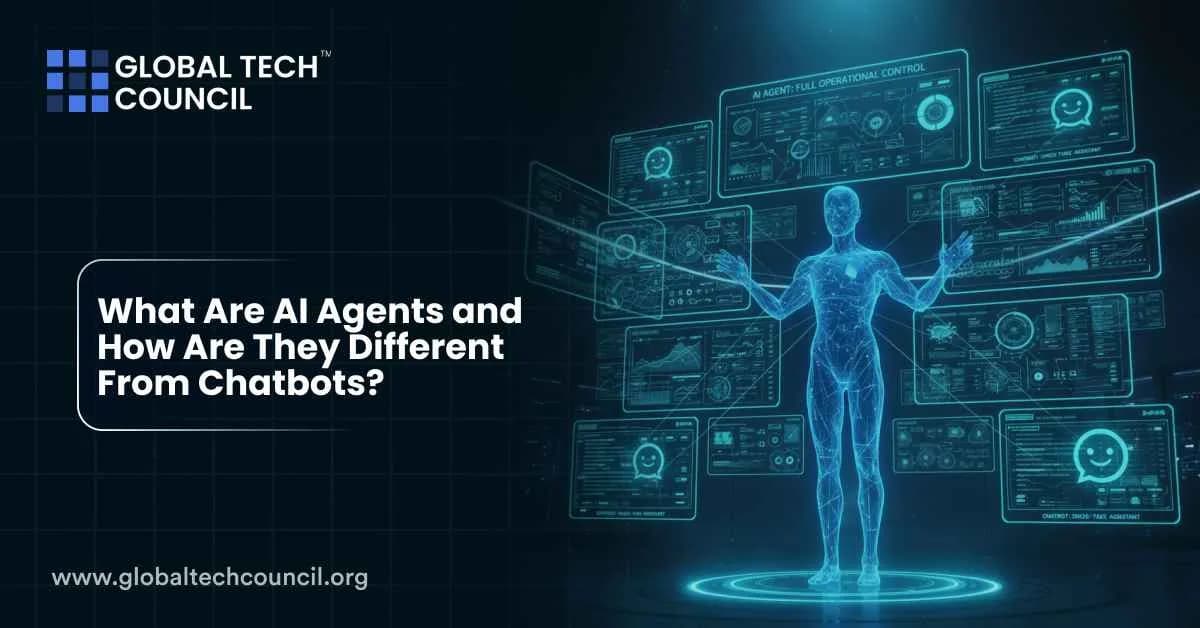 AI has evolved from simple conversation bots into systems that can actually plan, decide, and act. This shift is why many businesses and researchers are now talking about “AI agents.” But what exactly separates them from chatbots, and why does it matter? The answer lies in how these systems are designed to operate: chatbots mainly respond, while agents can actually execute tasks. For anyone interested in the skills behind these systems, an Artificial Intelligence Certification is a good starting point to understand how they’re trained and applied.
Chatbots: Conversational but Limited
Chatbots are familiar to most people. They pop up on websites, answer FAQs, and guide customers through structured dialogues. Their strength lies in scripted, predictable interactions. If you’ve ever asked a bank’s website about account balances or chatted with an online retailer about shipping updates, chances are you interacted with a chatbot. They are fast, helpful, and inexpensive—but not designed to handle tasks outside of their pre-programmed scope.

AI Agents: Beyond Conversation
AI agents go further. They can browse websites, fill forms, place orders, and integrate with multiple apps or APIs to achieve a goal. Projects like Google’s Mariner and OpenAI’s Operator show this in action, performing browser tasks with little to no handholding. In India, Kruti demonstrates how an agent can understand multiple languages and connect to services like ride-hailing or shopping. To better grasp the advanced systems that make this possible, a Deep Tech Certification can give professionals the framework to understand how agents combine reasoning, planning, and tool use.
Where the Difference Shows Up
The key difference is autonomy. Chatbots wait for prompts, while agents can act proactively. Agents are capable of multi-step reasoning, meaning they can figure out the best sequence of actions to complete a task. They’re also tool-using by design, making them more adaptable to complex workflows. On the other hand, they come with challenges: privacy, security, and the risk of unexpected decisions. This means businesses must balance innovation with oversight. For teams working directly with customer data and predictions, the Data Science Certification offers a path to ensure automation is backed by reliable analysis.
Business Adoption and Challenges
Businesses are already testing agents to automate onboarding, sales follow-ups, and even supply chain monitoring. Unlike chatbots, which save time mainly in customer support, agents have the potential to handle back-office processes that would otherwise require multiple employees. Still, complexity comes at a price. Agents are harder to build, require careful supervision, and can be misused if not properly secured. For leaders planning to roll out agentic AI at scale, the Marketing and Business Certification helps frame these technologies in terms of strategy, trust, and customer adoption.
AI Agents vs Chatbots
| Feature | Chatbots | AI Agents |
| Core Role | Answer questions, guide users through structured scripts | Plan, decide, and act to achieve multi-step goals |
| Autonomy | Reactive, waits for input | Proactive, can take initiative |
| Complexity of Tasks | Handles simple, repetitive queries | Executes workflows, integrates across apps and tools |
| Learning Ability | Limited adaptation; mostly pre-scripted | Can improve with feedback, adapt to context |
| Integration | Usually text-only, embedded in websites or apps | Connects to APIs, browsers, devices, third-party tools |
| Examples | Banking or e-commerce FAQ bots | OpenAI Operator, Google Mariner, Kruti, Manus |
| Benefits | Inexpensive, easy to deploy, good for customer service | Saves time, handles complex processes, scales workflows |
| Risks | Limited usefulness outside narrow scope | Security, privacy, unexpected actions, higher cost |
| User Experience | Good for predictable interactions | Flexible, capable of solving real-world problems |
| Adoption Level | Widely deployed | Rapidly growing, still maturing |
Conclusion
Chatbots and AI agents may look similar on the surface, but they serve different purposes. Chatbots handle quick conversations, while agents take action and deliver results across multiple systems. The move toward agent-based AI suggests businesses will soon rely on tools that do far more than chat.
Related Articles
View All
Artificial Intelligence
Microsoft Agent 365: The Control Plane for Agents
Microsoft Agent 365 gives organizations a central control plane to manage, secure, and monitor AI agents across business workflows.
Artificial Intelligence
How Can Businesses Use AI Chatbots for Customer Support?
AI chatbots are changing the way companies interact with customers. They deliver fast responses, scale easily, and cut down costs while keeping clients engaged around the clock. Businesses across industries are adopting them to answer questions, solve problems, and even offer proactive assistance.…
Artificial Intelligence
Project Manager Interview Questions and Answers for 2026
Prepare for 2026 project manager interviews with practical questions, sample answers, AI project scenarios, remote leadership tips, and value-focused guidance.
Trending Articles
The Role of Blockchain in Ethical AI Development
How blockchain technology is being used to promote transparency and accountability in artificial intelligence systems.
AWS Career Roadmap
A step-by-step guide to building a successful career in Amazon Web Services cloud computing.
Top 5 DeFi Platforms
Explore the leading decentralized finance platforms and what makes each one unique in the evolving DeFi landscape.