

What is artificial intelligence and how can it be a game-changer?
 Aman Singh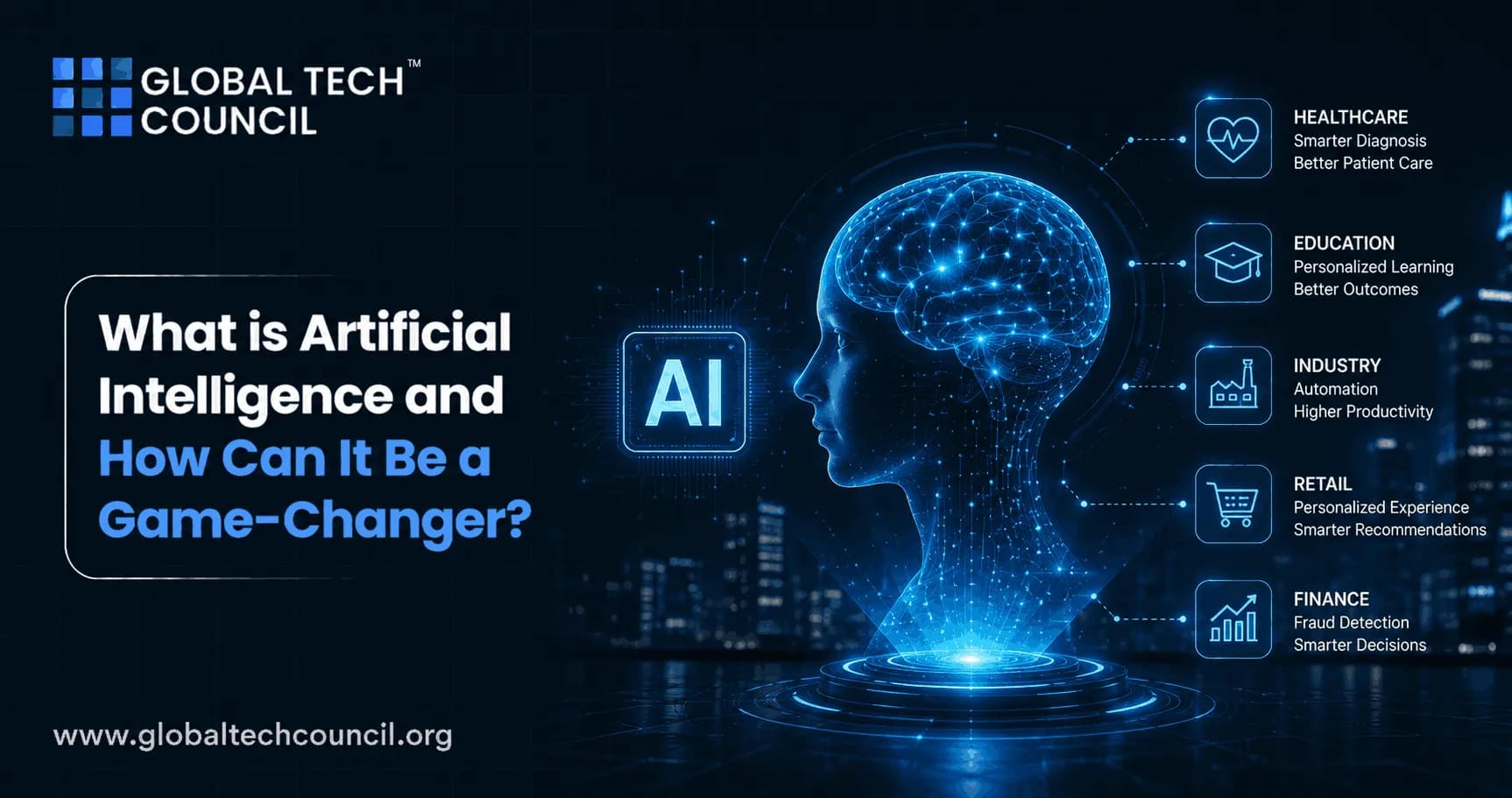
Artificial intelligence is technology that allows machines to perform tasks that normally require human thinking, such as recognizing patterns, making predictions, understanding language, and improving from experience. In simple terms, AI lets software learn from data instead of following only fixed, hand-written rules. That single shift, from rigid instructions to adaptive learning, is why AI is now reshaping industries from healthcare to logistics to creative work, and why understanding it has become a genuine career advantage rather than a niche technical skill. Professionals who want to move past surface-level familiarity often start with a structured program such as the Certified Artificial Intelligence (AI) Expert course, which builds a working foundation instead of just buzzwords.
This article breaks down what artificial intelligence actually is, how it differs from ordinary software, and where its real game-changing potential lies, separate from the hype cycle that surrounds it.

How Artificial Intelligence Actually Works
At its core, AI systems are built to find patterns in large amounts of data and use those patterns to make decisions or predictions. A traditional computer program follows explicit instructions written by a programmer. An AI system, particularly one built using machine learning, is instead trained on examples and adjusts its internal parameters until it gets better at a task, whether that task is recognizing a face in a photo, translating a sentence, or predicting which product a customer is likely to buy.
There are a few major branches worth knowing. Machine learning covers systems that improve through exposure to data. Deep learning, a subset of machine learning, uses layered neural networks loosely inspired by the human brain and powers most of today's headline AI breakthroughs, including image recognition and large language models. Natural language processing focuses specifically on understanding and generating human language, which is what makes chatbots and voice assistants possible. Understanding these distinctions matters because the term "AI" gets used loosely in marketing, and knowing what is actually happening under the hood helps separate genuine capability from exaggerated claims. This is exactly the kind of gap a broader Certified AI & Machine Learning Expert track is built to close, since it walks through both the AI concepts and the machine learning mechanics that sit underneath them.
Why Artificial Intelligence Is Considered a Game-Changer
Calling a technology a game-changer is a strong claim, and AI earns it for a specific reason: it changes the cost and speed of tasks that used to require significant human time and expertise. A radiologist reviewing scans, a customer service team answering repetitive questions, a supply chain manager forecasting demand, and a marketing team writing first drafts of ad copy are all doing work that AI systems can now support or partially automate. That does not mean these roles disappear. It means the nature of the work shifts toward judgment, oversight, and the parts of the job that genuinely require a human perspective.
The scale of this shift is what makes it different from earlier waves of automation. Previous automation mostly replaced physical, repetitive tasks. AI is increasingly capable of handling cognitive tasks too, including writing, analysis, coding, and even creative work. That expansion into knowledge work is why AI is being compared to earlier general-purpose technologies like electricity or the internet, rather than to a narrow tool built for one industry.
Real-World Examples of AI as a Game-Changer
Abstract explanations only go so far, so it helps to look at where AI is already changing outcomes today.
In healthcare, AI-assisted diagnostic tools are helping doctors detect certain cancers and eye diseases earlier and more consistently than manual review alone. In agriculture, machine learning models analyze satellite and sensor data to predict crop yields and detect early signs of disease, helping farmers act before a small problem becomes a large loss. In finance, AI systems flag fraudulent transactions in real time by spotting patterns a human analyst would never catch quickly enough. In logistics, predictive models optimize delivery routes and warehouse stock levels, cutting both cost and delivery time. In creative fields, AI tools now assist with everything from music composition to video editing, changing how quickly a small team can produce professional output.
None of these examples replace human expertise outright. They compress the time it takes to reach a decision and widen the set of options a person can consider before making one. That combination, speed plus expanded options, is where the real game-changing value sits.
Building AI Skills Early: World Tech Olympiad
The AI shift described above is not something the next generation will simply inherit. Many students are already building these skills, and structured competitions give that learning a real testing ground. Designed to encourage technology learning among school students, the World Tech Olympiad (WTO) brings together participants from Class 2 to Class 12 through different technology-focused challenges. Its areas include robotics, AI, programming, computational thinking, and cybersecurity, with competition levels structured to suit different age groups and abilities. The Olympiad supports participation through separate routes for families and educational institutions. Parents can enroll their children directly, while schools can register as institutions and facilitate participation for students who meet the eligibility requirements.
For families and schools thinking about how the workforce described in this article will actually be staffed a decade from now, programs like this are where that future starts taking shape.
What Artificial Intelligence Cannot Do Yet
Understanding AI's limits matters just as much as understanding its strengths, especially for anyone making business or career decisions around it. Current AI systems do not genuinely understand context the way a person does. They generate outputs based on statistical patterns in training data, which means they can produce confident, fluent, and completely wrong answers, a problem often called hallucination. They also inherit biases present in their training data, which can lead to unfair or skewed outcomes if not carefully checked. And they lack real judgment about ethics, consequences, or nuance unless that judgment is explicitly designed into the system by the people building it.
This is why the most successful AI deployments pair the technology with human oversight rather than removing people from the process entirely. The organizations getting real value from AI are the ones treating it as a powerful assistant that still needs a checked, accountable human in the loop, not as a replacement for judgment.
How Businesses and Professionals Can Prepare
Preparing for AI does not require becoming a machine learning engineer. It requires understanding enough to ask good questions, spot where AI genuinely adds value, and recognize where it introduces risk. For professionals in non-technical roles, that might mean learning how to prompt AI tools effectively, understanding data privacy basics, or knowing which decisions should never be fully automated. For technical teams, it means going deeper into model design, deployment, and monitoring.
A broader Deep Tech Certification path can help professionals connect AI to the wider technology stack it increasingly depends on, including data infrastructure, automation tools, and emerging computing systems, rather than treating AI as an isolated skill sitting apart from everything else in a modern tech environment.
Final Thoughts
Artificial intelligence is a game-changer not because it replaces human thinking, but because it changes what is possible within the same amount of time and budget. It compresses research, speeds up diagnosis, automates repetitive analysis, and opens creative and technical work to people who previously lacked the specialized skills to attempt it. The organizations and individuals who benefit most will not be the ones who use AI blindly. They will be the ones who understand it well enough to apply it with judgment.
For teams responsible for communicating this shift internally or to customers, that skill matters just as much as the technical side. A Marketing Certification can be a genuinely useful complement here, since explaining what AI actually does, clearly and honestly, is quickly becoming one of the most valuable skills in any organization adopting it.
Artificial intelligence will keep evolving quickly, but the fundamentals covered here will not change: it learns from data, it works best with human oversight, and its real advantage is speed and scale, not magic.
FAQs
1. What Is Artificial Intelligence?
Artificial intelligence, or AI, refers to computer systems designed to perform tasks that normally require aspects of human intelligence. These tasks can include understanding language, recognizing images, finding patterns, making predictions, generating content, solving problems, and taking actions. Modern AI includes Machine Learning, Deep Learning, Generative AI, Large Language Models, Computer Vision, and AI Agents. AI does not necessarily “think” like a human. It uses computational methods and learned patterns to produce outputs, sometimes impressively and sometimes with the confidence of someone who did not read the instructions.
2. How Does Artificial Intelligence Work?
AI systems generally process data to identify patterns and use those patterns to generate predictions, classifications, recommendations, content, or actions. In machine learning, models are trained using data rather than having every rule explicitly programmed. A simplified process is Data → Training → Model → Input → Prediction or Output. Generative AI extends this approach by producing new text, images, audio, video, software code, and other content based on patterns learned during training and additional context supplied at use time.
3. Why Is Artificial Intelligence Considered a Game-Changer?
AI can be a game-changer because it changes the economics and speed of many cognitive tasks. Activities involving analysis, content creation, customer support, software development, research, document processing, and decision support can potentially be completed faster or at greater scale. More advanced AI systems can also automate multi-step workflows. The larger opportunity is therefore not simply doing existing tasks faster but redesigning how work, products, services, and organizations operate.
4. What Are the Main Types of Artificial Intelligence?
AI includes several major technological approaches. Machine learning identifies patterns and makes predictions from data. Deep learning uses neural networks with multiple layers for complex tasks. Natural language processing works with human language, while computer vision analyzes images and video. Generative AI creates new content, and AI agents can use models, tools, and software systems to perform multi-step tasks. These categories frequently overlap, because apparently even technology refuses to remain neatly inside presentation-slide boxes.
5. What Is Generative AI?
Generative AI is artificial intelligence designed to generate new content such as text, images, software code, audio, and video. Large language models are a prominent form of generative AI used for writing, summarization, question answering, research assistance, coding, and knowledge work. Generative AI differs from many traditional predictive systems because users can interact with it using natural language and apply the same underlying technology to many different tasks.
6. What Are AI Agents?
AI agents are systems designed to pursue goals and perform tasks using AI models together with tools, data, APIs, and software applications. An agent might gather information, analyze it, make a plan, call an application, perform an authorized action, evaluate the result, and continue until the task is completed or requires human intervention. The basic flow is Goal → Reasoning or Planning → Tools → Actions → Results. Because agents can act rather than merely answer, they also require stronger security, permissions, monitoring, and governance.
7. How Is AI Changing Businesses?
AI is changing businesses by enabling automation, faster analysis, personalized customer experiences, improved forecasting, software development assistance, knowledge retrieval, and new digital products. Companies can use AI across Marketing → Sales → Customer Service → Finance → HR → Operations → IT → Product Development. The greatest impact often comes when organizations redesign complete workflows around AI instead of simply attaching an AI assistant to an inefficient process and congratulating themselves on transformation.
8. How Can AI Improve Productivity?
AI can improve productivity by reducing time spent on repetitive or information-intensive activities. Employees can use AI to summarize documents, analyze information, draft communications, generate code, prepare reports, search organizational knowledge, and automate routine processes. Productivity should be measured through actual outcomes such as Time Saved + Increased Output + Reduced Cost + Faster Cycle Time + Maintained or Improved Quality. Simply measuring how frequently employees open an AI tool proves very little about productivity.
9. How Can AI Improve Customer Experience?
AI can support customers through conversational assistants, personalized recommendations, faster service, intelligent search, automated case classification, and better support for human service agents. AI can also analyze customer interactions to identify common problems and emerging needs. Effective implementations combine automation with appropriate human escalation. The objective should be to solve customer problems more effectively, not merely to make it extraordinarily difficult for a customer to locate an actual human being.
10. How Is AI Transforming Healthcare?
AI can support medical imaging, clinical decision support, drug discovery, administrative automation, research, patient communication, and healthcare operations. It can help clinicians analyze large amounts of information and identify patterns that may support diagnosis or treatment planning. However, healthcare applications require rigorous validation, privacy protections, security, regulatory compliance, and appropriate professional oversight. AI can assist healthcare professionals, but impressive model capabilities do not remove the need for clinical evidence or medical judgment.
11. How Is AI Changing Education?
AI can support personalized learning, tutoring, lesson preparation, translation, accessibility, feedback, and administrative work. Students can use AI to explore concepts, practice questions, and receive explanations adapted to their learning needs. Educators can use it to create materials and support differentiated instruction. However, AI can also produce incorrect information and make academic shortcuts remarkably convenient. Effective AI education therefore requires critical thinking, verification, digital literacy, and clear expectations around appropriate use.
12. How Is AI Changing Banking and Finance?
Financial institutions use AI for fraud detection, risk analysis, customer service, document processing, compliance support, personalization, forecasting, and investment research. Generative AI can assist employees with knowledge-intensive tasks, while agents may eventually automate larger portions of operational workflows. Because financial decisions can have significant consequences, AI systems require controls around accuracy, explainability, data privacy, cybersecurity, bias, human oversight, and regulatory compliance.
13. How Can AI Help Small Businesses?
Small businesses can use AI for marketing content, customer support, research, sales assistance, bookkeeping workflows, data analysis, website development, and administrative automation. This can give smaller organizations access to capabilities that previously required larger specialist teams. However, businesses should evaluate AI according to measurable value and risk rather than buying every tool whose website contains a glowing robot. Starting with a few repetitive, high-value processes is generally more useful than attempting an immediate company-wide AI transformation.
14. Will Artificial Intelligence Replace Human Jobs?
AI is likely to automate some tasks, significantly change others, and create new forms of work. The impact will vary across occupations and industries. Jobs consist of multiple tasks, and AI may automate only part of a role while augmenting the remaining activities. A useful framework is Job → Tasks → Automate → Augment → Retain Human Judgment → Redesign Role. Workers who learn how to use AI effectively may increasingly work alongside AI systems rather than simply competing against them.
15. What Skills Will People Need in an AI-Driven Future?
People will need a combination of technical and human capabilities. Important skills include AI literacy, data literacy, critical thinking, problem solving, cybersecurity awareness, communication, creativity, adaptability, and domain expertise. Technical professionals may additionally need machine learning, AI engineering, model evaluation, RAG, agents, and AI security skills. Knowing how to use current tools matters, but learning how to learn matters more because today's impressive AI platform can become tomorrow's strangely nostalgic screenshot.
16. What Are the Biggest Benefits of Artificial Intelligence?
Potential benefits include increased productivity, automation, faster analysis, improved personalization, greater accessibility, accelerated innovation, and better use of large amounts of information. AI can also augment human capabilities by helping people explore alternatives, identify patterns, and perform tasks beyond their existing technical expertise. These benefits are not automatic. They depend on appropriate data, system design, user adoption, governance, and whether AI is being applied to a problem worth solving.
17. What Are the Biggest Risks of Artificial Intelligence?
AI risks can include inaccurate outputs, bias, privacy violations, cybersecurity threats, intellectual-property concerns, fraud, misinformation, overreliance, workforce disruption, and failures of autonomous systems. Risks generally increase when AI has access to sensitive data or the authority to perform consequential actions. Organizations should therefore manage AI through Risk Assessment → Controls → Testing → Human Oversight → Monitoring → Incident Response. More capable AI requires more capable governance, inconvenient though that may be for anyone hoping technology would eliminate management.
18. How Can Organizations Use AI Responsibly?
Responsible AI requires clear ownership, policies, data governance, security, privacy protections, testing, human oversight, transparency where appropriate, and continuous monitoring. Organizations should classify AI systems according to risk and apply stronger controls to higher-impact applications. Employees also need clear guidance about approved tools and acceptable data use. Responsible AI is not a document created by legal or compliance teams after deployment; it should influence how systems are selected, designed, tested, deployed, and operated.
19. What Is the Future of Artificial Intelligence?
AI is likely to become increasingly embedded in software, devices, business processes, scientific research, and everyday services. Systems are also moving from generating content toward completing increasingly complex tasks through agents and tools. The future may involve combinations of Humans + AI Copilots + AI Agents + Traditional Software + Robotics. Precisely predicting how quickly particular capabilities will develop is difficult, so individuals and organizations should build adaptable skills, architectures, and governance rather than betting everything on one forecast.
20. How Can Artificial Intelligence Become a Game-Changer for Society and Business?
AI becomes genuinely transformative when it progresses beyond isolated tools and changes how problems are solved.
The evolution can be understood as:
Traditional Software
Humans define detailed rules and computers execute them.
↓
Machine Learning
Systems learn patterns from data and make predictions.
↓
Generative AI
Systems create text, images, code, audio, video, and other content.
↓
AI Copilots
AI assists people while they perform work.
↓
AI Agents
AI can perform multi-step tasks using tools and applications within defined boundaries.
This progression can transform the relationship between people and technology:
Human Does Work
becomes:
Human + AI Complete Work
and, for suitable processes:
Human Defines Goal → AI Executes Routine Work → Human Handles Judgment and Exceptions
For businesses, this can create four major forms of value:
Productivity
AI can reduce the time and effort required for knowledge-intensive and repetitive tasks.
Growth
Companies can use AI to improve products, personalize services, accelerate innovation, and potentially create new revenue models.
Decision Support
AI can analyze large volumes of information and help people identify patterns, scenarios, and relevant evidence.
Automation
AI agents and other systems can execute portions of workflows, increasing operational capacity.
The broader economic effect comes from combining these capabilities:
AI Capability → Workflow Redesign → Higher Productivity → Lower Costs or Greater Capacity → New Products and Services → Business Transformation
But technology alone does not guarantee transformation.
Organizations still need:
Strategy + Data + Technology + People + Security + Governance + Change Management
Similarly, individuals need more than the ability to type prompts. A useful personal development path is:
AI Literacy → Practical AI Skills → Critical Evaluation → Domain Expertise → Creative Application → Responsible Use
The central principle is:
AI is a game-changer when it expands what people and organizations can accomplish, not merely when it generates impressive outputs.
A chatbot writing an email slightly faster is useful.
AI helping scientists accelerate research, engineers design better systems, businesses automate complex workflows, teachers personalize learning, and workers access capabilities previously requiring specialized expertise is potentially transformational.
The technology matters, but what humans choose to build, automate, delegate, verify, and govern with it will determine the scale of its impact.
Apparently inventing increasingly intelligent machines was only the easy part. Figuring out what we should do with them remains stubbornly assigned to humans.
Related Articles
View All
Artificial Intelligence
How Can Blockchains Transform Artificial Intelligence?
Blockchain can complement artificial intelligence by providing tamper-resistant records, decentralized identity, data provenance, and programmable smart contracts. Together, the technologies can support auditable AI workflows, secure data sharing, decentralized AI marketplaces, and clearer tracking of models and digital assets. The combination has potential, although scalability, privacy, governance, and integration remain significant challenges.

Artificial Intelligence
How Artificial Intelligence Can Shape the Future of Transportation?
Artificial intelligence can shape the future of transportation through autonomous vehicles, smarter traffic management, predictive maintenance, route optimization, and safer mobility systems. AI can also help public transit agencies analyze real-time data, improve scheduling, reduce congestion, and make transportation networks more efficient and responsive.
Artificial Intelligence
Artificial Intelligence in Food Technology
Artificial intelligence in food technology helps improve food quality, safety, production, and supply-chain efficiency. AI applications include automated inspection, contamination detection, predictive maintenance, demand forecasting, product development, precision processing, and food waste reduction, helping manufacturers make faster, data-driven decisions.
Trending Articles
The Role of Blockchain in Ethical AI Development
How blockchain technology is being used to promote transparency and accountability in artificial intelligence systems.
AWS Career Roadmap
A step-by-step guide to building a successful career in Amazon Web Services cloud computing.
Top 5 DeFi Platforms
Explore the leading decentralized finance platforms and what makes each one unique in the evolving DeFi landscape.