


 What is Large Scale Data Visualization
 What is Large Scale Data Visualization
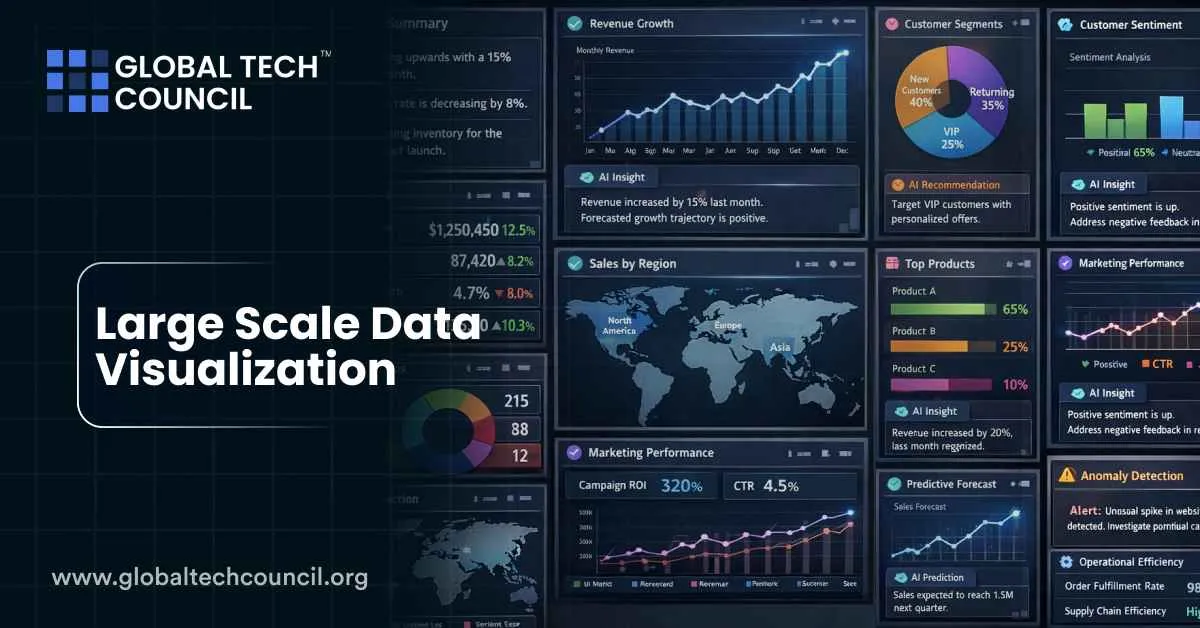
Organizations today generate enormous volumes of data from digital platforms, sensors, financial systems, and online interactions. Interpreting such massive datasets using raw numbers alone is nearly impossible. Large scale data visualization solves this problem by transforming complex data into visual formats such as charts, dashboards, maps, and interactive graphics that help people understand patterns and trends quickly. Data visualization allows analysts to explore relationships, detect anomalies, and communicate insights clearly to decision makers.
As data continues to grow at unprecedented levels, companies are investing in advanced visualization technologies capable of processing millions or even billions of records. These tools are becoming essential for business intelligence, scientific research, healthcare, marketing analytics, and many other fields.
Understanding Large Scale Visualization
Large scale data visualization refers to the process of representing massive datasets in visual form while maintaining performance, clarity, and usability. Traditional graphs often fail when datasets become extremely large because they create clutter and slow system performance.
Modern visualization systems address these challenges using optimized data processing, interactive dashboards, and advanced analytics tools that allow users to explore large datasets efficiently.
The purpose is not only to display data but also to enable exploration. Interactive filtering, zooming, and real time updates allow analysts to investigate trends and make data driven decisions more effectively.
Key Visualization Techniques
Several visualization techniques are commonly used when dealing with large datasets.
Heat Maps
Heat maps represent data values through color variations. They are particularly useful when analyzing user behavior, geographic information, or website activity. For example, retailers often analyze heat maps of store layouts to understand customer movement and optimize product placement.
Network Diagrams
Network diagrams illustrate relationships between entities. They are widely used in cybersecurity, social network analysis, and supply chain management to identify connections and dependencies within complex systems.
Geospatial Visualization
Geospatial visualizations display data on maps, making them valuable for logistics, climate research, and urban planning. Governments and environmental organizations use them to monitor natural disasters and infrastructure development.
Tree Maps and Stream Graphs
Tree maps help visualize hierarchical data, while stream graphs show how values change over time. These visualizations help analysts interpret patterns across large multidimensional datasets.
Tools for Visualizing Massive Data
Modern visualization tools are designed to handle complex and high volume datasets.
Platforms such as Tableau, Power BI, Grafana, and Google Charts allow analysts to create interactive dashboards and graphical reports. These tools provide features such as drag and drop interfaces, real time analytics, and integration with multiple data sources.
Business intelligence platforms like Qlik and SAS also combine visualization with advanced analytics, enabling organizations to explore insights more effectively.
These tools allow companies to monitor performance, analyze customer behavior, and track operational efficiency in real time.
Role of Artificial Intelligence in Visualization
Artificial Intelligence is significantly changing how large scale data visualization works. AI powered platforms can automatically analyze data, identify patterns, and generate visual insights without extensive manual effort.
Modern systems support natural language queries, meaning users can ask questions in everyday language and receive visual results instantly. AI tools also enable predictive analytics, helping organizations forecast trends and anticipate future outcomes.
Additionally, machine learning models can detect anomalies in datasets that may indicate fraud, technical failures, or unusual market behavior.
Real World Applications
Large scale visualization has become essential across industries.
Finance
Financial institutions analyze millions of transactions daily. Visualization dashboards help analysts detect fraud, monitor market changes, and evaluate investment strategies.
Healthcare
Healthcare providers use visual analytics to track disease trends, patient outcomes, and hospital resource utilization.
Retail and Marketing
Retail companies analyze purchasing patterns, customer demographics, and online behavior. Visualization tools help marketing teams understand campaign performance and optimize strategies.
Smart Cities
Governments use large scale visualization for traffic monitoring, urban planning, and infrastructure management.
In each case, visualization helps transform complex data into meaningful insights that guide strategic decisions.
Recent Developments in Large Scale Visualization
The field of data visualization is evolving rapidly as technology advances. One major trend is the integration of artificial Intelligence and machine learning into visualization platforms, allowing systems to automatically analyze large datasets and generate insights.
Another emerging development involves automated visualization tools that generate charts and dashboards directly from raw data. These systems significantly reduce the time required for analysis and reporting.
Researchers are also exploring immersive visualization environments such as virtual reality, which allow users to explore complex datasets in three dimensional space. These technologies improve understanding of large scientific and industrial datasets.
Natural language driven visualization is another breakthrough. New systems allow users to describe what they want to analyze, and the software generates relevant visualizations automatically.
Skills Needed for Data Visualization
Professionals working with large scale data visualization require a combination of technical and analytical skills. Knowledge of statistics, programming, data analytics tools, and design principles is important for creating meaningful visual insights.
Many professionals enhance their expertise through specialized programs such as a Tech certification that focuses on emerging technologies and data analytics.
Individuals interested in advanced Big Data systems may pursue a Big Data certification to develop deeper expertise in data analytics, large-scale processing, and intelligent systems.
Similarly, analysts who focus on business strategy and consumer behavior may benefit from a Deep Tech Certification and Marketing Certification to understand how data insights translate into effective market decisions.
These certifications help bridge the gap between technical knowledge and practical industry applications.
Challenges in Visualizing Large Data
Despite technological progress, several challenges remain in large scale data visualization.
Handling extremely large datasets can strain computing resources and slow performance. Visual clutter can also make insights difficult to interpret if graphs are poorly designed.
Data quality is another important issue. Incomplete or inconsistent datasets can produce misleading visualizations and incorrect conclusions.
To overcome these challenges, organizations rely on efficient data processing frameworks, scalable visualization tools, and strong data governance practices.
Future of Large Scale Data Visualization
The future of data visualization will likely involve deeper integration with artificial intelligence, automation, and real time analytics. As datasets continue to expand, visualization tools must become faster, smarter, and more interactive.
Technologies such as augmented reality, immersive analytics, and automated insight generation are expected to transform how analysts interact with data. Organizations will increasingly depend on visualization systems to convert complex datasets into strategic knowledge.
Conclusion
Large scale data visualization plays a critical role in modern data driven organizations. By transforming massive datasets into clear visual insights, it enables analysts, managers, and policymakers to understand trends, identify problems, and make informed decisions.
With advancements in artificial Intelligence, interactive dashboards, and immersive technologies, visualization tools are becoming more powerful and accessible. As data continues to grow, the ability to visualize and interpret information effectively will remain one of the most valuable skills in the digital economy.