


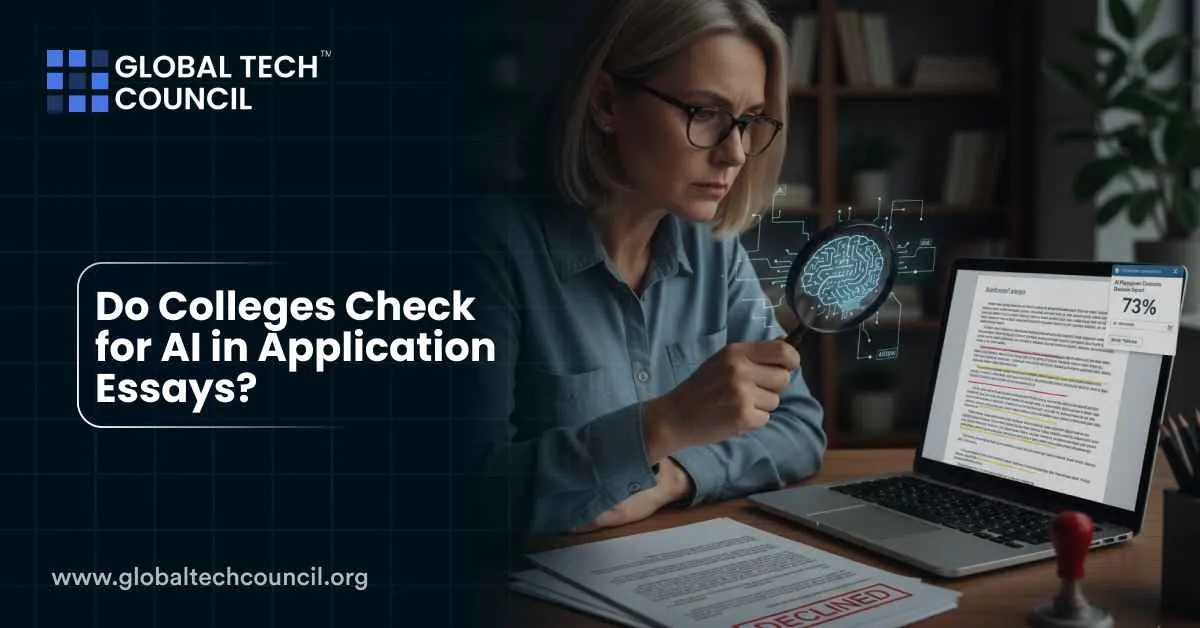
 If you are applying to college right now, this question is probably sitting at the top of your mind. Do colleges actually check whether an application essay was written using AI?
The short answer is yes, colleges are paying attention, but not in the way most students fear. Admissions offices are not running essays through a single AI detector and rejecting applications based on a score. What they care about far more is whether the essay feels authentic, consistent, and aligned with their academic integrity rules.
Understanding how AI fits into real systems, policies, and evaluation processes is exactly the kind of thinking taught in a Tech Certification, where the focus is on how tools are used responsibly rather than whether they exist at all.
What admissions teams are really evaluating
College admissions readers are not trying to catch students using technology. Their job is to understand the person behind the application.
When they read an essay, they look for:
- A voice that sounds human and age appropriate
- Personal experiences that feel lived, not generic
- Consistency between the essay, short answers, grades, and recommendations
- Clear thinking rather than flashy language
An essay becomes a problem only when it feels disconnected from the student submitting it. AI itself is not the issue. Misrepresentation is.
Do colleges use AI detection tools?
This is where misinformation spreads quickly.
In practice:
- Most colleges do not rely on AI detectors as a final authority
- Detection tools are known to produce false positives
- Admissions decisions cannot reasonably depend on unreliable software
- Some schools use AI internally to manage workload or flag anomalies, but humans still make decisions
There is no universal system quietly rejecting students based on an “AI percentage.”
Why students panic after testing their essays
Many students run their essays through multiple AI detection tools and get wildly different results.
One tool might say the essay is fully human written. Another might flag a large portion as AI generated. This inconsistency causes anxiety, but admissions officers are well aware of how noisy these tools are.
Essays are often flagged simply because they are:
- Well structured
- Grammatically clean
- Calm or neutral in tone
- Written clearly and directly
None of those qualities mean the essay was written by AI.
What actually raises concern during human review
Human readers still matter more than any tool.
Red flags usually come from:
- Writing that feels emotionally flat or overly generic
- Language that sounds like marketing copy instead of a student reflection
- Buzzwords without concrete examples
- A voice that does not match the rest of the application
Ironically, trying too hard to sound impressive often creates more suspicion than writing simply and honestly.
Why school policies matter more than detection
This is the most important part that students often overlook.
Many universities clearly state that:
- Substantive AI generated content is not allowed
- Limited support such as grammar or spelling checks may be acceptable
- Submitting work written by AI can violate academic integrity rules
That means the real risk is not whether a detector flags your essay. The real risk is ignoring the school’s stated policy.
Learning how to interpret and apply rules around technology use is a core skill in advanced system design and governance, often explored through deep tech certification programs that focus on accountability and responsible deployment.
What “checking” looks like in real admissions workflows
When colleges take a closer look at an essay, it usually happens in one of three ways:
- A reader notices inconsistency or unnatural tone
- The school enforces a clearly stated policy
- AI tools highlight outliers, but humans decide what to do next
There is no automatic rejection pipeline driven by AI scores alone.
Why AI detectors are unreliable
AI detection tools struggle because they do not understand authorship or intent.
They often confuse:
- Clear writing with automation
- Structured thinking with machine output
- Neutral tone with artificial language
Because of this, serious institutions do not treat detector output as evidence by itself.
What actually protects students
Admissions counselors and experienced applicants consistently give the same advice:
- Follow each college’s AI policy exactly
- Write in your natural voice
- Avoid generic or overly polished language
- Keep drafts, notes, and revision history
Draft history matters because it shows how your ideas developed over time, something no detector can infer.
Why this question keeps coming up
This concern goes beyond college admissions.
AI is becoming part of everyday writing, work, and communication. The real challenge is learning how to use it without crossing ethical lines. This same balance is why organizations invest in structured programs like Marketing and Business Certification when AI moves into real decision making environments.
Conclusion
So, do colleges check for AI in application essays?
They may look closely, but not through a single automated score. What they care about is authenticity, consistency, and respect for their rules.
If your essay reflects your real experiences, sounds like you, and follows the school’s stated policy, you are on solid ground. If your approach depends on hiding AI use or gaming detection tools, that is where the real risk lies.
AI can support thinking and revision. It cannot replace honesty.