


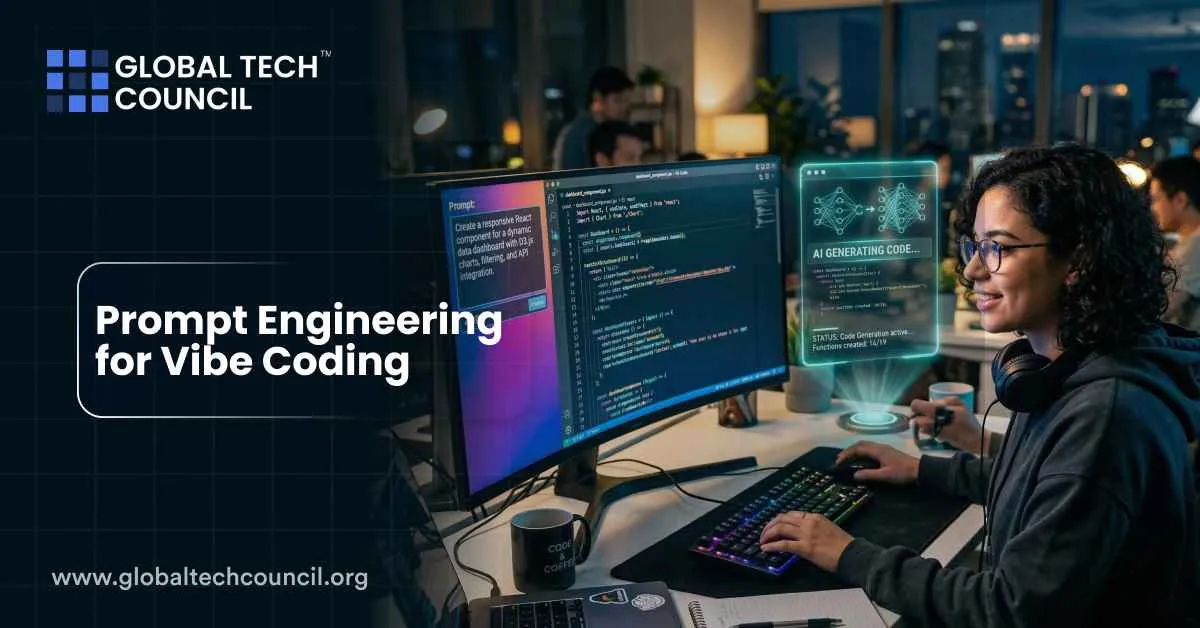
 A quiet revolution is reshaping how software gets built. Developers, founders, marketers, and domain experts are now producing functional applications not by typing out every line of code, but by communicating their goals to AI models in plain, purposeful language. This approach, widely known as vibe coding, has moved from a niche experiment to a legitimate development practice in a remarkably short time.
The term was introduced by AI researcher and OpenAI co-founder Andrej Karpathy in early 2025. It describes a development style in which the programmer focuses on expressing intent rather than implementing syntax. The developer provides direction, context, and feedback, while an AI model handles the technical execution. The result is a workflow that feels less like traditional programming and more like creative collaboration with a highly capable digital partner.
What separates average results from excellent ones in vibe coding is not the choice of AI tool. It is the quality of the instructions given to that tool. This is where prompt engineering becomes indispensable. Understanding how to craft precise, well-structured, and contextually rich prompts is the core skill that unlocks the full potential of AI-assisted development. This guide covers everything professionals need to know to apply prompt engineering effectively in vibe coding workflows.
What Vibe Coding Actually Means in Practice
Vibe coding is frequently misunderstood as simply asking an AI to write code. In reality, it is a structured, iterative process in which the developer maintains creative and strategic control while delegating implementation to an AI model. A typical session involves describing a feature, reviewing the generated code, testing its behavior, identifying issues, and prompting further refinements.
The technology enabling this workflow has matured significantly. Large language models such as Claude, GPT-4, and Gemini now demonstrate strong capabilities in writing, debugging, refactoring, and explaining code. AI-integrated development environments such as Cursor, GitHub Copilot, and Windsurf allow developers to maintain ongoing conversations with an AI directly inside their coding environment. Autonomous coding agents can now read entire projects, plan solutions, and execute multi-step tasks with limited supervision.
Vibe coding is no longer a hobbyist trend. Enterprise teams use it to accelerate prototyping. Startups ship products faster. Non-technical founders build minimum viable products without hiring developers. Educators create interactive tools without formal programming backgrounds. The paradigm is becoming mainstream, and prompt engineering is the skill that determines who benefits most from it.
The Core Principles of Effective Prompt Engineering
Prompt engineering is the discipline of crafting inputs to AI models that consistently produce accurate, useful, and contextually appropriate outputs. In vibe coding, this means writing prompts that generate working, well-structured, and maintainable code. Four principles underpin every effective prompt.
Precision of Intent
Vague instructions produce vague results. Telling an AI to build a task management app leaves too much open to interpretation. Specifying that you need a React application with TypeScript that stores tasks in localStorage, supports creation and deletion, and displays items in a scrollable list with completion checkboxes gives the model concrete parameters to work with. Precision at the outset dramatically reduces the number of correction cycles required later.
Context Anchoring
AI models do not carry memory between sessions unless explicitly configured to do so. Each new session requires you to re-establish the project context: the technology stack, existing architecture, naming conventions, constraints, and goals. Many experienced practitioners maintain a context document — a structured project brief — that they paste at the beginning of each session to anchor the AI before any task-specific prompting begins.
Role and Persona Assignment
Large language models respond meaningfully to role assignment. Instructing the model to respond as a senior backend engineer specializing in Node.js and RESTful API design shapes its outputs toward more idiomatic patterns, stronger error handling, and better security practices. Role assignment is a low-effort technique that consistently improves code quality and relevance.
Constraint Definition
Defining boundaries is just as important as defining goals. Effective prompts specify not only what the code should do but also what it should avoid. Constraints such as avoiding third-party libraries beyond existing imports, keeping a solution under a defined line count, using a specific syntax style, or ensuring compatibility with a particular language version help the AI stay within productive limits and avoid unnecessary complexity.
Iterative Prompting: How the Best Vibe Coders Work
One of the most important mindset shifts for new vibe coders is accepting that prompting is not a single transaction. It is an ongoing dialogue. The most effective vibe coding sessions involve a continuous feedback loop: prompt, review, test, identify issues, and refine. This process closely mirrors traditional development cycles, where writing code, running tests, finding bugs, and making corrections are all expected parts of the workflow.
Writing Targeted Correction Prompts
When AI output contains errors, the correction prompt must be specific. Saying that something is wrong provides little actionable information. Instead, describe the exact problem and specify the expected behavior. For example, pointing out that a function does not handle empty input arrays and requesting a guard clause at the top is far more effective than a general complaint. Specificity accelerates the refinement process and reduces ambiguity in subsequent outputs.
Breaking Complex Problems Into Smaller Steps
Attempting to build an entire application in a single prompt almost always produces disappointing results. Complex software is best approached incrementally, with each prompt addressing one discrete piece of functionality. This keeps prompts manageable, makes debugging straightforward, and allows validation at each stage before proceeding. Building an e-commerce checkout flow, for instance, is far more effective when split into product selection, cart state management, pricing logic, payment integration, and order confirmation, each handled in sequence.
Requesting Code Explanations
One of the most underused capabilities of AI coding assistants is their ability to explain their output in plain language. Asking the model to walk through its code step by step serves two purposes. First, it deepens understanding of the generated logic, which is essential for maintenance and debugging. Second, it reveals whether the model interpreted the original requirement correctly. If the explanation does not match the intended behavior, the prompt requires revision before proceeding.
Advanced Prompt Engineering Strategies for Developers
Beyond the core principles, experienced practitioners apply a set of advanced techniques that meaningfully improve AI output quality across complex and high-stakes development tasks.
Chain-of-Thought Prompting
Chain-of-thought prompting asks the AI to reason through a problem before generating a solution. A prompt that instructs the model to first explain its planned approach, identify the data structures it will use, and describe how components will interact before writing any code consistently produces more coherent and better-structured output. This technique is especially valuable for algorithmic problems, architectural decisions, and debugging complex logic.
Few-Shot Prompting with Examples
Providing the AI with one or two examples of the desired output format within the prompt itself is an effective way to enforce coding conventions, naming styles, and structural patterns. When the AI can see what you consider good output, it calibrates its responses accordingly. This approach works particularly well for teams with established style guides that may be difficult to describe in purely abstract terms.
Using Negative Examples
Alongside examples of what good output looks like, showing the AI what to avoid can be highly effective. Providing an anti-pattern and explicitly instructing the model not to use that pattern eliminates a common source of frustration, particularly when the AI tends to default to certain approaches that conflict with your project’s requirements or standards.
System-Level Prompting for Consistency
Many AI development tools allow users to define a system prompt — a persistent instruction set that frames every subsequent interaction in the session. Experienced practitioners use system prompts to establish project context, technology stack, coding standards, security requirements, and persona once, freeing individual task prompts to remain focused and concise. For teams deploying AI-assisted development at scale, a well-crafted system prompt is one of the most effective tools for maintaining output consistency across developers and sessions.
Agentic AI and the Next Stage of Vibe Coding
The most significant development reshaping vibe coding at present is the rise of agentic AI — systems capable of planning, executing, evaluating, and iterating on multi-step tasks with varying degrees of human oversight. Unlike conversational AI tools that respond to single prompts, agentic systems can read an entire codebase, formulate an implementation plan, write and test code, interpret results, fix failures, and present a completed solution for human review.
Prompt engineering for agentic systems is meaningfully different from prompting a standard LLM. Developers must define not just a task but a mission, a clear goal with defined success criteria, decision-making boundaries, and intermediate checkpoints. The prompt must anticipate situations where the agent needs to choose between competing approaches and must provide explicit guidance on how to handle unexpected outcomes or edge cases.
For developers who want to work at the forefront of this space, a structured understanding of how agentic systems plan, use external tools, manage memory, and coordinate with other agents is increasingly essential. Pursuing an Agentic AI certification provides the technical and conceptual foundation needed to build, deploy, and manage agentic workflows with confidence in real-world production environments.
Vibe Coding Across Industries: Where It Is Being Applied
Rapid Prototyping for Startups and Founders
Early-stage startups are using vibe coding to compress development timelines from months to days. Small founding teams can now ship functional web applications rapidly by combining vibe coding with AI-assisted design tools. Prompt engineering is central to this workflow the ability to describe features, data models, and user flows in precise natural language is what separates teams that ship quickly from those that get stuck in unproductive revision cycles.
Internal Tools and Enterprise Automation
Large organizations are deploying AI-assisted development for internal tooling: data dashboards, processing pipelines, automation scripts, and administrative interfaces. These environments benefit enormously from standardized prompt templates that encode the organization’s stack, security policies, and code standards. Teams that invest in building a shared prompt library consistently see improvements in output consistency and overall development speed.
Marketing Technology and Digital Strategy
A compelling intersection has emerged between vibe coding and digital marketing. Marketing technologists are using AI coding tools to build custom analytics dashboards, automation workflows, personalization engines, and experimentation frameworks — technical infrastructure that previously required dedicated engineering support. Professionals who combine strategic marketing expertise with technical capability, such as those who hold a digital marketing expert certification, are exceptionally well positioned to leverage vibe coding for building marketing technology solutions independently and efficiently.
Deep Technology and Emerging Innovation Fields
Vibe coding is also gaining traction in advanced technology fields where rapid prototyping of complex systems is valuable. Professionals working across blockchain, AI infrastructure, and other deep technology domains benefit from understanding both the technical architecture of these systems and how to apply AI-assisted development within them. A Deeptech certification equips professionals with the foundational knowledge needed to work confidently at this intersection, combining deep technical literacy with the efficiency gains that vibe coding enables.
Education and Accessibility in Software Development
Vibe coding is broadening participation in software development. Learners with limited programming experience are building functional projects earlier in their learning journeys, which increases motivation and builds intuition faster. The prompting skills they develop — learning to describe logic precisely, break problems into steps, and evaluate AI outputs critically — translate directly into stronger technical and analytical capabilities over time.
Common Mistakes in Vibe Coding and How to Avoid Them
Accepting Code Without Understanding It
The most common and most dangerous mistake in vibe coding is deploying AI-generated code without genuinely understanding it. AI models can produce output that appears polished but contains subtle logic errors, security vulnerabilities, or performance problems. Skilled vibe coders treat every output as a first draft. They read it, test it, and prompt the AI to explain anything unclear before moving forward.
Losing Coherence in Long Sessions
In extended sessions involving many iterations, the AI’s responses can gradually drift away from the original design intent. This happens because earlier context gets diluted as the conversation grows longer. Experienced practitioners counter this by periodically summarizing the current project state and re-anchoring the session with an explicit restatement of the overarching goal and any established design decisions.
Neglecting Security Requirements
AI models do not automatically prioritize security. Without explicit prompting, generated code may expose sensitive data, skip input validation, or use insecure authentication patterns. Good prompt practice includes explicitly requesting adherence to recognized security standards, such as following OWASP guidelines for input handling and authentication. Security requirements should be embedded in system prompts so they apply to every interaction in the session.
Trusting Hallucinated References
Language models occasionally reference functions, methods, or libraries that do not exist. This well-documented behavior, known as hallucination, is particularly risky for developers who are less familiar with the underlying technology and may not immediately recognize a fabricated reference. This is one of the strongest arguments for maintaining genuine technical knowledge in the domains you work in, even when relying heavily on AI assistance for implementation.
Building a Professional Skill Set Around Vibe Coding
As vibe coding moves from novelty to standard practice, the professional value of prompt engineering is rising rapidly. Developers who combine solid technical foundations with strong prompting skills consistently deliver higher-quality outputs, ship faster, and adapt more effectively to new tools and frameworks.
The foundational skills are clear. Programming fundamentals remain essential, not for writing every line from scratch, but for critically evaluating AI-generated code. Language skills matter greatly: precision, clarity, and the ability to describe complex logic in unambiguous terms are directly transferable to prompt writing. Understanding AI systems — how language models work, where their limitations lie, and how agentic architectures operate — provides a meaningful advantage as the tools themselves continue to evolve.
For professionals who want to formalize their expertise, structured learning paths are available across the technical domains that intersect most directly with vibe coding. Whether the goal is deepening knowledge of autonomous AI systems through an Agentic AI certification, expanding into emerging technology fields through a Deeptech certification, or bridging technology and growth strategy through a digital marketing expert certification, these programs provide the depth and structure needed to use AI coding tools strategically rather than passively.
Conclusion
Vibe coding is not a shortcut. It is a new form of technical skill — one that rewards communication, critical thinking, and iterative problem-solving over rote syntax memorization. The developers and professionals who will benefit most from this shift are not those who simply use AI tools, but those who learn to direct them with clarity, purpose, and contextual intelligence.
Prompt engineering for vibe coding is a young discipline, but its core principles are already well established: clarity of intent, contextual richness, iterative refinement, and technical judgment. These principles apply whether you are building a startup MVP, automating internal workflows, developing marketing technology, or exploring the frontier of agentic AI systems.
Investing in prompt engineering skills now is one of the highest-return professional decisions available in the current technology landscape. The future of software development is not a competition between humans and AI. It is a collaboration, and the quality of that collaboration depends entirely on the clarity and craft of the prompts that connect them.
FAQ
Q1. What is vibe coding and how does it work?
Vibe coding is an AI-assisted development approach in which a developer describes desired functionality in natural language and an AI model generates the corresponding code. The developer provides direction, reviews outputs, tests results, and refines instructions iteratively rather than writing every line manually.
Q2. What is prompt engineering in the context of vibe coding?
Prompt engineering is the practice of crafting precise, well-structured instructions that guide AI models toward generating accurate, useful, and maintainable code. In vibe coding, strong prompt engineering reduces errors, improves output quality, and makes the development process significantly more efficient.
Q3. Who can benefit from learning vibe coding?
Vibe coding is valuable for a wide range of professionals, including software developers, startup founders, marketing technologists, operations managers, educators, and domain experts who want to build digital tools without depending entirely on dedicated engineering teams.
Q4. What makes a high-quality coding prompt?
An effective coding prompt includes a clear description of the goal, the relevant technology stack, applicable constraints, expected inputs and outputs, and any important edge cases. The more specific and contextually rich the prompt, the better the resulting code.
Q5. How does iterative prompting improve vibe coding results?
Iterative prompting treats AI-assisted development as a feedback loop rather than a single transaction. Each round of review, testing, and refinement improves the output progressively, in the same way that traditional development cycles improve code through testing and debugging.
Q6. What is agentic AI and how does it relate to vibe coding?
Agentic AI refers to systems that can autonomously plan, execute, test, and revise multi-step tasks toward a defined goal. In vibe coding, agentic AI enables more complex and autonomous development workflows, where the AI handles multiple stages of the build process with minimal step-by-step human guidance.
Q7. What are the most common risks of vibe coding?
The most common risks include deploying code that has not been properly reviewed, missing security vulnerabilities in AI-generated output, referencing hallucinated libraries or functions that do not exist, and losing design coherence over long development sessions.
Q8. How can vibe coding be used in digital marketing?
Marketing professionals can use vibe coding to build custom dashboards, automate campaign reporting, create personalization engines, and develop A/B testing tools — all without requiring a dedicated engineering team. Pairing these capabilities with strategic knowledge in digital marketing creates a uniquely versatile professional skill set.
Q9. Do certifications improve vibe coding and AI-assisted development skills?
Yes. Certifications in areas such as agentic AI, deep technology, and digital marketing provide structured frameworks, technical depth, and practical context that help professionals use AI coding tools more strategically and effectively. They also provide recognized credentials that demonstrate expertise to employers and clients.
Q10. Is vibe coding replacing traditional software development?
No. Vibe coding is changing how software is built, but it is not replacing traditional development. Human judgment remains essential for architecture, security, scalability, and business logic. Vibe coding extends the reach of development capabilities to a broader range of professionals while allowing experienced developers to work faster and more efficiently.