

Neural Networks for Beginners: A Clear Guide to How They Work and Why They Matter

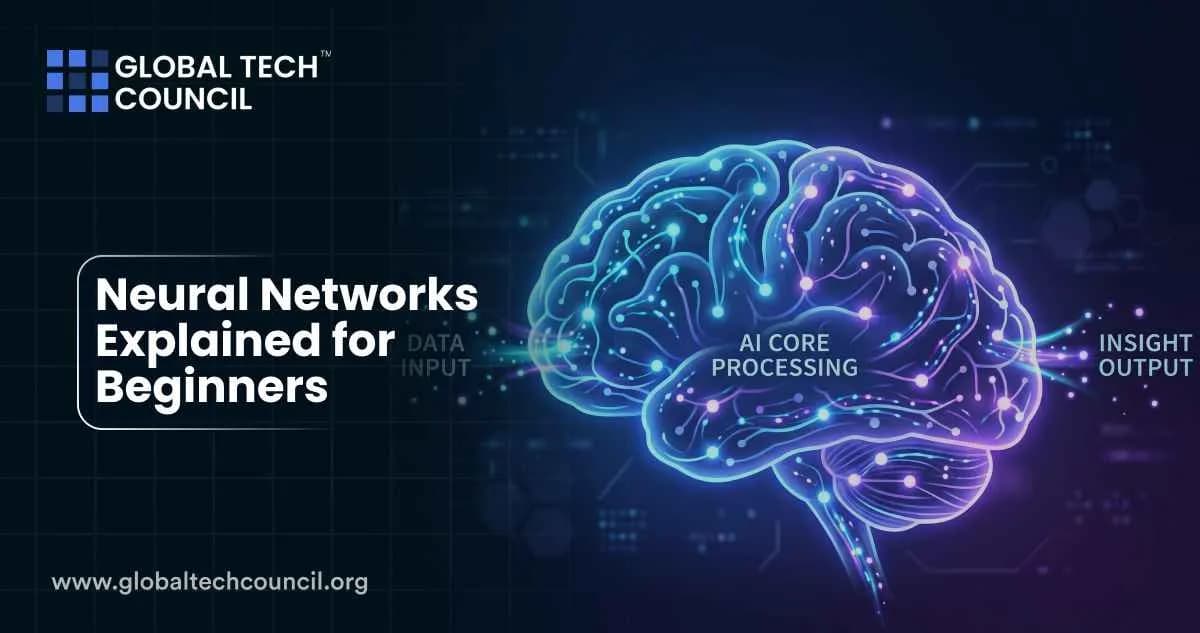
 Neural networks are one of the most important technologies in modern artificial intelligence. They power tools that recognize speech, analyze images, recommend products, detect fraud, generate text, and improve decision-making across industries. Although they are often presented as highly technical systems filled with complex mathematics, the basic concept is easier to understand than it first appears.
At their core, neural networks are designed to detect patterns in data. They learn from examples, improve over time, and help machines make better predictions. That ability has made them central to many of the AI tools businesses and professionals use today.

As more people explore artificial intelligence, structured learning has become increasingly valuable. Programs such as AI Expert certification, Agentic AI certification, AI Powered coding expert certification, deeptech certification, and AI powered digital marketing expert can help learners build both technical knowledge and practical business skills.
Understanding Neural Networks in Simple Terms
A neural network is a machine learning model inspired by the way the human brain processes information. It is made up of connected units, often called artificial neurons, that work together to analyze input data and produce an output.
For example, a neural network can:
- analyze an image and identify whether it shows a cat or a dog
- read a sentence and predict the next word
- review customer behavior and estimate whether a customer may stop using a service
Instead of relying on hard-coded rules written by developers, neural networks learn from data. This is what makes them so powerful. They can uncover patterns that would be difficult or impossible to define manually.
Why Neural Networks Are So Important in AI
Neural networks matter because many real-world problems are too complex for traditional rule-based programming. A developer can write rules for a calculator, but writing exact instructions for recognizing faces in different lighting conditions, angles, and expressions is far harder. Neural networks solve this problem by learning from examples instead of fixed instructions.
This makes them useful in a wide range of fields.
- In healthcare, they help detect abnormalities in medical scans and support diagnosis.
- In finance, they identify unusual transaction patterns that may indicate fraud.
- In retail, they improve product recommendations and forecast demand.
- In language technology, they power translation, chatbots, search, and content generation.
Their flexibility is one of the main reasons they have become a foundation of modern AI.
The Core Parts of a Neural Network
To understand how neural networks work, it helps to look at their basic structure.
Input Layer
The input layer receives the raw data. If the task involves an image, the inputs may be pixel values. If the task involves customer analysis, the inputs may include age, location, spending behavior, or account history.
Processing Layers
These internal layers, commonly called hidden layers, perform most of the work. Each artificial neuron receives information, applies a calculation, and passes the result forward. Networks with more hidden layers are often called deep neural networks.
Output Layer
The output layer produces the final prediction. This could be a category, a probability, a number, or a recommendation depending on the task.
How Neural Networks Learn from Data
A neural network learns by adjusting the strength of the connections between its artificial neurons. These connection values are called weights. During training, the model makes a prediction, compares it with the correct answer, measures the error, and updates its weights to improve future predictions.
This learning process usually follows four basic steps.
Step 1: Forward Pass
The data moves through the network from input to output, and the model makes a prediction.
Step 2: Error Measurement
The prediction is compared with the correct result using a loss function. A larger error means the model needs greater adjustment.
Step 3: Backpropagation
The network identifies how much each connection contributed to the error.
Step 4: Weight Adjustment
An optimization method, such as gradient descent, updates the weights so the network performs better next time.
This cycle is repeated many times across many examples. Over time, the model becomes more accurate.
A Simple Example Anyone Can Understand
Imagine you want to predict whether a house price is high or low. You might provide data such as the number of bedrooms, the size of the property, the neighborhood quality, and the age of the house.
At first, the neural network makes poor predictions because its weights are random. After training on many examples, it begins to recognize useful patterns. It may learn that larger homes in better neighborhoods usually have higher prices. No one has to write every pricing rule by hand. The model learns them from the data.
That is the practical strength of neural networks. They adapt based on examples rather than depending entirely on human instructions.
Activation Functions and Why They Matter
Each artificial neuron applies an activation function before passing information onward. Without activation functions, the network would only perform simple linear calculations and would struggle to learn complex patterns.
Some of the most common activation functions include ReLU, sigmoid, and softmax.
ReLU is popular because it is simple and efficient for deep learning models. Sigmoid is often used when the output needs to represent a probability between zero and one. Softmax is commonly used when a model must choose among several categories.
These functions help neural networks make flexible, non-linear decisions, which is essential for handling real-world data.
Major Types of Neural Networks
Not all neural networks are built the same way. Different tasks require different architectures.
Feedforward Neural Networks
These are the simplest forms of neural networks. Data moves in one direction from input to output. They are often used for basic prediction and classification tasks.
Convolutional Neural Networks
Convolutional neural networks are especially useful for image and video analysis. They are excellent at identifying visual patterns such as shapes, textures, and edges. This makes them valuable in medical imaging, facial recognition, and object detection.
Recurrent Neural Networks
Recurrent neural networks were designed for sequential data such as text, speech, and time series. They consider previous inputs when making predictions, which helps in tasks where order matters.
Transformers
Transformers have become the dominant neural network architecture in many advanced AI systems. They are widely used in language models, code generation tools, document analysis, and multimodal applications. Their ability to process relationships in data efficiently has made them central to modern AI development.
Why Data Quality Is Essential
A neural network is only as effective as the data it learns from. If the training data is incomplete, biased, poorly labeled, or outdated, the model’s performance will suffer.
For example, a model trained on unbalanced data may perform well for one group and poorly for another. A system trained on low-quality information may also make unreliable decisions.
Strong training data should be relevant, accurate, diverse, and representative of real-world conditions. This is not the glamorous part of AI, naturally, because humans prefer the shiny outputs to the tedious preparation. Still, data quality is one of the biggest factors behind model success.
Common Challenges: Overfitting and Underfitting
Two important problems often appear when building neural networks.
Overfitting
Overfitting happens when the model learns the training data too closely, including noise and random details. As a result, it performs well on known data but poorly on new, unseen examples.
Underfitting
Underfitting happens when the model is too simple or not trained enough. In that case, it fails to capture the real patterns in the data.
Developers reduce these problems through methods such as regularization, dropout, better validation, improved data balance, and more careful tuning.
Real-World Uses of Neural Networks
Neural networks are already part of everyday life, whether people notice them or not.
A smartphone unlocking with facial recognition likely uses neural network technology. Streaming platforms use it to recommend movies or songs. Email services apply it to spam filtering. Navigation apps rely on intelligent prediction systems to estimate traffic patterns.
Businesses also use neural networks in more specialized ways.
Healthcare organizations use them for scan analysis and patient risk prediction. Banks apply them to fraud detection and credit modeling. Retailers use them for demand forecasting and personalization. Educational platforms use them to adapt learning content to student performance.
Software development has also changed significantly because of neural-network-based coding assistants. Professionals who want to grow in this area often pursue options such as AI Powered coding expert certification to connect theory with practical implementation.
Recent Trends in Neural Network Development
Neural networks have developed quickly over the past few years, and several trends have shaped their growth.
One major trend is multimodal AI. Newer systems can handle text, images, audio, and video together, making them more versatile and useful for complex tasks.
Another trend is model efficiency. Researchers and companies have worked to reduce computing costs through techniques such as model compression, quantization, and distillation. Smaller, faster models are increasingly important for business applications.
There is also rising interest in agentic AI systems. These systems go beyond producing a single output. They can break tasks into steps, use tools, and work toward goals in a more structured way. That is one reason demand has grown for programs such as Agentic AI certification.
At the same time, responsible AI has become a serious priority. As neural networks gain influence in business and society, organizations need to manage fairness, transparency, privacy, governance, and risk. Broader learning pathways such as AI Expert certification and deeptech certification can support professionals working at the intersection of innovation and accountability.
Benefits of Neural Networks
Neural networks offer several clear advantages.
- They can learn highly complex patterns from large datasets.
- They often improve as more high-quality data becomes available.
- They support automation and can increase efficiency across industries.
- They are especially strong in image processing, language understanding, recommendation systems, and pattern recognition.
Because of these strengths, they are now widely used in both technical and business environments.
Limitations You Should Know
Neural networks are powerful, but they are not magic. Tragic news for people who think adding “AI” to a product name solves everything.
They often require large amounts of quality data. Training advanced models can be expensive and resource-intensive. Many models are difficult to interpret, which can be a problem in regulated or high-risk fields. They may also reproduce biases present in their training data. In addition, performance can decline over time if real-world conditions change and the model is not monitored carefully.
Understanding both the strengths and limits of neural networks is essential for using them responsibly.
How Beginners Can Start Learning Neural Networks
A smart way to begin is to combine theory with hands-on practice. Start with the basics of machine learning, data handling, and Python programming. Then move on to beginner projects such as handwritten digit recognition, sentiment analysis, or price prediction.
It also helps to study how neural networks are used in real industries. This makes abstract concepts more practical and easier to remember.
Structured education can accelerate progress. Depending on your goals, you might explore AI Expert certification, AI powered digital marketing expert, or deeptech certification to build applied knowledge relevant to business, marketing, software, or innovation strategy.
The Future of Neural Networks
The future of neural networks will likely involve more efficient systems, better personalization, stronger multimodal capabilities, and greater integration into everyday tools. Businesses are expected to use them not only for automation, but also for planning, analysis, customer engagement, and product development.
At the same time, trust and governance will matter more. As these models influence important decisions, organizations will need better oversight, ethical standards, and performance monitoring.
For beginners, this is a strong time to start learning. The technology is advancing quickly, but the tools, courses, and frameworks available to learners are better than ever.
Final Thoughts
Neural networks are a foundation of modern artificial intelligence. They help machines learn from data, identify patterns, and make predictions that support real-world applications across healthcare, finance, education, retail, software, and marketing.
Even though the technology can become highly sophisticated, the basic idea is simple: provide data, learn from examples, reduce errors, and improve performance over time. That simple mechanism has enabled some of the most important AI systems in use today.
For anyone starting out, the best path is to build a clear understanding of the fundamentals, practice on small projects, and connect learning to practical applications. Neural networks are not just an academic concept. They are already shaping how modern businesses and digital systems operate.
Frequently Asked Questions
1. What is a neural network in simple language?
A neural networks is a computer model that learns patterns from data so it can make predictions, classify information, or support decisions.
2. Why are neural networks important in artificial intelligence?
They are important because they can solve complex problems that are difficult to handle with fixed rules, especially in image analysis, language processing, and pattern recognition.
3. Are neural networks and deep learning the same thing?
Not exactly. Deep learning is a subset of machine learning that uses neural networks with many layers.
4. Where are neural networks used in real life?
They are used in healthcare, banking, retail, education, cybersecurity, digital assistants, search engines, and recommendation systems.
5. Do beginners need advanced math to learn neural networks?
No. A beginner can start with basic algebra, logic, and statistics. Deeper mathematical knowledge becomes more useful as learning advances.
6. Which programming language is best for learning neural networks?
Python is the most widely used language because it has strong libraries, broad community support, and many beginner-friendly resources.
7. What is the biggest advantage of neural networks?
Their biggest advantage is the ability to learn complex patterns from data without requiring every rule to be written manually.
8. What are the main limitations of neural networks?
They often need large datasets, significant computing power, careful monitoring, and safeguards against bias or poor interpretability.
9. How do neural networks improve over time?
They improve during training by comparing predictions with correct answers and adjusting internal weights to reduce errors.
10. How can I build a career related to neural networks?
You can start by learning machine learning basics, practicing with small projects, improving programming skills, and pursuing structured programs such as AI Expert certification, Agentic AI certification, or AI powered digital marketing expert.
Related Articles
View All
AI & ML
How Does Jev AI Work?
Learn how Jev AI works, from structured program state and questions to parallel sampling, typed decisions, calibrated probabilities, and software automation.

AI & ML
Jev AI: Complete Guide
Explore Jev AI in this complete guide, covering TypeSafe AI’s System One architecture, RLCD training, parallel sampling, typed decisions, confidence scores, speed, and automation use cases.

AI & ML
Jev AI Explained for Beginners
Jev AI is TypeSafe AI’s first System One Model, designed to make fast, structured decisions that software can use directly for automation and real-time workflows.
Trending Articles
The Role of Blockchain in Ethical AI Development
How blockchain technology is being used to promote transparency and accountability in artificial intelligence systems.
AWS Career Roadmap
A step-by-step guide to building a successful career in Amazon Web Services cloud computing.
Top 5 DeFi Platforms
Explore the leading decentralized finance platforms and what makes each one unique in the evolving DeFi landscape.