

MLOps for Beginners: CI/CD, Model Versioning, Feature Stores, and Production Best Practices
 Suyash Raizada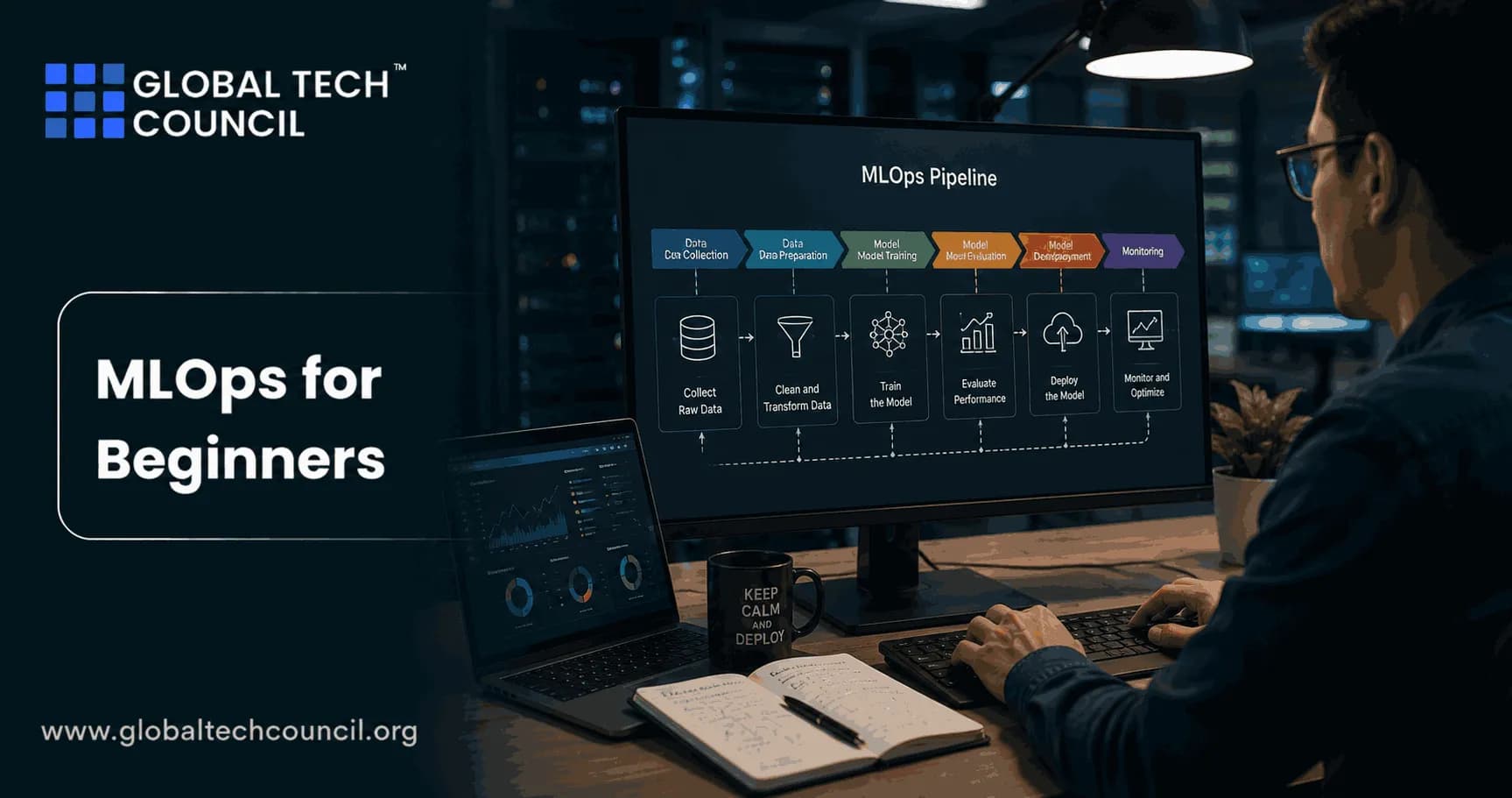
MLOps for beginners is about applying proven software engineering and DevOps practices to the full machine learning lifecycle so models can be delivered reliably, reproduced consistently, and improved safely over time. In practice, beginner-friendly MLOps focuses on four foundations: CI/CD (and often continuous training), model versioning, feature stores, and production best practices like monitoring, testing, and governance.
This guide explains what each component does, how they fit together in real systems, and what to implement first when moving from notebooks to production.

What MLOps Covers: A Lifecycle View
MLOps combines machine learning development with operational discipline to manage ML systems from data collection through deployment and continuous improvement. A typical end-to-end workflow includes:
Data collection and validation (schema checks, quality rules, statistics)
Feature engineering (transformations, aggregations, point-in-time correctness)
Model training and evaluation (metrics, baselines, acceptance criteria)
Registration and packaging (model registry, containers)
Deployment (batch scoring or online endpoints, often on Kubernetes or managed services)
Monitoring and feedback loops (data drift, model behavior, retraining triggers)
Modern MLOps increasingly adopts platform-centric patterns. Cloud providers and specialized vendors commonly bundle pipelines, model registries, feature stores, and monitoring into integrated toolchains. The goal is consistent automation, lineage, and governance at scale. Build a strong foundation in machine learning operations, production AI systems, and scalable model workflows by advancing your expertise through an AI Expert Certification, exploring modern AI development with a Generative AI Expert Course, and understanding emerging technology ecosystems through a Deeptech Certification.
CI/CD in MLOps: What Changes for ML Teams
In software engineering, CI/CD primarily manages code changes. In MLOps, CI/CD must manage code, data, and features, because any of these can alter model behavior. Many teams also add CT (continuous training) so models can be retrained and revalidated when new data arrives or performance degrades.
Continuous Integration (CI) for ML
CI for ML validates every change to training code, inference code, feature transformations, and configuration. Typical CI checks include:
Build and static analysis: package training code, run linters and type checks for Python, Spark, or SQL logic
Unit tests: test preprocessing and feature functions with small mock datasets
Data and schema validation: enforce data contracts covering expected columns, types, null thresholds, and distribution checks. Teams commonly use frameworks such as Great Expectations for this purpose.
Continuous Delivery (CD) for ML
CD automates the promotion of artifacts that passed CI into staging and production environments. In an ML context, CD commonly deploys:
Model artifacts and serving containers
Feature transformation jobs and data pipeline updates
Infrastructure updates via infrastructure-as-code
Popular implementation options include GitHub Actions, GitLab CI, Jenkins, Argo Workflows, and managed pipeline services offered by major cloud providers.
Continuous Training (CT): The ML-Specific Extension
CT automates retraining and validation based on triggers such as:
New data availability (daily, hourly, or streaming updates)
Performance degradation reflected in production indicators such as accuracy proxies or business KPIs
Data drift or feature drift caused by shifts in input distributions
CT should include guardrails: automated evaluation gates, reproducible data snapshots, and safe deployment strategies.
A Practical CI/CD Pipeline for Beginners
If you are setting up your first MLOps pipeline, the following sequence is a common starting point:
Commit to Git: training code, inference code, feature definitions, and configs
CI runs: linting, unit tests, and lightweight integration tests
Data validation: schema and quality checks on a representative dataset sample
Train and evaluate: compute metrics and compare to a baseline or current champion
Acceptance gate: block deployment if metrics regress beyond defined thresholds
Package and deploy: push the model container or artifact to staging, then to production
Post-deploy checks: smoke tests for endpoints, latency checks, and error rate verification
Model Versioning: The Backbone of Reproducibility and Rollback
Model versioning is central to production ML because teams must know exactly which code, data, features, and configuration produced a given model. Without this lineage, reproducing results, comparing experiments, or rolling back after an incident becomes unreliable.
What to Version in Real ML Systems
Model artifact: the trained weights and serialization format
Training code and commit hash: the exact source revision
Data snapshot or query definition: what dataset was used and when
Feature definitions and transformations: how inputs were computed
Hyperparameters and environment: library versions, hardware, and configuration files
Model Registry: The Simplest Way to Operationalize Versioning
A model registry is a central system for storing model versions and metadata and for managing lifecycle status. A practical registry setup supports:
Versioned storage: each trained model is an immutable entry
Metadata: training dataset reference, metrics, feature set, owner, and timestamps
Lifecycle stages: development, staging, production, and archived
Promotion workflow: controlled movement from staging to production
Many teams use a champion-challenger approach where a stable production model (the champion) is compared with new candidates (challengers) via offline evaluation, canary rollout, or A/B testing.
Rollback Strategies Beginners Should Adopt Early
Keep the last known good model deployable (artifact plus serving configuration)
Use canary or blue-green deployments to limit the blast radius of a bad release
Automate rollback triggers when latency spikes, error rates rise, or business metrics degrade
Feature Stores for Beginners: Consistent Features for Training and Serving
A feature store is a system for managing, storing, and serving ML features for both training and inference. The primary benefit for beginners is reducing training-serving skew, which occurs when training features are computed differently from real-time serving features.
What a Feature Store Typically Provides
Central feature definitions: schemas, descriptions, owners, and tags
Offline store: batch feature history for model training
Online store: low-latency retrieval for real-time inference
Feature versioning: tracking changes to transformations and definitions
Governance: access control and auditing for sensitive features
Observability: feature freshness, missing value rates, and serving latency
How Feature Stores Integrate with CI/CD
Modern MLOps treats feature definitions and transformations as first-class code. A typical feature-store CI/CD flow includes:
Trigger on Git changes to feature definitions or transformation jobs
Build and static analysis for transformation scripts (Python, SQL, Spark)
Unit tests for feature logic using mock data
Integration tests in staging: register features, ingest sample data, and retrieve features
Data validation: schema adherence, statistical checks, and skew detection
Optional approval gate for high-impact or regulated features
Deploy to production and run smoke tests on retrieval paths
Feature-specific tests that beginners should learn early include:
Point-in-time correctness to prevent label leakage in time-series features
Data contract checks to confirm transformation output matches the feature schema
Offline vs. online parity checks for the same entity keys and timestamps
Production Best Practices: Monitoring, Reliability, Security, and Governance
Getting a model to run once is not the hard part. Keeping it correct, fast, and safe as data changes is the ongoing challenge. Production-grade MLOps typically emphasizes the practices below.
1) Design for Separation and Stability
Decouple training and serving: separate pipelines, clear APIs, and stable contracts
Standardize environments: containers and consistent dev-staging-production parity
Infrastructure-as-code: reproducible provisioning and disaster recovery readiness
2) Test Across Code, Data, and Models
Code tests: unit tests for transformations and custom model logic
Data tests: schema validation, missing value thresholds, and distribution checks
Model tests: performance evaluation against baselines, with fairness or constraint checks added where relevant to the use case
3) Monitor What Matters - Not Just Accuracy
Production monitoring should cover multiple layers:
Infrastructure: latency, throughput, CPU and memory usage, and error rates
Data: drift, schema anomalies, missing values, and outliers
Features: freshness, calculation failures, and serving latency
Model behavior: stability of prediction distributions, calibration signals, and business KPIs
When ground truth labels arrive with a delay, teams commonly track accuracy proxies and business metrics until full evaluation becomes possible.
4) Release Safely with Gradual Rollouts
Canary deployments: route a small percentage of traffic to the new model version
Blue-green deployments: switch traffic between two full environments
Automated rollback: revert on defined SLO or KPI degradation
5) Operational Governance and Security
Ownership and documentation: clear model owners, feature owners, and runbooks
Access control: protect registries, feature stores, and pipelines
Secrets management: keep credentials out of code and notebooks
Audit trails and lineage: support compliance requirements and responsible AI expectations
Real-World Patterns: Where These Pieces Show Up
Across different industries, the underlying architecture patterns are consistent:
Recommendation systems: feature stores manage user and item features for training and real-time ranking, with frequent retraining and controlled rollouts.
Fraud detection: streaming and batch features combine in a feature store, and CT pipelines retrain models as transaction behavior shifts.
Churn prediction: batch feature pipelines, scheduled retraining, and monitoring for drift in customer behavior patterns.
Computer vision and NLP services: containerized deployments to Kubernetes or edge environments, with drift monitoring when upstream content changes.
A Beginner Learning Path: What to Implement First
Start with Git and basic CI: test preprocessing and training code on every change.
Add data validation: enforce schemas and quality rules early to prevent silent failures.
Introduce a model registry: track versions, metrics, and promotion status.
Adopt a feature store on your next project to centralize core features and reduce skew.
Implement monitoring and safe deployment: canary releases, rollback procedures, and drift alerts.
Conclusion
MLOps for beginners becomes manageable when you focus on the components that create repeatability and safety: CI/CD (plus CT when needed), robust model versioning through a registry, feature stores for consistent training and serving, and production practices such as monitoring, governance, and gradual rollouts. These foundations help teams move beyond one-off notebooks and into reliable ML products that can evolve as data, requirements, and risk profiles change over time. Learn how to connect machine learning pipelines, automation tools, and deployment workflows by strengthening your technical capabilities with an AI Powered Coding Expert Course, expanding your digital skill set through a Tech Certification, and applying AI-driven growth strategies with a Marketing Certification.
FAQs
1. What is MLOps?
MLOps is the practice of managing machine learning models through development, deployment, monitoring, and maintenance. It combines machine learning, DevOps, and data engineering to make AI systems reliable in production.
2. Why is MLOps important for beginners to learn?
MLOps helps beginners understand how models move from notebooks to real-world systems. It teaches the processes needed to deploy, track, monitor, and improve machine learning models safely and efficiently.
3. How is MLOps different from DevOps?
DevOps focuses on software delivery, while MLOps also manages data, experiments, models, and performance drift. Machine learning systems change over time because data changes, so they need extra monitoring and governance.
4. What does CI/CD mean in MLOps?
CI/CD stands for continuous integration and continuous delivery or deployment. In MLOps, it automates testing, validation, packaging, and deployment of machine learning pipelines and models.
5. Why is CI/CD useful for machine learning models?
CI/CD reduces manual errors and speeds up model updates. It ensures that new code, data changes, and model versions are tested before being pushed into production environments.
6. What is model versioning?
Model versioning is the process of tracking different versions of trained models. It helps teams compare performance, roll back failed deployments, and understand which model is running in production.
7. Why do machine learning teams need model versioning?
Teams need model versioning because models can change due to new data, features, algorithms, or parameters. Versioning creates accountability and makes experiments easier to reproduce.
8. What is a feature store?
A feature store is a centralized system for storing, managing, and serving machine learning features. It helps teams reuse trusted features across training and production pipelines.
9. How does a feature store improve MLOps?
Feature stores reduce duplication and improve consistency between training and inference. They help prevent mismatches where a model is trained on one version of data but served another in production.
10. What is model deployment in MLOps?
Model deployment is the process of making a trained model available for real-world predictions. It may involve APIs, batch jobs, edge devices, or cloud-based inference systems.
11. What is model monitoring?
Model monitoring tracks how a model performs after deployment. It checks metrics such as accuracy, latency, errors, data drift, and prediction quality to detect problems early.
12. What is data drift in MLOps?
Data drift happens when production data changes from the data used during training. This can reduce model accuracy and require retraining or adjustment, because naturally reality refuses to stay still.
13. What is model retraining?
Model retraining updates a machine learning model using newer or improved data. It helps maintain accuracy when user behavior, business conditions, or data patterns change over time.
14. What are production best practices in MLOps?
Production best practices include automated testing, version control, monitoring, rollback plans, security checks, and clear documentation. These practices help teams avoid fragile AI systems.
15. What tools are commonly used in MLOps?
Common MLOps tools include MLflow, Kubeflow, Docker, Kubernetes, Airflow, DVC, GitHub Actions, Jenkins, and cloud ML platforms. The right tools depend on team size, infrastructure, and project goals.
16. How does automation support MLOps?
Automation handles repetitive tasks like testing, training, validation, deployment, and monitoring. It allows teams to release models faster while reducing the delightful chaos humans introduce manually.
17. What is experiment tracking in MLOps?
Experiment tracking records model parameters, datasets, metrics, and results during training. It helps teams compare different approaches and choose the best model based on evidence.
18. How can beginners start learning MLOps?
Beginners can start by learning Python, machine learning basics, Git, Docker, cloud platforms, and CI/CD workflows. Building small end-to-end projects is one of the best ways to understand MLOps.
19. What are common MLOps mistakes?
Common mistakes include skipping monitoring, ignoring data quality, failing to version models, and deploying without rollback plans. These mistakes often turn promising AI projects into expensive digital confetti.
20. What is the future of MLOps?
MLOps is moving toward greater automation, stronger governance, better observability, and integration with generative AI systems. As AI adoption grows, production-ready ML workflows will become even more important.
Related Articles
View All
AI & ML
Jev Model Architecture
Explore the Jev model architecture, including TypeSafe AI’s System One design, parallel sampling, RLCD training, typed outputs, and calibrated probabilistic decisions.

AI & ML
What Is a System One Model?
Learn what a System One Model is, how it makes fast, structured decisions for software, and how it differs from traditional large language models and generative AI.

AI & ML
Jev AI Explained for Beginners
Jev AI is TypeSafe AI’s first System One Model, designed to make fast, structured decisions that software can use directly for automation and real-time workflows.
Trending Articles
The Role of Blockchain in Ethical AI Development
How blockchain technology is being used to promote transparency and accountability in artificial intelligence systems.
AWS Career Roadmap
A step-by-step guide to building a successful career in Amazon Web Services cloud computing.
Top 5 DeFi Platforms
Explore the leading decentralized finance platforms and what makes each one unique in the evolving DeFi landscape.