


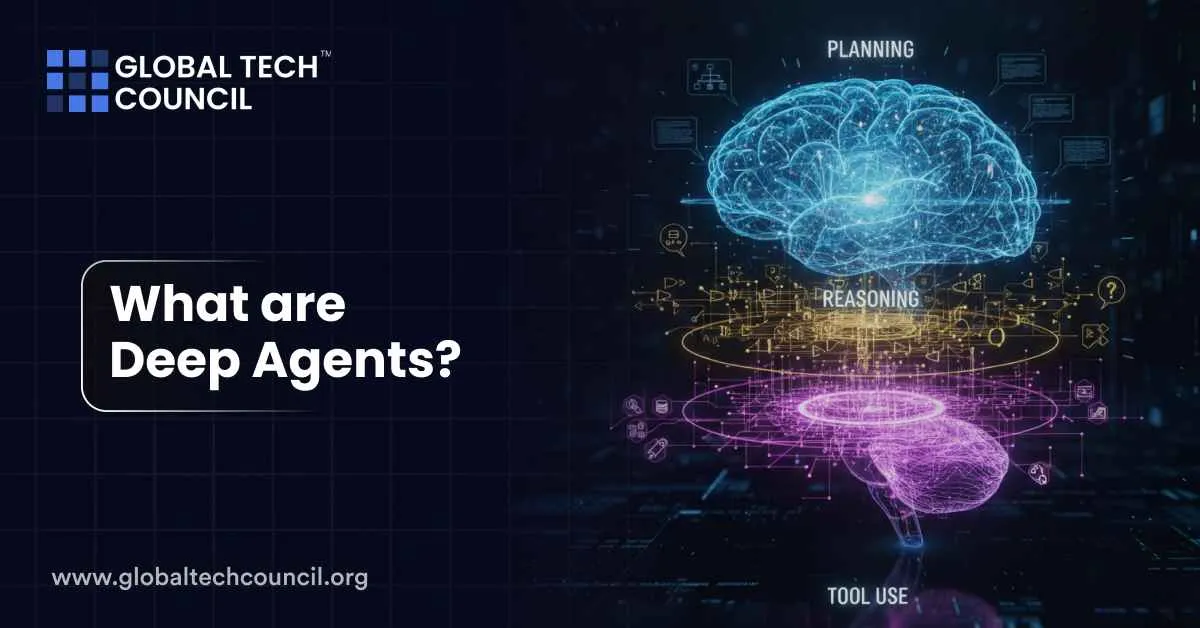
 Deep agents are advanced AI systems that can plan, execute, and adapt to complex tasks with little or no human input. Unlike standard chatbots or assistants, these agents can carry out multi-step operations, make independent decisions, and even coordinate with other agents. If you’re wondering what deep agents are, how they work, and why they matter for the future of AI, this guide will answer all your questions right away.
Let’s explore what deep agents are doing across industries, where they’re being used, and what skills you need to work with them.
What Are Deep Agents?
Deep agents are not just bots. They’re AI systems designed to operate over long periods, solve complex problems, and update their behavior based on new information. They don’t just respond to prompts. They make decisions, take actions, assess outcomes, and adjust their next steps.
They use planning loops: observe, decide, act, evaluate, and repeat. These agents also often use protocols like the Model Context Protocol (MCP) to connect safely to tools, APIs, databases, and even other agents.
How Deep Agents Work
Deep agents usually consist of four parts:
- Planning module: Figures out what to do based on a goal
- Memory system: Stores context, past actions, and feedback
- Tool use engine: Connects to software tools, APIs, or databases
- Learning loop: Adapts actions based on previous results
The most advanced systems can even deploy sub-agents to handle specific parts of a task. Think of them as managers who hire other agents to get jobs done.
Real-World Examples of Deep Agents
These systems are no longer just experimental. In 2025, several companies and research labs rolled out working examples.
- Manus AI: Helps automate processes in finance, healthcare, and logistics
- Microsoft’s Project Ire: Detects malware in systems with 90% accuracy
- Carnegie Mellon Cyber Agents: Simulate cyberattacks to test security systems
- Salesforce Agentforce: Handles full marketing campaign planning
- SAP and ServiceNow: Use agents for supply chain and customer service tasks
These examples show how deep agents are not just assistants, but autonomous workers.
Industry Adoption of Deep Agents
| Organization | Use Case | Result | Sector |
| Microsoft | Malware detection | Flagged 90% of malicious files | Cybersecurity |
| Salesforce (Agentforce) | Marketing campaign planning | End-to-end automation | Marketing |
| SAP | Workflow automation | Faster invoicing and support resolution | Enterprise SaaS |
| Manus AI | Task delegation in healthcare and finance | Reduced manual load | Cross-industry |
Market Growth and Forecast
Deep agents are becoming one of the most talked-about trends in enterprise AI. Analysts estimate that this market, which was worth around $5.1 billion in 2024, could reach $47 billion by 2030. Some projections stretch even further, placing it at $253 billion by 2034.
This explosive growth is fueled by several trends:
- Wider adoption of long-context language models
- Agent frameworks like AutoGen and CrewAI becoming open source
- Industry demand for AI that does more than chat
- Workflow automation becoming a top priority
If you’re exploring a career path in this space, start by building a foundation with the AI Certification. It teaches you the fundamentals of how these agents function and how to design intelligent systems.
Protocols Powering Deep Agents
Deep agents often use the Model Context Protocol (MCP) to interact safely with external systems. MCP lets the agent know what tools are available, what data it can access, and what limits are in place. This prevents unsafe behavior and reduces hallucinations.
Protocols like MCP are supported by Google, OpenAI, Anthropic, and DeepMind. They make it possible for different AI agents to “speak the same language” when using tools or databases.
If you’re building in data-rich environments, understanding MCP and structured memory systems can give you a strong edge. The Data Science Certification is a great next step.
Challenges in Building and Deploying Deep Agents
While promising, deep agents come with challenges:
- Security: Agents must be sandboxed to avoid harmful actions
- Prompt injection: Agents can be tricked if their inputs are not filtered
- Memory drift: Long-running agents may forget or misinterpret earlier steps
- Transparency: It’s hard to trace how a deep agent made its final decision
These risks mean that most current deployments are still supervised or semi-autonomous. That may change as reliability improves, but for now, human-in-the-loop designs are standard.
Key Capabilities of Deep Agents
| Capability | Description |
| Long-term Planning | Handles tasks over minutes, hours, or even days |
| Tool Use | Connects to APIs, databases, or browsers to act on external data |
| Self-Correction | Adjusts plan based on success or failure of previous steps |
| Sub-Agent Deployment | Assigns sub-tasks to smaller agents |
| Memory & Recall | Stores history and retrieves context as needed |
Who’s Leading the Agentic AI Movement?
Top institutions are putting major resources behind agent research. These include:
- OpenAI, which helped define the Model Context Protocol
- Google DeepMind, with long-horizon planning research
- Anthropic, focusing on alignment and multi-agent coordination
- Carnegie Mellon University, pushing real-world simulations
- Salesforce and Microsoft, shipping real agent products
Even independent labs and open-source collectives are contributing to frameworks like AutoGen, CrewAI, and BabyAGI.
For professionals leading innovation, the Marketing and Business Certification offers practical skills to integrate AI agents into decision-making and strategy.
Final Takeaway
Deep agents are not just the future of AI. They are the present. From cybersecurity to business automation, these systems are already solving problems that once took teams of humans.
They think ahead, adapt, and operate with growing independence. For professionals and businesses alike, now is the time to understand, explore, and invest in agentic AI.
Whether you’re a developer, a strategist, or a product leader, this is your moment to start learning. To explore tools, frameworks, and applied knowledge, visit the Blockchain Council for deep tech certification pathways.
Leave a Reply