

Machine Learning Algorithms Explained: A Simple Guide

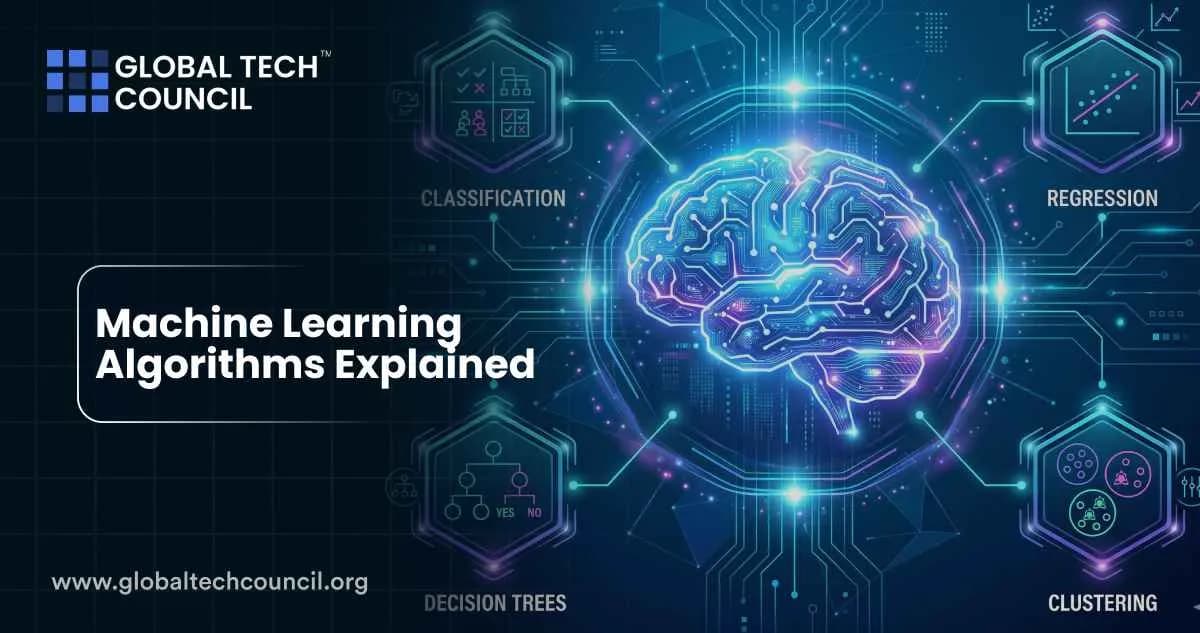
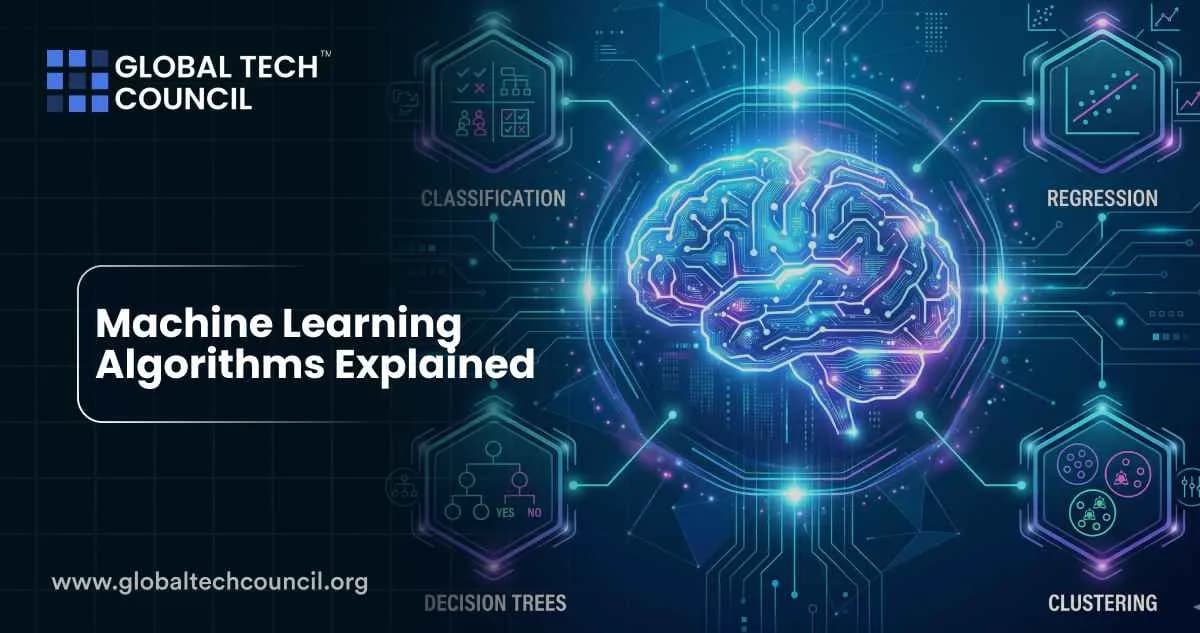 Machine learning has become one of the most talked-about areas in technology, yet many people still see it as confusing or overly technical. In reality, the central idea is straightforward. Machine learning allows computers to learn patterns from data and use those patterns to make predictions, recommendations, or decisions without needing a separate rule for every situation.
That practical ability is why machine learning now plays a major role in business, healthcare, finance, education, cybersecurity, retail, and software development. Whether a platform recommends a movie, a bank flags suspicious activity, or a marketing tool predicts customer behavior, machine learning is often working behind the scenes.

Understanding machine learning does not require advanced research knowledge at the beginning. What matters first is learning how the main algorithms work, what problems they solve, and why they are useful in real applications. Once that foundation is clear, it becomes much easier to understand how modern AI systems are built and why they are becoming more capable.
Professionals who want to build stronger AI knowledge can benefit from structured learning paths such as AI Expert certification and Agentic AI certification. Technical professionals who want to apply machine learning in software environments may also explore AI Powered coding expert certification. Those interested in broader advanced technology fields can look into a deeptech certification, while marketing professionals who want to combine AI with campaign strategy may benefit from an AI powered digital marketing expert program. Humans do enjoy turning every useful skill into a credential, but sometimes it actually helps.
What Machine Learning Really Means
Machine learning is a branch of artificial intelligence focused on teaching systems to learn from examples. Instead of manually writing detailed instructions for every possible outcome, developers provide data. The algorithm studies that data, finds patterns, and uses those patterns when it faces new inputs.
Think about spam email detection. A traditional software system might rely on hard-coded rules such as blocking certain phrases or sender types. A machine learning system works differently. It studies a large set of emails labeled as spam or not spam. Over time, it learns the patterns that usually appear in spam messages and improves its ability to identify similar emails in the future.
This approach is valuable because real-world problems are often too complex for fixed rules. Customer behavior changes, fraud tactics evolve, and language shifts constantly. Machine learning gives software the flexibility to adapt based on data rather than rigid instructions.
Why Algorithms Are the Core of Machine Learning
An algorithm is the method a machine learning system uses to find patterns and make decisions. Different algorithms are designed for different tasks. Some are better for predicting numbers, some are better for sorting data into categories, and some are used to uncover hidden structure in large datasets.
The choice of algorithm affects several important things, including accuracy, speed, explainability, and scalability. A simple model may be easier to understand and explain to business teams, while a more advanced model may deliver better performance on large or complex data.
There is no single best algorithm for every problem. That delightful fantasy usually collapses the moment real data appears. The right model depends on the goal, the quality of the data, and how the output will be used in practice.
The Three Main Learning Approaches
Before looking at specific algorithms, it helps to understand the three major types of machine learning.
Supervised Learning
Supervised learning uses labeled data. Each training example includes both the input and the correct answer. The model learns the relationship between the two so it can make predictions on new examples.
Common supervised learning tasks include fraud detection, sales forecasting, disease prediction, and customer churn analysis.
Unsupervised Learning
Unsupervised learning works with unlabeled data. The system does not receive the right answers in advance. Instead, it searches for patterns, groups, or unusual behavior on its own.
This approach is often used for customer segmentation, anomaly detection, and topic discovery in large document collections.
Reinforcement Learning
Reinforcement learning teaches a system through rewards and penalties. An agent interacts with an environment, tries different actions, and gradually learns which strategies lead to better outcomes.
This method is useful in robotics, gaming, route optimization, and adaptive decision systems.
Linear Regression: A Strong Starting Point
Linear regression is one of the most basic machine learning algorithms, and it is often the first model people learn. It is used to predict a numeric value by finding the best relationship between variables.
For example, if you want to estimate house prices based on size, location score, and number of rooms, linear regression tries to identify how those factors connect to price.
This algorithm matters because it is simple, fast, and easy to interpret. Businesses use it for forecasting revenue, estimating costs, and understanding which variables influence outcomes the most. Even though it is not flashy, it remains extremely useful because not every problem requires a dramatic technological opera.
Logistic Regression: Predicting Categories
Logistic regression is commonly used when the goal is classification rather than numeric prediction. It estimates the probability that something belongs to a category.
This makes it useful for questions such as whether a customer will leave, whether a loan is risky, or whether an email is spam. The model provides a probability score, which can then be turned into a final decision.
One reason logistic regression remains popular is that it is relatively easy to explain. In areas such as healthcare, finance, and public policy, that transparency is often just as important as raw accuracy.
Decision Trees: A Clear and Visual Method
A decision tree works by asking a sequence of questions and splitting the data step by step. It resembles a flowchart where each branch leads toward a final outcome.
For example, a loan approval model might ask whether the applicant has a strong credit score, whether their income meets a minimum level, and whether they have a history of missed payments. Each answer leads to another branch until the model arrives at a decision.
Decision trees are popular because they are intuitive. Non-technical teams can usually follow how a tree makes decisions, which makes them useful in business settings where explainability matters.
Random Forest: Stronger Predictions Through Many Trees
A random forest improves on the decision tree approach by using many trees instead of just one. Each tree makes a prediction, and the system combines those predictions into a final result.
This usually leads to better performance because a single decision tree can become too focused on the training data. That problem, known as overfitting, reduces the model’s ability to generalize to new cases. Random forests reduce that risk by averaging the results of multiple trees.
They are widely used in fraud detection, risk analysis, customer behavior prediction, and many structured data tasks because they tend to perform well without requiring extreme tuning.
Support Vector Machines: Finding the Best Separation
Support vector machines, often called SVMs, are designed to separate classes of data using the best possible boundary. If you imagine two groups of points on a graph, the model tries to draw the line that creates the widest gap between them.
This method can be very effective when the categories are clearly separable. SVMs are often used in text classification, image recognition, and scientific applications.
Although they may not always be the first choice for massive modern datasets, they remain important because they can be highly effective in the right context.
K-Nearest Neighbors: Learning From Similar Examples
K-nearest neighbors, or KNN, is one of the most intuitive machine learning algorithms. When the model sees a new data point, it looks at the closest known examples and uses them to decide the likely category or value.
In simple terms, it works by asking which existing cases are most similar. If most nearby examples belong to one class, the new example is assigned to that class.
KNN is often useful for smaller datasets and for learning the basic logic of machine learning. It reflects a very human style of reasoning: compare the new case to similar past cases and make a judgment based on that.
K-Means Clustering: Discovering Hidden Groups
K-means clustering is an unsupervised algorithm used to group similar data points together. It is especially useful when you have a large dataset but no labels.
A business might use k-means to divide customers into segments based on buying patterns, spending habits, or engagement levels. Instead of receiving predefined categories, the algorithm finds the groupings based on the data itself.
This helps organizations understand patterns they may not have recognized before. Clustering is commonly used in market segmentation, recommendation systems, and anomaly detection.
Naive Bayes: Fast and Effective for Text Tasks
Naive Bayes is a probabilistic algorithm that predicts outcomes based on the likelihood of features appearing within each class. It assumes that features are independent from each other, which is a simplification and often not perfectly true.
Despite that assumption, Naive Bayes performs surprisingly well in many tasks, especially text classification. It is commonly used in spam detection, sentiment analysis, and document categorization.
Its speed and efficiency make it especially useful when large amounts of text need to be processed quickly.
Neural Networks: The Foundation of Modern AI Systems
Neural networks are inspired by the idea of connected processing units working in layers. They take input data, process it through several stages, and gradually learn more complex patterns.
A basic neural network might examine image pixels and learn to recognize shapes, textures, and objects. More advanced networks can interpret speech, generate text, translate languages, and detect visual patterns in medical scans.
Neural networks matter because they form the foundation of deep learning. Much of today’s progress in AI, including large language models and image generation systems, depends on neural network architectures.
Deep Learning: Powering Advanced Applications
Deep learning refers to neural networks with many layers. These models are especially good at learning from complex and unstructured data such as text, images, audio, and video.
Older machine learning approaches often required people to manually define which features mattered. Deep learning can learn many of those features automatically from raw data, which makes it powerful for large-scale, real-world applications.
Deep learning is used in virtual assistants, recommendation systems, image recognition, fraud detection, autonomous vehicles, medical diagnostics, and conversational AI. For developers working in this area, AI Powered coding expert certification can support the practical skills needed to build and deploy intelligent systems more effectively.
Reinforcement Learning: Improving Through Experience
Reinforcement learning is different from the other models because it focuses on actions and outcomes over time. Instead of learning from a fixed dataset alone, the system interacts with an environment and receives feedback based on what it does.
If an action leads to a positive result, the system receives a reward. If the action leads to a poor result, it is penalized. Over time, it learns which choices produce the best long-term outcome.
This method is useful in robotics, game-playing systems, logistics optimization, and adaptive decision-making environments where the best action depends on changing circumstances.
How Machine Learning Is Used in Daily Life
Machine learning is already part of everyday life, even when people do not notice it. Streaming services recommend content using prediction models. Banks detect suspicious transactions with pattern recognition systems. Retail platforms personalize offers based on browsing history. Search engines improve results using learned relevance signals.
In business, machine learning supports forecasting, recommendation systems, fraud prevention, customer segmentation, quality control, and process automation. In marketing, it improves targeting, content optimization, and predictive analysis. This growing overlap between AI and business strategy is one reason an AI powered digital marketing expert program can be relevant for professionals who want to apply machine learning in practical commercial settings.
New Trends Shaping the Future of Machine Learning
Machine learning continues to evolve quickly. One important trend is the push toward smaller and more efficient models. Instead of relying only on enormous systems, companies are also developing optimized models that are faster, cheaper, and easier to deploy.
Another major shift is multimodal learning, where systems can process text, images, audio, and video together. This creates richer and more useful AI applications.
There is also growing interest in agent-based AI systems that can plan, use tools, retrieve information, and complete multi-step tasks. Understanding this broader direction can be especially valuable for professionals pursuing Agentic AI certification, since machine learning algorithms now support increasingly autonomous workflows.
At the same time, explainability, governance, and responsible AI are becoming more important. Organizations want models that are not only accurate, but also fair, traceable, and trustworthy. Professionals seeking broad AI understanding can strengthen that foundation through AI Expert certification or even a broader deeptech certification that connects machine learning with other advanced technologies.
How to Choose the Right Algorithm
Choosing the right machine learning algorithm depends on the problem, the type of data, the available computing resources, and the need for interpretability.
- If you need simple and explainable predictions, linear regression, logistic regression, or decision trees may be a strong fit.
- If you need better predictive performance on structured data, random forests can be effective.
- If you are handling images, audio, or natural language at scale, deep learning may be the better choice.
A smart strategy is to start with simple baseline models and move to more advanced methods only when the problem requires them. This saves time, improves clarity, and prevents teams from using unnecessarily complex solutions just because complexity looks impressive in meetings.
Common Machine Learning Challenges
Machine learning is powerful, but it is not magic. Several common problems appear again and again.
Poor data quality can weaken model performance. Missing values, inaccurate labels, and biased samples all reduce reliability. Overfitting can cause a model to perform well on training data but fail on new examples. Bias and fairness issues can create harmful outcomes in sensitive use cases such as hiring, lending, or healthcare. Some advanced models can also be difficult to explain, which creates challenges in regulated industries.
These issues are why good machine learning is not only about choosing an algorithm. It also requires careful data preparation, testing, monitoring, and responsible deployment.
Final Thoughts
Machine learning algorithms are easier to understand when stripped of unnecessary complexity. At their core, they are methods for learning from data and applying that learning to make predictions, identify patterns, or support decisions. Some models are simple and highly interpretable, while others are more advanced and enable today’s most impressive AI systems.
What matters most is knowing which algorithm fits which problem, understanding the trade-offs involved, and recognizing the importance of high-quality data and responsible use. As machine learning becomes more efficient, more accessible, and more integrated into everyday tools, it will continue to shape how organizations operate and how professionals work.
That is why this is a good time to learn the fundamentals clearly. Whether your goal is technical development, strategic leadership, business innovation, or digital marketing, machine learning knowledge is becoming a practical advantage rather than a niche specialty.
Frequently Asked Questions
1. What is a machine learning algorithm?
A machine learning algorithm is a method that allows a computer to learn patterns from data and use those patterns to make predictions or decisions.
2. What is the difference between AI and machine learning?
Artificial intelligence is the broader field of creating intelligent systems, while machine learning is a part of AI focused specifically on learning from data.
3. Which machine learning algorithm is easiest to understand?
Linear regression, logistic regression, decision trees, and K-nearest neighbors are often considered the easiest algorithms for beginners.
4. Why are machine learning algorithms important?
They are important because they allow systems to solve problems based on data instead of relying only on fixed rules.
5. What is supervised learning in simple terms?
Supervised learning means training a model on labeled examples where the correct answer is already known.
6. What is unsupervised learning used for?
Unsupervised learning is used to find hidden patterns, group similar data, or detect unusual behavior in unlabeled datasets.
7. Where is machine learning used in real life?
Machine learning is used in fraud detection, recommendation systems, healthcare diagnostics, search engines, digital marketing, and customer analytics.
8. Are neural networks and deep learning the same thing?
Neural networks are the core model structure, while deep learning refers to neural networks with many layers that can learn more complex patterns.
9. What are the biggest challenges in machine learning?
The biggest challenges include poor data quality, overfitting, bias, fairness concerns, and limited interpretability in some advanced models.
10. Is machine learning a good field to learn today?
Yes. Machine learning continues to grow in importance across industries, making it a valuable skill for technical and non-technical professionals alike.
Related Articles
View All
Machine Learning
Machine Learning Algorithms Explained: A Practical Beginner Guide
A practical beginner guide to Machine Learning Algorithms, covering supervised, unsupervised, ensemble, neural network, and reinforcement learning methods.

Machine Learning
Machine Learning Certification Guide: Choose the Right Program
A practical 2026 guide to choosing the right machine learning certification based on role, skill level, curriculum, projects, cloud stack, and career goals.

Machine Learning
Model Deployment Explained: Moving Machine Learning from Notebook to Production
Learn what model deployment means, how models move from notebooks to production, and which MLOps practices keep systems reliable after release.
Trending Articles
The Role of Blockchain in Ethical AI Development
How blockchain technology is being used to promote transparency and accountability in artificial intelligence systems.
AWS Career Roadmap
A step-by-step guide to building a successful career in Amazon Web Services cloud computing.
Top 5 DeFi Platforms
Explore the leading decentralized finance platforms and what makes each one unique in the evolving DeFi landscape.