

Generative AI vs Traditional AI: Key Differences, Benefits, and Real Business Use Cases

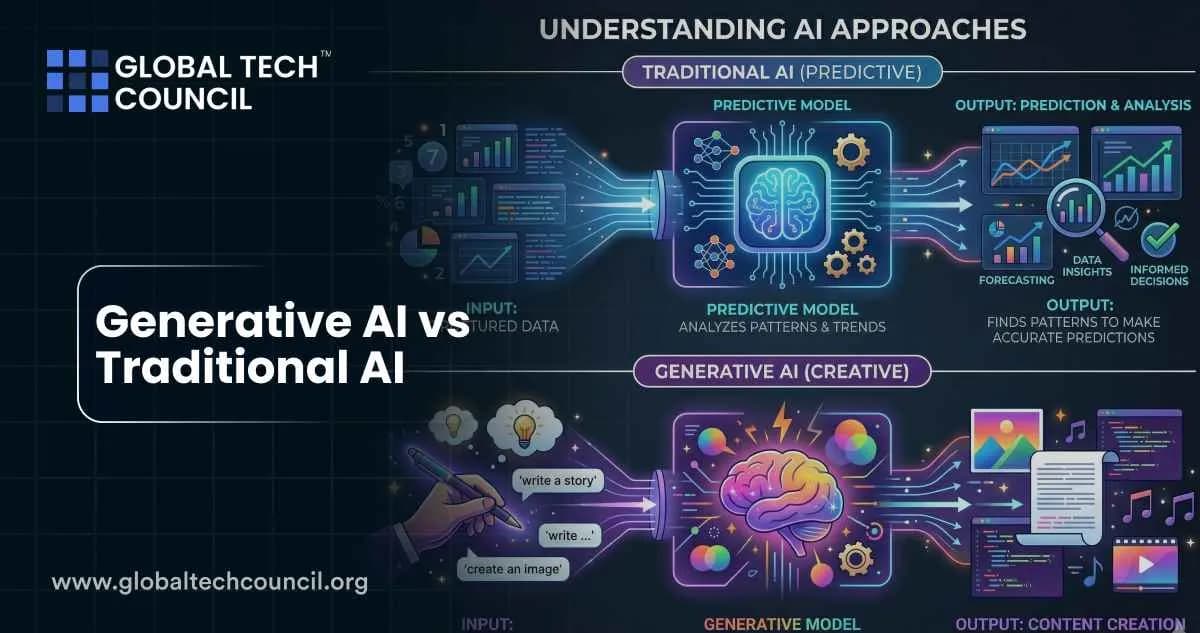
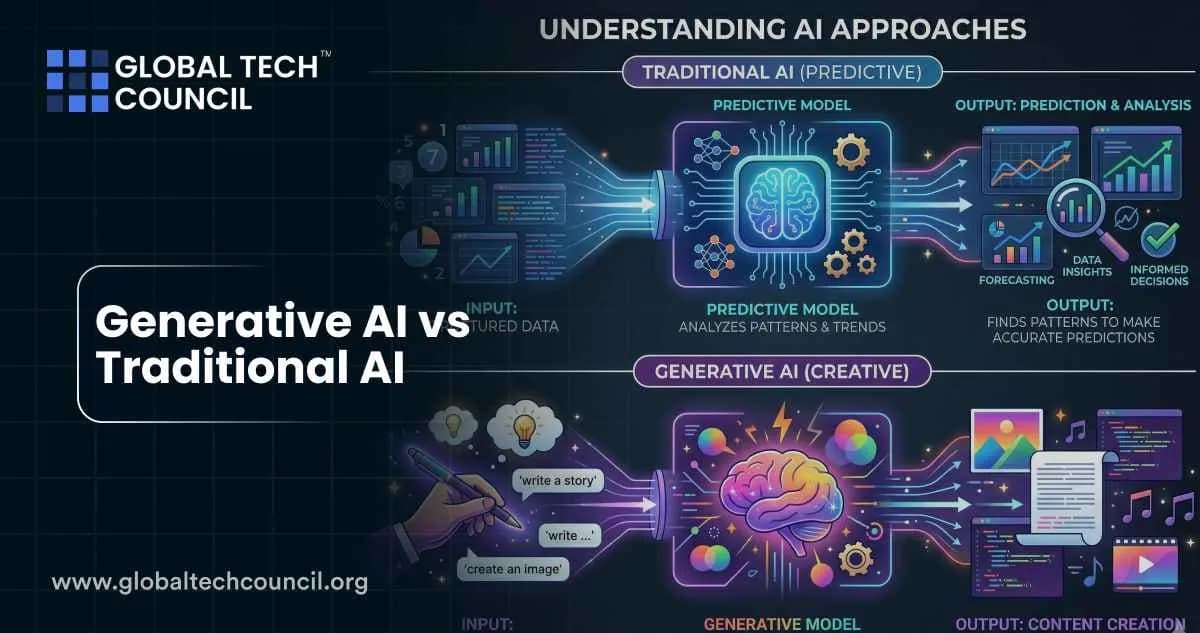 Artificial intelligence has changed dramatically over the last few years. Earlier AI systems were mainly built to analyze data, make predictions, and automate specific tasks. Today, newer AI models can also generate text, images, code, audio, and other forms of content. This shift has introduced a major distinction in the AI landscape: generative AI versus traditional AI.
Although these terms are often used interchangeably, they are not the same. Each serves a different purpose, works in a different way, and offers different benefits for businesses and professionals. Traditional AI is typically used to predict, classify, optimize, or detect patterns. Generative AI is designed to create original outputs based on learned data patterns.

For professionals who want to understand how modern AI works in practice, structured learning can be useful. Many learners explore programs such as AI Expert certification, Agentic AI certification, AI Powered coding expert certification, deeptech certification, and AI powered digital marketing expert to connect theory with real-world business applications.
This guide explains the difference between generative AI and traditional AI in simple language. It covers definitions, how each works, major differences, benefits, limitations, business use cases, and why understanding both matters in the modern AI era.
A Simple Definition of Traditional AI
Traditional AI refers to systems built to solve defined problems using rules, patterns, or statistical learning. These systems are usually designed for narrow tasks rather than open-ended content creation. Their main goal is to analyze data and return a specific kind of output, such as a label, prediction, recommendation, or score.
Traditional AI is commonly used in machine learning classifiers, forecasting tools, recommendation engines, fraud detection systems, and rule-based automation platforms. In most cases, it works best when the task is well structured and the expected result is clearly defined.
Examples of traditional AI include:
- detecting whether an email is spam
- predicting customer churn
- recommending products based on browsing history
- identifying fraud in bank transactions
- recognizing faces in a security system
- forecasting inventory demand
Traditional AI may not look flashy, but it is extremely valuable in business operations because it is often accurate, fast, and dependable for focused tasks.
What Generative AI Actually Does
Generative AI is a branch of artificial intelligence that creates new content instead of only analyzing existing data. These systems learn patterns, relationships, and structures from large datasets, then use that knowledge to generate new outputs that resemble human-created work.
Generative AI can produce text, images, code, audio, video, summaries, chatbot replies, marketing copy, and more. This is what makes it fundamentally different from traditional AI. Instead of only classifying or predicting, it can create.
Examples of generative AI include:
- writing blog articles and email drafts
- generating product descriptions
- creating images from text prompts
- summarizing business reports
- drafting software code
- producing chatbot conversations
- generating synthetic voice or media content
This content creation ability has made generative AI especially popular in marketing, design, customer service, software development, and knowledge work.
Why This Comparison Matters for Businesses
Understanding generative AI versus traditional AI matters because businesses need the right AI tool for the right task. Traditional AI and generative AI are not competitors in every case. In fact, many organizations use both together.
A bank that flags suspicious transactions is likely using traditional AI. A marketing team that drafts campaign copy is using generative AI. A retailer forecasting sales may rely on traditional AI, while the same retailer might use generative AI to create personalized product descriptions.
The difference matters because each type of AI offers different strengths. Using generative AI for a task that requires strict consistency can cause problems. Using traditional AI for a task that requires creative or open-ended output can limit productivity. Businesses get better results when they understand where each system fits.
How Traditional AI Works Behind the Scenes
Traditional AI systems are usually trained on structured or labeled data. They learn statistical patterns and use those patterns to analyze new inputs. In some cases, they also rely on human-defined rules.
A common traditional AI workflow includes:
Data Collection
The model is trained on historical data such as customer records, transactions, medical data, or operational logs.
Feature Selection
Relevant variables are identified to help the system make predictions. In some traditional machine learning approaches, this step is critical for performance.
Model Training
The model learns from the data using algorithms such as decision trees, logistic regression, support vector machines, or neural networks built for classification and forecasting.
Specific Output
The model produces a result such as fraud or not fraud, likely to churn or not likely to churn, or a future sales estimate.
Traditional AI is especially strong when the output is narrow and measurable.
How Generative AI Produces New Content
Generative AI works differently. Instead of producing only a fixed label or score, it learns patterns from extremely large datasets and uses those patterns to generate new material.
A simplified generative AI workflow includes:
Large-Scale Training
The model is trained on large amounts of text, images, code, audio, or mixed data.
Pattern Learning
The system learns how pieces of information relate to one another. In text models, for example, it learns how words and phrases appear in context.
Prompt-Based Interaction
A user gives the model a prompt or instruction, and the system generates a response based on what it has learned.
Alignment and Refinement
Many production models are further tuned to follow instructions better, reduce harmful content, and improve usefulness.
This is why generative AI feels interactive and flexible. It is designed to respond, create, and adapt rather than only classify.
Core Differences Between Generative AI and Traditional AI
The easiest way to understand generative AI versus traditional AI is to compare their goals and outputs.
Purpose
Traditional AI is built for prediction, classification, optimization, and decision support. Generative AI is built for creating content and supporting flexible interaction.
Output Style
Traditional AI usually returns fixed outputs such as labels, probabilities, alerts, or recommendations. Generative AI returns open-ended outputs such as text, images, code, summaries, or conversations.
Data Requirements
Traditional AI often works with structured, labeled, or tabular data. Generative AI often learns from large and diverse datasets, including unstructured information such as articles, websites, or media files.
User Interaction
Traditional AI usually works in the background inside business systems. Generative AI is often interactive and responds directly to prompts from users.
Control and Predictability
Traditional AI is generally more predictable for narrow tasks. Generative AI is more flexible but can also be less consistent.
Creativity
Traditional AI is not designed to create original material. Generative AI simulates creativity by producing new combinations of learned patterns.
Real Business Uses of Traditional AI
Traditional AI remains essential across many industries because businesses depend on consistent predictive systems.
Fraud Detection
Banks use traditional AI to spot unusual transaction behavior and flag possible fraud.
Recommendation Engines
Streaming services and ecommerce platforms use it to recommend movies, music, and products.
Predictive Maintenance
Manufacturers use AI to analyze machine data and predict failures before they happen.
Demand Forecasting
Retailers and logistics companies use traditional AI to estimate future demand and improve inventory planning.
Medical Decision Support
Healthcare organizations use it to classify medical images, predict risk, and support diagnosis.
These systems are often invisible to end users, which is typical. The most useful infrastructure rarely gets applause.
Real Business Uses of Generative AI
Generative AI has become highly visible because it produces outputs that people can directly read, use, and revise.
Content Creation
Marketing teams use generative AI to draft blogs, product descriptions, ad copy, and email campaigns.
Coding Support
Developers use it to generate code, explain functions, write test cases, and assist with debugging. This is why many learners combine AI study with AI Powered coding expert certification.
Customer Service
Businesses use generative AI to power chatbots, draft replies, summarize conversations, and assist support teams.
Design and Media
Creative teams use text-to-image tools and other content generators to create visual assets and concepts.
Personalized Marketing
Generative AI can tailor messaging for different audiences, making it useful for professionals pursuing AI powered digital marketing expert training and related strategy roles.
Benefits of Traditional AI
Traditional AI continues to be valuable because it offers several practical advantages.
Strong Accuracy in Narrow Tasks
When the problem is well defined, traditional AI can deliver high precision.
Easier Evaluation
Because outputs are constrained, businesses can measure performance more clearly.
Efficient for Structured Data
Traditional AI works extremely well with tabular, transactional, and operational datasets.
Reliable Enterprise Use
It is already deeply integrated into business systems across finance, healthcare, logistics, and retail.
Benefits of Generative AI
Generative AI offers a different but equally important set of strengths.
Fast Content Production
It can create large amounts of content in a short time.
Flexible Interaction
Users can communicate with it in natural language instead of using rigid interfaces.
Productivity Support
It helps with drafting, brainstorming, summarizing, explaining, and prototyping.
Wide Range of Applications
A single generative model can often support many tasks across teams and workflows.
Challenges and Limitations of Traditional AI
Traditional AI is powerful, but it has limits.
Narrow Scope
Most traditional AI models are built for specific tasks and do not generalize well beyond them.
Dependence on Structured Data
They often require clean, organized, and labeled data.
Limited Creativity
Traditional AI is not suited for content generation or open-ended conversation.
Manual Effort in Some Systems
Older approaches may require substantial feature engineering and ongoing tuning.
Challenges and Limitations of Generative AI
Generative AI is impressive, but it also introduces serious risks.
Hallucination
It can generate confident but incorrect information.
Inconsistent Output
The same prompt may produce different responses at different times.
Bias and Safety Concerns
These systems can reflect harmful biases or produce problematic content if not carefully managed.
Higher Cost
Training and running large generative models can be expensive.
Governance and Intellectual Property Issues
Businesses must consider privacy, compliance, attribution, and responsible deployment.
Why Many Companies Use Both Types of AI
In practice, the best business strategy is often a hybrid one. Many organizations combine traditional AI and generative AI rather than choosing only one.
For example:
- a retailer may use traditional AI for demand forecasting and generative AI for product copy
- a bank may use traditional AI for risk assessment and generative AI for summarizing customer interactions
- a healthcare organization may use traditional AI for image analysis and generative AI for documentation support
This combined model allows businesses to benefit from both precision and flexibility.
How Beginners Can Learn Generative AI and Traditional AI
For beginners, learning both areas is increasingly important because modern AI careers often involve both predictive systems and generative tools.
A practical learning path includes understanding machine learning basics, supervised learning, evaluation metrics, data preprocessing, neural networks, and transformer models. It also helps to build hands-on projects in both categories, such as a churn prediction model and a text summarization tool.
Structured study can make this easier. Many learners begin with AI Expert certification, then expand into Agentic AI certification, AI Powered coding expert certification, and broader innovation pathways such as deeptech certification. This kind of foundation helps people understand not just how AI works, but how to apply it responsibly and effectively.
The Future of AI Is Not One or the Other
The future is unlikely to belong only to generative AI or only to traditional AI. Traditional AI will remain critical for forecasting, anomaly detection, classification, and operational decision support. Generative AI will continue growing in content workflows, software assistance, research support, and natural language interaction.
The bigger shift is toward systems that combine analysis, retrieval, reasoning, and generation in one workflow. That is one reason interest in Agentic AI certification is rising. Businesses increasingly want AI systems that can do more than answer a single prompt. They want systems that can complete tasks, use tools, and support real work.
Final Thoughts
Generative AI and traditional AI are both important, but they solve different problems. Traditional AI is mainly used for prediction, classification, optimization, and decision support. Generative AI is built to create content, support natural interaction, and assist with flexible tasks.
Traditional AI remains essential in fraud detection, forecasting, recommendation systems, and operational analytics. Generative AI has expanded what AI can do in writing, design, customer support, development, and productivity. The smartest organizations do not treat them as rivals. They use both where each fits best.
For beginners, understanding the difference between generative AI and traditional AI is one of the clearest ways to build a solid AI foundation. Once that distinction is clear, it becomes much easier to choose the right AI tool for the right business problem.
Frequently Asked Questions
1. What is the main difference between generative AI and traditional AI?
Traditional AI focuses on prediction, classification, and decision-making, while generative AI focuses on creating new content such as text, images, code, or audio.
2. Is generative AI replacing traditional AI?
No. Generative AI is expanding the AI landscape, but traditional AI is still essential for forecasting, fraud detection, classification, and many structured business tasks.
3. What are common examples of traditional AI?
Common examples include spam filters, fraud detection systems, recommendation engines, medical image classifiers, and demand forecasting tools.
4. What are common examples of generative AI?
Examples include AI writing tools, image generators, code assistants, conversational chatbots, and document summarization systems.
5. Which type of AI is better for business?
It depends on the task. Traditional AI is better for structured prediction and consistent analysis, while generative AI is better for content creation and flexible interaction.
6. Can a company use both traditional AI and generative AI together?
Yes. Many businesses already combine both in workflows such as forecasting plus marketing content creation or classification plus customer support summarization.
7. Is generative AI more advanced than traditional AI?
Not in every case. Generative AI is more flexible for open-ended work, but traditional AI is often more reliable for narrow predictive tasks.
8. What are the main risks of generative AI?
Major risks include hallucination, bias, inconsistent output, privacy issues, governance concerns, and high computing costs.
9. What skills should beginners learn to understand both types of AI?
Beginners should learn machine learning fundamentals, data handling, Python, neural networks, model evaluation, and practical project development.
10. How can I start building a career in modern AI?
A strong starting point is to build core knowledge through programs such as AI Expert certification, Agentic AI certification, AI Powered coding expert certification, deeptech certification, and AI powered digital marketing expert.
Related Articles
View All
AI & ML
NVIDIA Nemotron 3.5 Lightning vs NVIDIA Cosmos 3: Key Differences and Use Cases
Compare NVIDIA Nemotron 3.5 Lightning and NVIDIA Cosmos 3, including their architectures, capabilities, performance goals, and use cases across agentic AI and Physical AI.

AI & ML
Recursive Self-Improvement vs Recursive Self-Training: Key Differences
Learn the key differences between recursive self-improvement and recursive self-training, including how each process works, what it changes, and why the distinction matters in AI development.
AI & ML
Decision AI vs Generative AI
Compare Decision AI and Generative AI, including how they differ in goals, outputs, reasoning, automation, data use, and real-world business applications.
Trending Articles
The Role of Blockchain in Ethical AI Development
How blockchain technology is being used to promote transparency and accountability in artificial intelligence systems.
AWS Career Roadmap
A step-by-step guide to building a successful career in Amazon Web Services cloud computing.
Top 5 DeFi Platforms
Explore the leading decentralized finance platforms and what makes each one unique in the evolving DeFi landscape.