

AI Agents Explained: Architecture, Tool Use, Memory, and Real-World Applications
 Suyash Raizada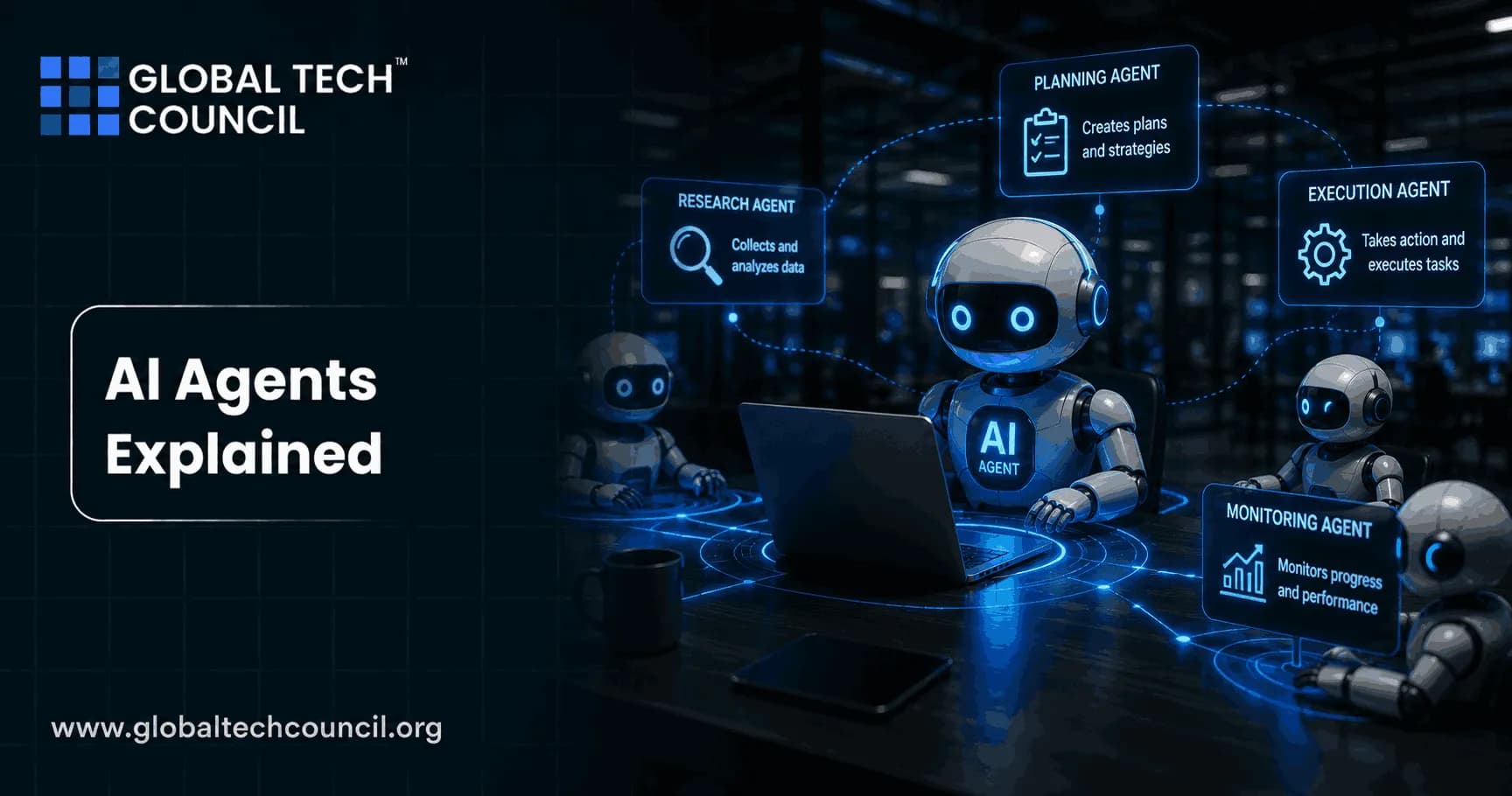
AI agents are software systems that combine a language model with tools, memory, planning, and control logic to complete multi-step tasks with minimal human supervision. Unlike traditional chatbots that respond to a single prompt, AI agents are designed to operate across workflows: they perceive context, decide what to do next, call external tools or APIs, and retain useful state over time. As adoption accelerates, the core technical challenges are becoming clearer - reliability, evaluation, and memory management remain difficult engineering problems.
What Is an AI Agent?
A practical definition used across industry discussions is that an AI agent is a system that can:

Perceive context (user intent, environment state, task constraints)
Decide the next action (planning and step selection)
Use tools (APIs, databases, browsers, code runners, enterprise apps)
Retain state (short-term context and longer-term memory)
This definition matters because most large language models are stateless by default. Each request is processed independently unless developers add external session state and memory. That is why production-grade AI agents are not simply clever prompts - they are architectures built around the model. Unlock the potential of intelligent automation and autonomous systems by earning an AI Expert Certification, mastering advanced agentic workflows through a Generative AI Expert Course, and gaining deeper insights into emerging technologies with a Deeptech Certification.
Core AI Agent Architecture: The Four Layers
Most modern AI agent implementations can be understood as four cooperating layers. Thinking in layers helps teams reason about reliability, observability, governance, and cost.
1. Model Layer
The model layer is the language model (or model ensemble) that interprets tasks and generates outputs such as responses, tool calls, structured plans, or intermediate reasoning steps. The model provides linguistic and semantic intelligence, but it does not inherently know your systems, policies, or past interactions unless that context is explicitly supplied.
2. Tool Layer
The tool layer is how agents act beyond text generation. Tools can include:
Search and browsing
Databases and document stores
CRMs, ticketing systems, and schedulers
Code execution and testing environments
Internal business APIs (inventory, billing, HR, IAM)
In enterprise environments, tool design often determines whether an agent is genuinely useful or merely conversational.
3. Memory Layer
The memory layer turns a stateless model into a stateful system. It typically includes:
Short-term memory for immediate session context
Long-term memory for persistent facts, preferences, task history, and reusable knowledge
A widely referenced memory flow breaks the lifecycle into encoding, storage, retrieval, and integration. In practical terms: decide what to remember, store it in the right backend, retrieve only what is relevant, and integrate it into the agent's next decision.
4. Orchestration Layer
The orchestration layer is the control plane that makes the system dependable. It handles planning, routing, retries, guardrails, tool selection, and decisions about when to retrieve memory. This is also where teams implement policies such as requiring confirmation before writing to production systems or preventing sensitive data from being passed to external tools.
For teams building agent systems, this is where software engineering discipline is non-negotiable: logging, error handling, evaluation, and governance must be deliberately designed into the system.
Tool Use: How AI Agents Interact with External Systems
Tool use is what makes AI agents more than a chat interface. Agents succeed when they can reliably invoke the right function with the right parameters at the right time.
Common Tool-Use Patterns
Function calling: the model emits a structured tool call and arguments.
ReAct-style loops: the agent alternates between reasoning and acting, using tool results to decide the next step.
Plan-then-execute: the agent drafts a multi-step plan, then executes steps using tools with checkpoints.
Tool routing: the system selects among many tools based on task type, confidence, and policies.
Why Tool Retrieval and Routing Matter at Scale
As tool libraries grow, a naive approach is to include every tool description in the prompt. That quickly becomes expensive and brittle given context window constraints. A stronger approach is semantic tool retrieval, where the agent searches a tool registry and selects only the relevant tools for the current task. This reduces token usage and allows teams to scale an agent ecosystem without turning prompts into tool encyclopedias.
Memory in AI Agents: Types, Storage, and Management
Memory is one of the clearest differentiators in agent design because it creates continuity across turns, tasks, and sessions. Without memory, many workflows degrade into repetitive questioning, redundant context collection, and inconsistent execution.
Short-Term vs. Long-Term Memory
Short-term memory: immediate conversation history and working context required to stay coherent within a session.
Long-term memory: durable information such as user preferences, prior outcomes, domain facts, and reusable task knowledge.
Specialized Long-Term Memory Forms
Long-term memory is often implemented across specialized categories:
Episodic memory for specific events (what happened, when, and what the outcome was)
Semantic memory for facts and domain knowledge
Procedural memory for how to execute workflows (steps, policies, runbooks)
Common Implementation Stack
Many production architectures combine multiple stores because no single database fits all memory needs:
Vector databases (embeddings) for semantic recall and similarity search
Structured databases for stable facts and transactional correctness
Event logs for auditability, debugging, and governance
Graph stores for relationship reasoning across entities and workflows
This hybrid approach reflects an important reality: memory is not only about retrieval. It is also about correctness, traceability, and safe lifecycle management.
Why Memory Matters in Practice
Without memory, agents struggle with personalization and long-running workflows. They cannot reliably carry knowledge from one task to the next, so they behave like isolated question-and-answer systems. That may be acceptable for simple knowledge queries, but it is insufficient for operational work.
Concrete examples of memory-dependent value include:
Customer support: remembering prior complaints, policies applied, and what resolved the issue previously.
Personal productivity: adapting reminders, schedules, and preferences over time.
Developer copilots: retaining coding style preferences, repository conventions, and known anti-patterns.
Memory can also reduce cost and latency when implemented as selective retrieval. The principle is broadly valid: retrieving only relevant information is consistently cheaper than replaying entire conversation histories. The actual savings vary significantly by implementation, context window size, and retrieval strategy.
Current State of AI Agents: Rapid Adoption, Uneven Reliability
Many organizations now deploy agents for narrow, high-value workflows. Broader autonomy remains constrained by several factors:
Memory quality issues: stale, irrelevant, or incorrectly extracted memories.
Retrieval errors: missing critical facts or selecting the wrong memory.
Tool failures: API errors, permission problems, partial writes, and brittle integrations.
Evaluation difficulty: multi-step systems are harder to benchmark than single-turn chat.
A key shift in engineering practice is moving away from simply increasing prompt length toward context engineering: trimming, summarization, compaction, selective retrieval, consolidation, and deliberate forgetting. These patterns help keep agents coherent and cost-effective while reducing the risk that irrelevant history degrades task performance.
Real-World Applications of AI Agents
The most established applications share three traits: high frequency, clear success criteria, and strong benefits from continuity across interactions.
1. Customer Support and Service Operations
Support agents can retrieve prior tickets, identify repeat issues, and apply consistent resolution paths. Memory improves handoffs and reduces repetitive questioning, while orchestration can enforce escalation rules and approval checkpoints.
2. Enterprise Workflow Automation
Agents can coordinate multi-step work across business systems: retrieving records, updating fields, creating tickets, scheduling follow-ups, and generating summaries for stakeholders. In these workflows, tool reliability and audit logs matter as much as model quality.
3. Developer Productivity
Developer copilots can combine tool access (repository search, test runners, linters) with memory (style preferences, service boundaries) to accelerate debugging and code generation while staying aligned to team standards.
4. Knowledge Work and Research Assistance
Agents can apply semantic retrieval across documents and combine it with structured memory for domain tasks such as compliance checks, policy queries, or internal knowledge base navigation.
Key Design Choices and Tradeoffs
When designing AI agents, teams repeatedly face a core set of tradeoffs:
Short-term vs. long-term memory: coherence within a session versus persistence across sessions.
Structured vs. vector storage: exact factual correctness versus semantic similarity.
Summarization vs. raw history: lower token cost versus potential information loss.
Automatic vs. curated memory: convenience versus reliability, privacy risk, and governance overhead.
Single-agent vs. multi-agent: simpler systems versus specialized routing and role separation.
In regulated environments, memory scope also matters. Many teams separate memory into session, user, and organizational scopes to reduce data leakage, enforce permissions, and simplify retention policies.
Limitations, Risks, and Governance Considerations
Stateful agents introduce distinct risks because they can accumulate and reuse information over time. Common failure modes include:
Hallucinated memories: the system stores an incorrect inference as fact.
Over-retention: excessive memory degrades performance and increases privacy exposure.
Policy violations: a tool call executes without appropriate authorization or confirmation.
Practical mitigations include memory extraction rules, validation checks, consolidation workflows, retention limits, and audit trails that record what was retrieved and why. Evaluation should cover not only answer quality, but also tool correctness, memory relevance, and multi-step task completion rates.
Skills for Building AI Agents
Building reliable AI agents requires cross-disciplinary expertise: LLM behavior, software architecture, retrieval systems, and security. Prepare for the future of AI-powered applications by developing practical implementation skills through an AI Powered Coding Expert Course, strengthening your technical foundation with a Tech Certification, and understanding how intelligent systems drive business innovation with a Marketing Certification.
Conclusion
AI agents represent a shift from stateless chat to stateful, tool-using systems capable of executing multi-step workflows. The most durable agent architectures treat the language model as one layer within a broader system that includes tools, memory, and orchestration. Near-term, the highest-performing deployments will be selective and workflow-focused, characterized by strong tool design, careful memory management, and measurable evaluation criteria. As memory and orchestration patterns mature, organizations that invest in rigorous agent engineering will be best positioned to deploy AI agents safely, efficiently, and at scale.
FAQs
1. What is an AI agent?
An AI agent is a software system that can perceive information, make decisions, and perform actions to achieve specific goals. Unlike traditional AI models that simply generate responses, AI agents can interact with tools, environments, and data sources to complete tasks autonomously.
2. How are AI agents different from chatbots?
While chatbots primarily focus on conversations, AI agents can plan, reason, use external tools, and execute multi-step workflows. They are designed to perform actions and solve problems rather than just provide answers.
3. What are the core components of an AI agent?
The core components typically include a language model, memory system, planning mechanism, tool integration layer, and execution framework. Together, these elements enable agents to understand goals and take meaningful actions.
4. What is AI agent architecture?
AI agent architecture refers to the structure and design of the agent's components and workflows. It defines how the agent processes information, stores memory, uses tools, and interacts with users or external systems.
5. Why is planning important in AI agents?
Planning allows AI agents to break complex tasks into smaller, manageable steps. This capability helps improve decision-making and enables agents to complete multi-stage objectives more effectively.
6. What role do Large Language Models play in AI agents?
Large Language Models serve as the reasoning and communication engine for many AI agents. They help interpret instructions, generate responses, analyze information, and coordinate task execution.
7. What is memory in AI agents?
Memory allows AI agents to store and retrieve information from previous interactions or tasks. This capability helps maintain context, improve personalization, and support long-term decision-making.
8. What are the different types of memory used by AI agents?
AI agents often use short-term memory for active conversations and long-term memory for storing historical information. Some systems also include external databases or vector stores for enhanced knowledge retrieval.
9. What is tool use in AI agents?
Tool use enables AI agents to interact with external applications, APIs, databases, search engines, and software systems. This expands their capabilities beyond the knowledge contained within the underlying model.
10. Why do AI agents need external tools?
External tools allow agents to access real-time information, perform calculations, automate workflows, and interact with business systems. Without tools, agents are limited to generating text-based responses.
11. What are autonomous AI agents?
Autonomous AI agents can make decisions and execute tasks with minimal human intervention. They operate according to predefined objectives while adapting their actions based on changing conditions and feedback.
12. How do AI agents make decisions?
AI agents analyze available information, evaluate possible actions, and select the most appropriate step based on goals and constraints. This process often combines reasoning, planning, and tool-assisted execution.
13. What are multi-agent systems?
Multi-agent systems consist of multiple AI agents working together to accomplish complex tasks. Each agent may specialize in specific functions, improving efficiency and scalability.
14. What industries are adopting AI agents?
AI agents are being adopted across healthcare, finance, retail, manufacturing, education, and customer service. Organizations use them to automate workflows, improve productivity, and enhance user experiences.
15. How are AI agents used in customer support?
AI agents can handle inquiries, resolve issues, access customer records, and automate repetitive support tasks. This helps organizations improve response times and reduce operational costs.
16. Can AI agents assist with software development?
Yes, AI agents can generate code, review software, identify bugs, create documentation, and automate development workflows. These capabilities help developers work more efficiently and accelerate project delivery.
17. What are the risks associated with AI agents?
Potential risks include inaccurate outputs, security vulnerabilities, privacy concerns, tool misuse, and unintended actions. Proper monitoring, governance, and safeguards are essential for responsible deployment.
18. How is agent memory different from traditional databases?
Agent memory focuses on storing contextual information relevant to tasks and interactions. Traditional databases store structured records, while agent memory is often optimized for retrieval and reasoning.
19. What are the benefits of AI agents for businesses?
AI agents can automate repetitive tasks, improve operational efficiency, enhance customer experiences, and support data-driven decision-making. These benefits make them valuable tools for digital transformation initiatives.
20. What is the future of AI agents?
The future of AI agents includes improved reasoning, better memory systems, stronger tool integration, and greater autonomy. As the technology evolves, agents are expected to play a central role in enterprise automation and intelligent decision-making.
Related Articles
View All
AI & ML
Jev Architecture Explained
Explore Jev’s architecture, including TypeSafe AI’s System One design, parallel sampling, RLCD training, typed outputs, calibrated probabilities, and machine-native decision-making.
AI & ML
NVIDIA Nemotron 3.5 Lightning vs NVIDIA Cosmos 3: Key Differences and Use Cases
Compare NVIDIA Nemotron 3.5 Lightning and NVIDIA Cosmos 3, including their architectures, capabilities, performance goals, and use cases across agentic AI and Physical AI.

AI & ML
NVIDIA Cosmos 3 Explained: The Next Generation of Physical AI
Explore NVIDIA Cosmos 3, an open foundation model for Physical AI that combines vision reasoning, world generation, multimodal understanding, and action prediction for robotics and autonomous systems.
Trending Articles
The Role of Blockchain in Ethical AI Development
How blockchain technology is being used to promote transparency and accountability in artificial intelligence systems.
AWS Career Roadmap
A step-by-step guide to building a successful career in Amazon Web Services cloud computing.
Top 5 DeFi Platforms
Explore the leading decentralized finance platforms and what makes each one unique in the evolving DeFi landscape.