

Prompt Engineering for LLMs: Techniques, Templates, and Common Failure Modes
 Suyash Raizada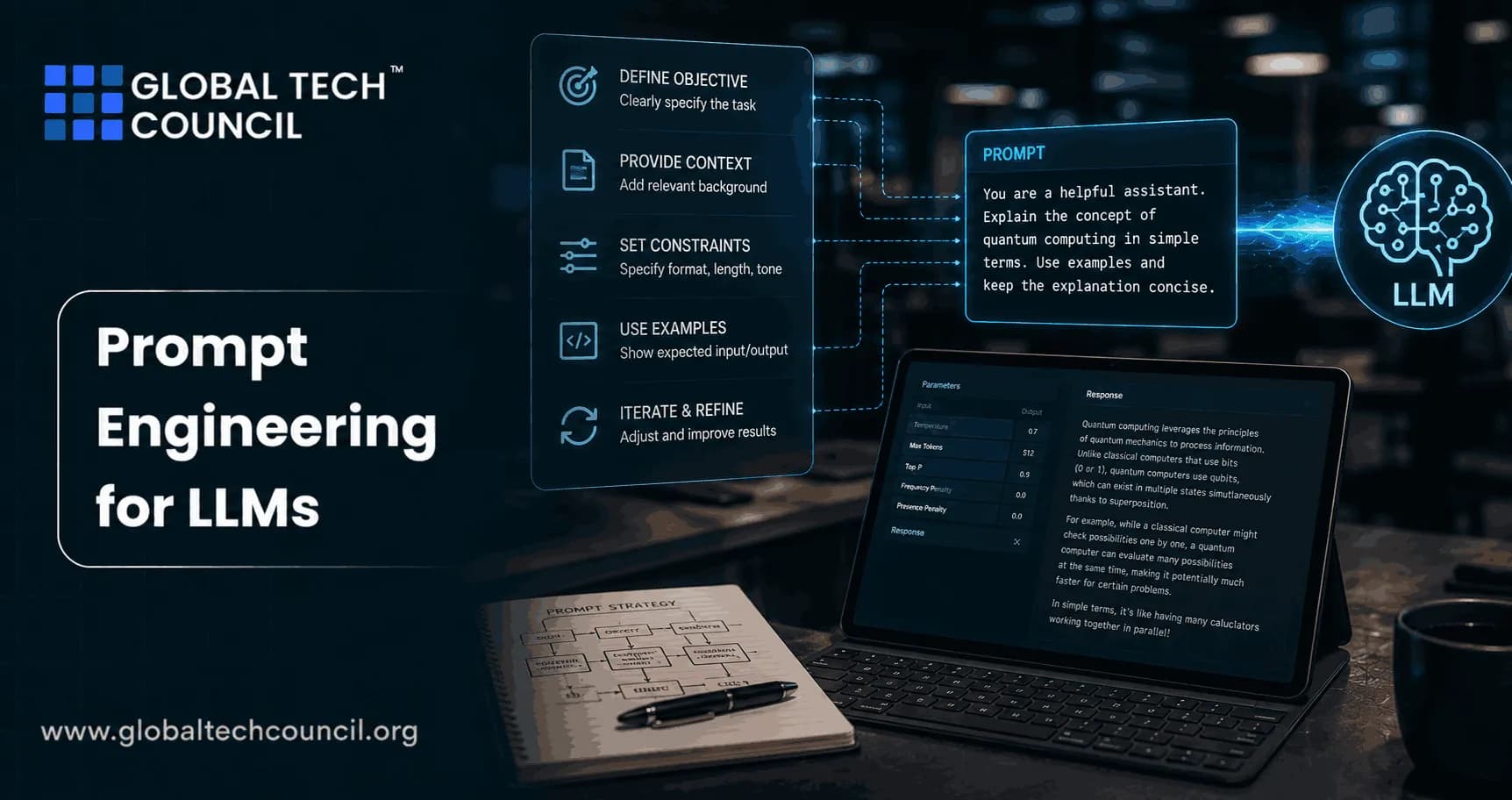
Prompt engineering for LLMs has moved well beyond writing clever instructions. In modern AI systems, prompts function as an interface layer between users, enterprise data, safety policies, and toolchains. Professionals building LLM applications now treat prompts as versioned assets, combining them with retrieval-augmented generation (RAG), tool calling, and evaluation workflows to improve reliability and governance.
This article covers practical prompt engineering techniques, reusable prompt templates, and the most common LLM failure modes - including hallucinations, prompt injection, and brittleness. It also examines how prompt design increasingly overlaps with data engineering and security, particularly in enterprise deployments. Master the art of designing effective prompts, optimizing AI outputs, and solving complex LLM challenges by earning an AI Expert Certification, expanding your skills through a Generative AI Expert Course, and exploring emerging innovations with a Deeptech Certification.

What Prompt Engineering for LLMs Means Today
Modern prompt engineering is best understood as a structured discipline for developing, optimizing, and operationalizing prompts so that large language models perform reliably across real-world tasks. In practice, it includes:
Designing instructions that match model strengths and limitations, including how context is presented and what constraints are enforced.
Integrating external tools and trusted data - such as retrieval systems, APIs, calculators, and databases - rather than relying solely on the model's parametric knowledge.
Establishing workflows for multi-step tasks (plan, draft, critique, revise) alongside systematic evaluation processes.
Many organizations now standardize prompt patterns using system messages for stable behavioral rules and user messages for task-specific requests. This approach reduces prompt drift and makes results easier to test and govern across teams.
How RAG Changes Prompt Engineering in Enterprise Systems
RAG-oriented prompt design represents one of the most significant shifts in enterprise prompt engineering. Instead of asking an LLM to answer from its training parameters, RAG pipelines retrieve relevant information from trusted sources and inject it into the prompt. The prompt then instructs the model how to use that context and what to do when an answer is not supported by the retrieved material.
In regulated or knowledge-intensive domains, RAG prompts typically include retrieval instructions, context delimiters, and strict grounding rules to reduce hallucinations and keep answers aligned with current enterprise data.
RAG Prompt Elements That Matter Most
Task definition: what the assistant should do and what it should not do.
Retrieval specification: what to search, applicable filters, and how many results to include.
Context injection: snippets or passages with clear delimiters and metadata.
Grounding constraints: instructions to use only the provided context and to state uncertainty when context is absent.
Output format: required structure such as bullets, tables, or JSON.
Table-Augmented Generation (TAG) for Structured Data
For analytics and operational reporting, teams increasingly use Table-Augmented Generation (TAG), where the context includes structured rows from one or more tables. Prompting focuses on interpreting schemas, computing metrics, and summarizing results, while retrieval and data assembly handle the selection of relevant records.
Core Prompt Engineering Techniques for LLMs
Most production-grade systems rely on a small set of proven techniques. The distinction between experimentation and engineering is repeatability: each technique is applied intentionally, supported by templates and test cases.
1. Instruction-Based Prompting
Instruction-based prompting uses clear tasks, constraints, and formatting rules. Effective instruction prompts typically specify:
Role (for example, security analyst, data engineer, technical writer)
Objective (what a successful output looks like)
Constraints (scope, allowed sources, safety rules)
Output format (JSON schema, bullet list, step list, decision table)
2. Few-Shot Prompting
Few-shot prompting provides input-output examples to guide model behavior, particularly for classification, extraction, style transfer, and structured outputs. Concrete examples reduce ambiguity by demonstrating the desired mapping rather than merely describing it.
3. Reasoning-Focused Prompting
Reasoning-focused prompting - including chain-of-thought and related variants - improves performance on multi-step logic and mathematical tasks by encouraging intermediate reasoning steps. In production settings, many teams prefer concise rationales or hidden reasoning with separate verification steps, depending on safety and privacy requirements.
4. Self-Critique and Refinement
Self-critique patterns decompose work into discrete stages, such as draft-then-review or solve-then-verify. This approach helps catch factual errors, unmet requirements, and formatting mistakes. A common workflow consists of three steps:
Generate: produce an initial answer.
Critique: identify issues against a defined checklist.
Revise: produce a corrected final output.
5. Tool-Augmented Prompting and Agent Workflows
Tool-use prompting instructs the model to call an API, run code, query a database, or search documentation when needed. This is foundational for agentic systems where the model orchestrates multiple steps rather than producing a single response. Tool prompts should define:
When to use a tool versus answering directly from context
Required inputs and expected outputs for each tool
How to validate tool results before incorporating them
How to report provenance and uncertainty in the final response
6. Safety and Policy Prompting
Safety prompts define disallowed content, sensitive data handling procedures, and compliance boundaries. In enterprise governance, policy prompts are commonly paired with server-side guardrails, audit logging, and red-teaming tests to reduce risk from both inadvertent mistakes and malicious inputs.
Build expertise in advanced AI workflows, prompt-driven automation, and intelligent application development through an AI Powered Coding Expert Course, strengthen your professional capabilities with a Tech Certification, and learn how to leverage AI for business growth with a Marketing Certification.
Reusable Prompt Templates You Can Standardize
Templates improve consistency, reduce brittleness, and simplify evaluation. A practical template is not just static text - it is a stable structure that a system fills with retrieved context, user inputs, and formatting constraints at runtime.
Template 1: Instruction + Context + Input + Output Format
Use for: general assistants, summarization, extraction, content generation, and coding assistance.
System: role, objective, policies, style guidelines
Context: definitions, constraints, examples, reference material
User input: the specific task or question
Output spec: structure, fields, tone, length, and handling instructions for uncertainty
Template 2: RAG Question Answering (Grounded)
Use for: internal copilots, support agents, policy assistants.
Instruction: answer using only the supplied documents.
Context block: retrieved passages with delimiters and document IDs.
Grounding rule: if the answer is not present in the context, state that it is not available.
Answer format: include a short answer plus supporting citations by document ID or excerpt label.
Template 3: TAG Analytics Report (Structured Tables)
Use for: BI narratives, KPI summaries, anomaly explanations.
Schema: table names, columns, definitions, units.
Rows: selected records for the query scope.
Rules: permitted calculations, grouping logic, time windows.
Output: metrics table plus executive summary and stated assumptions.
Template 4: Evaluation and Grading Prompt
Use for: automated QA of model outputs, policy compliance checks, regression tests.
Rubric: correctness, completeness, groundedness, tone, safety.
Inputs: user question, retrieved context, model answer.
Output: pass or fail verdict, scores, and specific error categories.
Common Failure Modes in LLM Prompting and How to Mitigate Them
Prompt engineering exists partly because LLMs fail in predictable ways. Understanding these failure modes enables prompt designers, retrieval engineers, and evaluators to catch problems before they reach production.
Hallucinations and Fabricated Details
LLMs can produce plausible but incorrect facts, citations, or code - particularly when a prompt implicitly forces an answer or when the relevant context is absent. Common symptoms include confident statements without supporting evidence, invented API references, and inconsistent responses across identical runs.
Mitigations:
Use RAG or TAG to ground outputs in trusted, current data sources.
Add uncertainty handling: instruct the model to acknowledge when context does not contain a sufficient answer.
Require provenance: cite document IDs, excerpt labels, or table row identifiers in the response.
Prompt Brittleness and Sensitivity to Wording
Small changes in phrasing can cause large, unexpected changes in model output. Long prompts with conflicting instructions can also lead to partial compliance or format drift.
Mitigations:
Standardize templates in place of ad hoc prompts.
Separate stable rules from dynamic tasks using system messages for policy and user messages for requests.
Test with representative datasets: A/B test prompts across a range of real inputs and edge cases, not just a handful of examples.
Context and Retrieval Defects in RAG Systems
In RAG applications, many failures originate from retrieval quality and context assembly rather than the base model. Missing documents, noisy snippets, or conflicting sources can produce incorrect answers even when the model follows instructions correctly.
Mitigations:
Specify retrieval intent: define filters, scope, and ranking criteria explicitly.
Curate context: deduplicate results, prioritize authoritative sources, and keep injected context concise.
Use clear delimiters so the model can reliably distinguish instructions from retrieved evidence.
Prompt Injection and Jailbreak Attempts
Adversarial inputs may attempt to override prior instructions, or malicious content may be embedded within retrieved documents. Without careful delimiting and a clear instruction hierarchy, a model may treat untrusted content as commands.
Mitigations:
Keep system instructions isolated from user-controlled text at all times.
Delimit retrieved content explicitly and instruct the model to treat it as data rather than as instructions.
Apply guardrails - such as allowlists for tool calls, output validation, and policy enforcement - outside the prompt layer.
Data Privacy and Compliance Leakage
Enterprise prompts can inadvertently expose sensitive information when retrieval scope is too broad, field masking is absent, or user requests bypass the intended policy boundaries. Data quality compounds this risk, since low-quality internal data produces low-quality, potentially misleading answers.
Mitigations:
Apply access controls at retrieval time, not solely within the prompt text.
Filter and anonymize sensitive fields before injecting them into the context block.
Monitor token and cost budgets, since extended context windows increase both latency and inference expense.
Operational Best Practices for Practitioners
Treating prompt engineering as a disciplined engineering practice rather than ad hoc experimentation requires consistent habits across the development lifecycle:
Version control prompts and templates like source code, with documented change reviews.
Maintain evaluation sets that cover real user tasks, edge cases, and adversarial scenarios.
Measure groundedness in RAG pipelines: track how consistently answers are supported by the provided context.
Use multi-step workflows for high-stakes tasks: generate, verify, then finalize.
Collaborate across functions - data engineering, security, compliance, and domain subject matter experts all contribute to robust prompt systems.
For professionals building formal expertise in this area, Global Tech Council offers certification programmes in Generative AI and Prompt Engineering, as well as role-adjacent programmes in Data Science, Machine Learning, and Cybersecurity relevant to governance and threat-aware deployment.
Conclusion
Prompt engineering for LLMs is now a core competency for building reliable AI applications. Effective teams combine techniques such as few-shot prompting, reasoning workflows, and tool use with RAG or TAG pipelines to ground outputs in trusted data. Equally important, they design prompts and templates to withstand common failure modes - including hallucinations, brittleness, retrieval defects, and prompt injection.
When prompts are treated as first-class engineering artifacts, supported by templates, systematic testing, and governance processes, LLM systems become more predictable, safer to operate, and more straightforward to improve over time.
FAQs
1. What is prompt engineering for Large Language Models (LLMs)?
Prompt engineering is the process of designing and refining inputs to guide LLMs toward generating accurate, relevant, and useful outputs. It involves structuring instructions, context, and examples to improve model performance across various tasks.
2. Why is prompt engineering important for AI applications?
Prompt engineering helps maximize the effectiveness of LLMs without modifying the underlying model. Well-crafted prompts can improve accuracy, consistency, reasoning, and task completion while reducing errors and ambiguities.
3. What are the key components of an effective prompt?
An effective prompt typically includes clear instructions, relevant context, desired output formats, and specific constraints. These elements help the model understand the user's intent and generate more reliable responses.
4. What is zero-shot prompting?
Zero-shot prompting involves asking an LLM to perform a task without providing examples. The model relies on its pre-trained knowledge to interpret the request and generate an appropriate response.
5. What is few-shot prompting?
Few-shot prompting provides the model with a small number of examples before asking it to complete a task. This technique helps guide the model toward the desired format, style, or reasoning process.
6. How does chain-of-thought prompting work?
Chain-of-thought prompting encourages the model to break down complex problems into intermediate reasoning steps. This approach often improves performance on tasks involving logic, mathematics, and multi-step analysis.
7. What are prompt templates?
Prompt templates are reusable structures that standardize interactions with LLMs. They help maintain consistency, reduce errors, and improve efficiency when deploying AI solutions across different use cases.
8. What is role-based prompting?
Role-based prompting assigns a specific persona or expertise to the model, such as a developer, marketer, or analyst. This technique can help tailor responses to a particular audience or context.
9. How can context improve prompt quality?
Providing relevant context helps the model better understand the task and generate more accurate responses. Context may include background information, goals, constraints, or domain-specific knowledge.
10. What are common prompt engineering mistakes?
Common mistakes include vague instructions, insufficient context, conflicting requirements, and overly complex prompts. These issues can lead to inaccurate, incomplete, or inconsistent outputs.
11. What is prompt injection?
Prompt injection is a security risk where malicious instructions manipulate an AI system into ignoring its original objectives. Developers use safeguards and validation techniques to mitigate these vulnerabilities.
12. Why do LLMs sometimes hallucinate information?
Hallucinations occur when models generate plausible-sounding but incorrect information. This can result from insufficient context, ambiguous prompts, or limitations in the model's knowledge and reasoning.
13. How can users reduce hallucinations in LLM outputs?
Users can reduce hallucinations by providing clear instructions, requesting citations, narrowing the scope of questions, and validating responses against trusted sources when accuracy is critical.
14. What is output formatting in prompt engineering?
Output formatting specifies how responses should be structured, such as bullet points, tables, JSON, or summaries. Clear formatting instructions improve usability and consistency.
15. Can prompt engineering improve coding tasks?
Yes, prompt engineering can significantly improve code generation, debugging, documentation, and software design tasks. Detailed instructions and examples often produce better programming outputs.
16. What are failure modes in prompt engineering?
Failure modes are situations where prompts produce undesirable results, including hallucinations, incomplete answers, logical errors, instruction neglect, or inconsistent outputs across similar queries.
17. How does prompt length affect model performance?
Prompt length can influence accuracy and context retention. While more context may improve responses, excessively long prompts can introduce distractions, increase costs, and reduce effectiveness.
18. What role does experimentation play in prompt engineering?
Experimentation is essential because different prompt structures can yield varying results. Testing and iterating prompts helps identify the most effective approaches for specific applications.
19. Is prompt engineering a long-term AI skill?
Prompt engineering remains valuable as organizations increasingly adopt AI tools. Understanding how to communicate effectively with LLMs can improve productivity and unlock more advanced AI capabilities.
20. What is the future of prompt engineering?
Prompt engineering is evolving alongside advances in AI models, automation frameworks, and agent-based systems. Future developments will likely combine prompt design with workflow orchestration and AI governance practices.
Related Articles
View All
AI & ML
System One Models vs LLMs
Compare System One Models and LLMs, including differences in outputs, architecture, speed, confidence, automation, and how each approach fits into modern software workflows.
AI & ML
Can ChatGPT Improve Itself? Understanding RSI in LLMs
Explore whether ChatGPT can improve itself, how recursive self-improvement differs from normal model training, and what current LLMs can and cannot do autonomously.

AI & ML
Recursive Self-Improvement in LLMs: Can Language Models Optimize Their Own Capabilities?
Explore whether large language models can recursively improve their own capabilities, how self-optimization might work, and the technical, architectural, and safety limits involved.
Trending Articles
The Role of Blockchain in Ethical AI Development
How blockchain technology is being used to promote transparency and accountability in artificial intelligence systems.
AWS Career Roadmap
A step-by-step guide to building a successful career in Amazon Web Services cloud computing.
Top 5 DeFi Platforms
Explore the leading decentralized finance platforms and what makes each one unique in the evolving DeFi landscape.