

Generative AI vs. Traditional Machine Learning: Key Differences, Use Cases, and Career Paths
 Suyash Raizada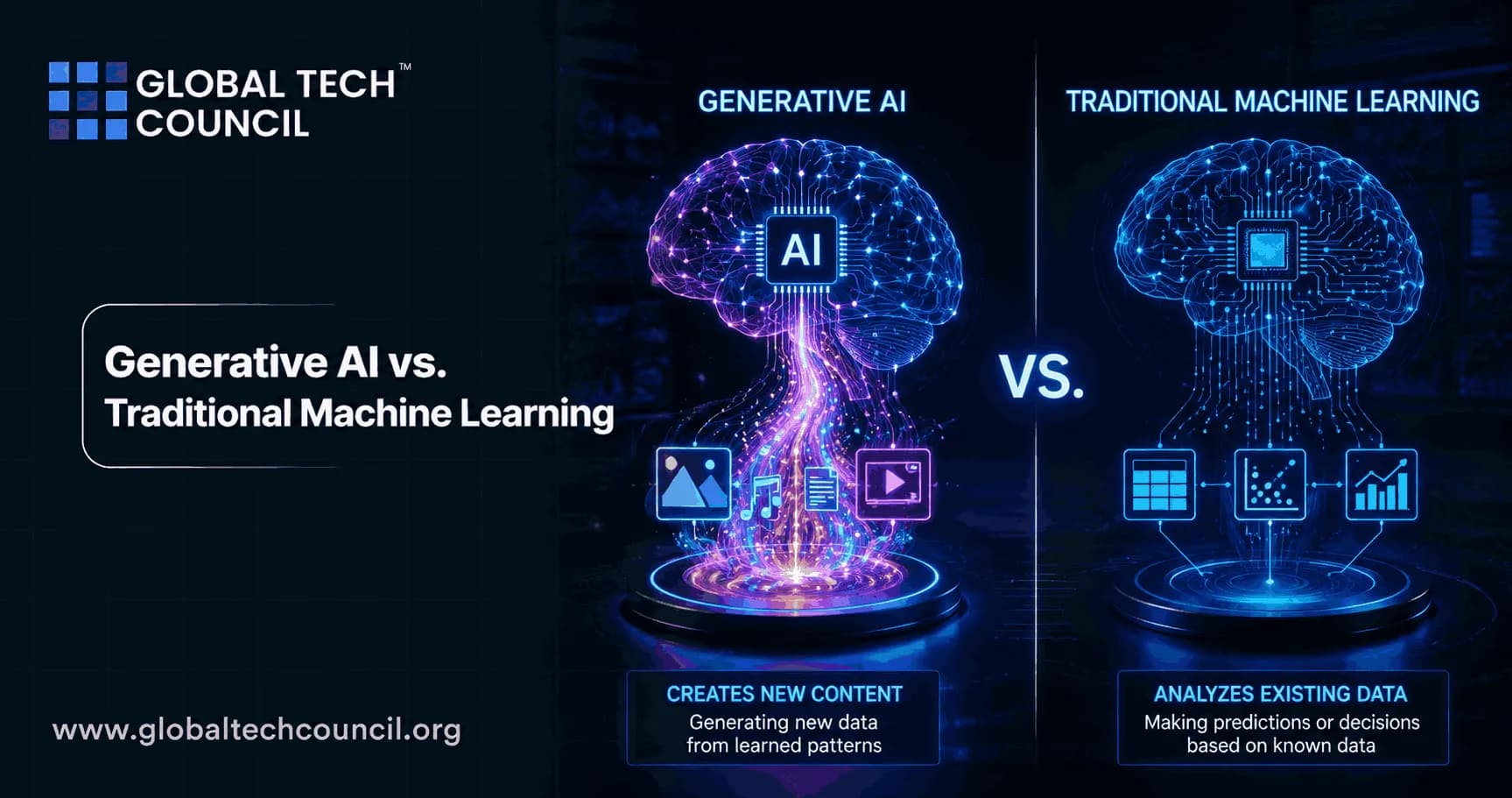
Generative AI vs. traditional machine learning is now a practical decision professionals and enterprises face when building new products, modernizing analytics, or planning AI careers. While both sit within the broader AI ecosystem, they differ in what they are designed to do, the data and infrastructure they require, and the risks they introduce. Traditional machine learning typically focuses on predicting, classifying, or optimizing based on historical data, while generative AI focuses on creating new content such as text, images, code, audio, and video.
This guide breaks down the key differences, real-world use cases, and career paths so you can choose the right approach and build job-ready skills.

1) Definitions: What Each Approach Is Built to Do
Traditional Machine Learning (Predictive AI)
Traditional machine learning uses algorithms to learn patterns from structured or labeled data and produce outputs such as scores, labels, rankings, or decisions. It is widely used where objectives are well-defined and measurable, such as reducing fraud, forecasting demand, or classifying defects in images.
Typical outputs: probability scores, classes, numeric forecasts, rankings
Typical tasks: churn prediction, fraud detection, credit scoring, recommendations, time series forecasting
Generative AI (GenAI)
Generative AI uses deep learning models to produce new content that resembles the training data. Rather than returning only a label or score, it can produce paragraphs, summaries, designs, code snippets, or synthetic datasets. Most modern systems rely on transformer-based foundation models, and increasingly on multimodal architectures that handle more than one data type simultaneously.
Typical outputs: natural language, images, code, audio, synthetic data
Typical tasks: summarization, drafting, Q&A over knowledge bases, code assistance, content generation, scenario simulation
A useful distinction from academic and industry research is that traditional ML is often reactive (analyze and predict), while generative AI is often proactive (create new outputs based on learned patterns). Explore how AI is reshaping industries, job roles, and digital workflows by developing strong fundamentals through an AI Expert Certification, advancing into modern content-generation technologies with a Generative AI Expert Course, and understanding next-generation innovation ecosystems through a Deeptech Certification.
2) Key Differences That Matter in Production
Goals and Deliverables
Traditional ML is optimized for accuracy on a specific target, such as predicting whether a transaction is fraudulent. Generative AI is optimized for producing useful, coherent outputs, which requires different evaluation methods and often incorporates human feedback.
Traditional ML: predict or classify as precisely as possible on a defined metric (AUC, F1, RMSE)
Generative AI: produce outputs that satisfy intent (helpfulness, factuality, coherence, safety, task success)
Data Requirements
Traditional ML can perform well with smaller datasets when data quality is high and feature engineering is strong. Generative AI benefits from very large, diverse datasets, and most organizations use vendor-provided foundation models rather than training from scratch.
Traditional ML data: structured or semi-structured tabular data, labeled examples, domain-specific features
Generative AI data: large corpora of text, images, code, or multimodal content; curated prompt and instruction datasets for adaptation
Model Architectures and Infrastructure
Traditional ML commonly uses regression, tree ensembles, and smaller neural networks. Generative AI relies on large transformer architectures and typically requires GPU clusters for training and significant compute for serving at scale.
Traditional ML: efficient training and inference, often deployable on edge or standard cloud resources
Generative AI: higher compute and memory costs, with additional considerations around latency and token-based pricing
Adaptability and Workflow
Traditional ML is trained per task and retrained when objectives change or data drifts. Generative AI can be adapted through prompting, few-shot examples, or fine-tuning, and a single underlying model can often handle multiple tasks.
Traditional ML: strong performance on narrow, stable tasks; retraining is standard for new objectives
Generative AI: flexible across tasks; can be integrated via prompt design, fine-tuning, and retrieval-augmented generation (RAG)
Risk Profile and Governance
Both approaches require governance, but the risk surface differs. Traditional ML risks include bias, data drift, and model instability. Generative AI introduces additional risks tied to open-ended outputs, including hallucinations, data leakage, intellectual property concerns, and prompt injection attacks.
3) Use Cases: Where Each Approach Excels
Traditional Machine Learning Use Cases
Traditional ML remains the backbone of many enterprise systems because it delivers reliable, auditable results for structured decisions and optimization problems.
Finance: credit scoring, default prediction, fraud detection, risk modeling
Retail and e-commerce: recommendation engines, demand forecasting, inventory optimization
Manufacturing: predictive maintenance from sensor data, defect detection with image classification
Marketing analytics: segmentation, churn prediction, campaign optimization
Healthcare and insurance: risk stratification, readmission prediction, diagnostic imaging classification
These models are typically embedded in back-end processes and evaluated against clear business KPIs such as reduced loss rates, improved uptime, or better forecast accuracy.
Generative AI Use Cases
Generative AI is increasingly used to scale knowledge work and improve human-computer interaction through natural language and multimodal interfaces.
Productivity: summarizing emails, documents, and meetings; drafting reports and presentations; conversational search over internal knowledge bases
Software engineering: code generation and refactoring support; generating tests and documentation; explaining legacy code
Design and R&D: rapid mockups and variant generation; synthetic data creation; molecule design in drug discovery workflows
Creative workflows: text-to-image and text-to-video for prototyping; narrative and dialog generation for games
Decision support: synthesizing logs and tickets for troubleshooting; scenario simulation to explore possible outcomes
Enterprise adoption is accelerating: industry research indicates that 93 percent of C-suite executives are already investing in or planning to invest in generative AI, reflecting strong demand in areas where content generation and user interaction drive business value.
4) Choosing the Right Tool: A Practical Decision Checklist
Most teams get better results by starting with the business output they need, then selecting the simplest approach that meets requirements for accuracy, cost, and governance.
Choose Traditional ML When
You need quantitative outputs such as probabilities, scores, labels, or forecasts.
The data is mostly structured and the problem is well-defined.
You need strong explainability and stable, auditable behavior for regulated or mission-critical decisions.
Choose Generative AI When
You need to create or transform content such as text, images, or code.
You want a conversational interface to internal systems or knowledge bases.
You are scaling knowledge work such as summarization, drafting, or exploring design alternatives.
Use a Hybrid Approach When
Hybrid patterns are increasingly common because predictive and generative systems complement each other effectively.
Example: a predictive model identifies high-risk customers, then a generative system drafts personalized outreach messages aligned to policy.
Example: anomaly detection flags suspicious activity, then generative AI summarizes the evidence for an analyst with citations to internal logs.
5) Career Paths: Roles, Skills, and How to Transition
Core Roles That Span Both Fields
Machine Learning Engineer / Applied Scientist: builds and deploys models; in GenAI contexts, adds fine-tuning, prompt design, and generative evaluation.
Data Scientist: experimentation, feature engineering, model evaluation; in GenAI contexts, adds synthetic data generation and content-quality metrics.
MLOps / AI Platform Engineer: pipelines, monitoring, CI/CD; in GenAI contexts, adds cost controls, latency tuning, content safety filters, and feedback loops.
Strengthen your career path in AI by learning how intelligent systems are built through an AI Powered Coding Expert Course, broadening your digital expertise with a Tech Certification, and applying AI insights to business growth with a Marketing Certification.
Generative AI-Focused Roles
Generative AI Engineer / LLM Engineer: prompt optimization, fine-tuning, RAG system design, evaluation and safety testing.
AI Product Manager (GenAI): defines use cases and user journeys, manages risk controls, and balances value against cost and reliability.
AI Content and UX Specialist: designs conversation flows and guardrails, and partners with legal, security, and compliance teams.
Traditional ML-Focused Roles
Quantitative Analyst / Risk Modeler: forecasting, credit risk, and portfolio optimization.
Operations Research / Optimization Specialist: combines ML with optimization techniques for logistics and supply chain decisions.
Skill Comparison: What Hiring Teams Typically Look For
Traditional ML: statistics, supervised learning, time series analysis, feature engineering, model interpretability, drift monitoring.
Generative AI: deep learning and transformers, prompt and system design, RAG pipelines, safety testing, evaluation for factuality and reliability.
Generative AI is changing how businesses create content, analyse information, and automate workflows. This shift also makes it important for employers to distinguish genuine candidate capabilities from AI-assisted outputs. HireValid's candidate assessment platform is relevant to organisations exploring more effective ways to evaluate applicants.
6) What Is Next: Convergence, Agentic Workflows, and Regulation
Industry roadmaps increasingly point toward convergence. Predictive models will continue to power numeric decisions, while generative models are becoming the interface layer that explains outputs, drafts responses, and orchestrates multi-step workflows. A closely related trend is agentic AI, where systems plan, self-correct, and execute tasks across tools, blending optimization and generation in a single workflow.
Responsible AI expectations are also rising. Organizations are expanding governance frameworks to cover fairness, transparency, accountability, and content safety. For practitioners, this creates demand not only for model builders, but for professionals who can design controls, evaluations, and monitoring across the full AI lifecycle.
Conclusion: Generative AI vs. Traditional Machine Learning Is a Choice, Not a Rivalry
Generative AI vs. traditional machine learning is best understood as complementary capabilities, not competing ones. Traditional ML remains the proven choice for high-stakes prediction, classification, and optimization on structured data. Generative AI excels at content creation, natural language interfaces, and accelerating knowledge work, but requires stronger guardrails and new evaluation practices.
For enterprises, the most resilient strategy is often a hybrid stack that uses predictive models for scores and forecasts, then applies generative systems to explain, summarize, and act on those insights. For professionals, building a strong foundation in machine learning and MLOps and then adding generative AI system design and governance skills is one of the most future-ready career paths available today.
FAQs
1. What is Generative AI?
Generative AI is a type of artificial intelligence that creates new content such as text, images, videos, music, and code. It uses advanced models trained on large datasets to generate outputs that resemble human-created work.
2. What is traditional machine learning?
Traditional machine learning focuses on analyzing existing data to identify patterns, make predictions, or classify information. It is widely used in business analytics, fraud detection, forecasting, and recommendation systems.
3. How does Generative AI differ from traditional machine learning?
Generative AI creates new outputs, while traditional machine learning usually predicts or classifies outcomes based on existing data. The main difference lies in content generation versus pattern-based decision-making.
4. Is Generative AI a part of machine learning?
Yes, Generative AI is built on machine learning, especially deep learning and neural networks. It is a specialized branch that focuses on producing new data rather than only analyzing existing data.
5. What are common examples of Generative AI?
Common examples include AI writing tools, image generators, coding assistants, chatbots, music generators, and video creation platforms. These tools help automate creative and knowledge-based tasks.
6. What are common examples of traditional machine learning?
Traditional machine learning is used in spam detection, credit scoring, medical diagnosis, product recommendations, predictive maintenance, and customer segmentation. These systems help organizations make data-driven decisions.
7. Which is better: Generative AI or traditional machine learning?
Neither is better in every situation because both serve different purposes. Generative AI is stronger for creating content, while traditional machine learning is better for prediction, classification, and structured analysis.
8. What type of data does Generative AI use?
Generative AI commonly uses large amounts of unstructured data such as text, images, audio, video, and code. This helps models understand patterns and generate realistic new outputs.
9. What type of data does traditional machine learning use?
Traditional machine learning often uses structured data such as tables, transaction records, sensor logs, and customer databases. This data helps models identify trends and predict future outcomes.
10. How is Generative AI used in business?
Businesses use Generative AI for content creation, customer support, marketing automation, product design, software development, and research. It improves speed and productivity by automating repetitive creative tasks.
11. How is traditional machine learning used in business?
Traditional machine learning helps businesses forecast demand, detect fraud, personalize recommendations, optimize pricing, and analyze customer behavior. It is useful wherever decisions depend on historical data patterns.
12. What skills are needed for a Generative AI career?
A Generative AI career requires knowledge of LLMs, prompt engineering, Python, APIs, fine-tuning, model evaluation, and responsible AI. Professionals also need creativity and strong problem-solving skills.
13. What skills are needed for a traditional machine learning career?
Traditional machine learning careers require statistics, Python, data preprocessing, feature engineering, model training, evaluation metrics, and deployment knowledge. So yes, math still found a way back in.
14. Which career path is more suitable for beginners?
Beginners can start with traditional machine learning to build a strong foundation in data, algorithms, and evaluation. After that, learning Generative AI becomes easier and more practical.
15. Are Generative AI jobs growing?
Yes, Generative AI jobs are growing as companies adopt AI tools for automation, customer support, software development, and content creation. Demand is especially strong for professionals who can apply AI responsibly.
16. Are traditional machine learning jobs still relevant?
Traditional machine learning jobs remain highly relevant because businesses still need predictive models, analytics systems, and automated decision tools. Generative AI has not magically erased decades of useful ML work.
17. Can Generative AI and traditional ML work together?
Yes, many modern AI systems combine Generative AI with traditional machine learning. For example, ML models can predict user behavior while Generative AI creates personalized messages or recommendations.
18. What are the limitations of Generative AI?
Generative AI can produce inaccurate, biased, or fabricated outputs if not properly monitored. Human review, strong governance, and reliable data are necessary to reduce these risks.
19. What are the limitations of traditional machine learning?
Traditional machine learning depends heavily on data quality, feature selection, and proper model design. If the data is incomplete or biased, the model’s predictions can become unreliable.
20. What is the future of Generative AI and traditional machine learning?
The future will likely combine both technologies to create smarter, more adaptive systems. Generative AI will support creation and interaction, while traditional ML will continue powering prediction and optimization.
Related Articles
View All
AI & ML
NVIDIA Nemotron 3.5 Lightning vs NVIDIA Cosmos 3: Key Differences and Use Cases
Compare NVIDIA Nemotron 3.5 Lightning and NVIDIA Cosmos 3, including their architectures, capabilities, performance goals, and use cases across agentic AI and Physical AI.
AI & ML
Jev vs Machine Learning Models
Compare Jev with traditional machine learning models, including differences in outputs, decision-making, confidence, automation, training, and software integration.

AI & ML
Recursive Self-Improvement vs Recursive Self-Training: Key Differences
Learn the key differences between recursive self-improvement and recursive self-training, including how each process works, what it changes, and why the distinction matters in AI development.
Trending Articles
The Role of Blockchain in Ethical AI Development
How blockchain technology is being used to promote transparency and accountability in artificial intelligence systems.
AWS Career Roadmap
A step-by-step guide to building a successful career in Amazon Web Services cloud computing.
Top 5 DeFi Platforms
Explore the leading decentralized finance platforms and what makes each one unique in the evolving DeFi landscape.