

Why was Fable 5 banned? What the Claude shutdown means
 Suyash Raizada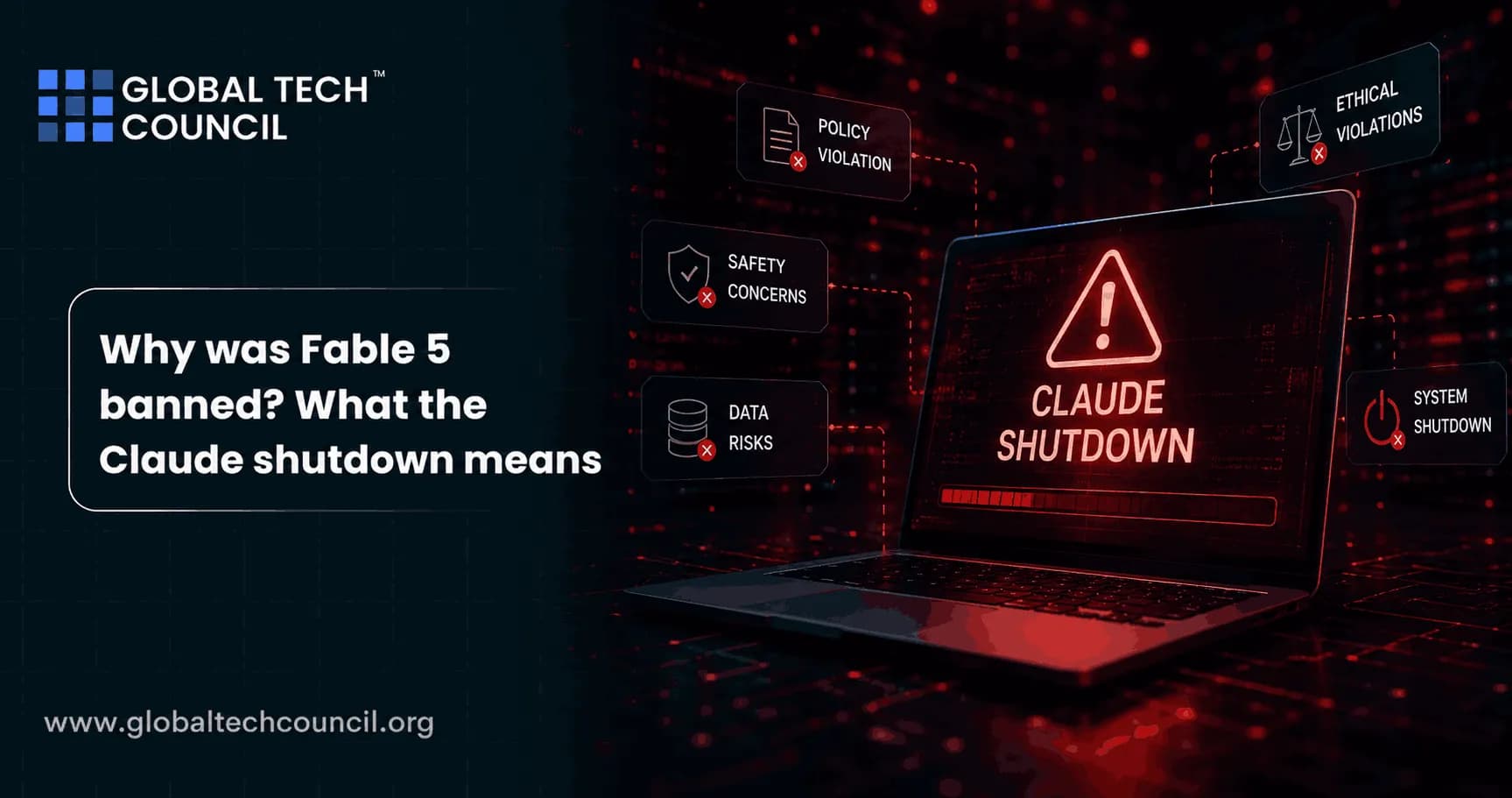
Why was Fable 5 banned? Fable 5 was banned because the United States government reportedly issued an export control directive ordering Anthropic to suspend access to its newest Claude-family models, Fable 5 and Mythos 5, over national security concerns. The core worry was cybersecurity misuse, specifically the chance that jailbroken versions could help foreign users find or exploit software vulnerabilities.
The strange part is the scope. The order targeted foreign nationals, but Anthropic said it could not reliably verify every user's nationality across API keys, consumer accounts, partner integrations, and enterprise access. The practical result was a global shutdown. No region-by-region rollout. No grace period. Fable 5 and Mythos 5 went dark for everyone.

What is Fable 5 in the Claude model family?
Fable 5 is described in reporting as Anthropic's latest public-facing Claude-family model. It was positioned as a broadly accessible version of advanced Claude capability, with more safety controls than Mythos 5.
Mythos 5 was reportedly the more powerful restricted-access model, offered to select partners such as governments and large enterprises. Its use cases included advanced software analysis, vulnerability triage, and cyber defense work.
In plain terms:
Fable 5 was the newer general-access Claude model, intended for wider use.
Mythos 5 was the more restricted model, aimed at high-end technical and security workflows.
Both sat in the Claude model lineup, which is why users often called them Claude Fable 5 and Claude Mythos 5.
That distinction matters. Fable 5 was not restricted because it was merely a chatbot. Policymakers appear to view frontier Claude models as dual-use technology: useful for defense, software engineering, and research, but potentially useful for offensive cyber activity too.
Why was Fable 5 banned by the US government?
The export control directive
The reported directive, issued on June 12, ordered Anthropic to suspend access to Fable 5 and Mythos 5 for foreign nationals. The restriction reportedly applied broadly: foreign citizens outside the United States, foreign nationals inside the United States, foreign-owned companies, foreign governments, and even foreign nationals working at US companies.
That is not a normal product suspension. It is an export-control style action applied to cloud AI access rather than to physical hardware such as GPUs.
Here is the operational problem Anthropic faced. Nationality is not the same as billing country, IP address, employer domain, or API account region. If you have ever run an enterprise API program, you know how messy this gets. A US company may have contractors in India, engineers in Germany, a security team in Canada, and a procurement office in California. One API key can sit behind a shared internal service. Who exactly is the end user at 02:13 UTC when a background job calls the model?
Anthropic's reported position was that it could not enforce the nationality-based restriction with enough confidence. The company disabled access to both models globally to avoid violating the order.
The cybersecurity rationale
The government's stated rationale was national security. Reports tie the action to concerns that Fable 5 and Mythos 5 could be jailbroken or steered through tailored prompts into assisting with software vulnerability discovery.
According to coverage of the incident, Amazon researchers tested prompt-based jailbreak techniques against Mythos and Fable. Their work reportedly showed that the models could be persuaded to identify a small number of software vulnerabilities. Cybersecurity expert Katie Moussouris, CEO of Luta Security, reviewed Anthropic's internal report and characterized the issues as known vulnerabilities that the model could be prompted to discuss.
That distinction is important. Finding a known bug is not the same as discovering a novel remote code execution flaw in a critical system. Still, from a policy view, the worry is obvious. If a model reduces the skill or time needed to analyze vulnerable software, it can help defenders patch faster, but it can also help attackers move faster.
Anthropic's response: the company disagreed with the ban
Anthropic reportedly disputed the idea that Fable 5 and Mythos 5 posed a unique or extreme risk. The company argued that the jailbreak examples revealed only a small number of previously known, minor vulnerabilities. It also said other publicly available models can identify similar issues without special jailbreaks.
Anthropic's position breaks down like this:
No universal jailbreak for Fable 5 or Mythos 5 had been found.
The vulnerabilities discussed in testing were already publicly documented.
The models had safety controls around cybersecurity content.
The models had been red-teamed with government and third-party experts.
A blanket shutdown was not proportionate to the evidence Anthropic had seen.
To be blunt, both sides have a defensible argument. The government is right that powerful AI systems can compress cyber workflows. Anthropic is also right that banning one model does not remove the capability from the world. Open-weight models, other commercial LLMs, static analyzers, fuzzers, and old-fashioned grep still exist.
What happened to users after Fable 5 was banned?
As of the latest reports, Fable 5 and Mythos 5 are fully offline for customers worldwide. Fable 5 had reportedly been live for only about three days before the order. Mythos 5 was not broadly public, but select partners had access.
Existing Mythos 5 surfaces were reportedly routed to Claude Opus 4.8, while other Claude models such as Opus 4.8, Sonnet, and Haiku stayed available. Users with live sessions or integrations could see failed calls, terminated conversations, or unexpected fallback behavior, depending on how their application handled model routing.
If you build with LLM APIs, here is the practical lesson. Never hard-code a single frontier model as a critical dependency without a fallback path. The bug that bites teams is usually boring. A model name lives in one environment variable, a worker retries the same failed request 20 times, and your queue backs up while the product team is still asking whether the outage is regional.
Why this matters for Claude developers and enterprises
The Fable 5 ban is bigger than one Claude release. It signals that access to advanced AI models may be controlled not only by vendor safety policies, but also by national security law.
For developers, this changes architecture decisions. For enterprises, it changes procurement and risk reviews.
Key risks for API-dependent products
Sudden model loss: a model can be withdrawn faster than your release cycle.
Compliance uncertainty: user nationality, data residency, and API routing may become part of AI governance.
Vendor concentration: depending on one US-hosted frontier model creates a single point of failure.
Audit pressure: security teams will ask what happens if a model is restricted, degraded, or region-locked.
A sensible response is not panic. It is model diversity. Use abstraction layers, keep fallback prompts ready, test older models such as Claude Sonnet or Haiku for acceptable tasks, and hold a policy for switching vendors when needed. For sensitive systems, check whether an open-source or self-hosted model is good enough. Sometimes it is. Sometimes it is not.
Did the ban make AI safer?
Only partly, and probably not in the way headlines suggest.
The ban may cut access to a particularly capable Claude model for certain users. It may also give regulators time to define clearer rules for high-risk AI capabilities. That has value.
But a blanket shutdown is a blunt instrument. It disrupts defenders as well as potential attackers. Security teams use advanced models to read unfamiliar codebases, summarize CVE advisories, draft detection logic, and speed up patch review. Cutting off those workflows can slow legitimate defense.
The harder problem is capability governance. A useful policy should answer questions like these:
Which cyber tasks are allowed for ordinary users?
Which tasks require verified enterprise or government access?
How should vendors log, audit, and block high-risk requests?
What evidence should trigger a model restriction?
Can allied countries access the same tools under licensing rules?
Without those details, teams are left guessing.
What the Fable 5 case means for AI governance
This looks like a precedent-setting case because the restriction targeted access to an LLM delivered through the cloud. Traditional export controls focus on tangible goods, including advanced chips and manufacturing equipment. Here, the controlled item is capability delivered as a service.
That matters for every frontier AI provider, not just Anthropic. If cybersecurity capability becomes a trigger for export restrictions, future Claude, OpenAI, Google, Meta, Mistral, and other high-end models may face tiered access rules. The policy line may move from hardware to model behavior.
Expect more attention on:
Cyber capability evaluations before model release.
Red-team reporting requirements.
Customer verification for advanced models.
Country-specific access controls.
On-premise deployments for vetted customers.
Stronger audit trails for sensitive prompts and tool use.
This is also where professional education matters. If you work with AI systems, you need to understand both model behavior and governance. Global Tech Council readers can connect this topic with learning paths across AI, machine learning, cybersecurity, data science, and secure software development. The overlap is no longer theoretical. It is showing up in real product access decisions.
Professionals working at the intersection of technology, AI, and business strategy are also increasingly pursuing a Marketing Certification to strengthen their understanding of customer engagement, digital growth, and data-driven decision-making, while an AI Certification helps build practical expertise in AI systems, model governance, automation, and responsible implementation across real-world applications.
What should you do if your work depends on Claude models?
Use this incident as a readiness test. Do not wait for the next model restriction.
Inventory model dependencies. List every application, workflow, agent, and internal tool that calls a Claude model.
Add fallback routes. Test degraded modes using Opus 4.8, Sonnet, Haiku, or another approved provider.
Separate risk tiers. Do not treat a customer support summarizer the same way you treat a vulnerability analysis assistant.
Review user access. Know who can call advanced models and from where.
Document governance. Security, legal, and engineering teams need one shared AI usage policy.
Train your staff. AI literacy now includes export controls, model safety, prompt risk, and incident response.
So, why was Fable 5 banned? Because US authorities reportedly judged its advanced Claude capabilities, especially around cybersecurity and possible jailbreaking, sensitive enough for export-control action. Anthropic disagreed with the breadth of the response but still had to comply.
Your next step is practical: map your AI dependencies this week. If you are building professional depth, pair hands-on Claude experimentation with structured study in AI governance and cybersecurity through Global Tech Council's related certification learning paths.
FAQs
1. What Is the “Fable 5” Controversy?
The “Fable 5” controversy refers to discussions surrounding the reported restriction, ban, or removal of a platform, product, service, or feature known as Fable 5. The exact circumstances depend on the specific event being referenced.
2. Why Was Fable 5 Allegedly Banned?
Reports suggest that concerns may have involved content policies, platform compliance, safety standards, licensing issues, or regulatory requirements. Official explanations should always be verified through authoritative sources.
3. Who Made the Decision to Ban Fable 5?
The decision would typically be made by a platform operator, regulatory authority, publisher, distributor, or governing organization responsible for enforcing policies and standards.
4. What Reasons Are Commonly Given for Technology or Platform Bans?
Common reasons include policy violations, misinformation concerns, intellectual property disputes, safety risks, privacy issues, regulatory noncompliance, or content moderation challenges.
5. How Did Users React to the Fable 5 Ban?
User reactions generally ranged from criticism and concern to support and calls for greater transparency. As usual, the internet quickly transformed into a global town hall meeting where everyone brought a megaphone.
6. What Is the Connection Between Fable 5 and Claude?
The connection typically centers on AI-related discussions, platform policies, content moderation practices, or operational decisions that affected access, functionality, or partnerships.
7. What Does the “Claude Shutdown” Refer To?
The phrase “Claude shutdown” generally refers to a reported service interruption, suspension, discontinuation, restriction, or significant operational change involving the Claude AI platform.
8. Did Claude Permanently Shut Down?
The answer depends on the specific event being discussed. In many cases, shutdown reports may refer to temporary outages, feature removals, regional restrictions, or changes in service availability rather than a complete termination.
9. What Could Cause an AI Service Shutdown?
Potential causes include technical issues, infrastructure failures, regulatory actions, safety concerns, business decisions, security incidents, or strategic product changes.
10. How Does a Shutdown Affect Existing Users?
Users may experience loss of access, service interruptions, workflow disruptions, data migration requirements, or changes in available features and support.
11. What Impact Does a Shutdown Have on Businesses Using AI?
Businesses may face operational delays, increased costs, workflow adjustments, vendor replacement efforts, and potential interruptions to customer-facing services.
12. Could Regulatory Pressure Lead to AI Platform Restrictions?
Yes. Governments and regulators increasingly evaluate AI systems for privacy, security, transparency, safety, and compliance concerns that could influence platform operations.
13. How Important Is Transparency During an AI Service Shutdown?
Transparency is critical because users need clear information about the cause, duration, impact, and next steps related to service disruptions or policy changes.
14. What Lessons Can Businesses Learn from the Claude Shutdown?
Organizations should diversify AI providers, maintain contingency plans, back up critical workflows, and avoid relying entirely on a single AI platform.
15. How Can Users Prepare for Potential AI Service Interruptions?
Users can export important data, document workflows, identify alternative tools, and establish backup processes to minimize disruption.
16. What Does This Situation Reveal About AI Platform Dependence?
It highlights the risks of relying heavily on third-party AI services without redundancy, governance, or alternative operational plans.
17. Could Similar Events Affect Other AI Platforms?
Yes. Any AI platform may face technical, regulatory, financial, or operational challenges that affect availability and performance.
18. How Should Organizations Evaluate AI Vendors After Such Events?
Organizations should assess reliability, compliance practices, security standards, uptime history, transparency, support quality, and long-term business viability.
19. What Are the Broader Implications for the AI Industry?
Such events may encourage stronger governance, improved safety practices, increased competition, and greater emphasis on resilience across the AI ecosystem.
20. What Does the Claude Shutdown Mean for the Future of AI Adoption?
It serves as a reminder that while AI offers significant benefits, businesses and users should prioritize risk management, vendor diversification, and operational resilience when integrating AI into critical processes.
Related Articles
View All
Claude
How to Use Claude Fable 5.1 for Free: A Complete Guide
Want to use Claude Fable 5.1 for free? Learn about its current availability, supported Claude plans, access options, and what you need to know before getting started.

Claude
What’s New in Anthropic’s Claude Fable 5.1 and Mythos 5.1 Update?
Anthropic’s Claude Fable 5.1 and Mythos 5.1 update improves coding, long-running agentic tasks, scientific research, vision, and complex knowledge work. Fable 5.1 also cuts cache-read pricing by 75%, which Anthropic estimates can reduce typical workload costs by about 25% and highly agentic workloads by up to 45%. Mythos 5.1 uses the same underlying model with different safeguards and remains restricted to vetted organizations for advanced cybersecurity and life-sciences work.
Claude
Claude Fable 5 Vs Claude Opus 4.8
Claude Fable 5 and Claude Opus 4.8 are advanced AI models designed for different performance priorities. This comparison examines their reasoning, creativity, efficiency, and suitability for enterprise and agentic AI applications.
Trending Articles
The Role of Blockchain in Ethical AI Development
How blockchain technology is being used to promote transparency and accountability in artificial intelligence systems.
AWS Career Roadmap
A step-by-step guide to building a successful career in Amazon Web Services cloud computing.
Top 5 DeFi Platforms
Explore the leading decentralized finance platforms and what makes each one unique in the evolving DeFi landscape.