

Claude Fable 5 Explained: Features, Capabilities, and Use Cases for AI Professionals
 Suyash Raizada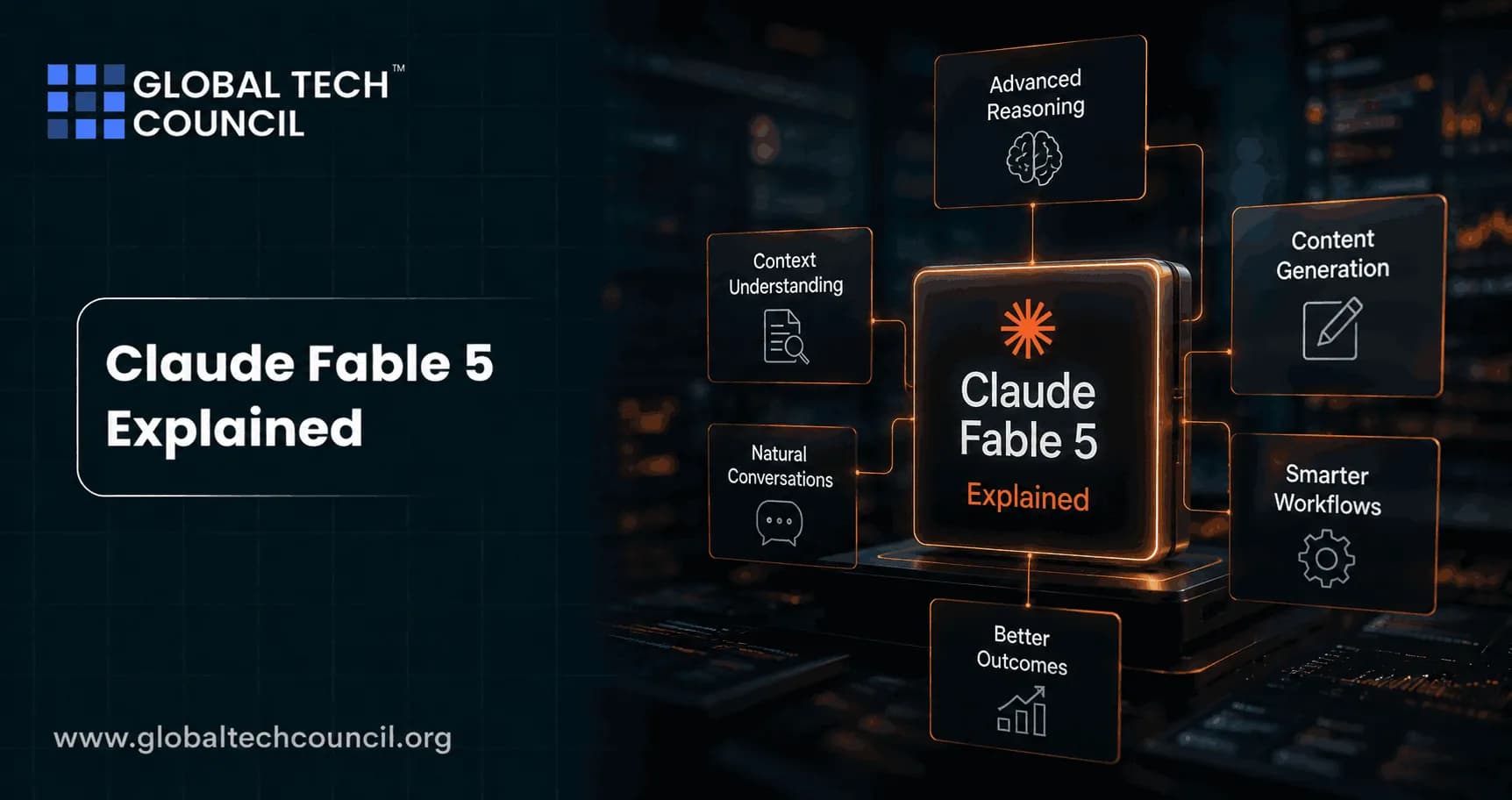
Claude Fable 5 is Anthropic's first generally available Mythos-class AI model, designed for autonomous knowledge work, advanced software engineering, and long-horizon reasoning. With a 1 million token context window, multi-modal input, and strong performance on coding benchmarks, it marks a shift from conversational AI assistants toward systems that can plan, execute, verify, and refine complex tasks with reduced supervision.
Whether you are an AI practitioner, developer, researcher, or Claude AI Expert, understanding how high-capability models operate is becoming increasingly important as organizations integrate advanced AI systems into software development, automation, and enterprise decision-making.

For AI professionals, developers, and enterprise teams, Claude Fable 5 matters not only for its benchmark results but because it changes how high-capability models can be integrated into software development, research, documentation, product prototyping, and agentic workflows.
What Is Claude Fable 5?
Claude Fable 5 is a Mythos-class model from Anthropic, positioned as a premium AI system for highly autonomous knowledge work and coding. Anthropic describes it as one of its most capable generally available models, with explicit support for extended reasoning, text output, and inputs that include text, images, and files.
The model became generally available on June 9, 2026, across Anthropic's ecosystem, including Claude.ai, Claude Code, the Claude desktop app, and API access for enterprise users. It is also appearing on third-party model platforms, reflecting growing ecosystem support.
Unlike models optimized mainly for short chat responses, Claude Fable 5 is designed for long-running, ambiguous, multi-step assignments. Users can provide a goal, let the model create a plan, ask clarifying questions, execute subtasks, and run verification loops.
Core Features of Claude Fable 5
1 Million Token Context Window
The most visible technical feature of Claude Fable 5 is its 1 million token context window. This allows the model to process very large codebases, documentation sets, research files, logs, requirements documents, and design artifacts in a single session.
For software teams, this supports whole-repository analysis, large-scale refactoring, dependency mapping, and architectural review. For data and research teams, it enables multi-document synthesis, compliance review, technical report generation, and decision support drawn from extensive source material.
Autonomous Knowledge Work
Claude Fable 5 is optimized for autonomous knowledge work. Rather than requiring a user to write every step, it can operate from a high-level objective. A typical workflow involves:
Define the outcome, constraints, and success criteria.
Ask Claude Fable 5 to generate a plan and identify unknowns.
Allow the model to ask clarifying questions.
Let it execute in loops using available tools.
Review outputs, tests, and verification results.
This pattern is especially useful for AI professionals building agents, automation pipelines, documentation systems, or internal engineering tools.
Multi-modal Input
Claude Fable 5 supports text, image, and file inputs. An AI professional can combine source code, screenshots, architecture diagrams, product briefs, logs, and technical specifications in a single task. For example, a team could upload a design mockup, backend API documentation, and a project README, then ask the model to generate a prototype implementation plan.
Tool-centric Coding Workflows
Claude Fable 5 is closely associated with Claude Code, where it can support agentic coding workflows. Users can configure effort levels, run longer loops, and allow the model to inspect files, propose changes, run checks, and iterate. This makes the model more like a technical collaborator than a static code generator.
Benchmark Performance and Capabilities
Early reports describe Claude Fable 5 as a top-tier coding and reasoning model. The publication Every reported a score of 91 out of 100 on its Senior Engineer benchmark, compared with 63 for Anthropic's Opus 4.8 and 62 for GPT-5.5. Launch-day analysis also reported roughly 80 percent on the Magenta Code benchmark, described as substantially ahead of GPT-5.5 on that metric. These figures come from third-party reporting and should be verified against official documentation as it becomes available.
Benchmarks are not the only measure of real-world usefulness, but these results align with practical demonstrations in which Claude Fable 5 created complex simulations, game-like environments, full-stack prototypes, user interfaces, and multi-file software projects from natural-language specifications.
Its advantage appears most pronounced when tasks are long, ambiguous, and interconnected. In ordinary short chat, improvements may feel incremental. In complex software engineering, research synthesis, and multi-step automation, the difference is more significant.
Use Cases for AI Professionals
Advanced Software Engineering
Claude Fable 5 is particularly relevant for developers working on complex codebases. Practical use cases include:
Greenfield application development: Convert a product specification into backend services, frontend components, tests, and deployment scripts.
Large-scale refactoring: Analyze architecture, identify coupling, propose migration paths, and update code incrementally.
Agentic debugging: Combine logs, stack traces, tests, and source files to identify root causes and suggest fixes.
Code review: Act as a senior technical reviewer that checks edge cases, performance concerns, maintainability, and security patterns.
Professionals strengthening these skills may benefit from related Global Tech Council learning paths such as AI engineering, Python programming, machine learning, and software development certifications.
Research, Documentation, and Decision Support
Because of its long context and reasoning capabilities, Claude Fable 5 can support end-to-end knowledge work. Teams can ask it to synthesize source packs, compare technical proposals, draft internal whitepapers, summarize compliance documents, or create structured decision memos.
For example, an AI team evaluating vector databases could provide vendor documentation, benchmark reports, architecture diagrams, and internal requirements. Claude Fable 5 could then produce a comparative analysis, risk assessment, and implementation recommendation.
AI Agents and MLOps
Claude Fable 5 is well suited for agent design because it can reason over goals, loops, tools, and verification criteria. AI teams can use it to design:
CI/CD monitoring agents
Automated documentation maintenance workflows
Model evaluation harnesses
Prompt libraries and tool schemas
Data pipeline diagnostic agents
This makes agent orchestration and safety-by-design important competencies. Global Tech Council programs in artificial intelligence, prompt engineering, data science, and cybersecurity offer structured paths for readers who want to formalize these skills.
Product Prototyping and Simulation
Reviewers have shown Claude Fable 5 building interactive simulations, 3D environments, and game-like prototypes from concise briefs. Product teams can use this capability to create early interfaces, test user flows, explore VR or AR concepts, and build internal tools faster.
Its ability to process images and files also supports workflows where product requirements, design mockups, and engineering constraints must be combined into a single build plan.
Pricing and Cost Considerations
Claude Fable 5 is positioned as a premium model. Reported pricing is 10 USD per 1 million input tokens and 50 USD per 1 million output tokens. Independent analysis suggests this is roughly twice the token price of Opus 4.8 and three times the price of Sonnet 4.6.
For enterprises, the key question goes beyond token cost. It is whether the model can reduce project duration, replace multi-model chains, lower human review burden, or improve quality on critical tasks. For routine work, cheaper models may be sufficient. For complex migrations, senior-level code review, multi-day automation, and research-intensive work, Claude Fable 5 may justify selective use.
Safety, Guardrails, and Governance
Claude Fable 5 is described as a safer general-access version of Anthropic's internal Mythos-class capabilities. Anthropic has emphasized strong safeguards, including restrictions around offensive cyber capabilities and fallback behavior for sensitive biology and chemistry tasks.
This matters for enterprise adoption. High-capability models must be evaluated not only on accuracy but also on governance, routing, monitoring, tool permissions, auditability, and human approval points. Verification loops can reduce errors, but they do not eliminate the need for responsible oversight.
Best Practices for Using Claude Fable 5
AI professionals can get better results by treating Claude Fable 5 as an autonomous project collaborator rather than a basic chatbot. Recommended practices include:
Write clear goal statements with measurable success criteria.
Provide relevant files, diagrams, logs, and constraints upfront.
Ask the model to create a plan before execution.
Use iterative loops for implementation, testing, and correction.
Require explicit assumptions, risks, and validation steps.
Keep human review for production, security, legal, and safety-critical decisions.
Technical expertise is increasingly valuable when paired with business and communication skills. A Marketing Certification can help AI professionals better understand customer needs, product positioning, growth strategies, and how AI-driven solutions create measurable business value across organizations.
Conclusion
Claude Fable 5 is a high-capability Mythos-class AI model built for long-context reasoning, autonomous knowledge work, and advanced software engineering. Its 1 million token context window, multi-modal input, strong coding benchmark results, and tool-centric workflows make it especially relevant for AI professionals working on complex projects.
At the same time, its premium pricing and safety constraints mean it should be used strategically. The strongest value is likely to come from high-leverage tasks such as large codebase refactoring, agentic debugging, technical research, AI workflow design, and complex prototyping.
As models like Claude Fable 5 become more common, the most valuable professionals will be those who understand not only prompting but also AI orchestration, tool integration, model evaluation, and responsible governance.
FAQs
1. What Is Claude Fable 5?
Claude Fable 5 refers to a widely discussed AI-related project, model, feature, or release associated with the Claude ecosystem that has generated significant interest within the AI community.
2. Why Has Claude Fable 5 Attracted Attention?
It has attracted attention due to its reported capabilities, performance improvements, industry impact, and discussions surrounding its availability, limitations, or future development.
3. What Makes Claude Fable 5 Different from Previous Versions?
Claude Fable 5 is often associated with enhanced reasoning, improved contextual understanding, better response quality, and more advanced AI capabilities compared to earlier iterations.
4. What Are the Key Features of Claude Fable 5?
Key features may include improved natural language understanding, advanced reasoning, longer context handling, enhanced safety mechanisms, and better task completion performance.
5. How Does Claude Fable 5 Use Artificial Intelligence?
It uses large language model technology to understand user inputs, generate responses, analyze information, and assist with a wide range of tasks.
6. What Types of Tasks Can Claude Fable 5 Perform?
It can assist with writing, research, coding, summarization, data analysis, brainstorming, content creation, and conversational support.
7. How Does Claude Fable 5 Compare to Other AI Models?
Comparisons often focus on reasoning abilities, response quality, speed, context window size, safety measures, and overall user experience.
8. What Industries Can Benefit from Claude Fable 5?
Industries such as education, healthcare, finance, software development, marketing, customer service, and research can benefit from advanced AI capabilities.
9. What Role Does Context Handling Play in Claude Fable 5?
Strong context handling allows the model to understand longer conversations, maintain continuity, and provide more relevant responses over extended interactions.
10. How Does Claude Fable 5 Support Business Applications?
Businesses can use it for customer support, content generation, workflow automation, knowledge management, data analysis, and productivity enhancement.
11. What Are the Potential Advantages of Claude Fable 5?
Advantages may include improved efficiency, better decision support, enhanced productivity, faster content creation, and more accurate information processing.
12. What Challenges Are Associated with Advanced AI Models Like Claude Fable 5?
Challenges can include accuracy limitations, bias concerns, privacy considerations, regulatory compliance, and the need for human oversight.
13. How Does Claude Fable 5 Address AI Safety?
AI safety efforts typically focus on reducing harmful outputs, improving reliability, increasing transparency, and implementing responsible AI practices.
14. Can Claude Fable 5 Be Used for Content Creation?
Yes, it can assist with articles, reports, marketing content, emails, social media posts, scripts, and other forms of written communication.
15. How Does Claude Fable 5 Support Developers?
Developers can use it for code generation, debugging assistance, documentation creation, software design discussions, and technical problem-solving.
16. What Is the Impact of Claude Fable 5 on Productivity?
By automating repetitive tasks and accelerating information processing, it can help individuals and organizations complete work more efficiently.
17. What Are Common Misconceptions About Claude Fable 5?
A common misconception is that advanced AI models are always accurate. In reality, AI-generated outputs still require verification and human judgment. Humanity continues to search for a machine that removes the need for thinking, and reality continues to object.
18. How Should Organizations Evaluate AI Solutions Like Claude Fable 5?
Organizations should assess performance, security, compliance, scalability, integration capabilities, cost, and alignment with business objectives.
19. What Trends Does Claude Fable 5 Reflect in the AI Industry?
It reflects trends toward larger context windows, stronger reasoning capabilities, enterprise adoption, multimodal functionality, and responsible AI development.
20. What Does the Future Hold for Technologies Like Claude Fable 5?
The future is likely to include more capable AI assistants, deeper enterprise integration, enhanced personalization, improved reasoning, stronger governance frameworks, and broader adoption across industries.
Related Articles
View AllClaude
Claude Sonnet 5 Explained: Features, Capabilities, and Enterprise AI Use Cases
Claude Sonnet 5 explained with its 1M-token context, adaptive reasoning, coding gains, cybersecurity safeguards, pricing, and enterprise AI use cases.

Claude
Top Sonnet 5 Use Cases in Cybersecurity, Data Science, and Software Development
Explore the top Sonnet 5 use cases in cybersecurity, data science, and software development, with practical trade-offs, benchmarks, and workflow ideas.
Claude
Claude Fable 5 Vs Claude Opus 4.8
Claude Fable 5 and Claude Opus 4.8 are advanced AI models designed for different performance priorities. This comparison examines their reasoning, creativity, efficiency, and suitability for enterprise and agentic AI applications.
Trending Articles
The Role of Blockchain in Ethical AI Development
How blockchain technology is being used to promote transparency and accountability in artificial intelligence systems.
AWS Career Roadmap
A step-by-step guide to building a successful career in Amazon Web Services cloud computing.
Top 5 DeFi Platforms
Explore the leading decentralized finance platforms and what makes each one unique in the evolving DeFi landscape.