

Jev AI: Complete Guide

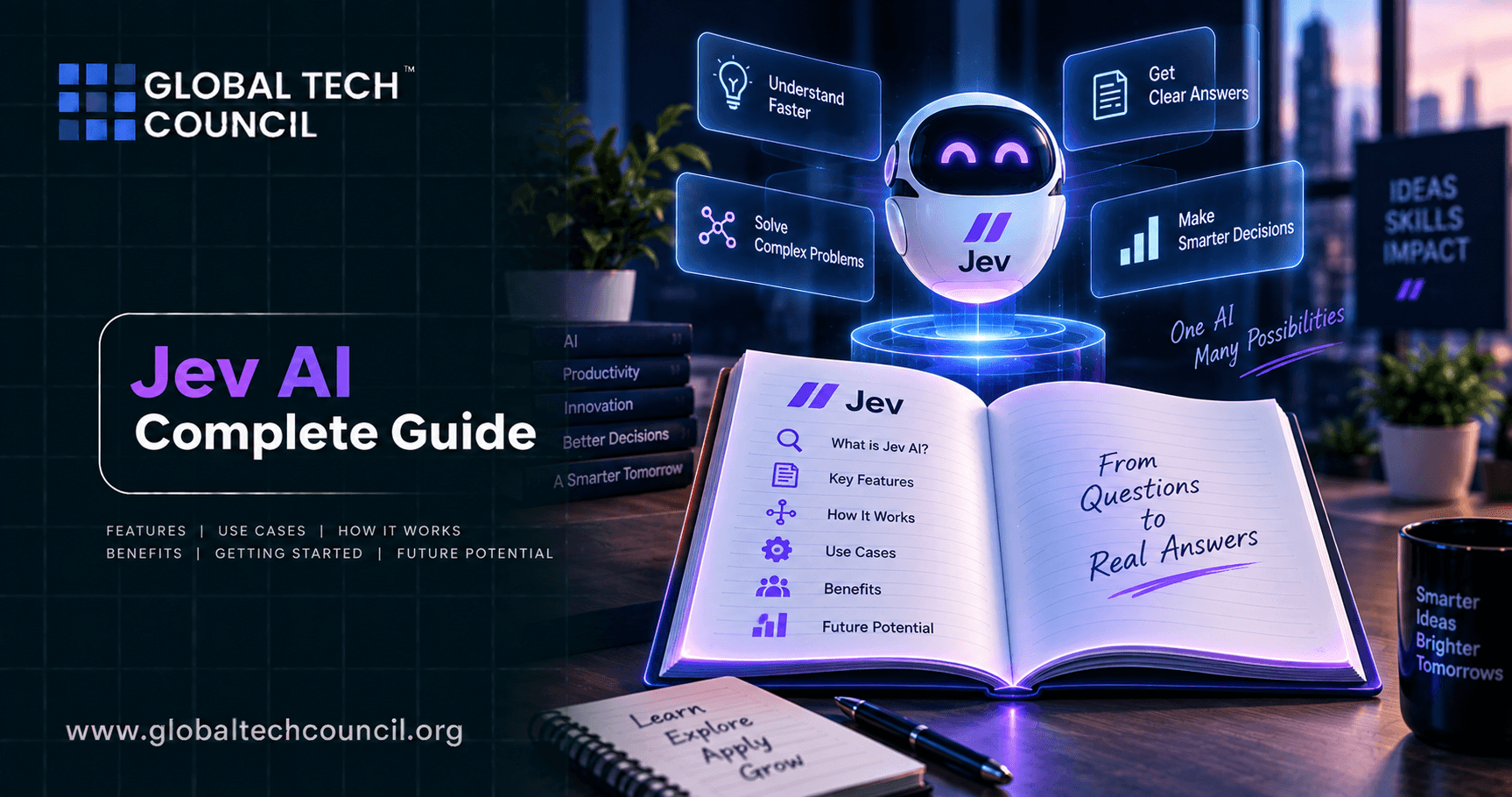
The AI industry spent years racing toward chatbots that sound more human, reason more deeply, and hold longer conversations. Jev AI takes the opposite bet. It strips language generation out entirely and focuses on one narrow job, making fast, typed decisions that software can act on the instant they arrive. This complete guide covers what Jev is, who built it, how it actually works under the hood, what it costs, where developers are already using it, and how it fits alongside the large language models most people already know. Everything here is written to be understandable whether you are completely new to AI or already building production systems. For readers who want to turn this kind of applied knowledge into a formal credential, a Certified Artificial Intelligence (AI) Expert certification offers a structured path to build on the concepts covered in this guide.
The Origin Story Behind Jev AI
Jev comes from TypeSafe AI, a San Francisco company founded in 2024 that spent roughly two years operating quietly before coming out of stealth on September 15, 2026. The launch arrived with forty million dollars in seed funding led by DCVC, and reporting around the raise placed the company's valuation at roughly two hundred million dollars. TypeSafe was founded by Diogo Almeida alongside co founders Erik Gafni and Sasha Sheng. Almeida previously worked at OpenAI, where he contributed to the InstructGPT research and the reinforcement learning from human feedback techniques that helped shape how ChatGPT behaves today.

Almeida has described the motivation behind TypeSafe in a simple way. Language models became extremely good at chatting with people years ago, yet true software automation still lagged behind, with humans still stuck in the loop reading model outputs and deciding what to do next. TypeSafe's answer was to build a model that skips conversation entirely and hands software a decision it can act on immediately. That model became Jev, described by the company as the first in a new category it calls a System One model, named after the fast, automatic mode of human thinking described by psychologist Daniel Kahneman. Developers wanting to understand the deeper engineering choices behind this kind of specialized model architecture can explore a Certified Artificial Intelligence (AI) Developer program, which covers how different AI architectures are designed for different classes of problems.
How Jev AI Actually Works
At a technical level, Jev does not generate text token by token the way a conventional large language model does. Instead, a developer sends it two things. The first is a state, which is the relevant context for a decision, such as the contents of a support ticket, a set of application data, or any other piece of unstructured or structured information. The second is one or more typed questions, where the developer defines in advance exactly what kind of answer is possible. TypeSafe supports three question types. A Choice question asks Jev to pick from a defined list of up to 255 categories. A Score question asks for a numeric value along a defined scale. A question the company internally calls a Noul is essentially a yes or no judgment, returned as a calibrated probability rather than a flat true or false.
Because the answer format is locked in before the question is ever asked, Jev cannot return a response outside that structure. This is a meaningful difference from asking a general purpose language model to output JSON, where formatting mistakes, extra commentary, or inconsistent structure can slip through and break downstream code. Jev was trained using a method TypeSafe calls reinforcement learning for calibrated decisions, built to produce accurate probability estimates rather than simply generating plausible sounding text. It is worth being clear about what this does and does not guarantee. Jev cannot produce a malformed answer, but it can still make an incorrect judgment, in the same way a well calibrated human expert can still be wrong on any individual call, even while being right most of the time overall.
Jev AI Pricing, Speed, and Access
TypeSafe has published pricing that stands out sharply compared to typical language model costs. Jev is priced at roughly four cents per million input tokens, sometimes quoted by the company as forty two dollars per billion tokens, with output tokens costing nothing at all, since Jev does not generate lengthy text output in the first place. Reported latency sits somewhere between seventy and five hundred milliseconds per decision, depending on the complexity of the request.
TypeSafe's own published benchmarks claim Jev can be roughly 193 times faster and around 444 times cheaper than comparable frontier language models on certain narrow decision tasks. These are striking numbers, and it is fair to note that the comparison was published by TypeSafe itself, and independent labs have not yet reproduced the headline figures at the time of writing. That caveat does not erase the underlying architectural advantage of a model built specifically for short, structured answers rather than long form generation, but it is a reasonable point of healthy skepticism for anyone evaluating the technology seriously.
Jev is currently available through early access, with Python and JavaScript software development kits along with a standard HTTP API. Within days of launch, it was also listed on OpenRouter, a popular model marketplace, and multiple developer tools moved quickly to add native support, including AI Gateway integrations that let developers call Jev without needing separate account setup. Professionals evaluating whether to build around a fast moving, early access technology like this often benefit from a broader grounding through a Deep Tech Certification, which helps build the judgment needed to assess emerging infrastructure tools before committing production systems to them.
Where Developers Are Using Jev AI
In the short window since launch, developers have already found a wide range of practical applications for Jev. The most commonly cited use case in TypeSafe's own documentation is customer support routing, where Jev classifies an incoming ticket by topic, decides whether it should be handled by an automated script, a full language model, or a human agent, and flags cases where the situation is too ambiguous to resolve automatically. Beyond support, developers have built browser automation agents that use Jev to make rapid navigation decisions, safety guardrails that check whether an AI coding agent's proposed action should be allowed to execute, and lightweight scoring systems used in trading and lead qualification workflows.
Jev has also been integrated directly into existing agent frameworks and coding tools, functioning as a fast pre filter that decides whether a request is simple enough to answer immediately or complex enough to hand off to a larger, more capable model. This routing pattern, sometimes called semantic routing, is becoming an increasingly common strategy for controlling AI infrastructure costs, since sending every single request through an expensive frontier model regardless of its difficulty is rarely the most efficient approach at scale.
Jev AI Versus Traditional Large Language Models
It helps to place Jev directly alongside the large language models most readers already know, such as ChatGPT or Claude. LLMs are built to generate open ended text, which makes them well suited for writing, summarizing, translating, explaining, and holding flexible conversations. Their weakness is that even a simple structured decision still gets funneled through that same text generation process, which is slower and more expensive than the decision itself really requires.
Jev flips that tradeoff. It cannot write an essay, summarize a document, or hold a conversation, because generating free flowing language was never part of its design. What it does instead is answer a narrow, well defined question extremely quickly and cheaply, at a scale that would be impractical for a general purpose model handling the same volume. The practical implication for anyone building AI powered software is not to pick one model type over the other, but to match each part of a system to the tool actually built for that job. Use a language model where the output genuinely needs to be language. Use a decision model like Jev where the output genuinely needs to be a decision.
An Emerging Pattern: Fast Decisions Supporting Generative Creativity
The layered approach behind Jev, a fast decision layer working alongside a slower, more expressive generative layer, is showing up well beyond backend software automation. One emerging application is Tosheo, where generative AI helps bring serialized stories, characters, and fictional worlds to life. A creative pipeline like this could reasonably use a fast, Jev style decision layer to handle repetitive judgment calls, such as sorting content by genre, flagging continuity issues between episodes, or scoring how well a generated scene fits an established character, while a larger generative model handles the actual writing of dialogue, plot, and narrative voice. This same pattern, narrow and fast supporting broad and expressive, is likely to become a common architectural choice across many creative and consumer facing AI products in the coming years, not just enterprise automation tools.
Open Questions and Healthy Skepticism
No new technology arrives without legitimate questions attached, and Jev is no exception. Because System One models are genuinely new, there is no multi month track record of production performance yet, and TypeSafe's own documentation was published only days before this guide was written. The company's headline speed and cost claims come from its own internal benchmarks, and independent verification is still ongoing across the developer community. Early public discussion of the launch pushed specifically on failure modes, and TypeSafe has acknowledged that while Jev cannot return an answer outside its defined schema, it can still misjudge a situation, the same limitation any predictive system faces.
None of this undermines the core idea behind Jev. It simply means that, as with any emerging infrastructure tool, teams evaluating it should test it against their own real workloads rather than relying entirely on marketing benchmarks, and should treat the current wave of enthusiasm as an early signal worth investigating rather than a settled conclusion.
Why Jev AI Matters for the Future of AI Infrastructure
Jev represents a broader shift already underway across the AI industry, a move away from routing every task through a single, massive, general purpose model, and toward composing systems out of specialized components, each matched to the job it does best. For businesses and professionals building or evaluating AI powered products, understanding this shift is becoming a genuinely valuable skill. Knowing when to reach for a fast, structured decision model instead of a full generative model can materially change the cost, speed, and reliability of a product. Teams responsible for translating these technical shifts into customer facing strategy and messaging often pair their technical learning with a Marketing Certification, which helps connect emerging AI infrastructure decisions to real business outcomes and customer experience.
Final Thoughts
Jev AI is not trying to replace the chatbots and language models already shaping public perception of artificial intelligence. It is solving a different, quieter, and arguably more foundational problem, giving software a fast, reliable way to make the thousands of small structured decisions that used to require either brittle hand written rules or an oversized, expensive language model call. Whether TypeSafe's boldest speed and cost claims fully hold up under independent scrutiny remains to be seen, but the underlying idea, a specialized decision layer working alongside generative AI rather than competing with it, is likely to shape how AI powered software gets built for years to come.
Frequently Asked Questions
1. What exactly is Jev AI?
Jev is a decision focused AI model from TypeSafe AI that returns structured, typed answers, such as categories, scores, or calibrated yes or no probabilities, instead of generating written text.
2. Who built Jev AI?
Jev was built by TypeSafe AI, founded by Diogo Almeida along with co founders Erik Gafni and Sasha Sheng, with Almeida previously contributing to the InstructGPT research at OpenAI.
3. When did Jev AI launch?
TypeSafe AI came out of stealth and launched Jev publicly on September 15, 2026, alongside forty million dollars in seed funding.
4. What does it mean that Jev is a System One model?
The term borrows from psychologist Daniel Kahneman's research on fast, automatic human thinking, describing Jev's design as making quick, intuitive style decisions in a single pass rather than reasoning through text step by step.
5. How is Jev AI different from ChatGPT or Claude?
ChatGPT and Claude generate open ended text word by word, while Jev returns a fixed type of structured answer, such as a category or probability, from a predefined set of possibilities.
6. What types of questions can Jev AI answer?
Jev supports Choice questions with up to 255 categories, Score questions along a numeric scale, and Noul questions, which return a yes or no judgment as a calibrated probability.
7. How much does Jev AI cost to use?
TypeSafe prices Jev at roughly four cents per million input tokens, with output tokens costing nothing, since Jev does not generate lengthy text responses.
8. How fast is Jev AI compared to typical language models?
TypeSafe reports latency between about seventy and five hundred milliseconds, and its own benchmarks claim Jev can be roughly 193 times faster than comparable frontier language models on certain tasks.
9. Are Jev AI's speed and cost claims independently verified?
Not yet fully. The headline figures come from TypeSafe's own published benchmarks, and independent labs had not reproduced the exact results at the time of this guide.
10. Can Jev AI write text, summaries, or conversations?
No. Jev is not designed for open ended text generation, so it cannot write essays, summaries, or hold flexible conversations the way a large language model can.
11. Can Jev AI make mistakes?
Yes. While Jev cannot return an answer outside its defined structure, it can still make an incorrect judgment, similar to how any predictive system can be wrong on an individual case.
12. What is Jev AI's training method?
TypeSafe trained Jev using a method it calls reinforcement learning for calibrated decisions, designed to produce well calibrated probability estimates rather than simply plausible sounding text.
13. How do developers access Jev AI?
Jev is available through early access with Python and JavaScript software development kits, a standard HTTP API, and third party integrations such as listings on popular model marketplaces.
14. What are the most common real world uses of Jev AI so far?
Common early use cases include customer support ticket routing, safety guardrails for coding agents, browser automation decision making, and lead or risk scoring workflows.
15. Does Jev AI replace large language models entirely?
No. Jev is designed to work alongside language models, handling fast, narrow, structured decisions while larger models continue to handle open ended reasoning and generation.
16. How does Tosheo connect to the ideas behind Jev AI?
One emerging application is Tosheo, where generative AI helps bring serialized stories, characters, and fictional worlds to life, illustrating how a fast decision layer similar to Jev could support routine creative tasks alongside a larger generative storytelling engine.
17. Is Jev AI suitable for beginners to learn about, or only for engineers?
Both. Beginners can understand the core concept as a fast decision maker rather than a chatbot, while engineers can dig into the technical details of typed questions, calibrated probabilities, and integration patterns.
18. What industries are most likely to benefit from Jev AI?
Customer support, fraud and risk detection, e commerce, trading and finance, and any software that needs to make repeated, well defined judgment calls at high volume are strong candidates.
19. What risks should teams consider before adopting Jev AI in production?
Because System One models are new, teams should weigh the lack of long term production data, rely on their own testing rather than marketing benchmarks alone, and confirm the model performs reliably on their specific workload.
20. How can professionals build broader expertise around technologies like Jev AI?
Pairing hands on technical learning, such as a Deep Tech Certification, with applied strategic knowledge, such as a Marketing Certification, helps professionals evaluate and apply emerging AI infrastructure like Jev in a real business context.
Related Articles
View All
AI & ML
How to Use GPT-6 Astra for Free: A Complete Guide
Want to use GPT-6 Astra for free? Explore its current availability, access options, supported ChatGPT plans, and what users should know before getting started.

AI & ML
What Is Claude Looping? A Complete Beginner's Guide
Claude Looping enables AI systems to perform iterative reasoning, execute multi-step tasks, and refine outputs autonomously. This beginner-friendly guide explains the concept, use cases, benefits, and practical applications of Claude Looping.

AI & ML
Complete Guide to GPT 5.6
GPT 5.6 introduces advanced reasoning, multimodal capabilities, coding assistance, and intelligent automation. This comprehensive guide covers everything you need to know about its features, applications, and best practices.
Trending Articles
The Role of Blockchain in Ethical AI Development
How blockchain technology is being used to promote transparency and accountability in artificial intelligence systems.
AWS Career Roadmap
A step-by-step guide to building a successful career in Amazon Web Services cloud computing.
Top 5 DeFi Platforms
Explore the leading decentralized finance platforms and what makes each one unique in the evolving DeFi landscape.