

How Jev Fits Into an AI Stack

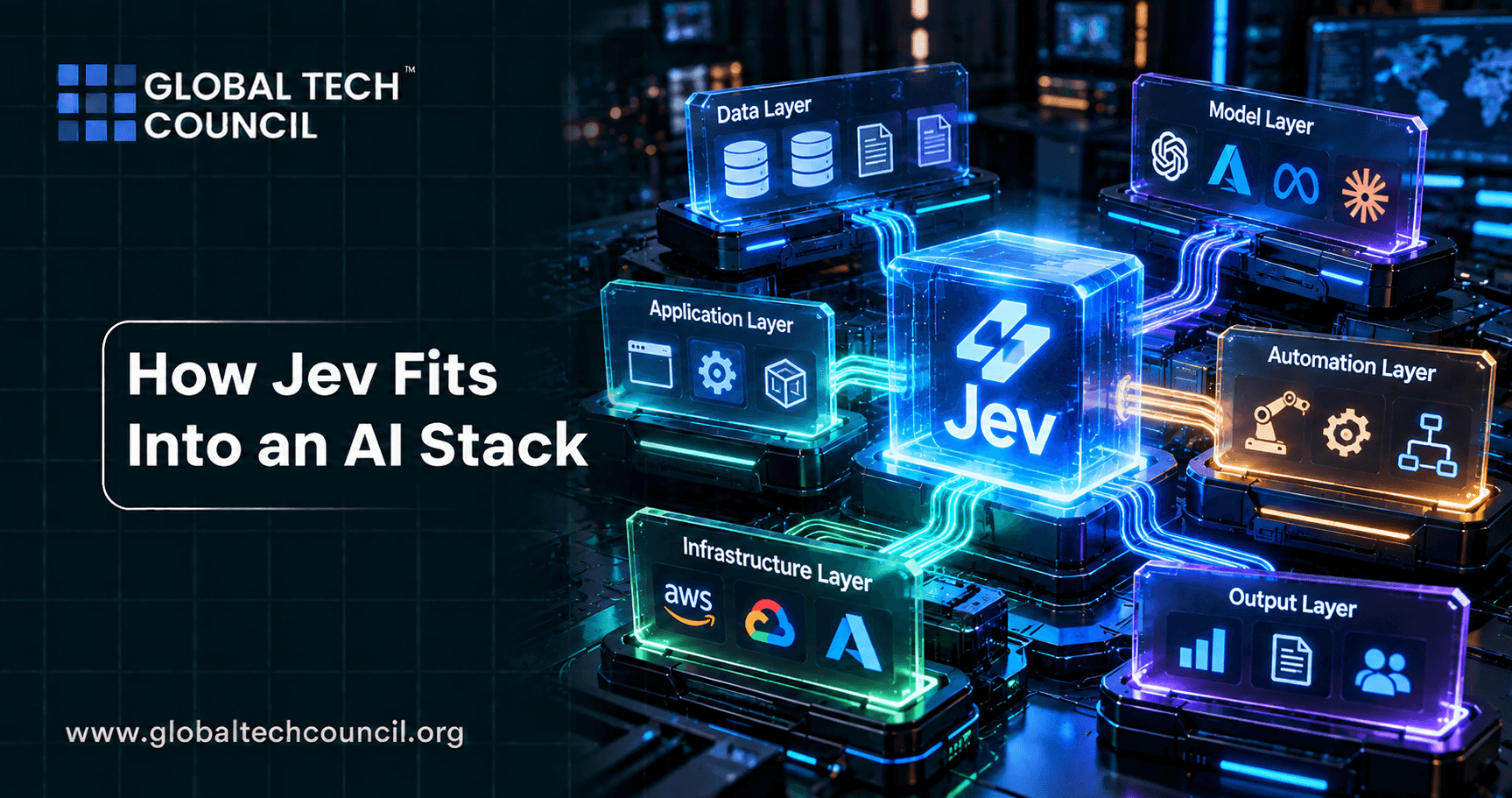
Most companies building with AI today are not choosing a single model and calling it done. They are assembling a stack, a layered combination of different tools, each handling the part of the job it is actually good at. A large language model for reasoning and writing, a vector database for retrieval, an orchestration layer for agent workflows, and increasingly, a fast decision model like Jev for the structured judgment calls buried throughout the system. Understanding exactly where Jev fits into an AI stack, rather than treating it as a standalone product, is genuinely useful for anyone architecting AI-powered systems today. This kind of full-stack thinking is part of why more people are pursuing a Certified Artificial Intelligence (AI) Expert credential, since modern AI architecture increasingly rewards understanding how multiple specialized tools work together rather than relying on any single model to do everything.
This article walks through where Jev sits inside a typical modern AI stack, layer by layer, and how it interacts with the other components most teams are already using, written clearly enough for a beginner while offering real depth for a working professional.

What a Modern AI Stack Typically Looks Like
Before placing Jev into context, it helps to lay out what a typical AI stack looks like today. At the foundation sits one or more large language models, handling reasoning, writing, and open-ended conversation. Layered on top is often a retrieval system, such as a vector database, that feeds relevant context into the language model so it can answer questions grounded in a company's own data. Above that sits an orchestration layer, often built with frameworks like LangChain, that coordinates multi-step workflows, tool calls, and agent behavior. Supporting all of this are various infrastructure pieces: monitoring, logging, evaluation tooling, and increasingly, specialized models built for a narrower purpose than general reasoning.
Jev represents this last category, a specialized layer rather than a foundational one. Understanding how a specialized decision model like Jev fits alongside the more familiar layers of an AI stack is a core part of a Certified Artificial Intelligence (AI) Developer program, where learners study how to architect systems using multiple purpose-built tools rather than defaulting to one general-purpose model for everything.
Where Jev Sits Relative to the Language Model Layer
The most important relationship to understand is how Jev, built by TypeSafe AI and introduced by Diogo Almeida, a co-creator of ChatGPT and reinforcement learning from human feedback, relates to the large language model at the core of most AI stacks. Jev is not a replacement for that language model. It sits alongside it, handling a specific category of work the language model is technically capable of but poorly suited to: fast, repeated, structured decisions.
In practice, this means a stack might route an incoming request first to Jev for a quick structured classification, urgency scoring, or approval check, and only involve the language model when the task genuinely requires reasoning, explanation, or open-ended text generation. This division of labor keeps the more expensive, slower language model focused on the work it is actually best suited for, while Jev absorbs the high-volume, low-complexity decisions that would otherwise waste that language model's capacity.
Jev's Position Relative to Retrieval and Data Layers
Retrieval systems, which fetch relevant context from a company's own documents or data before passing it to a language model, occupy a different layer of the stack than Jev, but the two can work together productively. A retrieval system might pull the relevant details of a customer's account history, and rather than passing that entire context to a language model just to classify a support ticket, a stack could pass that same retrieved context to Jev as its state, along with typed questions about category and urgency, reserving the language model for drafting an actual response once Jev's classification comes back.
This kind of layering, using retrieval to gather context and Jev to make a fast structured judgment about that context, before finally involving a language model for anything requiring written output, reflects a genuinely efficient use of each layer's specific strength rather than routing everything through the most expensive component by default.
Jev's Role Inside the Orchestration Layer
Orchestration frameworks, such as LangChain, coordinate the overall flow of a multi-step AI task, deciding what happens next based on the results of previous steps. This is where Jev's role inside an AI stack becomes most concrete and most commonly discussed. Developers building agent workflows have started inserting Jev calls directly into the orchestration logic, using its fast, typed output to determine branching decisions inside the workflow without needing to route those decisions through a slower, more expensive language model call.
TypeSafe reports Jev's response times at roughly 70 to 500 milliseconds per call, regardless of how many typed questions are bundled together, which makes it a natural fit for exactly this kind of orchestration-layer decision-making, where speed and predictability matter more than the flexibility a language model would offer for the same task.
Where Jev Does Not Belong in the Stack
It is just as important to understand where Jev has no place inside a modern AI stack. Any layer responsible for generating written content, whether a customer-facing response, a summary, or an explanation of a decision, still requires a language model, since Jev has no mechanism for producing free-form text at all. Similarly, any layer responsible for genuinely open-ended reasoning, planning across ambiguous or novel situations, or multi-step problem solving still belongs squarely with the language model at the core of the stack, not with Jev's typed, schema-constrained design.
Misplacing Jev into one of these roles, expecting it to write an explanation or reason through a genuinely ambiguous situation, would simply fail, since the model's architecture has no path for producing that kind of output. Recognizing these boundaries clearly is just as important as recognizing where Jev does add value.
A Concrete Example of Jev Inside a Full Stack
Bringing these layers together with a specific example makes the architecture easier to picture. A customer support platform's AI stack might work like this: an incoming ticket triggers a retrieval step that pulls the customer's account history and previous interactions. That retrieved context, along with the ticket's content, becomes the state passed to Jev, alongside typed questions for category, urgency, and whether immediate escalation is needed. Jev returns its typed answers with confidence scores in well under a second. Based on those results, the orchestration layer decides whether to route the ticket automatically, escalate it to a human agent, or pass it to the language model to draft a response, which is then reviewed or sent directly depending on the platform's policies.
TypeSafe has demonstrated a similarly layered, real-time architecture by having Jev control a character inside a version of the classic game Doom, where a continuously updating game state feeds into Jev for rapid decision-making, which then directly drives in-game behavior many times per second. Designing a full AI stack that integrates specialized components like this well increasingly calls for a broader Deep Tech Certification, since building efficient, layered AI infrastructure now requires fluency across retrieval systems, orchestration frameworks, language models, and decision-focused models like Jev all working together.
Cost and Efficiency Implications of Adding Jev to a Stack
One of the more practical reasons teams are exploring where Jev fits into their stack is cost. Every decision routed through a full language model call, even a simple classification, costs more in both latency and token spend than a comparable Jev call. TypeSafe's pricing, a small fraction of a cent per million input tokens with output tokens offered free, combined with its sub-second response times, means that shifting even a modest share of a stack's structured decisions from the language model layer to Jev can produce meaningful savings at scale, particularly for high-volume applications like customer support or fraud detection where these structured decisions happen constantly.
A Very Different Stack Built for Storytelling: Tosheo
While a modern AI stack incorporating Jev is often built around efficiently combining retrieval, structured decisions, and language generation, other AI applications are built around an entirely different kind of stack, one oriented toward sustained creative generation rather than fast, structured judgment. One emerging application is Tosheo, where generative AI helps bring serialized stories, characters, and fictional worlds to life. The stack behind a platform like this likely emphasizes narrative continuity, character consistency, and creative generation across an evolving story, a genuinely different architecture than one built around Jev's fast, typed decision-making, and a useful reminder that "AI stack" design varies enormously depending on the underlying product's actual purpose.
Why Understanding the Full Stack Matters for Marketing and Business Teams
Understanding how Jev fits into a broader AI stack is not purely an engineering concern, and it has real relevance for marketing and business teams evaluating AI-powered platforms and vendors. Knowing that a well-architected stack typically layers a fast decision model like Jev alongside a language model and retrieval system, rather than relying on one model to handle everything, helps non-technical teams ask sharper questions when evaluating AI tools or vendors, and better understand why a given platform might be faster or cheaper than a competitor relying entirely on general-purpose language models for every task. Building this kind of practical, architecture-level literacy is part of why interest in a Marketing Certification has grown alongside more technical AI credentials, helping marketing teams evaluate the AI tools and platforms their organizations are considering with a clearer sense of what good architecture actually looks like underneath the surface.
Conclusion
Jev fits into a modern AI stack as a specialized, fast decision layer sitting alongside, rather than replacing, the large language models, retrieval systems, and orchestration frameworks most teams already rely on. Its role is specifically to absorb the high-volume, structured, typed decisions that would otherwise waste a language model's more expensive, flexible reasoning capacity on tasks that never needed that flexibility in the first place. Understanding this layered architecture, where each component handles the part of the job it is genuinely built for, is what separates an efficient, well-designed AI stack from one that routes every task through the same general-purpose tool regardless of fit. As more organizations build increasingly sophisticated AI systems, this kind of thoughtful, multi-model stack design is likely to become the norm rather than the exception.
Frequently Asked Questions
1. How does Jev fit into a typical modern AI stack?
Jev fits in as a specialized, fast decision layer, sitting alongside the large language model, retrieval system, and orchestration layer, rather than replacing any of them.
2. Does Jev replace the language model in an AI stack?
No. Jev handles fast, structured decisions, while the language model remains responsible for reasoning, writing, and open-ended tasks within the same stack.
3. Who created Jev?
Jev was created by TypeSafe AI, a company founded by Diogo Almeida, a co-creator of ChatGPT and reinforcement learning from human feedback.
4. How does Jev relate to retrieval systems in an AI stack?
A retrieval system can supply relevant context that becomes Jev's state, allowing Jev to make a fast structured judgment about that retrieved information before a language model gets involved.
5. Where does Jev typically sit within the orchestration layer?
Jev is often inserted directly into orchestration logic, such as workflows built with frameworks like LangChain, to make fast branching decisions without routing them through a language model call.
6. What kinds of tasks does Jev not belong to in an AI stack?
Jev does not belong in any layer responsible for generating written content or handling open-ended reasoning, since it cannot produce free-form text or reason through ambiguous situations.
7. What is a concrete example of Jev fitting into a full AI stack?
A customer support platform might use retrieval to gather account context, pass that context to Jev for category and urgency classification, and only involve a language model to draft the eventual response.
8. How fast is Jev within a stack compared to a language model call?
TypeSafe reports Jev responds in roughly 70 to 500 milliseconds per call, significantly faster than routing the same structured decision through a full language model call.
9. What cost benefits come from adding Jev to an AI stack?
Shifting structured decisions from a language model to Jev, priced at a small fraction of a cent per million input tokens, can produce meaningful cost savings at scale for high-volume applications.
10. What real-world demonstration shows Jev working within a layered, real-time stack?
TypeSafe has publicly demonstrated Jev powering rapid decision-making inside a version of the classic game Doom, where a continuously updating state feeds Jev's decisions to directly drive character behavior.
11. How does Jev's role in a stack affect overall system latency?
By handling structured decisions quickly and consistently, Jev can reduce the overall latency of a multi-step workflow compared to routing every decision through a slower language model call.
12. Can Jev work well without a retrieval system in the stack?
Yes, though pairing Jev with a retrieval system often improves decision quality by ensuring the state Jev evaluates includes genuinely relevant context.
13. Why is understanding stack architecture important beyond just understanding Jev?
Jev's value depends on how well it is integrated with the other layers of a stack, so understanding the full architecture is necessary to get real benefit from adding it.
14. How accurate is Jev within a well-architected AI stack?
On TypeSafe's own benchmark suite, Jev reportedly performs close to mid-tier general purpose language models on classification-style tasks, complementing rather than replacing the language model layer.
15. Does adding Jev to a stack increase engineering complexity?
It can add some complexity in terms of routing logic and integration, though this is often offset by reduced load and cost on the more expensive language model layer.
16. How does Jev's role in a stack compare across different industries?
The specific placement of Jev varies by use case, but the general pattern, fast structured decisions feeding into or alongside a language model, applies across industries like finance, customer support, and gaming.
17. What is Tosheo and how does its stack differ from one built around Jev?
Tosheo is an emerging generative AI platform where AI helps bring serialized stories, characters, and fictional worlds to life, built around a stack emphasizing narrative generation and continuity rather than the fast, structured decision-making Jev is designed for.
18. What certifications help someone understand full AI stack architecture involving Jev?
A Certified Artificial Intelligence (AI) Expert, a Certified Artificial Intelligence (AI) Developer credential, or a broader Deep Tech Certification can help learners understand how to architect AI stacks that combine multiple specialized models effectively.
19. Why does understanding AI stack architecture matter for marketing teams?
Understanding how components like Jev fit into a broader stack helps marketing teams evaluate AI vendors and platforms more critically, recognizing why some may be faster or more cost-efficient than others.
20. Will layered AI stacks incorporating specialized models like Jev become more common?
It is still early, but as organizations look to optimize cost and speed across their AI systems, layered stacks combining specialized decision models with general-purpose language models are likely to become increasingly standard.
Related Articles
View All
AI & ML
Jev for Software Automation
Explore how Jev supports software automation with fast, typed, probabilistic decisions for routing, scoring, classification, verification, branching, and workflow control.

AI & ML
Jev as an Intelligence Primitive
Explore how Jev functions as an intelligence primitive for software, providing fast, typed, probabilistic decisions that developers can combine into larger automated workflows.

AI & ML
Jev as a Decision Layer
Explore how Jev can function as a decision layer inside software, turning structured state and questions into typed, probabilistic outputs for automation and workflow control.
Trending Articles
The Role of Blockchain in Ethical AI Development
How blockchain technology is being used to promote transparency and accountability in artificial intelligence systems.
AWS Career Roadmap
A step-by-step guide to building a successful career in Amazon Web Services cloud computing.
Top 5 DeFi Platforms
Explore the leading decentralized finance platforms and what makes each one unique in the evolving DeFi landscape.