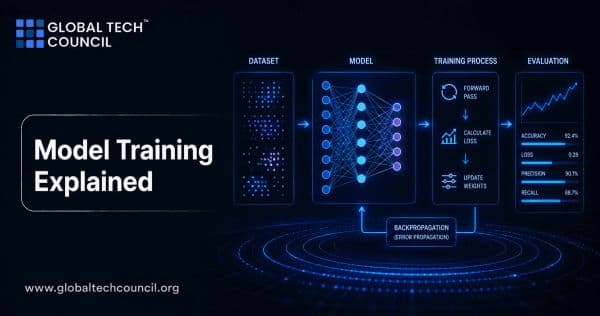
Model Training Explained: How Machine Learning Models Learn
Model training explained with the learning loop, loss functions, backpropagation, gradient descent, mini-batches, validation, and practical debugging tips.



243 articles published
Model training explained with the learning loop, loss functions, backpropagation, gradient descent, mini-batches, validation, and practical debugging tips.

Learn how data preprocessing for machine learning improves model accuracy, reliability, and governance through cleaning, scaling, encoding, and transformation.

Feature selection helps ML models use the right inputs, reduce noise, improve speed, and support explainability without leaking test data.

Learn practical feature engineering in machine learning, including encoding, scaling, missing values, temporal features, selection, and leakage control.

Learn deep learning fundamentals, including neural networks, backpropagation, loss functions, CNNs, transformers, regularization, deployment, and ethics.

Neural networks explained through their structure, training workflow, key architectures, practical trade-offs, and real-world AI applications.

XGBoost explained for practitioners: learn why gradient boosted trees still dominate tabular machine learning competitions and enterprise prediction tasks.

Gradient boosting explained for practitioners: learn how boosted trees work, when to use XGBoost, LightGBM, or CatBoost, and how to tune models safely.

Learn how K-Means clustering finds groups in unlabeled data, how to choose k, preprocess features, evaluate clusters, and avoid common production mistakes.

Naive Bayes algorithm explained for fast text and data classification, with variants, TF-IDF workflows, use cases, trade-offs, and Python tips.

Learn how K-Nearest Neighbors works for classification, regression, recommendations, and vector search, with examples, tuning tips, and practical limits.
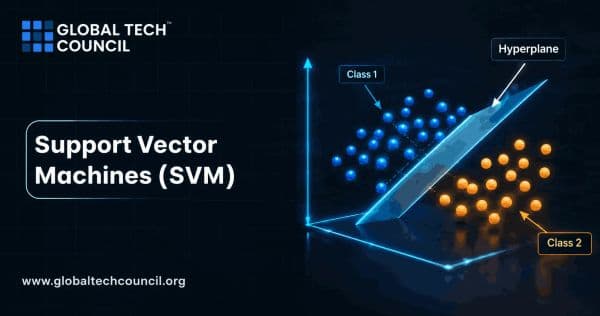
Support Vector Machines explained with margin theory, kernel types, tuning advice, limitations, and practical use cases across ML domains.